On this page
- Current MarketPulse workflow
- Choose a staffing specialty and employer promise
- Assign research and approval owners
- Evaluate the supported account research stack
- Compare signals, research and relationships
- Model research and review costs
- Measure employer acceptance and client use
- Choose clients with delivery capacity
- Keep employer evidence separate from candidates
- Control employer and candidate data boundaries
- Maintain the recurring employer brief
- Worked example: postings, employers and accepted accounts
- Frequently asked questions
Direct answer: Intent-data services for recruiting and staffing agencies should focus on employer demand, not candidate scoring. Verify an observable business signal, resolve the company, confirm that the need fits the staffing firm’s specialty and capacity, exclude protected and candidate data, validate the business contact, and require a human business-development owner to approve action.
Current MarketPulse offer: intent-data plans start at $500/mo. See the product, demo, and current plans. Updated October 3, 2026.
An open role can be useful research context. It is not proof that an employer wants an outside staffing provider, has budget, or will make a commitment. A responsible service narrows the accounts a salesperson should inspect and records why. It does not make an employment decision or rank a worker.
Who this is for: Recruiting-marketing agencies, staffing business-development teams, and resellers seeking a recurring employer-demand offer. It is not for candidate ranking, eligibility decisions, worker surveillance, or protected-trait inference.
Current MarketPulse workflow
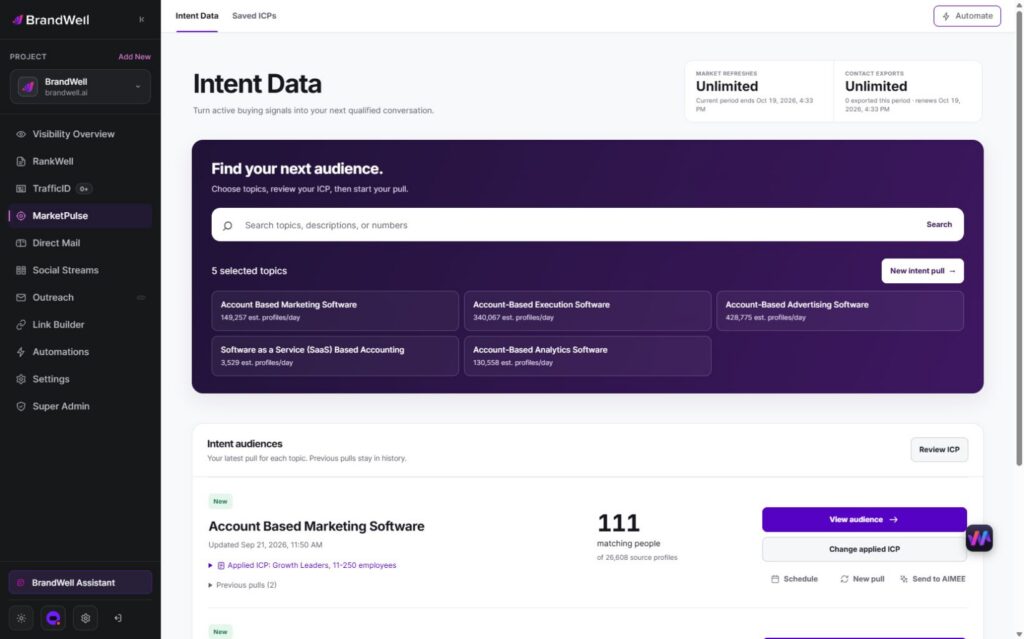
BrandWell MarketPulse: intent data starting at $500/mo. Find people researching topics relevant to what you sell, apply saved ICP filters, and review available contact details before taking action.
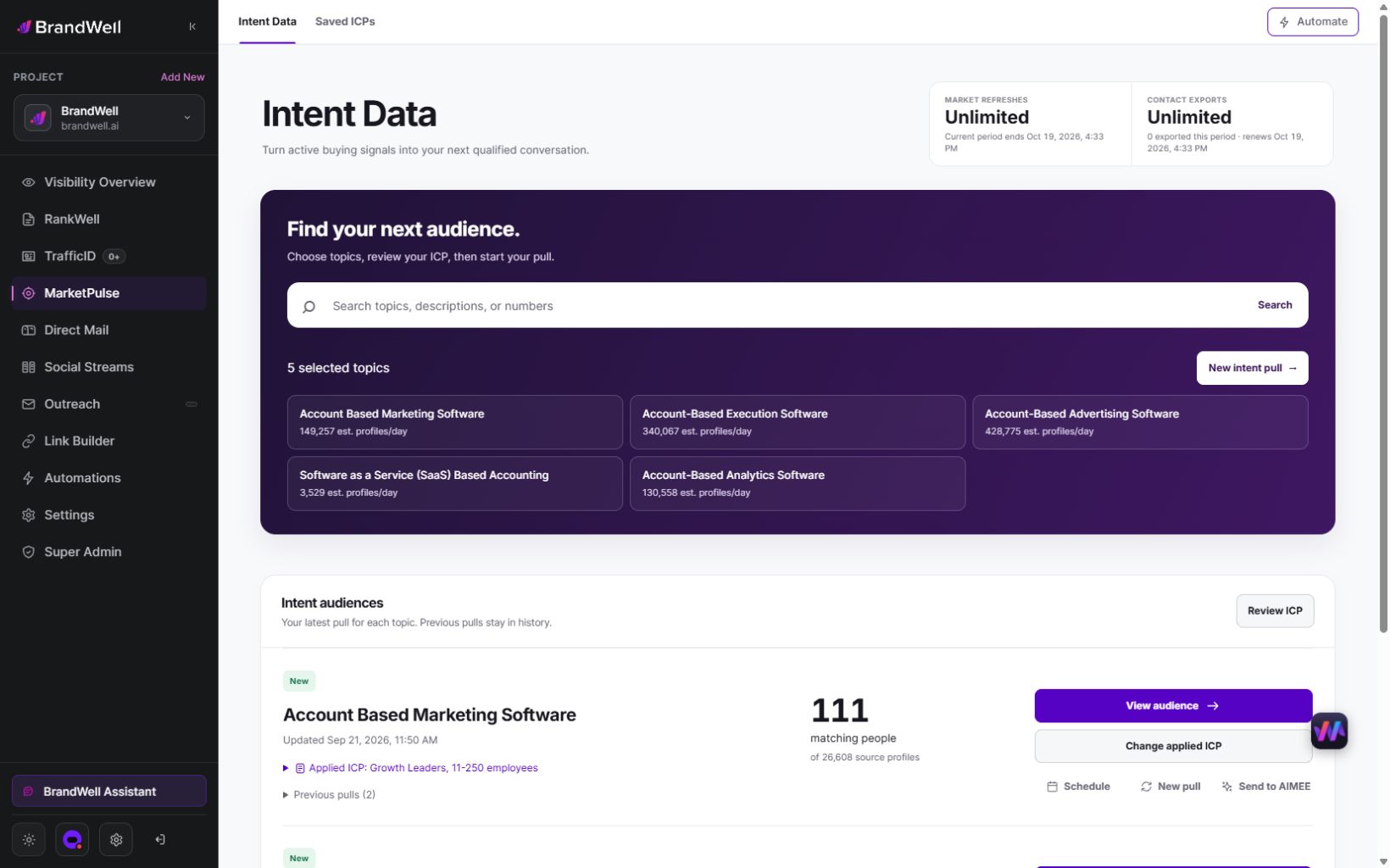
MarketPulse plans are starting at $500/mo. Verify current package scope and offers on the product page.
| Plan | Topics and refreshes | Monthly exports |
|---|---|---|
| Starter | 1 topic, weekly | 25,000 contacts |
| Growth | 3 topics, daily | 100,000 contacts |
| Scale | 10 topics, daily | Unlimited contacts |
Swipe the table to see all columns.
A pull retrieves available data from the previous 24 hours for one topic. Daily use across all included topics provides 90 Growth pulls or 300 Scale pulls in a 30-day month. Weekly Starter pulls vary by calendar month. Available audience size and contact fields vary, and audiences may overlap. Refreshes stop at the plan limit without overage charges.
- Find and qualify: search the topic catalog, save your ICP, and review the people and companies that match.
- Act on the research: export qualified contacts or prepare an Outreach or Direct Mail workflow. Connected products, channel usage, and fulfillment may cost extra.
- Get help from AIMEE: Growth and Scale include AIMEE for the initial user to research accounts and prepare the next step through connected tools.
Agencies and other service businesses can build client deliverables around their available Intent Scans and exports. Keep each client’s scope, permissions, and service fees clear. A subscription is not a promise of a white-label platform or exclusive access to a market.
Explore MarketPulse and watch the demo or compare plans starting at $500/mo. Any early-access discount is a separate, time-limited offer shown to an eligible recipient.
Choose a staffing specialty and employer promise
Choose one staffing specialty, employer profile, geography, and business-development action. A program for industrial contract staffing should not use the same topics, account-fit rules, or evidence as an executive-search program. Use structured agency discovery questions about buying intent to learn which job families the firm can fill, where it can deliver, what account size matters, how sales follows up, and what signals the firm will reject.
The offer should promise a disciplined employer-demand review and activation process. More qualified pipeline and recurring revenue are goals to measure. They are not certain results. Define early client value as an accepted account brief that contains a dated demand signal, a resolved employer, a service-fit reason, a validated business contact state, and a human-owned next step.
Keep the business-development service outside the candidate workflow. Do not send candidate profiles into the intent engine, score applicants, infer who is job seeking, or use protected attributes and proxies to qualify employer accounts. That separation is both an operating advantage and a trust boundary the agency can explain.
Assign research and approval owners
Assign owners for signal research, company resolution, contact validation, business-development approval, data stewardship, compliance review, and reporting. In a small agency, one person may cover multiple roles. Still record which hat approves each decision. The sales owner should never assume that a researcher’s account recommendation is permission to contact.
Seven-gate employer-demand activation workflow
- Define: document the staffing specialty, ideal employer, approved signals, geography, action, and prohibited data.
- Observe: capture a dated public or contracted business-demand signal with its source and freshness rule.
- Resolve: match the employer while keeping employer, job, candidate, worker, person, and contact states separate.
- Fit: check job family, location, demand pattern, contract type, and the staffing firm’s real delivery capability.
- Exclude: remove protected-trait, candidate, eligibility, medical, and other disallowed inputs.
- Approve: have a human sales owner accept the account and approve the message and channel.
- Learn: record delivery, response, correction, suppression, opportunity association, and service feedback.
Run the research and approval queue weekly when the firm’s sales team can act weekly. Use a slower cadence if reviews accumulate or account ownership is unclear. A monthly client report should show what was accepted, rejected, corrected, suppressed, and acted on. Volume without review is not service performance.
Create separate queues for new evidence, identity exceptions, fit exceptions, approved accounts, suppressions, and corrections. Do not let an unresolved company match sit beside an outreach-ready account with the same status. Queue age is useful only when the state and accountable owner are clear.
Evaluate the supported account research stack
The useful answer is a capability map, not a vendor leaderboard. The stack needs public or contracted employer-demand evidence, company resolution, business-contact validation, CRM routing, suppression, audit records, and agency-branded reporting. It also needs a hard boundary that prevents candidate or worker data from entering the business-development workflow.
- Demand evidence: preserve source, date, job family, location, and what was actually observed.
- Company identity: resolve employer and parent or location without treating a job posting as a person record.
- Contact validation: distinguish a possible contact from a validated business channel and an approved recipient.
- Workflow: support account ownership, human approval, retries, corrections, and suppression before export.
- Reporting: expose acceptance, reasons, follow-up, outcomes, and data-quality exceptions.
- Governance: log source rights, permitted use, retention, access, exports, and client-specific prohibitions.
Test tools with closed jobs, duplicate companies, staffing-firm clients, misleading titles, remote roles, franchises, and a deliberately prohibited candidate field. Verify every named capability, integration, price, and limitation on current first-party documentation. Use the staffing specialty, permitted inputs and approved account workflow to decide which implementation fits.
Compare signals, research and relationships
Broad open-role targeting is fast but noisy because a vacancy does not establish outside-provider need. Manual account research adds context but takes time. A verified demand plus service-fit model adds consistent evidence and triage while preserving human judgment. Referral and relationship programs remain strong when the addressable market is small, trust is central, or data-use risk outweighs the value of behavioral context.
| Approach | Best use | Primary limitation |
|---|---|---|
| Any open role | Early market exploration | Does not prove staffing need, budget, or commitment |
| Manual research | Few strategic employers needing deep context | High labor and inconsistent documentation |
| Verified demand plus fit | Repeatable specialist business development | Needs provenance, company resolution, and human review |
| Referral or relationship | Small trusted markets | May not surface emerging accounts outside the network |
Swipe the table to see all columns.
Use the approaches together when appropriate. A signal can prompt manual research. A relationship owner can correct an account record. A referral can validate that a demand pattern matters. The decision criterion is not which method looks most automated. It is which method produces explainable accounts the sales team can responsibly evaluate.
Keep job-posting evidence in proportion. Multiple relevant roles, repeated postings, location expansion, and a stated workforce program may justify deeper account research, but none independently proves use of an external agency. The account brief should preserve the exact evidence and ask a sales question rather than announce a conclusion.
Model research and review costs
Model setup from specialty discovery, employer-profile design, signal definitions, geography, company matching, prohibited-data controls, CRM fields, acceptance testing, and training. Model recurring cost from data and usage, research, validation, business-development review, exceptions, compliance work, reporting, support, and account management.
Employer-demand economics worksheet
For each client package, record specialties, job families, geographies, employer count, sources, usage basis, research minutes, company-resolution exceptions, contact-validation minutes, approved-account rate, report cadence, support, and direct delivery cost. Model low, expected, and high exception scenarios before setting the agency’s retail price.
Do not use a generic staffing conversion rate or margin as a promise. A specialist executive-search firm, high-volume industrial staffing provider, and recruiting-marketing agency have different account values, review burdens, and sales cycles. Agency economics depend on its retail price, delivery labor, data and usage, corrections, and client retention. If a vendor price is not public, record it as quote required rather than inventing a number.
Measure employer acceptance and client use
Start with signal and account quality. Track records with source provenance, employer-match acceptance, job-family and geography fit, stale or closed-role rejection, duplicate rate, validated-contact state, approved-account rate, and corrections. Use a documented lead and intent-data QA process with a sample that includes both accepted and rejected records.
Then measure the operating handoff: time to review, accounts with a named sales owner, approved actions, delivery receipts, response, meetings, opportunities, and returned outcome status. Define denominators. An approved-account rate should be approved unique employers divided by unique employers reviewed, not a count without context.
For agency economics, track client service revenue, data and usage, direct labor, exception time, support, contribution, renewal, and scope changes. Opportunity and revenue fields can show association, but the program does not control the client’s offer, message, sales skill, market timing, or competition. Do not claim the signal caused a placement, pipeline, or revenue event unless a defensible evaluation design supports that narrow statement.
Choose clients with delivery capacity
Best-fit clients have a clear staffing specialty, defined employer profile, known job families, geographic coverage, available fulfillment capacity, a business-development owner, and a lawful data-use process. The service is especially useful when the sales team has too many possible employers to research manually but enough account value to justify human review.
Good use cases include prioritizing employers within a known vertical, monitoring a named account universe for workforce-demand changes, and preparing business-development briefs. Poor fits include clients that accept every industry and role, have no capacity to fill new work, cannot follow up, want guaranteed meetings, or intend to use the service for candidate screening.
Use a disqualification gate. Stop when the client requests protected traits or proxies, asks for job-seeker identity, wants an eligibility prediction, refuses suppression, cannot name the sales owner, or will treat all open roles as verified buyers. A smaller relationship or content program may be safer until the operating basics are ready.
Client maturity also matters. A new staffing firm with one seller may need a short weekly employer brief. A mature specialist with territories and named accounts may need routing, ownership conflict checks, and CRM receipts. Increase automation only after the client has consistent acceptance reasons and a reliable feedback loop.
Keep employer evidence separate from candidates
Useful employer context can include dated public business-demand evidence, approved account engagement, relevant topic research, and website activity under appropriate controls. Every item needs provenance, freshness, entity type, and limitation. Resolve the employer before adding a possible business contact. Keep the candidate, worker, and employment-decision systems outside this chain.
Activation should require a service-fit reason: the job family matches, geography is supported, likely delivery model is within scope, and the firm has capacity. The reviewer then approves an account and message. The evidence record captures delivery, response, correction, and later opportunity state. It never changes an observed open role into a claim of staffing commitment.
Agent-ready employer-demand account brief
In Claude, ChatGPT, or AIMEE, evaluate only the supplied employer-demand record.
Inputs: employer identifier, dated demand evidence, staffing specialty, geography, company-match confidence, business-contact validation state, and suppression and prohibited-data rules.
Return: observed evidence, employer resolution, service-fit reasons, missing evidence, prohibited-data check, and a draft internal recommendation.
Do not rank candidates, infer protected traits or eligibility, contact anyone, or write to the CRM.
Stop if candidate or worker data appears, a protected trait or proxy is requested, the employer is unresolved, provenance is missing, or the task could affect an employment decision.
AIMEE can help draft an internal employer account brief through configured connected tools, using approved business evidence. Keep candidate records and employment decisions out of this workflow. Preserve the source, service-fit reason and review owner.
Control employer and candidate data boundaries
The most serious mistake is allowing employer prospecting to become candidate or worker decision-making. Other risks include protected-trait inference, disability or medical information, false employer matches, stale job evidence, unauthorized outreach, shared credentials, excessive retention, weak suppression, and promises that every opening represents an opportunity.
EEOC contingent-worker guidance addresses ADA issues for staffing firms and clients; it is nonbinding and predates the 2008 amendments. Seek current qualified review for actual employment matters.
UK recruitment AI guidance discusses fairness, accountability and human oversight. This prospecting service stays outside recruitment decisions; enforce that boundary in its inputs and destinations.
Include a correction and contest path even though this is employer prospecting. A company can be matched incorrectly, a contact can change jobs, a role can close, or an account owner can know the evidence is misleading. Record the correction, prevent repeat delivery when appropriate, and review whether the underlying rule needs to change.
Maintain the recurring employer brief
Package recurring employer-demand intelligence around a defined specialty. Include discovery, allowed-signal rules, employer resolution, service-fit qualification, contact validation, a human-approved action queue, evidence reporting, corrections, suppression, and a monthly review of quality and cost to serve. The agency controls its brand, client billing, and retail price.
MarketPulse supplies topic research audiences and saved ICP filtering starting at $500/mo. Prepare an approved employer account brief and next step through configured connected tools. This is not a native candidate screening or job-posting feed; separate agency research, integrations and service work need their own verified scope.
MarketPulse plans are starting at $500/mo. Starter includes 1 topic, weekly refreshes, and 25,000 exportable contacts per month. Growth includes 3 topics, daily refreshes, and 100,000 exportable contacts. Scale includes 10 topics, daily refreshes, and unlimited contact exports. AIMEE for the initial user is included with Growth and Scale. Compare MarketPulse plans and current offers.
Validate employer fit without touching candidate decisions
Choose one specialty and a small employer cohort. Reject weak, stale, or prohibited records visibly. Expand only after the business-development team can explain every accepted account and the client respects the candidate-data firewall.
Worked example: postings, employers and accepted accounts
Suppose a fictional weekly research queue contains 200 job-posting rows associated with 80 distinct employers. Do not call that 200 employers or 200 staffing opportunities. Twenty employers are outside the firm’s geography or specialty, leaving 60 for research; 30 meet the documented service-fit and evidence rule. Accepted-employer rate is 30 / 60 = 50% of researched employers, or 30 / 80 = 37.5% of distinct employers in the initial queue.
If the sales owner approves follow-up for 20 of those 30, activation is 66.7% of accepted employers and 25% of the original 80. Five recorded replies are 25% of the 20 acted-on employers only if replies are deduplicated at employer level. A role posting or reply does not prove an outside staffing contract, placement or buying commitment. Preserve rejected, held and unanswered accounts.
Suppose monthly tools cost $500, research costs $600, validation costs $150 and reporting costs $150. Defined recurring cost is $1,400. For 30 accepted employers in the stated monthly cohort, cost is $46.67 per accepted employer, distinct from the weekly queue above. A $2,000 client fee leaves $600, or 30%, before acquisition, setup recovery, general overhead, financing and tax. Eight unpriced hours at $75 consume that remainder. These are invented planning inputs; align the actual cost and cohort windows before reporting a unit cost.
Prepare a scoped employer brief in BrandWell
Use MarketPulse to search relevant available topics and review the audience with a saved employer ICP. Preserve the actual preceding-24-hour pull window. Add separately verified public business evidence to an internal brief, clearly labeled as another source. Check job family, geography and the staffing firm’s capacity before drafting a permitted message through configured Outreach or AIMEE tools. Do not invent a topic, claim that BrandWell supplies a native job feed, or import candidate records.
Frequently asked questions
Does an open role prove a need for a staffing agency?
No. Use it as research context and verify employer fit separately.
Can this workflow score candidates?
No. This article scopes employer business development, not employment selection.
Is a posting count the same as an employer count?
No. Deduplicate and report the defined entity at each stage.
Does MarketPulse provide a native job-posting feed?
Do not assume that capability. Verify any separate source and integration before including it in the service.
Review the current research input: explore MarketPulse plans starting at $500/mo.
Reviewed and updated October 3, 2026.

Written by