On this page
- Current MarketPulse workflow
- Choose a bounded client promise
- Assign delivery owners and seven gates
- Evaluate evidence and operating capabilities
- Compare build, resell, refer and avoid
- Price the actual workload and exceptions
- Connect delivery to recorded outcomes
- Choose clients with a usable decision loop
- Preserve source, identity and action states
- Control quality, rights and expectation risks
- Maintain the recurring agency package
- Verify the claim before selling the service
- Worked example: price accepted research, not promised buyers
- Frequently asked questions
Direct answer: An agency should offer third-party topic-intent monitoring only when it can turn an external research observation into a governed, client-ready decision queue. Promise a repeatable process for finding, qualifying, and routing potentially relevant accounts. Do not promise identified buyers, a fixed data volume, pipeline, or revenue.
Current MarketPulse offer: intent-data plans start at $500/mo. See the product, demo, and current plans. Updated October 3, 2026.
Who this is for: Agency owners, service-line leaders, and productized-service operators deciding whether to build, resell, refer, or reject a topic-intent capability.
A provider name is not a service design. The real decision is whether the agency can secure appropriate source rights, understand what the observations mean, resolve them to useful business accounts, validate an activation path, and preserve evidence of what happened next. Those conditions matter more than a long feature list.
This buyer guide treats third-party monitoring as an evidence chain. Topic observation, account identity, contact validation, activation, and outcome measurement are separate states. Keeping them separate lets an agency explain uncertainty honestly, correct errors, and choose a provider without mistaking a signal for a sale.
Current MarketPulse workflow
BrandWell MarketPulse: intent data starting at $500/mo. Find people researching topics relevant to what you sell, apply saved ICP filters, and review available contact details before taking action.
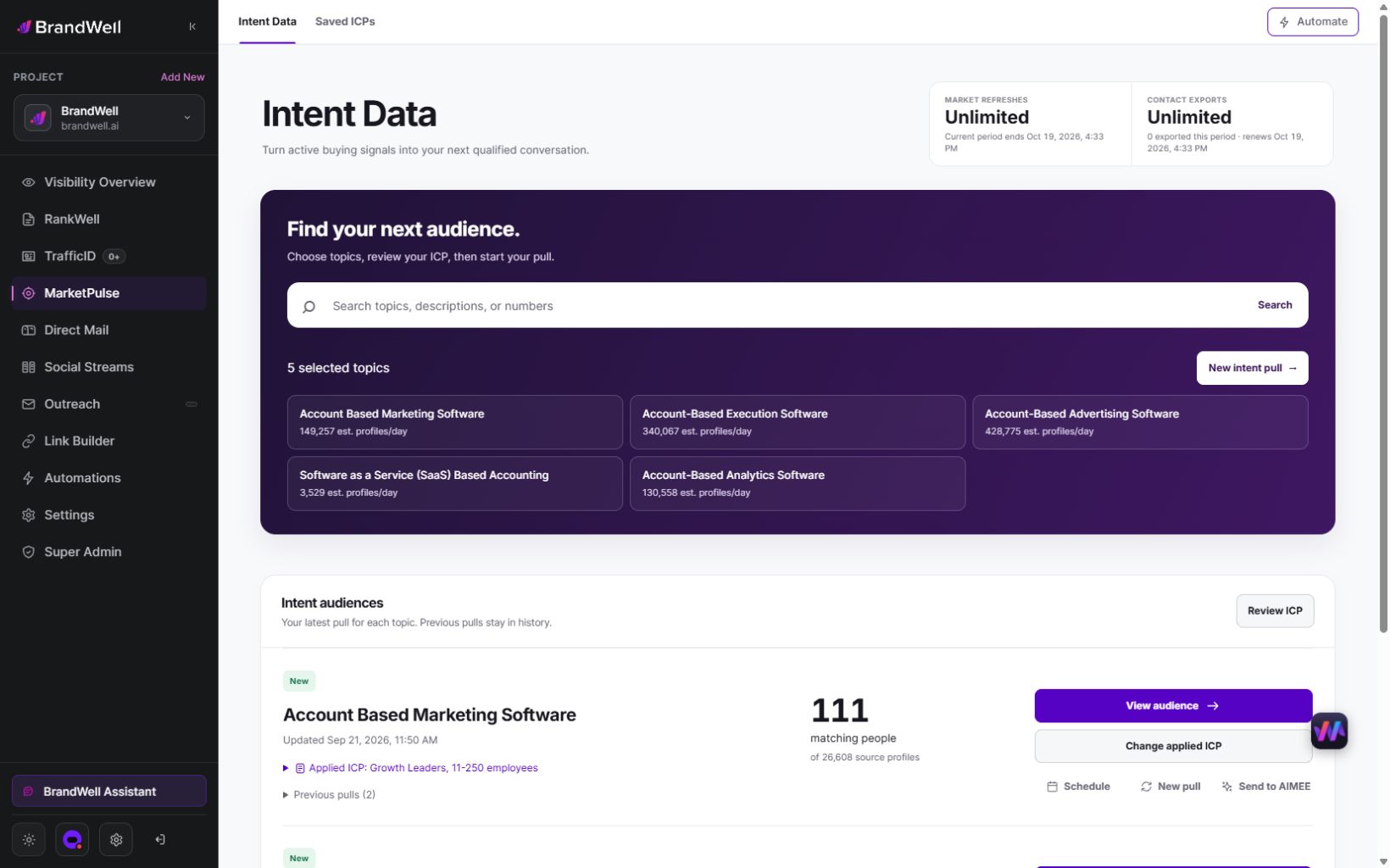
MarketPulse plans are starting at $500/mo. Verify current package scope and offers on the product page.
| Plan | Topics and refreshes | Monthly exports |
|---|---|---|
| Starter | 1 topic, weekly | 25,000 contacts |
| Growth | 3 topics, daily | 100,000 contacts |
| Scale | 10 topics, daily | Unlimited contacts |
Swipe the table to see all columns.
A pull retrieves available data from the previous 24 hours for one topic. Daily use across all included topics provides 90 Growth pulls or 300 Scale pulls in a 30-day month. Weekly Starter pulls vary by calendar month. Available audience size and contact fields vary, and audiences may overlap. Refreshes stop at the plan limit without overage charges.
- Find and qualify: search the topic catalog, save your ICP, and review the people and companies that match.
- Act on the research: export qualified contacts or prepare an Outreach or Direct Mail workflow. Connected products, channel usage, and fulfillment may cost extra.
- Get help from AIMEE: Growth and Scale include AIMEE for the initial user to research accounts and prepare the next step through connected tools.
Agencies and other service businesses can build client deliverables around their available Intent Scans and exports. Keep each client’s scope, permissions, and service fees clear. A subscription is not a promise of a white-label platform or exclusive access to a market.
Explore MarketPulse and watch the demo or compare plans starting at $500/mo. Any early-access discount is a separate, time-limited offer shown to an eligible recipient.
Choose a bounded client promise
Offer the service when the client has a defined market, a useful topic hypothesis, a team that can review and act, and an agreed data purpose. The outcome should be an accountable stream of prioritized account research opportunities, not a declaration that named people are ready to buy. The agency can promise the contracted workflow, review cadence, quality controls, handoff format, and reporting discipline that it controls.
A good promise sounds like this: “We will monitor the approved topics, apply the documented account and fit checks, deliver eligible observations to the agreed destination, and report actions, exceptions, and measured outcomes.” It does not state that every observation is accurate, every account is in market, or the program will create meetings. If a client demands a guaranteed lead number or sales result, pause the offer or reset the scope before contracting.
Assign delivery owners and seven gates
Use a named service owner, an operations analyst, a client approver, and a revenue-team recipient. Add privacy, legal, security, or procurement review when the data purpose, geography, contract, or destination requires it. The service owner owns scope and changes; the analyst runs quality checks; the client approver controls topics, exclusions, and activation; the recipient records disposition.
The workflow begins with an approved topic and account profile, then receives provider observations, checks provenance and freshness, resolves the company, applies exclusions, validates the intended destination, and places only eligible items into the handoff. The SLA should define cadence, cut-off times, severity levels, correction windows, and response responsibilities. It should not define success solely as raw records delivered. A useful handoff includes source category, observation time, company match confidence, fit reason, validation state, allowed next action, owner, and a feedback field.
The seven-gate provider-to-client operating blueprint
- Rights and purpose gate: record permitted uses, client purpose, geography, retention, onward sharing, and prohibited actions.
- Topic gate: approve definitions, synonyms, negative terms, review frequency, and the conditions for pausing a noisy topic.
- Source and freshness gate: preserve source class, observation time, refresh behavior, known blind spots, and stale-record rules.
- Identity and fit gate: separate company resolution, company fit, contact validation, and human qualification.
- Activation gate: specify destination, owner, permitted message, suppression checks, and client approval boundaries.
- Evidence gate: capture delivery, acceptance, action, response, opportunity, correction, and no-action reasons without forcing attribution.
- Contract and change gate: version topics, integrations, limits, fees, access, retention, and exception approvals.
Use this blueprint beside a detailed topic selection and maintenance process. A topic that was useful during onboarding can drift as a market, source mix, or client offer changes.
Evaluate evidence and operating capabilities
The best choice is the capability stack that survives the seven gates. Evaluate five layers: topic observation, company and contact resolution, workflow orchestration, client-facing reporting, and governance. A single platform may cover several layers, but the agency should still test each independently. A polished portal cannot repair unclear source rights or weak identity resolution.
Ask every candidate for primary documentation on coverage definition, observation freshness, matching method, integrations, access controls, export behavior, usage limits, support, pricing units, contract rights, and termination. Run a controlled sample using known accounts and deliberately ambiguous cases. Record true matches, false matches, unresolved records, stale observations, duplicate behavior, and analyst time. A maintained intent-data vendor evaluation scorecard is more useful than a static vendor ranking because capabilities and terms can change.
White-label presentation is valuable only after the underlying evidence is workable. Verify which elements can carry the agency brand, what provider attribution is contractually required, whether client access is isolated, and who controls support and data exports. Search results can surface options, but they are discovery provenance, not proof of features or rights.
Compare build, resell, refer and avoid
Build when the agency has differentiated workflow knowledge, engineering capacity, appropriate data rights, and enough recurring demand to justify maintenance. Resell when a contracted platform supplies dependable infrastructure and the agency’s value comes from topic design, qualification, activation, and client operations. Refer when the client can operate the platform and the agency does not want responsibility for delivery. Avoid when purpose, rights, identity quality, client action capacity, or economics cannot be made clear.
Compare the options symmetrically. Score time to launch, fixed cost, variable cost, data rights, control, differentiation, support burden, switching difficulty, client isolation, and evidence quality. Do not choose build merely for control or resell merely for speed. The correct route is the lowest-risk model that preserves the intended client outcome and an acceptable contribution after real delivery work.
Price the actual workload and exceptions
There is no universal responsible price or gross-margin benchmark. Price from scope and observed cost to serve. Include platform and usage fees, topic governance, analyst review, identity and contact QA, integration work, client meetings, reporting, support, exception handling, privacy or legal review, and a rework reserve. Then apply the agency’s chosen contribution target and commercial judgment.
Use expected, low-usable-volume and high-exception scenarios. Topic count, review volume, cadence, supported destinations, reporting and custom implementation can change cost. Do not infer exclusivity or additional commercial rights from a standard subscription; confirm the actual agreement.
Copyable service economics worksheet
- Fixed monthly inputs: platform access, core operations, governance, reporting, and account management.
- Variable inputs: topics, usage, company resolution, contact checks, destinations, review minutes, and client-specific exceptions.
- Quality reserve: failed matches, corrections, duplicates, integration repair, topic drift, and client support.
- Capacity constraint: the smallest of analyst review capacity, destination throughput, and client follow-up capacity.
- Observed contribution: client fee minus attributable delivery costs under the agency’s written accounting policy.
Connect delivery to recorded outcomes
Build a traceable chain rather than claiming that a signal caused revenue. Give every eligible observation an identifier. Record when it was delivered, who reviewed it, whether it was accepted, what action was taken, whether the destination received it, and which later events the client’s system recorded. Preserve denominators: all observations, resolved companies, eligible accounts, accepted handoffs, acted accounts, responses, meetings, opportunities, and closed outcomes.
Compare cohorts or periods only when definitions and operating conditions are sufficiently similar. Label evidence as experimental, quasi-experimental, attributed, or observational. Report missing follow-up and contamination, including accounts that were already active. The agency can discuss influenced pipeline only under an agreed attribution rule. It should never turn sequence into causality. For a deeper method, use a documented intent-data compliance program alongside the measurement plan so permissions and evidence travel together.
Choose clients with a usable decision loop
Strong-fit clients sell a defined B2B offer to identifiable organizations, have meaningful research topics, can tolerate probabilistic evidence, and have capacity to review and act promptly. They also have an accountable owner, a usable CRM or approved destination, documented exclusions, and enough addressable accounts to learn from a recurring program.
Exclude or pause clients that demand person-level intent claims from company-level evidence, cannot state a lawful and appropriate purpose, expect guaranteed volume or revenue, lack follow-up capacity, or want to use sensitive topics in ways that could create harm. Also pause very small universes, vague offers, and programs where the same account cannot be resolved consistently. A service can be technically possible and still be commercially or ethically unwise.
Preserve source, identity and action states
Track source category and provenance before treating an observation as useful. Topic activity from third-party environments, first-party site behavior, campaign engagement, and client-system events have different meanings. Preserve their origin rather than blending them into one score. For identity, test company resolution, domain, entity hierarchy, geography, duplicate handling, fit criteria, and separate contact validation. A company match does not prove which person researched or who has authority.
Activation should be permissioned and reversible. Route to an approved queue, let a human review the fit and message, apply suppressions, then record delivery and disposition. Outcome evidence begins with receipt and action, not a vanity count of signals. Later responses, meetings, opportunities, and revenue belong in the chain only when the client records them and the reporting method states its limits.
Control quality, rights and expectation risks
Material risks include stale observations, ambiguous topics, incorrect account matches, missing entity hierarchy, invalid contacts, duplicates, broken integrations, cross-client leakage, excessive retention, unauthorized reuse, and aggressive outreach based on weak inference. Client-expectation risk is equally important: a buyer may hear “intent” and assume a named person, active project, budget, or purchase timing that the evidence does not establish.
Review source meaning, client purpose, permissions, suppression, access, correction and retention. Read the provider and agency-client agreements together. Confirm the actual responsibilities and obtain qualified review for the applicable facts and jurisdiction; a checklist is not a legal finding.
Turn the risk register into negative tests before launch. Submit an expired observation, an ambiguous domain, a parent-subsidiary conflict, a suppressed account, a duplicated record, a failed destination, and an unauthorized user request. Confirm that each condition stops, routes, or corrects as designed. Repeat the tests after a material provider, topic, integration, or contract change. This maintenance work is part of delivery, not a one-time implementation task.
Maintain the recurring agency package
The recurring package should define approved topics and markets, source and rights boundaries, monitoring cadence, company and contact checks, exclusions, client-isolated access, activation destinations, SLA, reporting definitions, exception handling, change control, retention, support, and a review calendar. Include a monthly decision meeting that can keep, revise, pause, or retire topics based on evidence.
In the client report, separate service health from commercial observations. Service health covers freshness, resolution, eligibility, acceptance, latency, rework, and exceptions. Commercial observations cover actions and later client-recorded events under the stated attribution rule. Include a decisions section with owner and due date. That structure helps the client see the work even during a quiet signal period without pretending that operational activity is business impact.
AIMEE can organize supplied source documents and draft a provider worksheet through configured connected tools. Human owners verify evidence, rights, pricing, workflow scope and public claims before client delivery.
MarketPulse supplies topic audiences and saved ICP filtering starting at $500/mo. Agency review, reporting and custom delivery require their own supported scope. A topic subscription does not automatically provide a custom API, client portal, exclusive territory or a turnkey monitoring operation.
Copyable agent-ready provider evaluation workflow
You are evaluating a third-party topic-intent monitoring service for an agency.

Inputs: approved client purpose, topic list, account profile, exclusions, provider documentation, sample observations, contract notes, planned destinations, SLA, and cost assumptions.

1. Create separate columns for source rights, freshness, topic definition, company identity, contact validation, activation permission, delivery evidence, and outcomes.
2. Mark each claim verified, unverified, conflicting, or not applicable. Cite the supplied primary document for every verified provider claim.
3. Run ambiguous-account, stale-record, duplicate, suppression, and failed-destination scenarios.
4. Compare build, resell, refer, and avoid using the same criteria.
5. Produce a cost-to-serve model with expected, low-volume, and high-exception cases. Do not invent market benchmarks.
6. Draft the handoff fields, SLA, correction path, and monthly review agenda.
7. Stop if source rights, purpose, identity quality, tenant isolation, or client action capacity is unresolved.

Claude, ChatGPT, or AIMEE may organize evidence and draft the worksheet. A human service owner approves the provider, contract interpretation, topics, exclusions, activation, pricing, and client-facing claims before anything is delivered.
Before launch, run a client acceptance rehearsal. Give the intended recipients a sample queue containing a strong-fit account, a weak-fit account, an unresolved company, a duplicate, and a suppressed record. Ask them to disposition each item, explain the approved next action, and identify missing context. Measure review time and disagreement. Revise the handoff until recipients can use it without relying on the agency founder. This rehearsal reveals whether the promised cadence is operationally credible and whether the client can supply the feedback needed for maintenance.
Maintain a decision log after launch. For every material change, record the evidence, proposed change, affected topics and destinations, risk review, approver, effective version, and expected observation. At the next review, compare the expected observation with what actually happened. This creates a learning loop without turning routine adjustment into a performance guarantee.
Third-party topic-intent monitoring becomes a defensible agency service when its uncertainty is designed into the workflow. The most credible package makes each evidence state visible, gives the client a useful next decision, and stops when the evidence is not good enough.
Verify the claim before selling the service
FTC substantiation policy calls for support for objective advertising claims before publication. Keep proposed provider and agency claims beside their actual evidence. This reference is not a finding that a particular data service meets every applicable requirement.
Test the stated observation window, available identity fields, account-fit rules, suppressions and supported destination. Record whether each item is verified, unresolved or conflicting. A source’s large audience count does not establish unique usable client accounts, named purchasing authority or permission for every channel.
Worked example: price accepted research, not promised buyers
A fictional sample contains 200 distinct candidate companies. Eighty pass the client’s fit and exclusion rules, and the client accepts 40 for research. Fit is 80 / 200 = 40%; acceptance is 40 / 80 = 50% of fitting companies, or 20% of all candidates. Accepted companies are not necessarily active buyers or qualified sales opportunities.
Assume $500 in software, $600 in review and $150 in reporting and support. Defined monthly cost is $1,250. At a $2,000 agency fee, the remainder is $750, or 37.5%, before acquisition, general overhead, setup recovery, tax and financing. Defined cost per accepted company is $31.25. These invented figures are not typical performance, wholesale terms or a complete quote.
If only 20 companies are accepted at the same defined cost, cost per accepted company becomes $62.50. If ten unpriced exception hours at $75 are also required, cost rises to $2,000 and the fee leaves no remainder before excluded expenses. Model both useful output and exception effort rather than assuming a software markup will fund operations.
Evaluate a current MarketPulse sample
Review an available topic and audience, apply the saved client ICP and record the actual preceding-24-hour window and available fields. Deduplicate the unit being reported, preserve uncertainty and obtain approval for the next action. AIMEE can draft account context through configured tools. Weekly pulls do not recover the entire previous week, and custom client delivery needs separate support and rights.
Frequently asked questions
What should the agency promise?
A supported, scoped review and delivery process with named responsibilities, rather than guaranteed buyers or revenue.
Does the subscription fee equal the managed-service cost?
No. Include review, reporting, support, implementation and applicable channel or usage costs.
Do topic counts equal unique client accounts?
Not automatically. Check overlap, identity resolution, fit and the unit being counted.
Is branded client access included?
Confirm the actual capability, implementation and rights; do not infer a custom portal from a topic subscription.
Evaluate the topic-data input: explore MarketPulse and current plans.
Reviewed and updated October 3, 2026.

Written by