
On this page
- BrandWell: MarketPulse intent data and connected growth automation
- Should an agency offer signal-to-action automation services, and what client outcome should it promise?
- What should the delivery workflow, staffing, SLA, and client handoff include for signal-to-action automation services?
- What are the best tools, platforms, or white-label providers for signal-to-action automation services?
- Should an agency build, resell, refer, or avoid signal-to-action automation services?
- How much should an agency charge for signal-to-action automation services, and what gross margin is realistic?
- How should an agency prove the pipeline or revenue impact of signal-to-action automation services?
- Which agency clients are the best fit for signal-to-action automation services, and who should be excluded?
- How should buyer intent, website behavior, identity, and enrichment support signal-to-action automation services?
- What data-quality, delivery, privacy, and client-expectation risks affect signal-to-action automation services?
- What should a recurring agency package for signal-to-action automation services include?
- Put buyer intent to work with MarketPulse
Direct answer: An agency should sell signal-to-action automation as a governed operating service, not as a promise that every signal will create a sale. The defensible outcome is faster, more consistent review and routing, with permissions, human approvals, retries, rollback, and evidence built into every action path.
Current MarketPulse offer: intent-data plans start at $250/month. See the product, demo, and current plans. Updated October 1, 2026.
Who this is for: Agency owners, RevOps consultants, and productized-service leaders who want to turn buyer-intent or website signals into a recurring client workflow without creating an unmonitored outreach machine.
A signal is only an observation. It may describe topic research, an identified company visit, a form event, a changed account attribute, or a validated contact. An action is a separate decision: research, suppress, enrich, add to a queue, prepare a message, update a field, or notify an owner. The service between them must establish whether the signal is current, permitted, relevant, and safe to act on.
That separation is the control model. It keeps a failed match from becoming a CRM overwrite, an ambiguous visitor from becoming an outreach target, or an expired topic from starting an irrelevant sequence. It also gives the client a usable receipt: what was observed, which rule evaluated it, who approved the next step, where it went, and what happened afterward.
BrandWell: MarketPulse intent data and connected growth automation
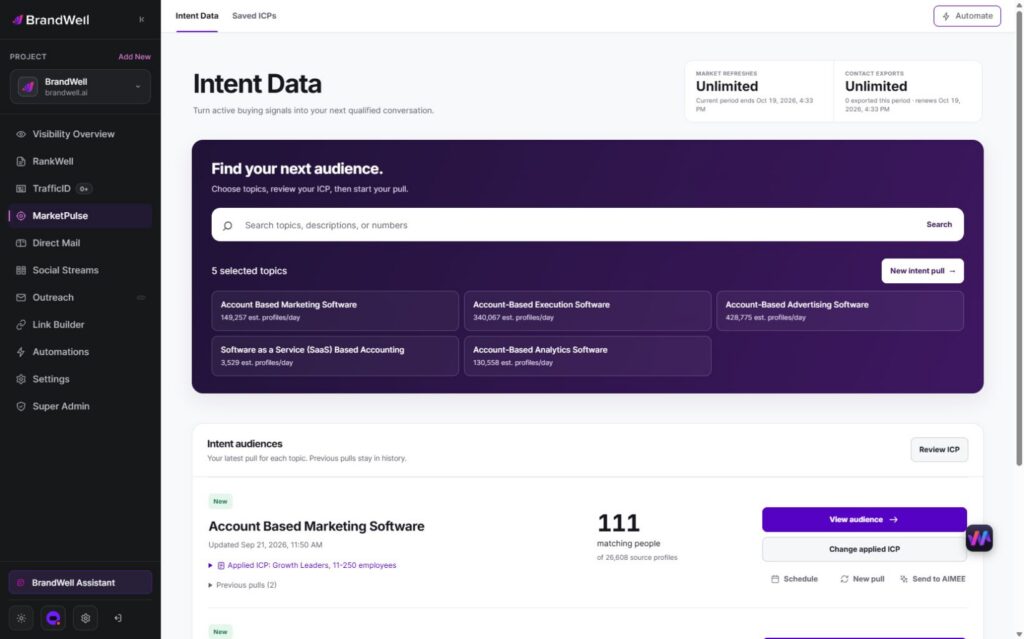
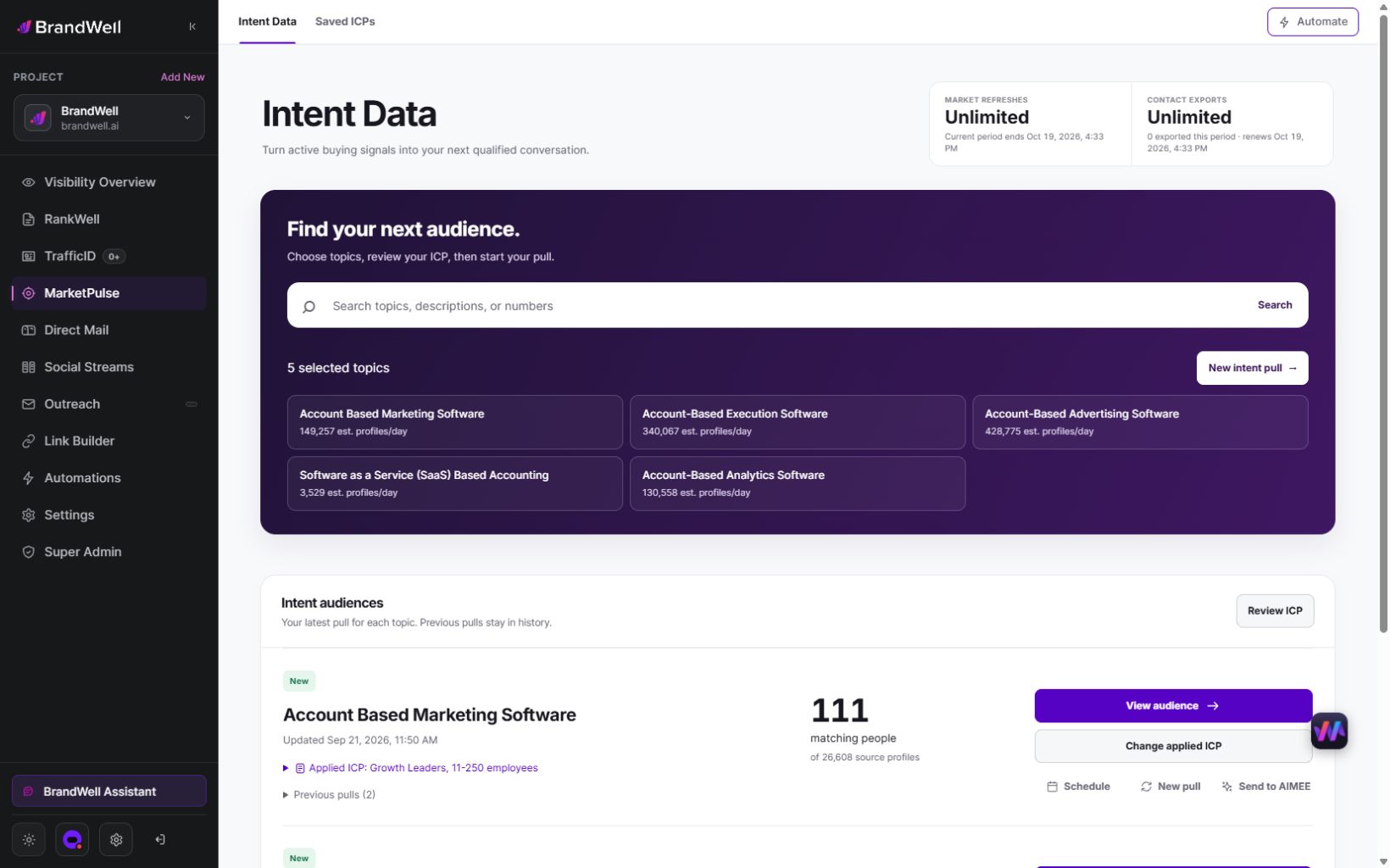
BrandWell MarketPulse: intent data from $250/month. Find people researching topics relevant to what you sell, apply saved ICP filters, and review available contact details before taking action.
| Plan | Price | Topics and refreshes | Monthly exports |
|---|---|---|---|
| Starter | $250/month | 1 topic, weekly | 25,000 contacts |
| Growth | $500/month | 3 topics, daily | 100,000 contacts |
| Scale | $1,000/month | 10 topics, daily | Unlimited contacts |
Swipe the table to see all columns.
A pull retrieves available data from the previous 24 hours for one topic. Daily use across all included topics provides 90 Growth pulls or 300 Scale pulls in a 30-day month. Weekly Starter pulls vary by calendar month. Available audience size and contact fields vary, and audiences may overlap. Refreshes stop at the plan limit without overage charges.
- Find and qualify: search the topic catalog, save your ICP, and review the people and companies that match.
- Act on the research: export qualified contacts or prepare an Outreach or Direct Mail workflow. Connected products, channel usage, and fulfillment may cost extra.
- Get help from AIMEE: Growth and Scale include AIMEE for the initial user to research accounts and prepare the next step through connected tools.
Agencies and other service businesses can build client deliverables around their available topic pulls and exports. Keep each client’s scope, permissions, and service fees clear. A subscription is not a promise of a white-label platform or exclusive access to a market.
Explore MarketPulse and watch the demo or compare plans starting at $250/month. Any early-access discount is a separate, time-limited offer shown to an eligible recipient.
Should an agency offer signal-to-action automation services, and what client outcome should it promise?
Offer the service when the client has a repeatable decision that can be expressed as evidence, qualification, approval, and action rules. Promise reliable processing, a shorter review cycle, and a traceable handoff. Do not promise a fixed number of contacts, meetings, opportunities, or revenue.
The best first use case is narrow. Choose one signal family, one audience, one destination, one accountable owner, and one low-risk action. For example, a qualified topic signal might produce a research brief for an account owner, not an automatic sales email. The client can verify relevance before expanding the path.
Describe the service in operating terms: monitored inputs, qualification logic, permitted uses, cadence, exception handling, delivery evidence, and monthly improvement. A vague promise to “automate intent” hides the decisions that determine quality. A specific promise to deliver reviewed, policy-compliant action candidates makes the work inspectable.
What should the delivery workflow, staffing, SLA, and client handoff include for signal-to-action automation services?
Use named owners for source, data quality, routing, client approval, destination administration, and incidents. The workflow should receive the signal, validate source and freshness, resolve the account or person only to an allowed identity state, apply fit and exclusion rules, select a permitted action, request approval when required, deliver, confirm receipt, and reconcile errors.
Set service levels by stage rather than one broad turnaround promise. Define an ingestion window, review window, delivery window, failed-action response, correction target, and escalation path. Pause the clock when client input or approval is missing. The handoff record should carry the source, observed time, entity confidence, rule version, decision reason, evidence, action, owner, destination, approval state, and receipt.
Separate production from testing. A sandbox should use synthetic or approved sample records and nonproduction destinations. Promotion requires a test packet, owner approval, rollback plan, and a defined first-run limit. The detailed intent-data delivery SOP can supply the broader cadence and acceptance structure.
What are the best tools, platforms, or white-label providers for signal-to-action automation services?
The best stack is the one that preserves evidence and control across collection, identity, qualification, orchestration, destination, and audit. Evaluate capabilities, not brand popularity. Required features often include tenant isolation, field-level permissions, rule versioning, approval steps, idempotency, retries, suppression, rate limits, logs, export controls, and role-based access.
For data and identity, verify current source rights, available fields, confidence states, validation methods, refresh behavior, and contract terms on primary pages. For orchestration, test how the tool handles duplicate events, partial failures, expired credentials, destination schema changes, and replay. For reporting, require a receipt that links the original observation to the final disposition without implying causation.
Do not choose a “best” provider from a search snippet or an unverified feature list. Run the same test packet through shortlisted options, include a deliberately ambiguous identity and a failed destination, and compare the resulting evidence. A white-label layer is useful only if the agency can still explain and govern what happens beneath the branding.
Should an agency build, resell, refer, or avoid signal-to-action automation services?
Build when proprietary routing logic is central and the agency can own reliability; resell when a contracted platform supplies governed multi-client primitives; refer when the client mainly needs software; avoid when rights, ownership, or failure recovery are unclear.
A custom build offers flexibility but creates ongoing responsibility for authentication, connectors, entity resolution, monitoring, security, schema drift, retries, and support. A reseller model can shorten time to service while the agency owns configuration, interpretation, client delivery, billing, and retail pricing. A referral model is safer when the vendor should contract, support, and operate the system directly.
Use a failure-radius test. Ask what happens if one rule is wrong for one hour. If the answer includes mass outreach, destructive CRM changes, cross-client leakage, unbounded spend, or a difficult rollback, the current design is not ready. Avoid automation entirely when the client refuses approvals, suppression, audit logs, or a bounded launch.
How much should an agency charge for signal-to-action automation services, and what gross margin is realistic?
Price from the controlled service boundary, not from a generic automation benchmark. Model discovery, rule design, data access, integrations, testing, documentation, analyst review, exception volume, support, reporting, maintenance, and incident reserves. Gross margin is realistic only after measuring the actual cost to serve under current written wholesale terms.
Separate setup from recurring delivery. Setup can cover the decision charter, field map, destination configuration, test packet, approval matrix, and launch review. Recurring work covers signal processing, human review, exceptions, connector monitoring, delivery receipts, client meetings, rule changes, and audits. Add an explicit change allowance so a new destination or signal family does not quietly consume the base fee.
A worksheet can calculate contribution margin as collected service revenue minus contracted data and software usage, assigned delivery labor, support, and a reasonable incident reserve. Do not label pass-through spend or founder time as free. Do not publish universal margin claims because client complexity and wholesale terms vary.
How should an agency prove the pipeline or revenue impact of signal-to-action automation services?
Show the operational chain first, then report downstream associations with qualified language. Track signals received, eligible signals, rejected signals, approved actions, successful deliveries, failed actions, client acceptance, completed follow-up, responses, meetings, opportunities, and associated pipeline or revenue. Keep each denominator visible.
Compare cohorts only when definitions and windows are stable. A useful operational comparison might examine median review time before and after the controlled route, or acceptance by signal type. A business-outcome comparison needs a credible baseline or counterfactual and enough observations for the decision. “Associated with” is not “caused by.”
Keep a reason code for every rejection and failure. If accepted actions rise because the agency loosened the acceptance definition, the apparent improvement is not comparable. The lead and intent-data quality assurance guide can help structure error sampling before outcome interpretation.
Which agency clients are the best fit for signal-to-action automation services, and who should be excluded?
Best-fit clients have a focused ICP, a meaningful decision triggered by fresh evidence, clean destination ownership, and staff who will review and act. They can state why a signal matters, what would disqualify it, which action is proportionate, and who approves that action.
Exclude clients that demand guaranteed lead volume, fully autonomous outreach, hidden data collection, or broad identity claims. Also exclude clients with no suppression process, no CRM owner, no response capacity, or no way to distinguish a useful signal from a sales-ready person. Automation amplifies these gaps.
Run a readiness interview around rights, identity states, action library, destinations, approvals, and incident ownership. A client may be ready for a weekly research queue but not for real-time routing. Start at the safest useful level rather than forcing the same maturity model on every account.
How should buyer intent, website behavior, identity, and enrichment support signal-to-action automation services?
Use each input as a separate evidence lane and combine them only through explicit rules. Topic intent can suggest research activity. Website behavior can describe authorized site events. Identity can range from company-level resolution to a validated individual match. Enrichment can add attributes or contact details where contracted and available. None is automatic permission to contact.
Score source confidence, entity confidence, fit, recency, and action readiness separately. A strong company fit with uncertain identity may justify account research, while a validated business email with weak relevance may justify no action. Keep unknown states instead of converting them to false certainty.
Before connecting destinations, document field purpose, allowed transformation, retention, suppression, and access. The CRM and marketing-stack integration guide covers destination design. Where commercial email is used, the FTC says its CAN-SPAM requirements also apply to B2B email and include accurate headers, nondeceptive subjects, identification, a physical address, an opt-out method, and timely honoring of opt-outs. Current law, contracts, and qualified counsel control the specific program.
What data-quality, delivery, privacy, and client-expectation risks affect signal-to-action automation services?
The main risks are source drift, stale evidence, wrong entity resolution, overbroad enrichment, duplicate execution, unsafe destinations, missing suppression, silent delivery failure, and an inflated promise. Treat every one as a testable control with an owner, detection method, and recovery path.
Privacy and communication rules vary by jurisdiction and channel. The ICO’s direct-marketing guidance emphasizes data protection by design, fair collection and explanation, a valid basis, and respect for objections. NIST’s AI Risk Management Framework is voluntary, but its govern, map, measure, and manage structure is a useful way to organize agent risk. Neither source replaces legal review.
Maintain an incident ladder: pause one record, pause one route, pause one tenant, or stop the service. Preserve the input and rule version, revoke unsafe credentials, prevent replay, notify the accountable owner, correct affected records, and document the decision to resume. Client messaging should explain scope and known impact without guessing.
What should a recurring agency package for signal-to-action automation services include?
Package a controlled route, not an unlimited automation promise. Define eligible signals, identity states, qualification rules, destinations, permitted actions, approval thresholds, cadence, service levels, exception capacity, delivery receipts, reporting, maintenance, support, change control, and incident response.
AIMEE is the agent-powered desktop app in BrandWell’s growth workflow. Assign work through the tools connected to your workspace and choose which actions can run automatically or require approval. Desktop availability, account permissions, and the configured workflow determine what can execute.
Start with MarketPulse intent data from $250/month. Review a topic and its matching audience, then use BrandWell’s connected growth tools and AIMEE desktop assistance to prepare the next action. Agency packaging and services can be scoped around the client workflow.
Nine-gate signal-to-action control model
- Charter: Name the client decision, allowed inputs, prohibited uses, owner, and success evidence.
- Receive: Capture source, observed time, tenant, schema, and consent or contract context.
- Validate: Check freshness, completeness, duplicates, suppression, and source availability.
- Resolve: Preserve the exact identity state and confidence instead of guessing a person.
- Qualify: Apply ICP, exclusions, intent relevance, thresholds, and a reason code.
- Select: Choose the least risky useful action, destination, owner, and expiry.
- Approve: Require a human for outreach, CRM writes, spend, exports, and material changes.
- Deliver: Use idempotency, rate limits, retries, and a receipt tied to the original event.
- Reconcile: Resolve failures, log disposition, test rollback, and review rules on cadence.
Copyable agent workflow for Claude, ChatGPT, or AIMEE
ROLE: You are a draft-only signal routing analyst.
INPUTS: Client charter, approved sources, identity states, qualification rules, exclusions, destinations, action library, approval matrix, and SLA.
1. Preserve the observed signal and its source before interpreting it.
2. Validate freshness, tenant, duplicate state, suppression, and required fields.
3. Classify identity, fit, relevance, and action readiness separately.
4. Recommend the least risky useful action and explain the rule.
5. Draft the route card with evidence, unknowns, expiry, owner, and rollback.
STOP WHEN: rights are unclear, identity is ambiguous for the proposed action, suppression matches, a destination is unapproved, confidence is below threshold, or evidence conflicts.
HUMAN APPROVAL: Required before outreach, CRM writes, exports, spend, pricing, client delivery, or rule promotion.
OUTPUT: Draft route card, reason code, evidence links, confidence states, proposed action, and approval request.
Route-card worksheet: Record client, purpose, source, observed time, entity and identity state, fit, exclusions, evidence, unknowns, selected action, destination, owner, approval, expiry, idempotency key, result, retry count, rollback status, and final disposition. Review a fixed sample of accepted, rejected, and failed routes every month. Retire rules that no longer lead to an accountable decision.
Launch test packet and maintenance cadence
Before the first client record runs, prepare ten cases: a clean eligible account, a stale signal, a duplicate event, a suppressed entity, a wrong-company match, an ambiguous person match, a missing required field, an expired destination credential, a retryable failure, and a prohibited action. For each case, write the expected disposition and receipt. The route is not ready merely because the successful case works. It is ready when the unsafe cases stop in the intended place and the failed action can be retried without duplication.
Run a controlled first batch below the normal capacity limit. Compare expected and actual routes, inspect every exception, test rollback, and require the client owner to accept the receipt format. Increase the limit only after the source, rule, destination, and approval owners sign off. Preserve the launch packet so a later connector or rule change can be evaluated against the same control cases.
Maintenance should have three clocks. Review exceptions and failed actions frequently enough to meet the promised SLA. Review acceptance, rejection reasons, and client usage on a regular operating cadence. Review permissions, source rights, destinations, credentials, action libraries, and retirement decisions on a slower governance cadence. A rule without an owner or recent decision use should be paused rather than left running by habit.
Track capacity as reviewed routes, exception minutes, connector incidents, client changes, and support load, not only raw signal volume. A small stream with ambiguous identity can require more work than a larger stream of clean company-level observations. Use actual time and failure data to revise the package boundary, staffing plan, and price before adding another client or signal family.

Written by