On this page
- Who this is for
- Copyable intent-data delivery SOP template
- How should an agency design SOPs to reach client value quickly and repeatably?
- What steps, owners, SLAs, quality checks, and handoffs should an SOP include?
- Which tools, templates, portals, or integrations best support SOPs?
- How do manual, automated, and white-label SOP approaches compare?
- What delivery cost and setup fee should an agency model?
- Which time-to-value, quality, adoption, and outcome metrics should be used?
- How should SOPs vary by client maturity, stack, and service package?
- Which signal sources, identity checks, activation workflows, and outcome evidence matter most?
- What scope, data, security, integration, and expectation risks affect SOPs?
- What must an SOP include for a recurring white-label intent-data service?
- The exception and change-control mini-playbook
- A bounded SOP review brief for AIMEE
- The test of a usable SOP
- Test a normal run and a staged exception
- Inspect MarketPulse before designing the delivery
Direct answer: An intent-data delivery SOP should be a controlled operating record with inputs, owners, ordered steps, decision gates, approvals, evidence, exceptions, client handoffs, and change history. Write it around the decisions that can stop or redirect delivery. A narrative checklist without release authority, evidence, and exception handling is not enough.
Current MarketPulse offer: intent-data plans start at $500/mo. See the product, demo, and current plans. Updated October 3, 2026.
The best standard operating procedures for intent-data delivery make a service easier to run without hiding judgment. They tell a new operator what to do, how to know it worked, when to stop, and whom to involve when reality does not match the happy path.
Copyable intent-data delivery SOP template
Use this as the minimum document structure. Put each field in the system where the team actually works. A long document nobody updates is not an operating system.
- Purpose and decision: What client decision does this procedure support, and what does it explicitly not cover?
- Service boundary: Client, package, topics, source categories, entities, destinations, geography, cadence, effective terms, and exclusions.
- Inputs: Required files, credentials, approvals, data dictionary, source evidence, baseline, and dependency owner.
- Roles: One accountable owner plus responsible, consulted, and informed parties for each decision gate.
- Ordered procedure: Numbered actions with input, tool, expected output, evidence, and next state.
- Decision gates: Pass, hold, reject, or escalate criteria for source, identity, qualification, suppression, activation, and delivery.
- Service levels: Acknowledgement, completion, review, dependency, correction, and escalation rules supported by current terms.
- Quality controls: Rule versions, sample method, reviewer, acceptance, exception, correction, and release approval.
- Security and privacy controls: minimum data, role access, approved systems, secure movement, retention, deletion, and incident route.
- Client handoff: Deliverable, explanation, open limitations, action owner, feedback route, next review, and acceptance evidence.
- Exceptions: severity, containment, workaround boundary, client-notification decision, approver, and closure test.
- Change control: request, rationale, impact, test, approval, effective version, training, rollback, and client notice where required.
- Records: what evidence is preserved, where it lives, who may access it, and when it is reviewed or deleted.
- Measures: time, quality, adoption, cost, risk, and outcome definitions with numerator, denominator, and owner.
Add a one-page run sheet for frequent operators, but keep it linked to the controlled SOP. The run sheet should never silently become a second, conflicting procedure.
How should an agency design SOPs to reach client value quickly and repeatably?
Start with the smallest end-to-end client outcome, such as a reviewed topic report or an approved account-priority handoff. Observe an experienced operator performing it. Capture inputs, decisions, evidence, rework, and exceptions rather than only clicks. Test the draft with another operator who did not help write it. Any step that requires unwritten context must be clarified or explicitly assigned to an expert.
Separate core controls from client configuration. Core controls include provenance, identity review, suppression, access, release, and exception handling. Client configuration includes topics, fit rules, destinations, cadence, and report presentation. This lets the agency improve a repeatable operating system without flattening meaningful client differences. The intent-data client onboarding checklist supplies the approved inputs an SOP needs.
What steps, owners, SLAs, quality checks, and handoffs should an SOP include?
Use the operating sequence: accept approved scope, verify dependencies, receive or retrieve signals, validate source and schema, resolve identity, apply qualification, suppress ineligible entities, run QA, obtain activation approval, deliver, reconcile the destination, prepare the client explanation, capture feedback, and close the run. Every step needs a responsible role, evidence, and a next state.
Name one accountable service owner, plus source, data, identity, activation, account, and escalation owners. Write service levels for acknowledgement, normal completion, dependency waiting, exception triage, correction, and client response. The handoff must include scope, delivery manifest, release status, test evidence, open exceptions, action instructions, and the next review. “Sent the file” is not a completed handoff.
Which tools, templates, portals, or integrations best support SOPs?
Choose a controlled documentation home, workflow or ticket system, data dictionary, source register, permission store, QA rule registry, exception log, secure delivery surface, client portal or report, and version history. The best stack makes the current procedure easy to find, links each run to evidence, restricts sensitive access, and records approvals. It should also support offboarding and deletion.
A simple document plus structured tracker can work for a limited service. Add automation when volume, cadence, or client count causes missed steps. Evaluate tools on ownership, versioning, audit events, role access, client separation, notifications, API behavior, portability, and failure recovery. Do not select SOP software because it generates attractive documents. The operating evidence matters more than presentation.
How do manual, automated, and white-label SOP approaches compare?
Expert-led delivery handles novel situations but creates key-person dependency when decisions stay in memory. Documented manual delivery improves training and transparency, yet repeated copying can cause drift. Automated delivery enforces known rules at scale, but a bad rule or broken integration can repeat quickly. White-label delivery can provide a branded portal and operational foundation, while the agency retains responsibility for client promise, configuration, approval, and support under its agreement.
A hybrid model is usually the decision guide: automate deterministic movement and validation, keep people at ambiguous identity, client-use, exception, and release gates. Compare models on control, speed, labor, explainability, resilience, client experience, portability, risk, and total cost. Do not automate a decision simply because it occurs often.
What delivery cost and setup fee should an agency model?
Setup work includes process observation, writing, field and rule definition, tool configuration, access setup, integration, quality testing, role training, client adaptation, and rollback planning. Recurring cost includes operator time, data and platform charges, QA, exception handling, client support, access review, change control, reporting, retraining, and periodic maintenance.
Use a role-by-step worksheet: frequency, normal minutes, exception probability, exception minutes, loaded cost, tool or usage cost, and reviewer cost. Set delivery cost estimate = actual contracted provider and usage cost + expected delivery labor + tooling allocation + support and maintenance + risk reserve . That estimate is not necessarily a sufficient selling price: model overhead, acquisition cost, uncertainty and desired contribution separately. Track actual contribution by package with the cost boundary stated. No public benchmark can determine the right setup fee or gross margin for an agency with different data, clients, and service commitments.
Which time-to-value, quality, adoption, and outcome metrics should be used?
Time metrics include time from approved input to first accepted delivery, normal cycle time, dependency wait, and exception resolution. Quality metrics include step completion, provenance coverage, identity conflicts, suppression failures, release holds, correction, destination reconciliation, and repeated exceptions. Adoption metrics include operator use of the current version, training completion, client acceptance, dispositions, and action completion.
Cost metrics include labor per run, exception labor, tool and usage cost, support load, and contribution margin. Outcome metrics may include client-defined responses, meetings, opportunities, and renewal evidence, but the SOP should not claim to cause them. Set baselines from the agency’s own runs. A benchmark is useful only when scope and definition are comparable. Review trends and underlying cases rather than rewarding operators for making exceptions disappear from the log.
How should SOPs vary by client maturity, stack, and service package?
A low-maturity client needs fewer destinations, more explicit manual approval, simple files or reports, and a guided review. A middle-maturity client may use CRM fields, recurring portal delivery, automated validation, and shared exception tickets. An advanced client can support APIs, warehouse lineage, automated routing, several activation paths, and stronger experimental measurement. Keep the core control gates across all tiers.
Create one master procedure with configuration annexes rather than cloning an uncontrolled SOP for every client. Annexes should state client fields, topics, fit, suppression, systems, access, cadence, metrics, and escalation. Higher service tiers may include more destinations, reviews, or analysis, but never imply that more automation guarantees better data or commercial outcomes.
Which signal sources, identity checks, activation workflows, and outcome evidence matter most?
The SOP should require a source record with category, observation, entity level, topic or behavior, freshness, permitted use, transformation, and limitations. Identity steps should name the inputs, method, conflict behavior, rejection state, and human-review trigger. Keep account-level signals at the account level unless the contracted evidence supports a different resolution.
Activation steps should verify client-approved topic and audience, fit, suppression, destination, payload, owner, permission, and evidence. Record the exact delivered state and reconcile the receiving system. Outcome evidence should link back through stable IDs and timestamps, while keeping association, influence, and incrementality distinct. The agency intent-data reporting guide can help translate run evidence into a clear client review.
What scope, data, security, integration, and expectation risks affect SOPs?
Risks include outdated procedures, copied client configuration, uncontrolled workarounds, excessive access, missing source evidence, identity overreach, suppression bypass, cross-client delivery, secrets in documents, silent integration changes, absent rollback, and sales promises outside the procedure. Treat a recurring workaround as a change request, not tribal knowledge.
Assign reviewers for the actual security and permitted-use requirements. Record approved access, destinations, retention, incident contacts and unresolved conditions. This author-proposed operating framework is not a certification or legal conclusion.
What must an SOP include for a recurring white-label intent-data service?
Include commercial scope, approved client configuration, source and identity rules, delivery cadence, release gate, branded-report or portal steps, access, quality checks, exception and incident paths, change control, client reporting, billing inputs, renewal evidence, and offboarding. State which parts belong to the agency, underlying provider, client, and any other contracted party.
Add a monthly operating review with service levels, quality, adoption, cost, open risk, requested changes, and a continue, repair, reduce, expand, or stop decision. Preserve the client-facing promise and current written terms alongside the procedure. White labeling changes presentation and commercial ownership. It does not remove the need to understand how the service works.
The exception and change-control mini-playbook
When a run deviates, first contain it. Stop the affected delivery, preserve evidence, and assign severity. Next decide whether the cause is input, source, identity, rule, system, access, client configuration, or unknown. Select correction, retest, client communication, and approval. Close only after evidence meets the release rule. Review whether the SOP or training must change.
For any procedure change, record requester, reason, affected clients, risk, test, reviewer, approval, version, effective state, rollback, and communication. Never edit the live instruction silently while a run is in progress. Emergency workarounds expire unless formally adopted after review.
A bounded SOP review brief for AIMEE
An AI assistant can draft or audit structure. It should not approve data use, rewrite live controls, or operate client systems without separately authorized tools and human review. Use minimized, approved context.
Act as an SOP analyst for a recurring agency intent-data delivery service.
Inputs: approved scope, current terms, roles, source register, data dictionary,
identity and suppression rules, QA plan, client configuration, tools, and examples.
Draft a controlled SOP with purpose, inputs, numbered steps, owners, evidence,
decision gates, SLAs, handoff, exception process, change control, rollback, records,
and measures. Create a short run sheet and a RACI linked to the full procedure.
Mark every missing rule or owner as an open decision. Do not invent permissions,
data sources, identity certainty, legal conclusions, SLAs, prices, metrics, outcomes,
or guarantees. Do not alter a live system. Route privacy, security, contract,
identity, activation, and release decisions to named qualified human reviewers.
The test of a usable SOP
Give every SOP a maintenance trigger rather than relying only on a calendar. Triggers include a source-field change, new activation destination, contract amendment, repeated exception, security event, client escalation, tool update, role change, or material cost shift. The trigger owner opens a change record and decides whether delivery can continue safely under the current version.
Review changes with three questions: Did the control still produce the intended evidence? Did the operating burden change enough to affect price or scope? Does any client configuration or training now conflict? Test the revision on a safe case, document rollback, train affected roles, and confirm adoption. Archive prior versions with their effective run records rather than overwriting history.
Measure procedure health separately from service outcomes. A consistently followed SOP can still encode a weak rule, while a strong commercial outcome can occur despite a missed control. Review adherence, exception patterns, control effectiveness, and outcome evidence as related but distinct views.
Give the procedure and approved access to a trained operator who did not write it. Ask them to run a safe test, preserve evidence, handle one staged exception, and complete the handoff. If they must call the original expert for hidden decisions, revise the SOP. The goal is not to eliminate expertise. It is to put expertise at explicit decision gates where the agency and client can see, train, measure, and improve it.
Test a normal run and a staged exception
For an author-created acceptance test, use approved sample records in a safe environment. One test should complete the normal handoff; another should contain a deliberate missing input or failed destination check. The expected response is an explicit hold or escalation, not a quiet workaround.
In a fictional test of ten cases, eight complete their expected behavior and two fail, giving 8 ÷ 10 = 80% case pass rate. If one of the eight passing cases correctly holds an invalid record, that is a successful control test, not a delivered lead. Report the individual failures and repair them. This small test is not evidence of population accuracy, production reliability or commercial performance.
Record the SOP version, client configuration, case inputs, expected state, actual state, evidence, reviewer and decision. Retest affected cases after a change and preserve the old result. Do not average a failed mandatory control into an acceptable overall score.
NIST SP 800-128, including its 2019 updates, describes security-focused configuration management for federal information systems. It is a reference for configuration governance, not proof that this agency SOP complies with that publication.
Inspect MarketPulse before designing the delivery
MarketPulse provides topic research, ICP filtering and available contact records. Standard plans are starting at $500/mo for one topic with weekly refreshes. Growth includes three topics with daily pulls; Scale includes ten topics with daily pulls. Available fields, audience sizes and overlap vary.
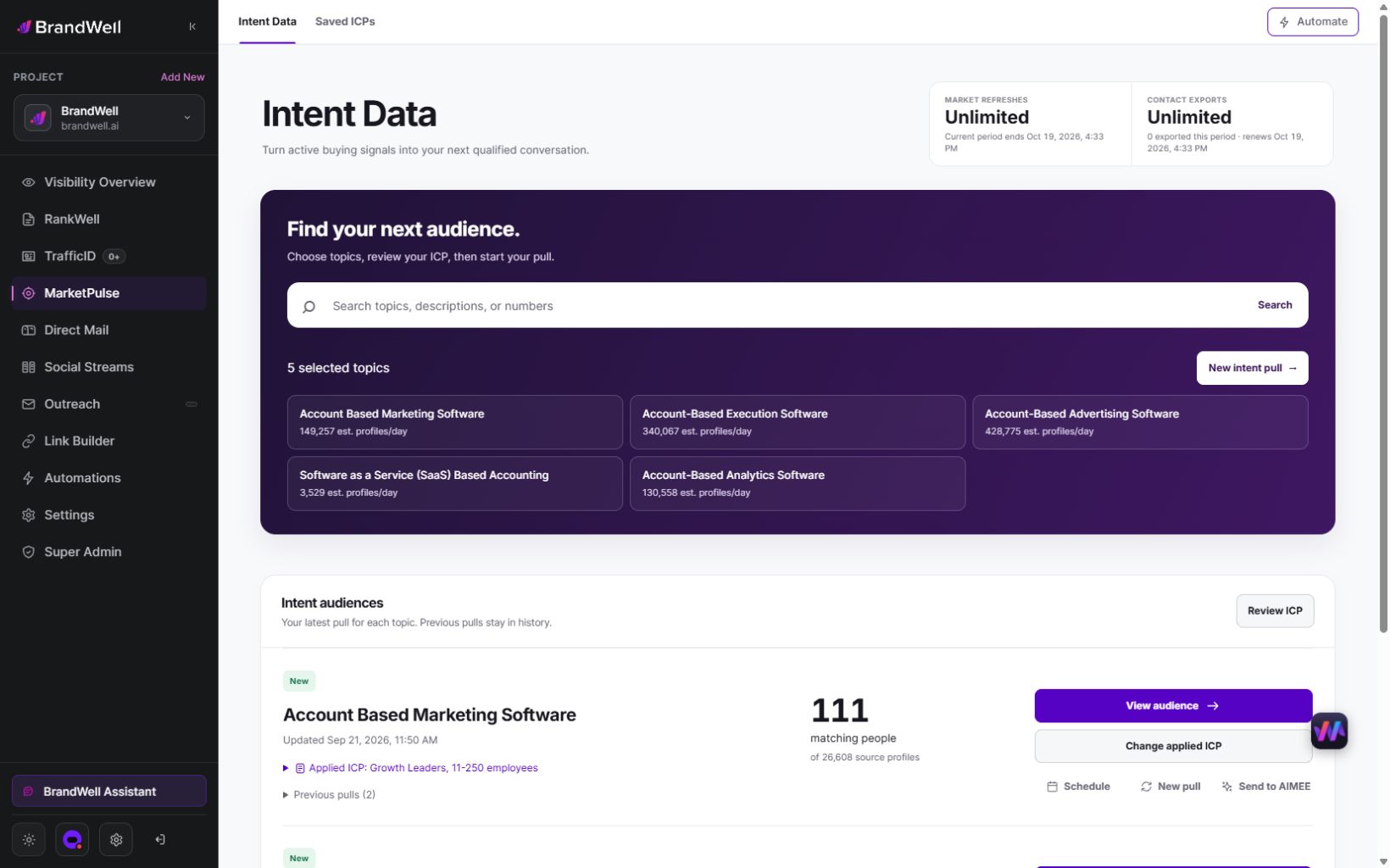
A standard subscription does not establish white-label portal hosting, custom APIs, native client billing, exclusive topics or a wholesale contract. Keep separately agreed agency rights and delivery work explicit. AIMEE helps prepare configured work through connected tools; approve and inspect the result at its destination.
Start with one topic, test the available output and build the SOP around the actual service boundary. Watch the demo and review current plans.
Reviewed and updated October 3, 2026.

Written by