On this page
- Should an agency offer co-selling programs, and what client outcome should it promise?
- What should the delivery workflow, staffing, SLA, and client handoff include for co-selling programs?
- What are the best tools, platforms, or white-label providers for co-selling programs?
- Should an agency build, resell, refer, or avoid co-selling programs?
- How much should an agency charge for co-selling programs, and what gross margin is realistic?
- How should an agency prove the pipeline or revenue impact of co-selling programs?
- Which agency clients are the best fit for co-selling programs, and who should be excluded?
- How should buyer intent, website behavior, identity, and enrichment support co-selling programs?
- What data-quality, delivery, privacy, and client-expectation risks affect co-selling programs?
- What should a recurring agency package for co-selling programs include?
- Keep the opportunity history inspectable
- A fictional pilot funnel
- Use MarketPulse as a research input
Direct answer: Structure an agency co-selling program as a permissioned opportunity operating system. Agree on account ownership, registration, qualification, handoffs, data sharing, client billing, support, and conflict resolution before either party approaches the account. Agents can prepare research and drafts, but humans must approve outreach, shared data, pricing, commitments, and CRM changes.
Current MarketPulse offer: intent-data plans start at $500/mo. See the product, demo, and current plans. Updated October 1, 2026.
Who this is for: Agencies, consultants, and technology partners combining complementary expertise to qualify and pursue selected accounts without confusing ownership or the client experience.
Co-selling is not two logos on a webinar or an informal promise to send leads. It is coordinated selling in which each party has a defined role in qualification, discovery, solution design, commercial terms, delivery, and support. The program succeeds operationally when the client sees one coherent process and both partners can reconstruct every decision.
Start with a small account set and one offer. Broad partner recruitment before rules exist creates duplicate outreach, disputed credit, unsafe data sharing, and proposals nobody owns. A co-sell program needs fewer slogans and more gates.
Should an agency offer co-selling programs, and what client outcome should it promise?
Offer co-selling when the partner adds a necessary capability, access path, or delivery role that the agency cannot credibly provide alone. Promise coordinated discovery and a clearly owned solution process. Do not promise opportunity volume, conversion, exclusivity, pipeline, or revenue.
Describe the intended combined value and operating boundary, such as coordinated qualification and one accountable discovery process. State who contracts, bills, delivers, supports and resolves issues. Do not promise faster qualification without evidence from the actual program.
Choose a narrow joint use case with observable qualification criteria. Agree on what disqualifies an account and when the motion returns to a single party. The first goal is a trustworthy buying experience, not a large registered-opportunity count.
What should the delivery workflow, staffing, SLA, and client handoff include for co-selling programs?
Use an opportunity protocol with program, account, solution, commercial, delivery, and support owners. The flow should cover partner eligibility, account permission, registration, conflict check, mutual qualification, approved data exchange, discovery preparation, joint meeting, solution decision, proposal, contracting, billing, delivery handoff, and closeout.
Set time limits for accepting or rejecting registration, resolving conflicts, supplying discovery input, approving a meeting, producing a proposal, and handing a signed client into delivery. Define what pauses each clock. An unanswered registration should expire rather than hold an account indefinitely.
The client handoff should identify one accountable contact, scope, responsibilities, data use, billing path, support path, known dependencies, evidence, and open decisions. The intent-data service proposal template can help make the division of work visible.
What are the best tools, platforms, or white-label providers for co-selling programs?
The best stack preserves permission, ownership, evidence, and status across partner relationship management, CRM, secure collaboration, proposal, contract, billing, and delivery systems. A shared spreadsheet may support a tiny pilot if access is controlled and history is preserved. Larger programs may need registration, conflict detection, role permissions, audit logs, expiry, and reporting.
Test the hard cases: both parties claim an account, a seller leaves, consent to share data is missing, an opportunity expires, pricing changes, a client asks for one invoice, or a partner fails delivery. The system should show who decides and what record survives.
Do not select a platform from a generic ranking. Verify current features, data handling, access controls, integrations, pricing, and contract terms on primary pages. No tool repairs an ambiguous commercial agreement.
Should an agency build, resell, refer, or avoid co-selling programs?
Build the operating layer when the partnership is strategic and repeatable; resell when the agency owns a packaged service on contracted infrastructure; refer when one party should take the account alone; avoid when capability, ownership, or incentives conflict.
A true co-sell is appropriate when both parties contribute to qualification or solution delivery and the buyer benefits from coordination. Resale is cleaner when the agency should own billing and service. Referral is cleaner when the vendor should own the entire commercial and delivery motion after a qualified introduction.
Avoid co-selling with overlapping offers, incompatible claims, unclear support, unapproved data exchange, hidden channel conflict, or compensation that rewards registration rather than client value. Complexity must earn its place.
How much should an agency charge for co-selling programs, and what gross margin is realistic?
Price the client offer from delivered scope, then allocate economics through current written terms and actual ownership. Model partner management, qualification, discovery, solution design, sales engineering, proposal, delivery, support, billing, exceptions, and conflict resolution.
Possible commercial structures include a referral fee, wholesale resale, subcontract, revenue share, or separately billed components. Each changes control, tax, collections, refunds, liability, and margin. Do not use a headline split before determining which party does the work and carries the risk.
Calculate contribution by party from collected revenue minus direct platform, data, labor, support, payment, refund, and program costs. Track unpaid partner coordination time. There is no universal realistic margin or split; current written terms and observed cost to serve control.
How should an agency prove the pipeline or revenue impact of co-selling programs?
Measure the joint operating funnel and use a declared credit rule without treating that rule as causal proof. Track eligible accounts, registrations, accepted registrations, conflict outcomes, jointly qualified opportunities, approved meetings, proposals, wins, losses, cycle time, delivery handoffs, renewals, and associated commercial value.
Keep reason codes for rejection, expiration, withdrawal, loss, and stalled handoff. Compare jointly worked accounts with a defensible reference only when definitions, periods, and selection are understood. Partners often choose their strongest accounts for co-selling, so a simple win-rate difference is vulnerable to selection bias.
Report client experience too: duplicate-contact incidents, time to accountable owner, proposal clarity, support handoff, and disputes. A program that claims pipeline while confusing clients is not healthy. Use qualified language such as “registered,” “jointly worked,” and “associated with.”
Which agency clients are the best fit for co-selling programs, and who should be excluded?
Best-fit clients have a problem that genuinely spans both parties, a named buyer, enough economic value to justify coordination, and permission for a joint process. They benefit when one partner supplies context or service expertise and the other supplies data or platform capability.
Exclude accounts already in an unresolved ownership dispute, clients that request secrecy between partners, highly sensitive data uses the team cannot govern, low-value deals overwhelmed by coordination cost, and buyers who want a single provider while neither partner will accept prime responsibility.
Use a qualification rubric for problem, fit, timing evidence, stakeholder, commercial path, delivery capability, client consent, and conflict status. The intent-data prospect qualification guide can support the underlying client-fit decision.
How should buyer intent, website behavior, identity, and enrichment support co-selling programs?
These inputs can prioritize accounts and prepare discovery, but sharing them between partners requires a documented purpose, authority, minimum fields, recipients, retention, and approval. A company-level signal should not be presented as a named individual’s request.
Create three views: private agency evidence, private partner evidence, and an approved joint record. Share only what the joint decision needs. Enrichment can confirm account or role attributes where contracted and available, but it should not manufacture a stakeholder or permission.
Before external communication, have the responsible owner review the channel, recipient context, claim evidence, suppression and applicable requirements. A partner registration or enriched contact record alone is not permission.
What data-quality, delivery, privacy, and client-expectation risks affect co-selling programs?
Risks include duplicate or conflicting account records, wrong ownership, stale registrations, unapproved data sharing, inconsistent claims, split accountability, billing surprises, delivery gaps, and pressure to overstate joint results.
Use one registration identifier, versioned status, expiry, conflict record, allowed-view matrix, and approved claim library. Maintain a client-facing responsibility statement. Define an incident process for leakage, duplicate outreach, wrong recipient, commercial disagreement, or partner withdrawal.
The nine gates below are author-proposed operating checks. They do not certify the program or resolve legal duties. Have the actual agreement, data roles and commitments reviewed for the parties and jurisdictions involved.
What should a recurring agency package for co-selling programs include?
A recurring package should include partner onboarding, account rules, registration and conflict handling, qualification, joint briefs, approved meeting support, commercial and delivery handoffs, reporting, enablement, maintenance, and quarterly program review.
Use AIMEE through configured tools to prepare a bounded, draft-only account brief. Supply approved inputs and references, preserve unknowns and verify the actual permitted tools. This guide is a proposed agency process, not a native co-selling program entitlement.
Keep product research separate from partner-program rights. A MarketPulse subscription does not establish partner compensation, account exclusivity, client branding or an approved data-sharing arrangement.
Nine-gate co-sell opportunity protocol
- Authorize: Confirm eligible partners, offer, territories, and allowed claims.
- Register: Capture account, owner, evidence, expiry, and requested collaboration.
- Resolve: Check conflicts and document the ownership decision.
- Qualify: Test client problem, fit, timing, value, and joint need.
- Permit: Approve minimum data, recipients, purpose, and retention.
- Prepare: Build the joint discovery brief and responsibility map.
- Engage: Obtain human approval before outreach and run one coherent meeting.
- Commercialize: Set proposal, pricing, billing, contract, and commitment owners.
- Handoff: Transfer evidence, scope, support, risks, and client accountability into delivery.
Copyable draft-only workflow for AIMEE
ROLE: You are a draft-only co-sell operations analyst.
INPUTS: Partner agreement, account rules, registration ledger, client permissions, approved fields, qualification rubric, claim library, and owner matrix.
1. Check partner, account, territory, expiry, and conflict status.
2. Summarize only approved evidence and label identity confidence.
3. Score joint fit and explain why both parties are needed.
4. Draft a discovery brief, meeting agenda, handoff, and open questions.
STOP WHEN: ownership conflicts, permission is missing, the account is suppressed, evidence is stale, claims are unsupported, or responsibility is unassigned.
HUMAN APPROVAL: Required before partner data sharing, outreach, CRM writes, pricing, proposal, contract interpretation, commitments, spend, and client delivery.
OUTPUT: Registration card, qualification result, minimum-data packet, draft agenda, responsibility map, and approval requests.
Registration card: Record partner, account, account owner, opportunity owner, evidence, client permission state, proposed joint value, conflict result, accepted or rejected reason, expiry, next decision, commercial path, delivery owner, and audit reference. Expire abandoned registrations automatically through a reviewed process, not through silent deletion.
Review the program by partner and client cohort. Inspect accepted registration quality, time to decision, conflicts, meetings, proposal clarity, handoff defects, support incidents, collected economics, and client feedback. Retire partners or plays that cannot maintain clear ownership even if their top-of-funnel counts look attractive.
Pilot charter and weekly operating review
Write a pilot charter before accepting registrations. Name the joint offer, eligible account profile, excluded accounts, territories, registration evidence, conflict authority, allowed data, discovery roles, commercial path, delivery ownership, support path, and exit criteria. Cap active opportunities at a level the joint team can review manually. A small, complete pilot provides more evidence than a large queue with missing decisions.
At the weekly review, reconcile new, accepted, rejected, conflicted, expired, and inactive registrations. For active accounts, confirm next client decision, accountable owner, due time, required evidence, approved data recipients, and any changed assumption. Do not let “waiting on partner” become a permanent status. Escalate, reassign, expire, or return the account to a single-party motion.
Review the client experience separately from the internal funnel. Look for duplicate messages, contradictory positioning, repeated discovery questions, unclear pricing, multiple proposals, and unresolved support ownership. Interview a small sample of buyers and delivery staff. Co-selling adds value only when the combined experience is clearer or more capable than either party alone.
At the end of the pilot, decide scale, revise, narrow, refer, or stop. Use accepted opportunity quality, owner compliance, client feedback, collected economics, delivery defects, and unresolved conflicts. Never convert a small pilot’s associated wins into a universal conversion or revenue forecast.
Conflict-resolution rule: Decide conflicts from documented account history, current client relationship, material work, registration timing, territory, and the written partner agreement. Do not reward a bare name upload. Record the facts considered, decision owner, outcome, expiry, and appeal path. Keep the client out of an internal credit dispute wherever possible.
Delivery readiness check: Before a proposal is sent, confirm service scope, contract party, client billing, wholesale charges, retail pricing authority, partner compensation, data roles, implementation owner, support escalation, incident notice, renewal, and termination. If any item is unresolved, pause the proposal rather than letting sales create an obligation delivery cannot honor.
Co-sell economics and capacity worksheet
For each active opportunity, log registration and coordination minutes, discovery participants, sales-engineering work, proposal revisions, partner fees, data and platform usage, travel or event spend, expected delivery labor, billing owner, collection timing, support allocation, and likely exceptions. Separate costs incurred before the client signs from recurring delivery. This reveals whether the partnership is creating leverage or merely moving project work into an unpaid presales category.
Set capacity limits for active registrations, joint meetings, proposals in flight, implementation starts, and support escalations. A partner manager should not accept more joint work than delivery and client success can absorb. When a limit is reached, queue or reject with a reason rather than allowing quality and response times to erode invisibly.
Reconcile commercial records after every closed outcome. Confirm which party invoiced, what was collected, whether the partner payment matched written terms, whether credits or refunds changed the calculation, and which delivery obligations remain. Do not count booked value as collected revenue or treat shared attribution as cash.
Keep the opportunity history inspectable
W3C’s non-normative PROV overview describes data provenance through the entities, activities and people involved in producing it. Apply that concept to record sources, decisions and corrections; this proposed ledger is not a claim of formal PROV conformance.
Use one shared opportunity identifier with partner contribution records. Two partners claiming credit for one deal must not become two deals in the combined pipeline total. Preserve private evidence, approved shared fields and the owner of each change.
A fictional pilot funnel
Suppose a pilot receives 20 registrations, accepts 12, produces five proposals and closes two wins. Registration acceptance is 12/20, or 60%; proposals are 5/12, or 41.7% of accepted registrations; wins are 2/5, or 40% of proposals. These invented counts are not benchmarks or proof of co-selling lift.
Report mature cohorts and distinct accounts. A booked contract, collected payment, partner credit and contribution margin are different measures. If the same win appears in two partners’ reports, reconcile it before presenting a joint result.
Use MarketPulse as a research input
MarketPulse standard plans are starting at $500/mo for one topic with weekly refreshes. Growth includes three topics with daily pulls; Scale includes ten topics with daily pulls. Fields and audience counts vary, and audiences can overlap.
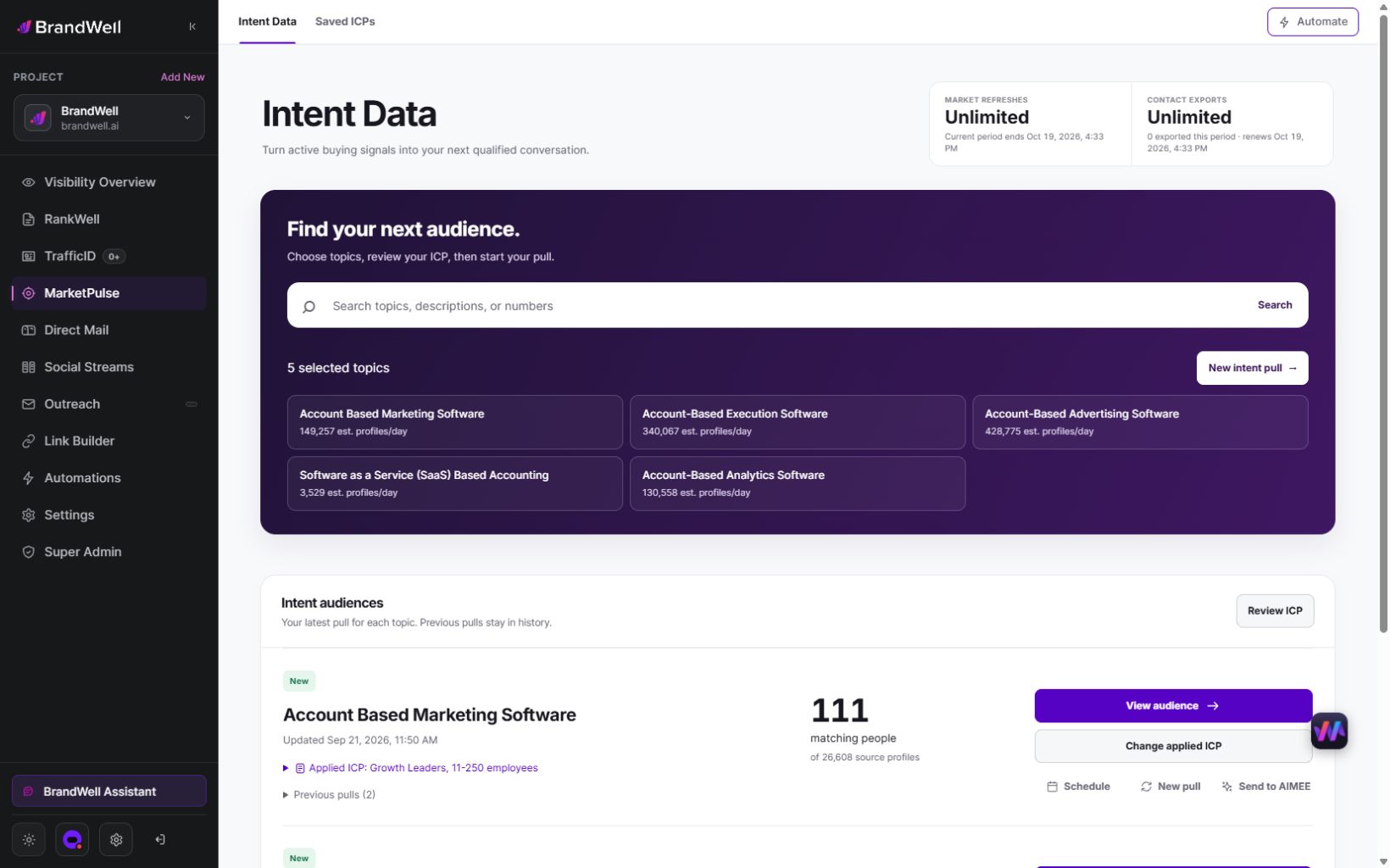
Review a topic and ICP for a possible account-research brief. Keep an inferred research interest distinct from a buyer request and share only approved fields. Watch the demo and review current plans before defining the product component of a separate agency service.
Reviewed and updated October 3, 2026.

Written by