On this page
- MarketPulse research in the current BrandWell workflow
- When a marketplace listing fits
- Define the response workflow and owners
- Evaluate the channel and supporting tools
- Build, list, refer, or decline
- Scope the service and its costs
- Measure inquiries and outcomes separately
- Qualify clients before listing
- Keep inquiry and research evidence distinct
- Maintain proof, privacy, and expectations
- Define the recurring package
- A small channel economics example
- Put buyer intent to work with MarketPulse
Direct answer: Treat an agency marketplace listing as a maintained qualification and response channel, not a passive directory entry. Promise accurate positioning, decision-useful proof, and timely governed responses. Never promise placement, traffic, reviews, ranking, leads, sales, pipeline, or revenue.
Current MarketPulse offer: intent-data plans start at $500/mo. See the product, demo, and current plans
Who this is for: Agency owners and partnership leaders deciding whether to invest in directories, platform marketplaces, partner catalogs, or similar discovery surfaces for a recurring intent-data service.
A listing can make the agency findable at a high-intent moment, but it also creates an operating obligation. Category rules can change. Proof can become stale. A request may arrive without enough context. A fast response may still be wrong if it uses unapproved data or makes claims the service cannot support.
The listing is viable when the audience, category, evidence, response path, economics, rights, and maintenance owner align. The useful question is not “Which marketplace is best?” It is “Which surface reaches an appropriate buyer under rules we can operate responsibly?”
MarketPulse research in the current BrandWell workflow
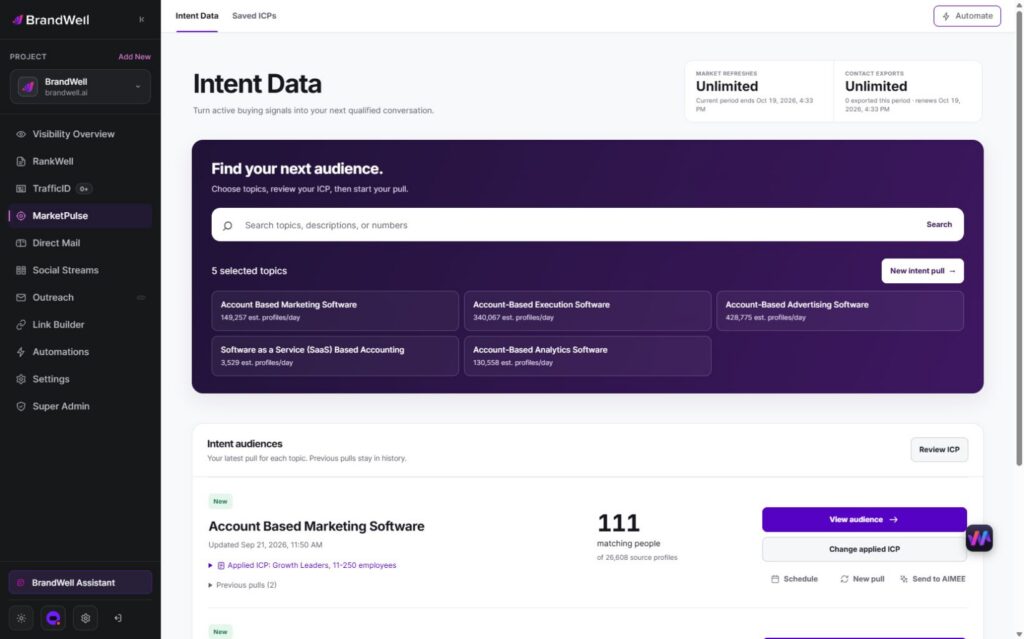
BrandWell MarketPulse: intent data starting at $500/mo. Find people researching topics relevant to what you sell, apply saved ICP filters, and review available contact details before taking action.
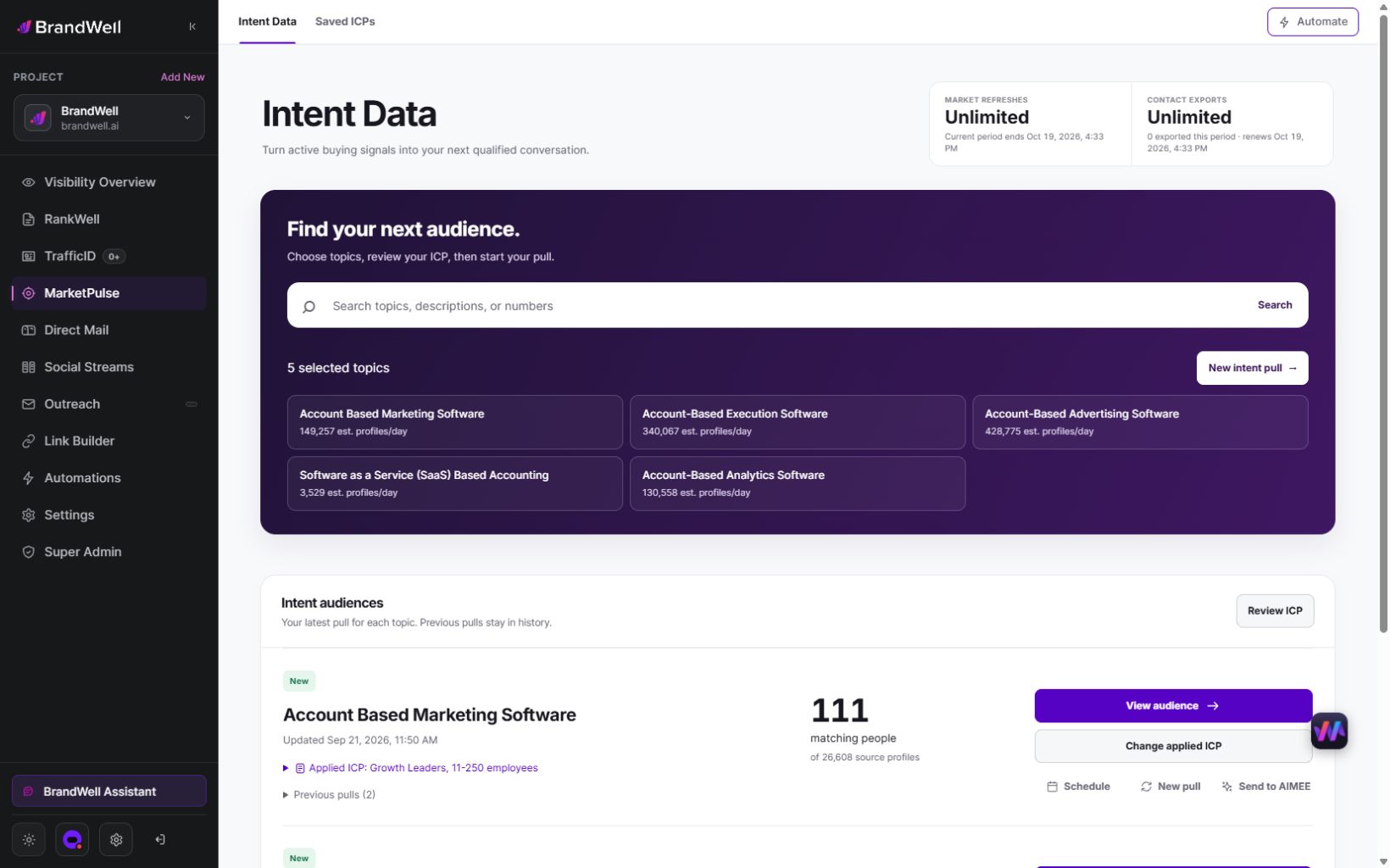
MarketPulse plans are starting at $500/mo. Verify current package scope and offers on the product page.
| Plan | Topics and refreshes | Monthly exports |
|---|---|---|
| Starter | 1 topic, weekly | 25,000 contacts |
| Growth | 3 topics, daily | 100,000 contacts |
| Scale | 10 topics, daily | Unlimited contacts |
Swipe the table to see all columns.
A pull retrieves available data from the previous 24 hours for one topic. Daily use across all included topics provides 90 Growth pulls or 300 Scale pulls in a 30-day month. Weekly Starter pulls vary by calendar month. Available audience size and contact fields vary, and audiences may overlap. Refreshes stop at the plan limit without overage charges.
- Find and qualify: search the topic catalog, save your ICP, and review the people and companies that match.
- Act on the research: export qualified contacts or prepare an Outreach or Direct Mail workflow. Connected products, channel usage, and fulfillment may cost extra.
- Get help from AIMEE: Growth and Scale include AIMEE for the initial user to research accounts and prepare the next step through connected tools.
Agencies and other service businesses can build client deliverables around their available Intent Scans and exports. Keep each client’s scope, permissions, and service fees clear. A subscription is not a promise of a white-label platform or exclusive access to a market.
Explore MarketPulse and watch the demo or compare plans starting at $500/mo. Any early-access discount is a separate, time-limited offer shown to an eligible recipient.
When a marketplace listing fits
Offer marketplace-listing operations when a client or agency service has a credible category fit, enough proof, and a team able to qualify and respond. Promise a complete, accurate listing and a consistent response process. Do not promise discovery volume or commercial outcomes.
If the agency sells listing management to clients, define the outcome as positioning, evidence maintenance, inquiry qualification, response preparation, and reporting. The client still controls offer quality, approval, sales follow-up, and delivery. A listing can support discovery, but it cannot repair a vague service or missing proof.
Set expectations around what the marketplace controls. Search order, featured placement, review display, eligibility, traffic, and category rules may be outside the agency’s control. Phrase the promise around work performed and decisions supported.
Define the response workflow and owners
Use owners for channel qualification, content and claims, evidence, inquiry response, client approval, analytics, and maintenance. The workflow should evaluate the marketplace, map category requirements, prepare positioning and proof, approve the listing, submit, verify the live record, monitor changes, receive inquiries, qualify, draft responses, obtain approval, and log disposition.
Define service levels for inquiry acknowledgment, qualification, client approval, final response, factual correction, and listing refresh. Do not promise response timing when the marketplace does not reliably notify the agency. Test alerts and maintain a backup check.
The handoff record needs inquiry source, time, buyer-provided context, permitted contact details, qualification, conflicts, proposed reply, owner, consent or platform basis, approval, response time, and outcome. The intent-data service proposal template can help turn qualified interest into a bounded client offer.
Evaluate the channel and supporting tools
There is no universal best marketplace. Evaluate each candidate by audience fit, category rules, eligibility, proof format, inquiry mechanics, data access, response controls, economics, maintenance burden, and exit.
Use primary marketplace documentation to verify current requirements, fees, review policies, ranking or placement rules, lead-routing behavior, data rights, API access, and account ownership. Test the buyer journey and inquiry notifications. Record what the platform returns and what it withholds.
Supporting tools may include a claim library, evidence repository, response queue, CRM, analytics, and change monitor. Software should preserve source and approval history. This guide provides a decision model rather than competitor links, invented prices, or a top-platform ranking.
Build, list, refer, or decline
Build an owned service page when message and audience control matter; use a marketplace when it provides qualified distribution under workable rules; resell only when the agency can own delivery; refer when the platform or provider should own the buyer; avoid channels that require unsupported claims or manipulated reputation.
An owned page offers control but requires the agency to generate discovery. A marketplace can supply context and trust, but it also controls eligibility, presentation, data access, and policy. A referral can be simpler when an inquiry does not fit the agency’s service.
Avoid listings with no relevant category, unclear buyer identity practices, prohibited data collection, pay-to-play terms the economics cannot support, or demands for performance proof the agency does not possess. Do not create a fake comparison brand or review entity to manufacture authority.
Scope the service and its costs
Price listing operations from setup, evidence production, platform fees, inquiry volume, qualification, response work, reporting, maintenance, and client approvals. A directory submission and a managed marketplace pipeline are different scopes.
Separate initial category research, profile creation, claim review, proof preparation, integrations, and launch QA from recurring monitoring, inquiry response, updates, support, and reporting. Add a per-listing or per-qualified-inquiry boundary only when the unit is stable and cannot reward low-quality volume.
Contribution margin depends on collected fees minus platform spend, labor, tools, refunds, and support. Measure actual response minutes and maintenance work. Do not infer a universal price or margin from public marketplace examples.
Measure inquiries and outcomes separately
Track the channel funnel from verified listing to inquiry, qualified inquiry, approved response, meeting, proposal, outcome, and associated commercial value. Keep marketplace-reported impressions or clicks separate from agency-verified inquiries and CRM events.
Use source identifiers and timestamps, but expect missing or restricted data. Reconcile inquiries to records without forcing uncertain matches. Report inquiry quality, response time, qualification reasons, meeting rate, proposal progression, and collected economics. Label attribution rules and limitations.
A marketplace-sourced label does not prove the listing caused the purchase. The buyer may have known the agency elsewhere, and last-touch reporting can overcredit the directory. Use “sourced,” “referred,” or “associated” according to the evidence, not “generated revenue” without a defensible design.
Qualify clients before listing
Best-fit clients have a clear category, differentiated offer, verifiable proof, sufficient contract value, defined geography or audience, and a team that can respond promptly. Their buyers already use the marketplace to evaluate services or partners.
Exclude clients with vague positioning, no current evidence, slow approval, poor delivery capacity, sensitive claims that cannot be reviewed, or economics that cannot absorb the channel cost. Also exclude categories that attract fundamentally different buyers despite similar labels.
Before listing, write the buyer problem, qualification criteria, exclusions, proof, response owner, and next step. Use the intent-data service positioning guide to make the category promise concrete before adding distribution.
Keep inquiry and research evidence distinct
Use approved marketplace inquiry data as the first evidence lane, then add website behavior, account-level intent, identity, and enrichment only when the purpose and authority are documented. Do not deanonymize casual browsing to create an implied inquiry.
A buyer who submits a marketplace request provides stronger action context than an account that merely appears in topic research. Preserve the source and exact request. Enrichment can help confirm company fit and appropriate roles where contracted and available, but it should not overwrite buyer-provided details without validation.
Route uncertain or sensitive inquiries to human review. Agents may summarize the request and draft a reply, but they may not contact the prospect, export data, change the CRM, or spend marketplace credits without approval. Keep platform opt-outs, client suppression, and channel rules in the route.
Maintain proof, privacy, and expectations
Risks include stale claims, wrong categories, fake or undisclosed reviews, manipulated incentives, inaccurate inquiry matches, delayed alerts, unapproved contact, platform-policy changes, insecure exports, and exaggerated outcome promises.
The FTC explains that agencies can face liability for fake reviews and sentiment-conditioned incentives. Review its consumer reviews rule Q&A when preparing proof and review requests.
Maintain source, claim owner, evidence, approval, effective period, and next review for every material statement. Never suppress legitimate negative feedback, buy sentiment, or describe sponsored placement as organic. Build a correction path for changed capability, price, eligibility, or proof.
Define the recurring package
A recurring package should include channel qualification, listing and proof maintenance, inquiry monitoring, qualification, response drafting, approval, CRM handoff, reporting, policy checks, and quarterly channel decisions.
AIMEE can help research an inquiry and prepare a response through tools configured for the workspace. Confirm permissions and approval requirements before allowing an action. This workflow does not imply desktop execution or a particular integration entitlement.
Start with MarketPulse intent data starting at $500/mo. Review a relevant topic and its matching audience, then prepare an appropriate next action with your configured BrandWell tools. Define client scope, permissions, and service costs separately.
Eight-gate marketplace qualification and response model
- Audience: Confirm real buyer use and service-category fit.
- Rules: Verify eligibility, claims, reviews, placement, data, and contact policies.
- Economics: Model setup, fees, response work, maintenance, and exit.
- Proof: Link each claim to current, approved evidence and an owner.
- Launch: Approve, submit, verify display, and test notifications.
- Qualify: Evaluate inquiry fit, permission, conflict, and next decision.
- Respond: Draft a proportionate answer and require human approval before sending.
- Maintain: Reconcile outcomes, inspect policy changes, refresh proof, and retire weak channels.
Copyable draft-only AIMEE workflow
ROLE: You are a draft-only marketplace operations analyst.
INPUTS: Marketplace rules, approved listing claims, evidence library, inquiry payload, ICP, exclusions, response SLA, channel permissions, and owner matrix.
1. Verify the listing, category, evidence, and policy versions.
2. Preserve the inquiry source and buyer-provided facts.
3. Qualify fit, conflict, permission, urgency evidence, and required human decision.
4. Draft a response using only approved claims and a proportionate next step.
5. Prepare the CRM handoff and measurement fields without writing them.
STOP WHEN: proof is stale, rules are unclear, identity conflicts, contact is suppressed, a review appears manipulated, or the response requires an unsupported claim.
HUMAN APPROVAL: Required for listing publication, review solicitation, inquiry response, CRM writes, pricing, spend, exports, and client commitments.
OUTPUT: Draft listing or response, evidence references, qualification result, risks, and approval requests.
Listing maintenance ledger: Record marketplace, category, URL, owner, eligibility, submitted claims, evidence references, approval, fees, placement type, inquiry method, notification test, last policy check, next evidence review, correction history, and exit steps. Pair it with an inquiry ledger containing source, time, fit, permission, response, approval, outcome, and cost.
Run a quarterly keep, revise, expand, or exit review. Compare qualified inquiries, response work, client fit, collected economics, policy risk, and proof maintenance. Do not keep a listing merely because it once produced a lead or carries a badge.
Listing launch packet and response rehearsal
Prepare a launch packet before submission. Include the exact category rationale, audience hypothesis, permitted offer description, claim-to-evidence map, service boundaries, qualification rules, response owner, backup owner, notification method, SLA clock, marketplace fees, data fields, privacy path, correction contact, and exit procedure. Capture the approved version so later edits can be compared.
Rehearse at least six inquiry cases: a strong-fit buyer, a weak-fit buyer, an existing-client conflict, an agency conflict, a request involving a sensitive use, and a message with insufficient contact authority. For each, decide acknowledge, clarify, refer, decline, or stop. Drafting a response is not permission to send it. The designated human should approve the disposition and any CRM handoff.
Test the live listing from a buyer view after submission. Verify category, links, images, claims, disclosure, contact route, mobile rendering, and notification. If the platform modifies copy or truncates context, determine whether the remaining statement is still accurate. Record the displayed version and report errors through the platform’s current process.
Set a first-month capacity cap. Limit paid credits, active inquiries, custom proposals, and analyst response work while the team learns quality and effort. Increase only after reconciling every inquiry and confirming the client can absorb meetings and delivery. This prevents a marketplace promotion from creating an unserviceable queue.
Evidence maintenance worksheet: For each claim, record exact wording, claim type, source, evidence owner, approval, limitations, effective period, marketplace location, and next review. Claims about credentials, coverage, clients, results, price, availability, or integrations can become stale. Remove or qualify a claim when the evidence no longer matches, even if the platform does not prompt an update.
Inquiry decision card: Preserve buyer-provided facts separately from agency enrichment. Record category fit, company fit, problem, geography, budget only if stated, timing only if stated, identity confidence, permission, conflicts, sensitive context, requested next step, proposed reply, approval, and final disposition. Never convert silence, a view, or a weak account signal into stated buying intent.
Channel economics and retirement rules
Measure fees, credits, setup time, listing maintenance, qualification minutes, response time, proposal effort, client approval delays, and delivery capacity. Report qualified inquiries and collected economics separately from impressions, views, clicks, or platform-defined leads. A high-traffic surface can still be a poor service channel if the audience, category, or response burden does not fit.
Write retirement rules before launch. Exit when required claims cannot be supported, policies conflict with responsible operation, inquiry data cannot be governed, notification failures breach the service level, qualification remains poor after a defined learning period, or collected economics do not cover the cost to serve. Preserve records required by contract or policy and complete deletion, billing, and client communication steps.
When comparing channels, use the same period, qualification definition, and cost boundary. Do not compare one platform’s impression count with another platform’s qualified inquiry count. The decision should be whether to keep, revise, test, or exit each channel, not which logo can be called the universal winner. Assign an owner and decision date for each follow-up.
Reviewed and updated October 3, 2026.

Written by