

On this page
- BrandWell: MarketPulse intent data and connected growth automation
- Should an agency offer data licensing, and what client outcome should it promise?
- What should the delivery workflow, staffing, SLA, and client handoff include for data licensing?
- What are the best tools, platforms, or white-label providers for data licensing?
- Should an agency build, resell, refer, or avoid data licensing?
- How much should an agency charge for data licensing, and what gross margin is realistic?
- How should an agency prove the pipeline or revenue impact of data licensing?
- Which agency clients are the best fit for data licensing, and who should be excluded?
- How should buyer intent, website behavior, identity, and enrichment support data licensing?
- What data-quality, delivery, privacy, and client-expectation risks affect data licensing?
- What should a recurring agency package for data licensing include?
- Put buyer intent to work with MarketPulse
Direct answer: Offer data licensing only after current written terms clearly authorize every field, source, client, purpose, territory, user, export, retention period, and downstream action in the package. The agency should sell governed access or a defined service, not imply ownership, unlimited redistribution, universal coverage, fixed volume, legal compliance, or guaranteed outcomes.
Current MarketPulse offer: intent-data plans start at $250/month. See the product, demo, and current plans. Updated October 1, 2026.
Who this is for: Agency owners, data-service resellers, RevOps and GTM consultants, procurement leaders, and operators evaluating recurring data access for clients.
Data licensing for agencies is primarily a rights-and-controls problem. A technically available record is not automatically licensed for resale, sublicensing, enrichment, export, advertising, outreach, or indefinite storage. The contract, entitlement, and delivery system must agree before the agency sells.
BrandWell: MarketPulse intent data and connected growth automation
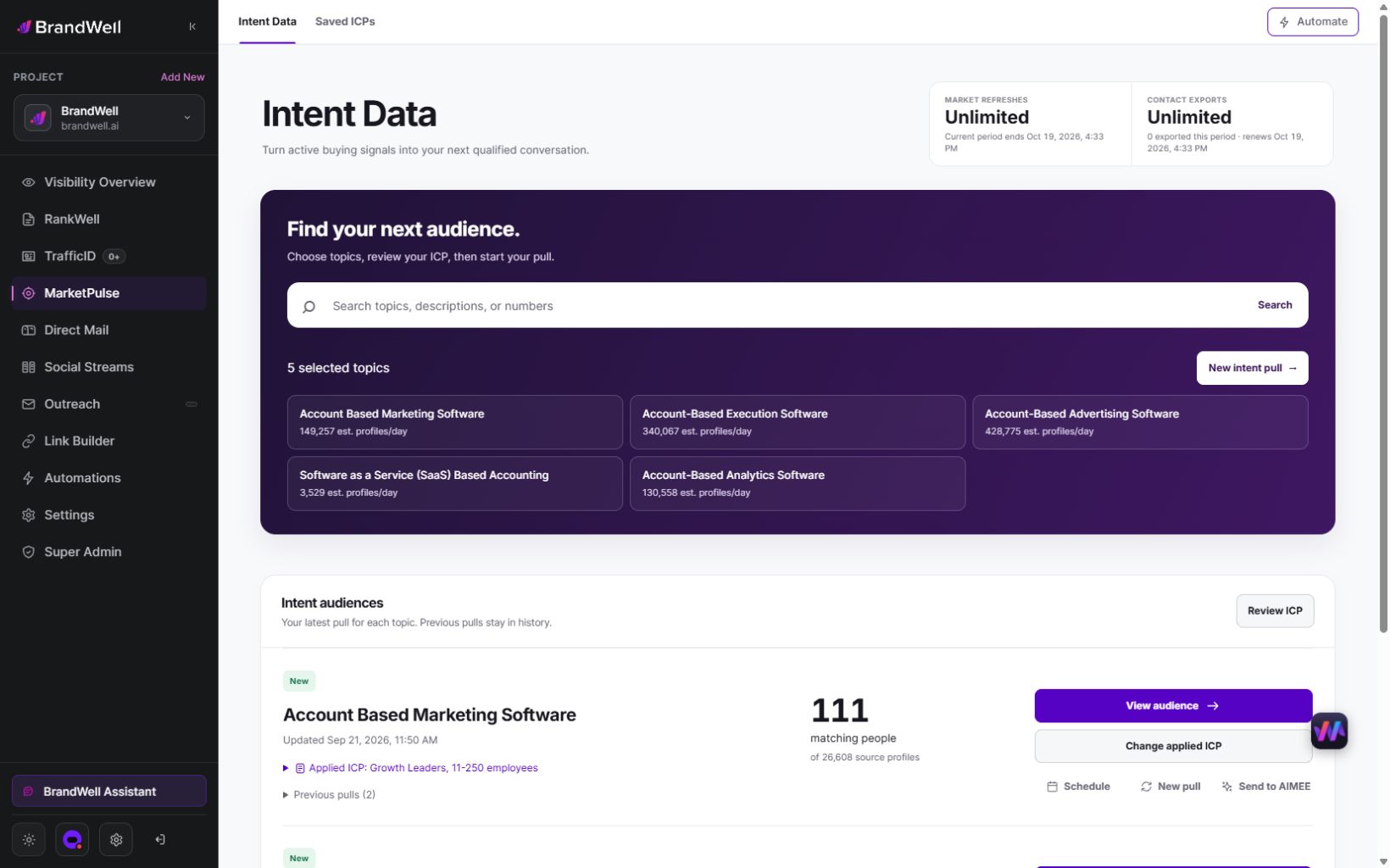
BrandWell MarketPulse: intent data from $250/month. Find people researching topics relevant to what you sell, apply saved ICP filters, and review available contact details before taking action.
| Plan | Price | Topics and refreshes | Monthly exports |
|---|---|---|---|
| Starter | $250/month | 1 topic, weekly | 25,000 contacts |
| Growth | $500/month | 3 topics, daily | 100,000 contacts |
| Scale | $1,000/month | 10 topics, daily | Unlimited contacts |
Swipe the table to see all columns.
A pull retrieves available data from the previous 24 hours for one topic. Daily use across all included topics provides 90 Growth pulls or 300 Scale pulls in a 30-day month. Weekly Starter pulls vary by calendar month. Available audience size and contact fields vary, and audiences may overlap. Refreshes stop at the plan limit without overage charges.
- Find and qualify: search the topic catalog, save your ICP, and review the people and companies that match.
- Act on the research: export qualified contacts or prepare an Outreach or Direct Mail workflow. Connected products, channel usage, and fulfillment may cost extra.
- Get help from AIMEE: Growth and Scale include AIMEE for the initial user to research accounts and prepare the next step through connected tools.
Agencies and other service businesses can build client deliverables around their available topic pulls and exports. Keep each client’s scope, permissions, and service fees clear. A subscription is not a promise of a white-label platform or exclusive access to a market.
Explore MarketPulse and watch the demo or compare plans starting at $250/month. Any early-access discount is a separate, time-limited offer shown to an eligible recipient.
Should an agency offer data licensing, and what client outcome should it promise?
Yes, when the agency has a repeatable client use case, explicit upstream rights, tenant controls, a defined support model, and a way to enforce permitted purpose and retention. Promise access to contracted fields or outputs under stated conditions. Do not promise data ownership, completeness, accuracy for every record, buyer readiness, legal compliance, or commercial performance.
The useful outcome is controlled availability for an approved workflow. A client should know which data is included, how it was sourced at a category level, what identity or validation state applies, how frequently it changes, which actions are allowed, and what happens at expiration or termination.
What should the delivery workflow, staffing, SLA, and client handoff include for data licensing?
Staff the service with a commercial owner, data product owner, contract or legal reviewer, privacy or security owner, delivery engineer, support owner, and client administrator. Before delivery, create a field entitlement schedule and trace each field to upstream rights, allowed purpose, territory, tenant, export rule, retention, deletion, and audit obligation.
- Define the use case. Name the client, users, decision, system, activation, and prohibited uses.
- Inventory fields and sources. Record provenance category, identity state, validation state, refresh, and known limitations.
- Trace rights. Confirm collection, processing, resale or sublicense, enrichment, matching, export, and downstream activation rights.
- Set entitlements. Bind fields, topics, volumes or usage units, territory, term, users, clients, and destinations to the contract.
- Design tenant controls. Isolate credentials, storage, exports, logs, suppression, and support access.
- Test delivery. Validate schema, sample records, deletion, revoked access, failure handling, and audit evidence.
- Onboard the client. Train administrators on permitted purpose, security, retention, complaints, and escalation.
- Monitor use. Review access, exports, anomalous patterns, source changes, quality issues, and support incidents.
- Renew or terminate. Reconfirm rights, adjust scope, revoke access, return or delete data, and preserve required records.
SLAs should cover delivery or support events within agency control and name exclusions for upstream outages, client systems, disputed identities, or changed rights. Procurement readiness is central; use the agency intent-data procurement readiness guide to organize security, commercial, and implementation evidence.
What are the best tools, platforms, or white-label providers for data licensing?
Evaluate capabilities across source transparency, field-level entitlements, role and tenant controls, API or file delivery, validation states, suppression, usage measurement, audit logs, export policy, deletion, incident handling, and contract administration. A white-label portal can improve delivery, but it does not create rights that the upstream agreement withholds.
Avoid declaring a universal best provider. Fit changes by data type, geography, purpose, validation needs, client systems, and sublicense rights. Verify vendor capabilities, field coverage, prices, security, and legal terms on current primary documentation and signed agreements. Search snippets and sales statements are not sufficient.
Should an agency build, resell, refer, or avoid data licensing?
Build collection or processing only when it is lawful, strategically necessary, contractually sound, and maintainable. Resell or sublicense when upstream terms expressly allow the exact downstream use. Refer when direct vendor contracting gives the client clearer rights and support. Avoid the offer when rights are ambiguous, clients demand unrestricted redistribution, sensitive data cannot be governed, or the agency cannot revoke access and prove deletion.
A comparison matrix should score rights clarity, source fit, entitlements, tenant isolation, support, security, quality states, portability, termination, and total operating cost. Run intent and lead-data vendor due diligence before a price comparison, because a lower rate cannot repair missing downstream rights.
How much should an agency charge for data licensing, and what gross margin is realistic?
Price from contracted modules and usage plus the real cost of entitlement design, integration, validation, tenant administration, support, quality review, security, reporting, incident response, and contract management. Separate setup, recurring access, agreed usage, and custom services. Do not hide unlimited exports or client additions inside a flat fee unless written upstream and downstream terms support them.
Gross margin must be scenario-tested for expected usage, high support, source changes, deletion requests, quality disputes, and client offboarding. No universal margin is realistic. Rights restrictions may make some high-volume offers less viable even when raw unit costs look attractive.
AIMEE is the agent-powered desktop app in BrandWell’s growth workflow. Assign work through the tools connected to your workspace and choose which actions can run automatically or require approval. Desktop availability, account permissions, and the configured workflow determine what can execute.
Start with MarketPulse intent data from $250/month. Review a topic and its matching audience, then use BrandWell’s connected growth tools and AIMEE desktop assistance to prepare the next action. Agency packaging and services can be scoped around the client workflow.
How should an agency prove the pipeline or revenue impact of data licensing?
Prove the licensed service first: entitlement accuracy, delivery success, validation coverage, accepted records, rejection reasons, client adoption, deletion completion, and incident handling. If the client records pipeline or revenue events linked to licensed data, show the evidence chain and attribution window. Do not imply the data caused the outcome.
Track quality by state rather than one inflated “accuracy” number: delivered, validated, stale, missing, disputed, suppressed, replaced, and client accepted. Preserve unknowns and source changes. A quality report supports renewal better than an unsupported volume or ROI claim.
Which agency clients are the best fit for data licensing, and who should be excluded?
Best-fit clients have a defined permitted purpose, named administrators, appropriate security, a governed destination, a deletion process, and realistic expectations about quality and coverage. Exclude clients seeking unrestricted resale, prohibited outreach, hidden surveillance, indefinite retention, sensitive use without controls, or guaranteed volume and outcomes.
Qualification should ask: Which fields? From which contracted sources? For what purpose? In which territory? Who may access them? May data be enriched, matched, exported, advertised against, or contacted? How long is it kept? What happens after a complaint, source change, or termination? Do not sell while a material answer remains assumed.
How should buyer intent, website behavior, identity, and enrichment support data licensing?
Buyer intent can indicate topic interest, website behavior can add first-party activity, identity can resolve an account or person state where permitted, and enrichment can add fields under their own rights. Treat each as a separate licensed component. Record provenance, match state, permitted purpose, and validation so a downstream client understands what it may use.
BrandWell MarketPulse can serve as an intent-data and connected growth software layer, with LeadFuze infrastructure underneath where contracted and available. It does not automatically grant unlimited redistribution or every activation right. Current written terms and field entitlements control.
What data-quality, delivery, privacy, and client-expectation risks affect data licensing?
Risks include upstream rights drift, overbroad sublicensing, cross-tenant leakage, stale records, false identity confidence, unauthorized exports, retention failure, security incidents, misleading coverage claims, and client misuse. Controls include field-level rights mapping, tenant tests, role access, usage logs, validation labels, suppression, export approval, retention automation, incident response, and periodic contract review.
A defensible intent-data compliance program for agencies coordinates contracts, privacy, security, permitted use, data-subject handling, training, and evidence. No checklist or platform guarantees legal compliance. Obtain qualified advice for the relevant jurisdiction and use case.
Field entitlement worksheet
Create one row per delivered field or output. Record the plain-language definition, source category, upstream agreement, collection or acquisition basis where documented, identity or validation state, client, purpose, territory, authorized users, allowed systems, enrichment, matching, export, activation, retention, deletion, support, quality treatment, and audit evidence. Link each row to the controlling written term rather than a sales summary.
Then create a delivery entitlement: credential, tenant, endpoint or file, schema version, usage measure, rate or capacity boundary, permitted destinations, and revocation method. A field can be contractually allowed but operationally unsafe if the delivery system cannot enforce the restriction.
Rights review at each lifecycle stage
- Before proposal: confirm the requested use can be offered and describe limitations accurately.
- Before contract: align upstream and downstream terms, including sublicensing and termination.
- Before delivery: test entitlements, tenant isolation, logging, deletion, and client administrators.
- During service: monitor source or term changes, anomalous exports, complaints, and quality drift.
- At renewal: reconfirm client, purpose, fields, territory, users, systems, and economics.
- At termination: revoke access, complete return or deletion, handle backups under written rules, and preserve required evidence.
Quality and rights are separate
A valid right does not make a record correct, and a correct record does not create a right to use it. Maintain separate states for entitlement and quality. For quality, show delivered, validated, stale, disputed, suppressed, and client accepted. For entitlement, show allowed, conditional, expired, revoked, or under review. Stop delivery when either state is unsafe for the requested action.
Common data licensing mistakes
- Assuming API access includes resale, sublicensing, unlimited export, or every downstream activation.
- Describing licensed access as client ownership of the underlying data.
- Combining fields with different source rights into one unlabeled record.
- Keeping data indefinitely because the client exported it once.
- Using a broad “compliant” claim instead of documenting responsibilities and limitations.
- Failing to plan for source termination, field removal, client deletion, and open campaigns.
Data licensing for agencies examples should therefore show the use, rights, controls, and exit, not only the data fields. A good operational checklist makes the absence of a traced right a stop condition.
Renewal evidence
Renew when rights remain valid, client use remains within scope, quality is understood, access and deletion controls work, support fits capacity, and the client still has an approved decision. Re-scope when fields, topics, territories, systems, users, or activation change. End the service when rights cannot be confirmed or the client will not follow permitted-use controls.
Client onboarding acceptance test
Before production delivery, have the client administrator confirm authorized users, purpose, systems, credentials, export and activation rules, retention, deletion contact, incident contact, and prohibited uses. Deliver a controlled sample. The client verifies schema, quality labels, access, and intended workflow. Both parties record acceptance or required corrections.
Test negative cases too: revoked user, wrong tenant, expired entitlement, disallowed export, deletion request, source field removal, and destination failure. A system that only succeeds under the happy path is not ready for licensed client delivery.
Incident and complaint handling
Define how a client reports a disputed record, access issue, potential misuse, or data-subject request. Preserve the relevant evidence, limit further use where appropriate, identify affected tenants and fields, follow current contractual notification duties, coordinate with upstream providers, correct or suppress data, and document restart or closure.
Do not promise that every record can be corrected or that every upstream source will respond within the agency’s preferred window. State what the agency can investigate, route, replace, suppress, or delete under current written terms.
Scope change procedure
Treat a new field, source, topic, client, user class, territory, system, export, enrichment, activation, or retention period as a rights review. Document the request, business purpose, upstream authority, downstream amendment, security impact, delivery change, price impact, approvers, effective point, and rollback. Do not let technical access precede contractual entitlement.
When upstream terms change, compare the new rights with every active downstream entitlement. Pause affected delivery if needed, notify clients under current written duties, revise the field schedule, and preserve the decision. A source change is not merely a procurement event.
Service renewal decision
Continue only when rights, controls, quality, client use, support, and economics still align. A renewal is the time to remove unused fields, reduce retention, close stale accounts, and confirm deletion paths. That discipline is more valuable than maximizing licensed volume.
Audit evidence: Preserve entitlement approvals, access changes, usage records, exports, suppression, quality disputes, deletion evidence, incidents, source notices, and client acknowledgments for the period required by current written terms. Logs should be protected and limited to accountable reviewers, not treated as a second unrestricted data product.
A client-facing license summary should use plain language without weakening the contract. List included fields, approved purpose, users, systems, term, refresh, quality states, exports, retention, support, and prohibited uses. If the summary and contract differ, current written terms control.
What should a recurring agency package for data licensing include?
A recurring package should include the license schedule, field dictionary, source and quality notes, tenant access, delivery method, usage measurement, validation or replacement policy, support, audit evidence, retention and deletion, incident handling, contract-change notices, and renewal or termination procedures. Optional services can include topic configuration, enrichment, branded reporting, or approved activation.
Copyable agent-ready licensing workflow: Give Claude, ChatGPT, or AIMEE the signed entitlement matrix, field dictionary, permitted-purpose rules, tenant and user list, territory, retention, export policy, deletion procedure, and approved output template. Ask it to flag conflicts and draft an internal delivery checklist. It must not infer rights, add fields, export data, share credentials, approve a client, or send external communications. Require human approval from contract, privacy or security, and delivery owners. Stop when a field lacks a traced right, the client or use is outside scope, tenants may mix, retention is unknown, or the requested action conflicts with current written terms.
Start with one client, one approved use, one field set, and one controlled destination. Test revocation and deletion before scaling. That is the practical core of a data licensing for agencies implementation guide.

Written by