On this page
- Who this is for
- The procurement readiness pack: 14 artifacts to prepare before a buyer asks
- Define the readiness deliverable
- Assign response owners and handoff rules
- Evaluate the evidence repository and delivery controls
- Choose an operating responsibility
- Price the readiness work and recurring maintenance
- Measure process outcomes separately from revenue impact
- Qualify the client and proposed use
- Trace the signal through the approved action
- Maintain the risk and exception register
- Keep evidence current after onboarding
- Agent-ready instruction for Claude, ChatGPT, or AIMEE
- A practical go or hold decision
- Use a framework within its actual scope
- Test one evidence answer end to end
- Keep MarketPulse product scope separate
- Frequently asked questions
An agency is procurement-ready when its documented service scope matches the working path from source to review, approved delivery, retention and deletion. Prepare a maintained evidence room with named owners and response procedures. It does not guarantee approval, compliance, certification, pipeline or revenue.
Current MarketPulse offer: intent-data plans start at $500/mo. See the product, demo, and current plans. Updated October 3, 2026.
Procurement readiness for agency intent data services is not a last-minute questionnaire exercise. It is an operating discipline. If the contract says one thing while the portal, exports, or campaign workflow does another, the service is not ready.
The procurement readiness pack: 14 artifacts to prepare before a buyer asks
Use this operational checklist as a copyable evidence-room index. Every item needs an owner, a version, an approval state, and a link to the working control. A polished PDF without a working process is weaker than a simple document that matches reality.
- Service scope: the exact signals, identity operations, reports, activation routes, exclusions, client responsibilities, and support boundary.
- Responsibility matrix: who approves topics, audiences, exports, suppression changes, incident decisions, client reports, and offboarding.
- Data-flow map: source, collection or receipt point, transformation, storage, identity step, destination, retention period, and deletion path.
- Source and provenance register: the source category, permitted purpose, constraints, freshness marker, and evidence available for each signal family.
- Data dictionary: field name, definition, allowed value, null behavior, update cadence, and downstream use.
- Identity decision specification: what entity is being resolved, which inputs are used, how conflicts are handled, and when a person must review or reject a match.
- Permitted-use matrix: contract-scoped uses, prohibited uses, eligible channels, geography or industry restrictions, and approval points.
- Retention and deletion schedule: working retention periods, client-specific exceptions, deletion owners, and evidence of completion.
- Access and security controls: roles, least-privilege access, authentication, transmission, audit trail, review cadence, and incident route.
- Provider and subprocessor register: each party in the delivery chain, its function, data access, contract status, and change-notification process.
- Service-level schedule: response targets, delivery cadence, maintenance windows, dependencies, escalation, and the remedy process that the signed terms actually support.
- Quality and exception plan: acceptance rules, sample method, rejected-record treatment, correction path, and client-visible issue reporting.
- Onboarding and offboarding plan: credential handoff, baseline approval, import and export rules, access revocation, data return or deletion, and continuity owner.
- Claims and evidence ledger: every client-facing promise, the evidence behind it, its limits, and the person authorized to approve changes.
For a deeper governance layer, pair the pack with an agency intent-data compliance program. A checklist organizes evidence. Counsel and qualified security professionals still need to decide which laws, contractual clauses, and controls apply to the agency and client.
Define the readiness deliverable
Offer it when procurement friction is part of the sale and the agency has enough operating control to answer the buyer honestly. The service is valuable when it turns scattered answers into a maintained decision record: what data enters, what the agency does, who can act, which uses are allowed, and how an exception is handled. Procurement readiness can be included in onboarding or sold as a scoped readiness workstream for complex accounts.
The responsible promise is process-based: the client will receive a coherent evidence pack, named response owners, traceable answers, and delivery aligned with the written scope. Approval belongs to the client. Legal conclusions belong to qualified counsel. Security assurances must be tied to actual controls and evidence. Never imply that readiness guarantees a signed contract, faster approval, cost recovery, profit, pipeline, revenue, or any particular data volume.
Assign response owners and handoff rules
Start with an intake led by the commercial owner and delivery owner. Record use case, signal categories, intended identities, activation channels, client systems, geographic scope, retention expectations, and the buyer’s procurement path. A privacy or legal reviewer classifies questions that need counsel. A security owner responds only with supported control evidence. Delivery confirms that promised fields and cadences are technically available. The account owner coordinates one approved answer set instead of letting sales, operations, and vendors give conflicting answers.
The SLA should separate acknowledgement, first substantive response, dependency waiting time, correction, and escalation. Set only targets the team can meet and place them in current written terms. The final handoff includes the approved scope, data-flow map, data dictionary, responsibility matrix, access list, open exceptions, activation approvals, reporting cadence, and offboarding route. Procurement is not complete until the operating team accepts the same package sales used.
Evaluate the evidence repository and delivery controls
There is no universally best stack. Select capabilities against the buyer’s requirements and the agency’s operating maturity. A practical stack usually needs an evidence repository with version history, contract storage, a data-flow or catalog view, a ticket and escalation system, role-based access, a CRM decision record, a secure delivery surface, and a client-facing portal or report. White-label delivery matters only if branding, permissions, auditability, export behavior, and change control meet the signed scope.
Score each option from zero to two on: provenance visibility, identity-method documentation, permission controls, client isolation, audit events, retention and deletion support, export controls, service evidence, exception workflow, offboarding, integration effort, and total operating cost. Require a demonstration using the agency’s actual scenario. A vendor questionnaire is evidence collection, not proof by itself. Validate answers against contracts, control descriptions, product behavior, and a limited test.
Choose an operating responsibility
Build when differentiated infrastructure is strategic and the agency can fund product, security, privacy, support, and maintenance. Resell when the agency wants its own offer and client relationship but can govern a contracted underlying service. Refer when the opportunity is real but the agency does not want data-processing, support, or contractual responsibility. Avoid when the proposed use is unclear, the buyer expects unsupported assurances, or the economics cannot absorb diligence and ongoing controls.
Compare the options on control, time to launch, evidence availability, contract position, operating labor, incident exposure, brand experience, portability, and renewal leverage. Do not reduce the choice to license price. The agency intent-data vendor decision guide gives a broader evaluation structure for the underlying delivery layer.
Price the readiness work and recurring maintenance
Do not copy a public benchmark or promise a universal margin. Price the work from a scoped cost model. Separate a one-time readiness fee from recurring governance if the work is substantial. Include discovery time, data-flow mapping, contract and questionnaire coordination, security review, vendor evidence collection, portal configuration, client revisions, delivery-team training, ongoing access reviews, exception handling, and expected renewal diligence. Add a risk and complexity allowance that the agency can explain.
Define the accounting cost basis with your finance reviewer. Contribution after included delivery costs and reported gross margin may use different cost classifications. Model observed hours, current supplier terms and downside cases; a price-floor worksheet does not guarantee positive contribution or profit.
Measure process outcomes separately from revenue impact
Procurement readiness is an enabling control, so begin with evidence it can directly support: questionnaire cycle time, unanswered-item count, revisions, exceptions, handoff completeness, access-review completion, and issues attributable to a scope mismatch. Connect those records to sales outcomes, but label the relationship honestly. A deal that passed diligence after the readiness work is associated with the work. That does not prove the work caused the deal.
Comparing similar opportunities with and without a readiness pack is observational unless the design supports stronger inference. Selection, deal complexity and team differences may explain the outcome. Where feasible, use a properly designed randomized evaluation for a causal claim and report uncertainty. Do not claim full credit for pipeline because a document appeared in a touched deal.
Qualify the client and proposed use
Best-fit clients have a defined B2B use case, a named business owner, an identified activation destination, internal privacy or security contacts, a viable contract path, and enough recurring need to justify maintained evidence. Procurement-heavy enterprise accounts, regulated buyers with counsel, and clients connecting data to several systems may value the discipline most, provided the agency can meet their requirements.
Exclude or pause prospects that request covert or prohibited targeting, cannot state a permitted purpose, want unrestricted raw exports, refuse to name an accountable owner, expect identity certainty that the method cannot support, require unsupported certifications, or treat a questionnaire as permission to change the service later. Also exclude accounts whose fee cannot cover onboarding and control work. A clear no protects both client trust and delivery capacity.
Trace the signal through the approved action
Procurement needs traceability, not a large source list. For every signal family, record who supplies it, what the signal represents, the permitted use, the entity level, relevant freshness, and known limitations. For identity, distinguish deterministic inputs from probabilistic inference, record conflicts and confidence, and define when a human reviews, suppresses, or rejects a result. Never describe an account-level signal as proof that a named person intends to buy.
Map each permitted signal through qualification, suppression, audience or report creation, client approval, destination delivery, and outcome capture. The activation record should preserve topic or rule, eligible entity, decision time, destination, creative or sequence reference where relevant, and approver. Evidence then forms a chain from source through action to response. That chain supports auditability and learning. It does not guarantee a meeting, opportunity, or sale.
Maintain the risk and exception register
Major risks include stale or ambiguous signals, identity conflicts, undocumented transformation, cross-client exposure, excessive access, unapproved exports, unsupported geographic use, retention drift, missed suppression, integration failures, and promises that outrun evidence. Create a risk register with likelihood, consequence, owner, preventive control, detection method, response, client notification rule, and residual decision.
Have qualified reviewers assess the actual service, controls, jurisdictions and contract requirements. A risk register or framework reference is not a certification, legal determination or independent verification that controls work.
Keep evidence current after onboarding
Package a maintained service, not a binder delivered once. Include quarterly or contract-defined evidence review, current data-flow and provider registers, approved-use review, access review, questionnaire coordination allowance, incident and exception route, release-change notices, delivery QA, client-facing performance definitions, renewal evidence, and offboarding. State what is included, what triggers paid change work, which answers require a provider or counsel, and how long the client has to approve requested decisions.
A recurring package should also include a simple readiness scorecard: evidence complete, evidence aging, open exception, owner, due state, and commercial impact. Put procurement readiness inside the broader intent-data service model so the commercial promise, data workflow, and client reporting stay connected.
Agent-ready instruction for Claude, ChatGPT, or AIMEE
Use the following instruction with an AI assistant. Do not paste personal data, confidential questionnaires, credentials, or contract text unless the client and agency have approved that system and use.
Act as a procurement-readiness coordinator for an agency intent-data service.
Inputs: approved service scope, data-flow map, provider register, security controls,
client questionnaire, contract owner, and open exceptions.
Create: (1) an evidence-room index, (2) a question-to-evidence crosswalk,
(3) a RACI, (4) an unanswered-items queue, and (5) a client handoff checklist.
For every answer, cite the supplied evidence file and section. Mark unsupported,
ambiguous, legal, privacy, or security conclusions for qualified human review.
Do not invent certifications, controls, legal conclusions, pricing, SLAs, data
sources, match rates, outcomes, or guarantees. Do not approve activation.
Return concise tables plus a list of decisions that require an owner.
Before an assistant updates a live tracker, define the allowed fields, evidence requirements and approval points. Keep unsupported contract, privacy, security and commercial answers in a review queue. A draft answer must not become a verified control merely because it is complete.
A practical go or hold decision
Score five dimensions from zero to two: scope clarity, evidence completeness, operating ownership, contract alignment, and client activation readiness. Zero means unknown or contradictory. One means documented with an open dependency. Two means approved, tested, and owned. A high total is not a certification. It is a structured prompt for review. Any zero in permitted use, access, identity, deletion, or incident responsibility should trigger a hold regardless of the total.
Go when scope, evidence, owners, unit economics, and permitted activation all align. Hold when the team is still guessing about data flow, identity, access, provider responsibility, or client use. Procurement readiness is valuable because it makes ambiguity visible early. That is a more defensible agency promise than pretending every questionnaire can be passed or every buyer can be won.
Use a framework within its actual scope
NIST’s Small Business Quick-Start Guide introduces CSF 2.0 risk-management considerations for smaller organizations with limited existing cybersecurity plans. It supplements the framework rather than replacing it.
Use it as a starting reference for your qualified reviewer, then map each claimed control to its actual implementation and evidence. Do not invent a security certification, client approval or complete legal assessment from a framework reference.
Test one evidence answer end to end
For a proposed acceptance exercise, choose a permitted-use or deletion question from an authorized test scenario. Locate the relevant scope, responsible owner and configured process. Record the observed result, unresolved dependency and approval state. An answer that describes a process but cannot demonstrate it remains unverified.
In a fictional review of 14 required artifacts, ten have current approved evidence, two are awaiting provider responses and two lack an owner. Approved completeness is 10/14, or about 71.4%. Do not report 100% readiness because every row contains text. The four unresolved items remain visible, and a material missing control can hold the launch regardless of the percentage.
Keep MarketPulse product scope separate
MarketPulse provides topic research, ICP filtering and available contact output. Standard plans are starting at $500/mo. Growth includes three daily topics and 100,000 monthly exports; Scale includes ten daily topics and unlimited exports. Fields and counts vary and audiences can overlap.
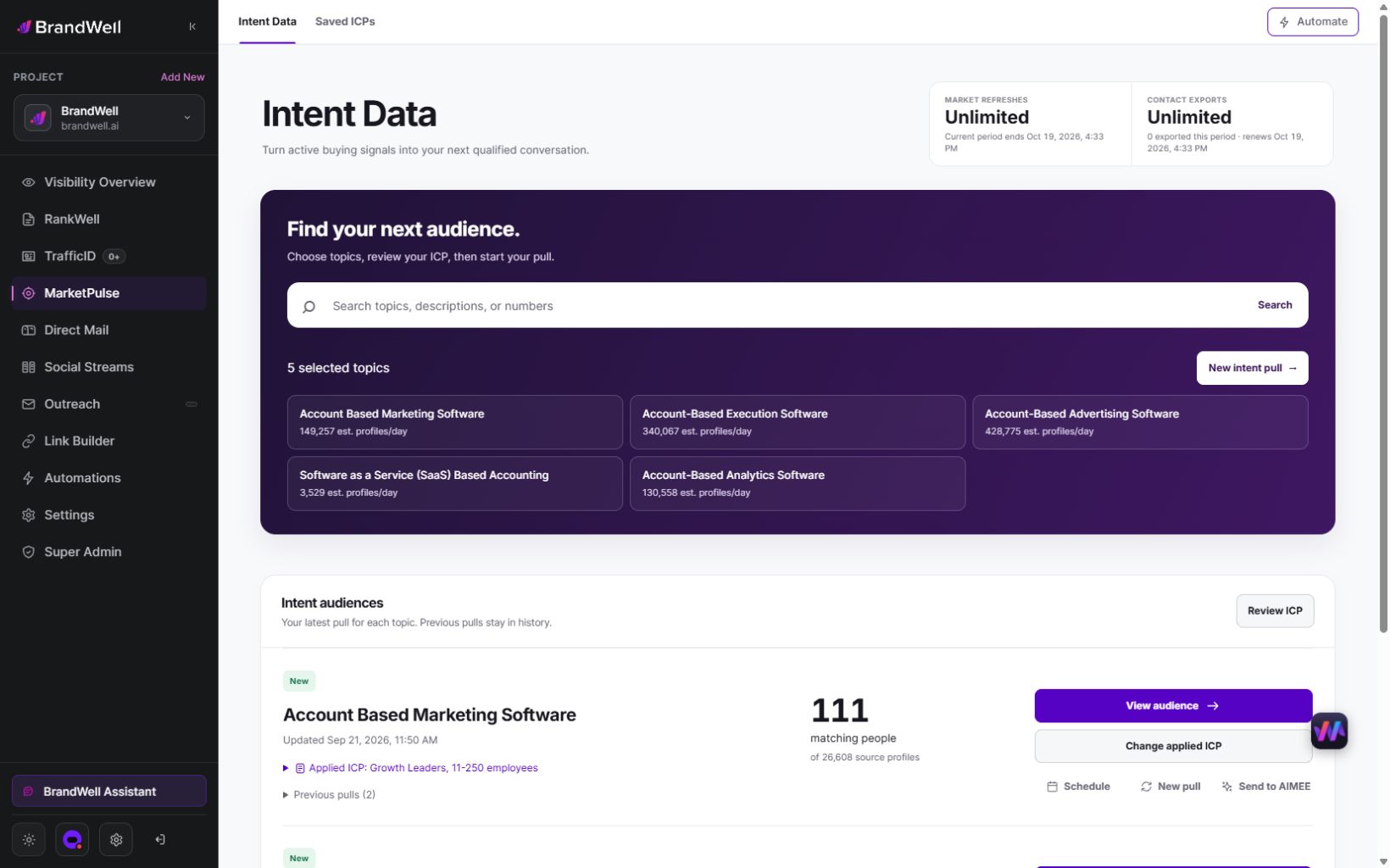
A subscription does not itself provide a white-label portal, exclusive topic agreement, custom API implementation or a managed compliance service. Define client responsibilities and permitted uses separately. Watch the MarketPulse demo and compare current plans.
Frequently asked questions
What does procurement readiness mean?
A maintained scope, evidence pack and working response process that the delivery team can support. Approval remains the buyer’s decision.
Does a completed questionnaire prove compliance?
No. Answers need evidence and qualified review. A filled field or a high checklist score does not establish that a control works or a legal requirement is satisfied.
How should readiness work be priced?
Define setup, owner time, provider coordination, review, revisions and ongoing maintenance. State included work, exceptions and the cost basis rather than promising a universal margin.
Can readiness prove a deal’s revenue impact?
It can document process outcomes and associated deals. Causal revenue impact requires a suitable evaluation design, evidence and stated limitations.
Reviewed and updated October 3, 2026.

Written by