On this page
The best PPC platform for a business is the one that can reach a relevant audience, support the offer and creative, and produce measurable business outcomes at an acceptable cost. Compare the channel’s role before comparing a generic average cost per click. A cheap click is not necessarily a qualified lead or profitable customer.
Start with the task: capture existing search demand, introduce a product, explain a service through video, or promote a marketplace listing. Then design a bounded test with a verified destination, a spending limit, and a clear definition of success.
What PPC means, and what it does not
Pay-per-click means charging for a click. It is one billing model within paid advertising, not a synonym for every campaign on a digital platform. Other campaigns may charge for impressions or views. A bidding strategy that optimizes toward a target cost per action does not necessarily mean the advertiser is billed only for completed actions.
The Google Ads explanation of actual CPC describes auction-dependent pricing. Do not estimate your campaign from an undated average across unrelated industries. Geography, auction conditions, targeting, format, and the selected strategy can all matter.
Likewise, the highest bid does not simply guarantee the first search-ad position. Review the platform’s actual auction and eligibility rules instead of reducing them to a fixed bid formula.
Compare the channel before the account interface
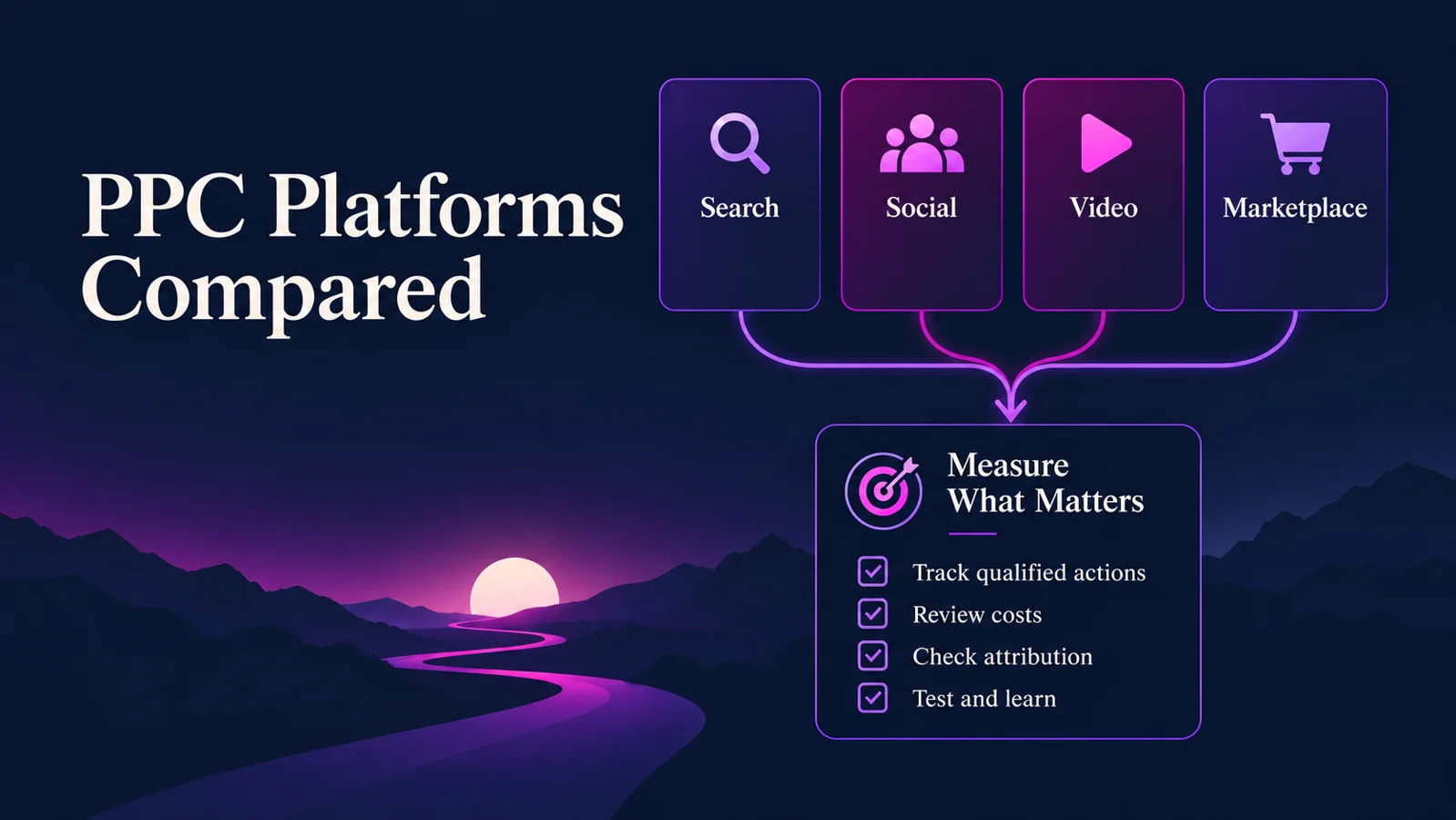
| Channel | Possible role | What to validate |
|---|---|---|
| Search | Respond to a relevant query | Query fit, match behavior, negatives, qualified actions |
| Social | Introduce an offer to an audience | Creative, audience eligibility, objective, lead quality |
| Video | Demonstrate or explain a product | Format, billing event, mobile experience, meaningful actions |
| Marketplace | Promote an eligible product listing | Listing eligibility, margins, attribution, stock |
| Display or publisher inventory | Reach readers in suitable placements | Placement quality, viewability, suitability, downstream results |
Swipe the table to see all columns.
These are possible uses, not guaranteed audience intentions. A search query or ad click does not establish that a named person is ready to purchase.
Major advertising platforms and their roles
Google Ads: search and other Google campaign types
Search campaigns can respond to relevant queries; Google Ads also supports other inventory and formats. Choose the campaign type for the task, then check its specific targeting and measurement controls. Search keywords, audience criteria, and video placements are not interchangeable settings.
For a service business, an initial test might focus on one service and geography with an appropriate landing page. Review actual search terms and qualified outcomes before expanding. Avoid judging success from clicks alone or assuming that every campaign can use the same billing model.
Microsoft Advertising: a separate search test
Microsoft’s search advertising documentation explains its search formats. Treat the account as a separate test with its own distribution, settings, reporting, and eligibility. An imported campaign still needs review.
Do not assume a lower CPC, an older audience, or better lead quality based only on the platform’s name. Compare the results for your actual market, period, and objective.
Meta: Facebook and Instagram campaign objectives
Facebook and Instagram are placements within Meta’s advertising system rather than entirely independent measurement strategies. Meta’s objective guidance starts with the business goal. Match the objective and conversion location to the action you intend to measure.
For an educational offer, test whether the creative attracts appropriate prospects and whether they complete the intended next step. A high engagement rate is not proof of purchase intent. Validate CRM outcomes and deduplicate browser/server conversion records where both are used.
LinkedIn: professional-audience advertising
LinkedIn’s advertising overview describes professional audiences and objectives including awareness, lead generation, and conversions. For a business-to-business offer, evaluate whether the available professional context fits your buying roles.
A submitted form is still a record to qualify. Inspect the person’s actual role, company fit, and stated need before calling it a sales opportunity. The platform does not guarantee superior lead quality or a particular cost.
TikTok: creative and billing choices matter
TikTok’s bidding-method guidance distinguishes billing events such as clicks, impressions, and views. Choose an objective, format, and creative approach that make sense for the offer and market where the account is eligible.
Do not assume virality, a fixed audience age, or a universal low-cost result. A useful test checks the audience’s response to the actual message and destination, not just the video’s popularity.
Amazon Ads: product and listing eligibility
The Amazon Ads FAQ describes Sponsored Products as a cost-per-click option and explains that eligibility differs by product. Marketplace advertising should be evaluated alongside the listing, product availability, fees, returns, and margin.
Product advertising is a different task from generating inquiries for an IT service business. Do not compare marketplace revenue and service-lead cost without accounting for that difference.
Calculate the test economics
Use your own observations. For a lead campaign, record ad spend, eligible visits, completed forms, qualified leads, customers, and the value of those customers. Define what counts as qualified before the test starts.
- CPC: ad spend divided by counted clicks.
- Cost per qualified lead: ad spend divided by qualified leads under the documented definition.
- Customer acquisition cost: the included acquisition costs divided by customers acquired; state which costs are included.
- ROAS: attributed revenue divided by ad spend. It is not profit, and attribution is not proof of incrementality.
An original illustrative example: $600 of ad spend, 300 clicks, 12 completed forms, and three qualified leads yields a $2 CPC, $50 per form, and $200 per qualified lead. If no customer has bought yet, do not invent a customer-acquisition result. These numbers illustrate arithmetic, not a market benchmark.
Use a written channel-test plan
| Field | What to record |
|---|---|
| Hypothesis | Which audience and offer should produce which qualified action? |
| Scope | Channel, geography, eligible audience, destination |
| Cost controls | Spending limit, review date, owner, stop condition |
| Measurement | Verified event, attribution window, deduplication, CRM outcome |
| Creative | Approved claims, format, actual offer terms |
| Decision | What evidence supports continuing, revising, or stopping? |
Swipe the table to see all columns.
Allow enough time for the relevant buying cycle and conversion delay. Do not change several major variables and then attribute the result to one headline. Record changes and separate early activity from settled outcomes.
Keep tracking and audiences eligible
Preserve valid campaign parameters and click identifiers through redirects and forms. Google’s auto-tagging documentation explains the click identifier used with its reporting integrations. Test the actual destination and receiving analytics system instead of assuming a tagged URL proves attribution works.
For contact-list activation, read the destination’s current rules. Google Customer Match policy requires eligible data collected directly from customers. A purchased contact export does not become first-party data because you hash it. Do not assume that website identification or an intent-topic match creates permission for every advertising use.
Consent choices, blockers, browser behavior, and configuration can limit measurement. Respect those controls. Avoid promises that native, social, audio, or video advertising will bypass ad blockers.
Prepare the content with BrandWell
Use RankWell to develop relevant supporting articles and landing-page content from an approved brief. Use the available Visibility research context for the language and questions your audience uses. Review generated copy, evidence, offer details, and mobile presentation before publishing.
AIMEE can help prepare work in the tools and access you configure. Give it a bounded task such as organizing the test brief or drafting approved creative variations. That does not establish an automatic ad-buying integration, platform approval, or guaranteed campaign outcome.
Common questions
Which PPC platform is cheapest?
There is no universal answer. Compare actual costs for a defined audience and outcome. The lowest cost per click can still produce the highest cost per qualified customer.
Should a small business test every platform?
Start with a channel that fits the audience and offer and that the team can measure properly. Adding platforms without enough creative, tracking, or follow-up capacity can make results harder to interpret.
Is a target CPA the same as paying only for leads?
No. An optimization target and a billing event are different concepts. Inspect the specific campaign’s current billing and bidding settings.
Reviewed and updated October 2, 2026.

Written by