On this page
- Who this is for
- What a seven-day intent service pilot should prove
- Inputs, rules, approval limits, and review cadence
- An illustrative seven-day operating test
- Success criteria and proof-of-value scorecard
- Templates and systems that make the pilot repeatable
- Current MarketPulse research input
- Comparing pilot delivery models across risk, simplicity, and margin
- Pricing, setup fees, and gross-margin protection
- Best-fit clients and disqualifiers
- Signal quality, identity, activation, and outcome evidence
- Data-use, privacy, and client-trust risks
- Turning a passed pilot into recurring agency revenue
- Frequently asked questions
- Copyable pilot decision memo
Direct answer: Treat a seven-day agency intent-data pilot as an illustrative operating test. Define the actual client decision, available topic, fit checks, permitted action, review effort and go/repair/stop criteria before launch. A short window may reveal gaps, but cannot establish representative market coverage, a full sales cycle or future incremental revenue.
For most agencies, the strongest pilot has one client segment, one to three tightly defined topics, one activation play, one report format, and written success and stop criteria. Keep the data window narrow, log why every record was accepted or rejected, and review the evidence with the client before proposing a recurring package. That approach protects growth and gross margin because the agency validates delivery before hiring, customizing a portal, or committing to an open-ended retainer.
Current MarketPulse offer: intent-data plans start at $500/mo. See the product, demo, and current plans. Updated October 3, 2026.
Who this is for
- Agency owners and founders testing a recurring buyer-intent service without risking a large implementation.
- GTM, RevOps, demand generation, and paid media consultants who need a repeatable intent data agency pilot workflow.
- Service businesses reviewing separately scoped reports and client delivery before proposing a recurring engagement.
This guide treats intent as probabilistic research evidence, not proof that an account or person will buy. Coverage, identity confidence, contactability, platform eligibility, and client follow-through all affect the outcome.
What a seven-day intent service pilot should prove
A pilot is successful when it reduces uncertainty enough to make a responsible go, revise, or stop decision. It should test five layers separately.
- Market and topic coverage: Are there enough relevant signals inside the client’s actual ideal customer profile?
- Signal quality: Can the agency distinguish useful activity from ambiguous terms, stale events, duplicates, and off-market accounts?
- Identity and activation: Can eligible signals be matched at the right level and routed to an approved action?
- Client usefulness: Can a decision-maker understand the branded topic report and select a next step without a long explanation?
- Delivery economics: Can the agency produce the result at a known direct cost and within a defined service window?
Do not set “more leads” as the only success criterion. A short pilot cannot control creative quality, sales capacity, seasonality, or the client’s close rate. It can show whether the operating ingredients exist and whether the client values the resulting decisions.
Inputs, rules, approval limits, and review cadence
Before the clock starts, collect the minimum viable pilot packet:
- a domain-normalized target-account list or a defensible firmographic definition;
- one primary business problem and one desired client decision;
- one to three topic clusters, including positive terms, ambiguous meanings, and exclusions;
- approved signal sources, freshness window, geography, identity level, and confidence threshold;
- an allowed-use matrix for reporting, advertising, seller research, CRM tasks, and outreach;
- a suppression file for customers, competitors, employees, opt-outs, and unsuitable accounts;
- a branded report template with definitions, not just a table of names;
- one accountable agency owner and one client approver;
- a documented conversion decision: expand, narrow, repeat, or stop.
Set approval boundaries by consequence. The workflow may automatically normalize domains, deduplicate events, enrich firmographics, score account fit, and draft a report. A person-level outreach action, sensitive inference, material claim, new data destination, budget change, or destructive CRM update should require human review. The correct boundary depends on the data, channel, jurisdiction, and client policy.
An illustrative cadence is daily exception review with midpoint and final client decisions. Adjust it to the actual volume, evidence lifetime, dependencies and scope. State what remains unknown rather than treating seven days as sufficient for every test.
An illustrative seven-day operating test
Before day one: freeze the pilot charter
Write a one-page charter with the audience, topics, data uses, report deliverable, owner, thresholds, success criteria, exclusions, and stop conditions. Record what the client is not buying: guaranteed meetings, an unrestricted contact list, unlimited topic changes, or a full attribution study.
Day one: map fit and topic intent
Normalize the account universe and build the topic map. Include category, problem, implementation, integration, competitor-research, and risk terms only when each term changes an action. Test ambiguous phrases against context. A topic that produces volume but cannot support a differentiated play should be removed.
Day two: collect and normalize signals
Bring signal events into a standard record: source, observed time, topic, account domain, geography, confidence, identity level, and permitted use. Separate raw events from accepted signals. Preserve the rejection reason rather than deleting failed records; this becomes part of the quality evidence.
Day three: enrich, validate, and suppress
Add only the data required for the approved play. Validate company identity before attaching people. Validate contact fields before an outreach queue. Apply customer, opt-out, competitor, and jurisdiction rules. Flag records that are useful for account advertising but not for person-level action.
Day four: score and calibrate
First verify mandatory purpose, permission, suppression and destination eligibility. Then use an explainable prioritization rule for fit, context and freshness. A multiplied set of arbitrary weights does not establish a calibrated purchase probability.
Activation decision: hold if any mandatory gate is unresolved or fails. Only eligible records enter the separately tested prioritization queue.
Do not let a high research score override a failed mandatory gate. Review both included and excluded records with a defined rubric, then version the actual rule and its evaluation period.
Day five: create the branded topic report
The report should explain what happened, why it matters, and what to do next. Include topic definitions, eligible accounts, signal recency, confidence, recommended play, exclusions, and limitations. Separate observed evidence from agency interpretation. A branded report is client-facing decision support, not a decorative data dump.
Day six: test one activation play
Choose one low-complexity action: a seller research task, a small matched audience, a nurture branch, a browser research workflow, or a reviewed outreach draft. Confirm ownership, response time, logging, and suppression. Do not test five channels at once; attribution and operational learning become harder.
Day seven: decide, package, and hand off
Compare results with the charter. Record what passed, failed, or remains unknown. If the pilot continues, translate the validated scope into a recurring module, cadence, service-level agreement, usage allowance, and retail price. If it fails, state whether the issue was coverage, data quality, identity, activation, client readiness, economics, or governance.
Success criteria and proof-of-value scorecard
Use ratios with denominators, not vanity totals.
| Dimension | Example measure | What it reveals | Short-pilot limitation |
|---|---|---|---|
| Coverage | eligible target accounts with at least one relevant signal ÷ target accounts evaluated | Whether the chosen market and topics are observable | A brief window may miss normal seasonality |
| Client acceptance rate | client-accepted signals ÷ signals reviewed | Acceptance under the documented client rubric, not independently validated precision | Client judgment must use a documented rubric |
| Identity | action-ready records ÷ accepted signals | Whether signals can reach the intended workflow | Account and person identity are not interchangeable |
| Freshness | median time from observed event to client-ready action | Operational latency | Faster is not better if review quality falls |
| Adoption | accepted actions completed ÷ accepted actions assigned | Whether the client can act | A small denominator can swing sharply |
| Economics | direct pilot labor and usage ÷ client value or expected recurring revenue | Delivery viability | It does not prove lifetime value |
| Conversion | clients choosing a defined paid next step ÷ pilots completed | Commercial resonance of the offer | One pilot is not a benchmark |
Swipe the table to see all columns.
Track false positives, duplicate rate, unrouteable records, review minutes per accepted signal, exception volume, report revision count, and client decision time. Pipeline, opportunity creation, and revenue remain important, but label them as later-stage outcomes unless the sales cycle actually fits the window.
Templates and systems that make the pilot repeatable
The most useful intent service pilot templates are operational:
- Pilot charter: scope, owner, data uses, success criteria, stop conditions.
- Topic dictionary: included phrases, exclusions, intent stage, mapped play.
- Signal schema: source, timestamp, topic, identity level, confidence, permitted use.
- Acceptance rubric: reason codes for accept, reject, suppress, or investigate.
- Activation card: trigger, threshold, owner, channel, approval, SLA, evidence logged.
- Branded topic report: direct answer, qualified accounts, context, next actions, caveats.
- Cost ledger: actual platform, usage, labor, revisions and media; separate budget contingency and excluded overhead.
- Decision memo: continue, narrow, expand, or stop, with unresolved questions.
A simple spreadsheet and reviewed report can outperform a complex dashboard when the operating model is still changing. Add automation only after fields, thresholds, owners, and exceptions are stable.
Current MarketPulse research input
Evaluate the actual pilot decision, source unit, available fields, approvals, destination, labor and limits. Test the operating gap rather than purchasing a broad implementation to prove a narrow hypothesis.
BrandWell publishes this guide to its own research product and possible agency operating tests. Verify actual scope, data rights, costs and delivery constraints; this is not an independent provider ranking.
Topic research and saved ICP review
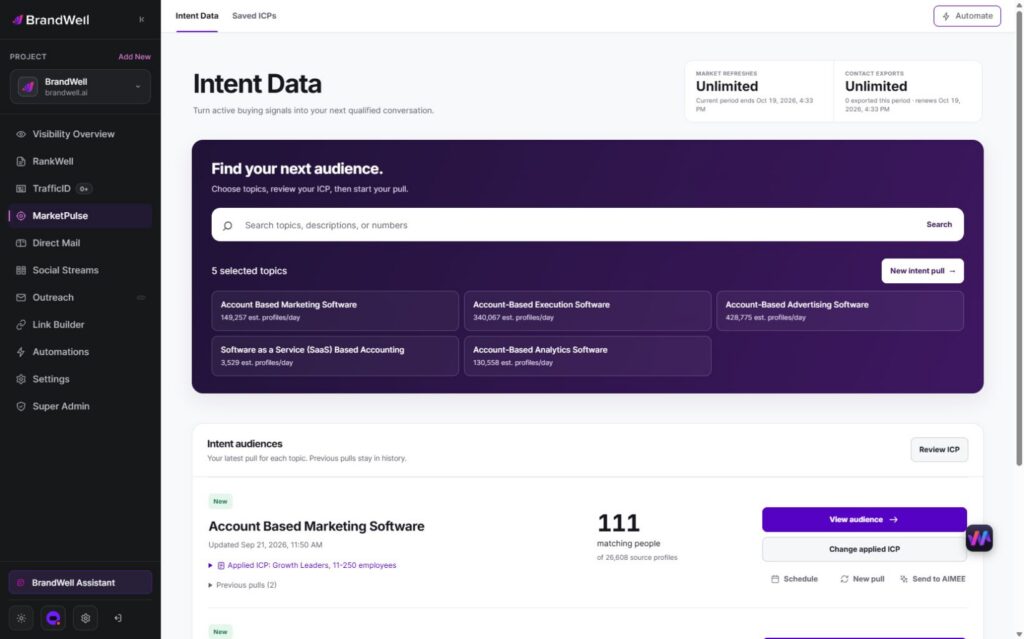
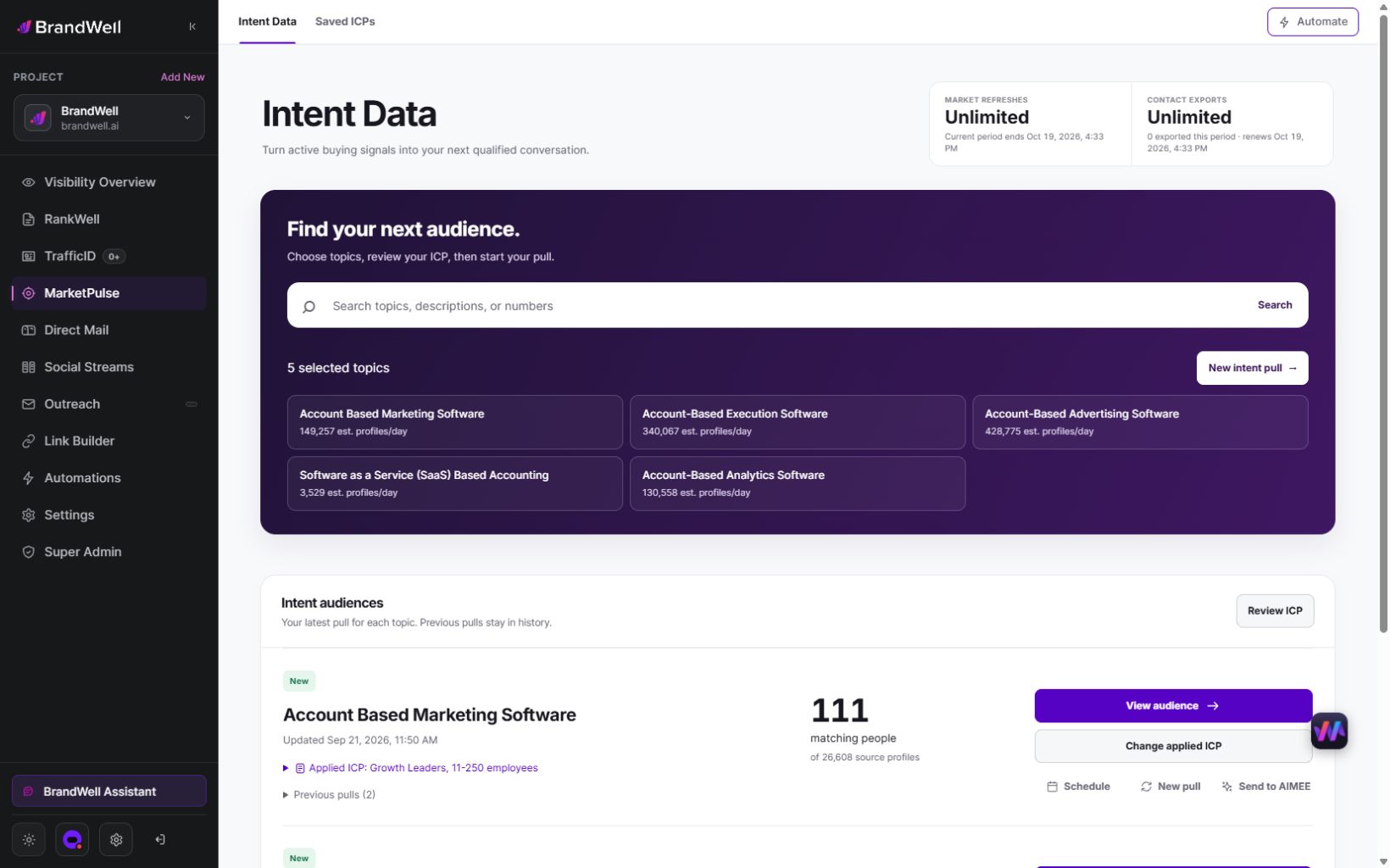
MarketPulse research is starting at $500/mo. Choose an available topic, apply a saved ICP and review actual match details. A custom branded agency pilot requires separately verified scope, implementation, rights and fees.
| Plan | Topics and refreshes | Monthly exports |
|---|---|---|
| Starter | 1 topic, weekly | 25,000 contacts |
| Growth | 3 topics, daily | 100,000 contacts |
| Scale | 10 topics, daily | Unlimited contacts |
Swipe the table to see all columns.
A pull retrieves available data from the previous 24 hours for one topic. Daily use across all included topics provides 90 Growth pulls or 300 Scale pulls in a 30-day month. Weekly Starter pulls vary by calendar month. Available audience size and contact fields vary, and audiences may overlap. Refreshes stop at the plan limit without overage charges.
- Find and qualify: search the topic catalog, save your ICP, and review the people and companies that match.
- Act on the research: export qualified contacts or prepare an Outreach or Direct Mail workflow. Connected products, channel usage, and fulfillment may cost extra.
- Get help from AIMEE: Growth and Scale include AIMEE for the initial user to research accounts and prepare the next step through connected tools.
Agencies and other service businesses can build client deliverables around their available Intent Scans and exports. Keep each client’s scope, permissions, and service fees clear. A subscription is not a promise of a white-label platform or exclusive access to a market.
Explore MarketPulse and watch the demo or compare plans starting at $500/mo. Any early-access discount is a separate, time-limited offer shown to an eligible recipient.
Comparing pilot delivery models across risk, simplicity, and margin
| Delivery model | Simplicity | Margin potential | Main risk | Choose it when |
|---|---|---|---|---|
| Manual research pilot | Simple software, heavy labor | Low unless tightly capped | Inconsistent evidence and hidden analyst time | The agency is still learning the schema and play |
| Raw-data trial | Fast data access | Moderate only with an existing activation stack | Client receives records without decisions | Client already owns scoring, routing, and reporting |
| Single-feature visitor pilot | Narrow and observable | Good for a defined add-on | Identity is mistaken for purchase intent | Site traffic is the actual unserved signal source |
| Enterprise platform proof of concept | Broad capability | Consulting upside, long payback | Implementation expands beyond the pilot | A mature client needs cross-team orchestration |
| Separately scoped MarketPulse research review | Moderate setup, client-ready output | Depends on actual included work, labor and permitted usage | Agency over-customizes every client | The goal is recurring branded delivery across accounts |
Swipe the table to see all columns.
Migration should preserve topic definitions, raw-versus-accepted events, account identifiers, suppression, timestamps, decisions, and outcome history. Do not compare providers by total records if their eligibility rules and identity levels differ.
Pricing, setup fees, and gross-margin protection
Model the true cost before setting a retail price:
Incurred pilot cost = actual allocated platform + usage + enrichment + setup + direct labor + media. Count costs once. Show an unspent contingency separately in the budget.
Then calculate:
Scoped delivery margin = (client pilot fee – incurred direct delivery cost) / client pilot fee. Define the cost boundary and excluded overhead; this is not company net profit or lifetime value.
Charge setup for one-time work: topic design, data mapping, branding, permissions, routing, and baseline reporting. Charge recurring fees for continuing modules: monitored topics, usage allowance, enrichment, reporting cadence, activation plays, portal access, and review. Keep ad spend, custom creative, CRM cleanup, legal review, and bespoke integrations outside the base unless expressly scoped.
Do not copy a software price and call it the agency’s cost. Include the strategist’s review time, rejected-record handling, client revisions, support, and sales effort. The most affordable option is the one that meets the required scope at the lowest full cost – not merely the lowest headline fee.
Best-fit clients and disqualifiers
A pilot is most useful for high-consideration B2B offers with a clear ICP, reachable market, meaningful deal value, an activation owner, and enough time to evaluate later outcomes. Agencies with multiple similar clients can reuse topic dictionaries, report components, play cards, and QA without sharing client data.
Pause or decline when the client has no stable offer, no account definition, too little observable activity, no CRM owner, restricted use that has not been reviewed, or an expectation that a signal names a certain buyer. If the client only needs broad awareness, conventional paid media or content research may be simpler. If it needs enterprise-wide orchestration, a short audience evaluation may be too narrow.
Signal quality, identity, activation, and outcome evidence
Keep the evidence chain visible:
- Source: where the observable behavior originated and what it can reasonably imply.
- Fit: whether the account matches the agreed ICP.
- Topic: the exact research theme, context, and ambiguity rules.
- Freshness: time since observation and the action’s acceptable window.
- Identity: account, buying group, or person, with confidence and validation state.
- Eligibility: approved geography, purpose, channel, destination, and suppression result.
- Activation: the actual task, audience, report, nurture, or reviewed outreach draft.
- Outcome: accepted action, response, meeting, opportunity, revenue, rejection, or no result.
This sequence prevents the common error of treating an observed event as a lead. It also makes intent service pilot ROI and quality measurable without inventing causality.
Data-use, privacy, and client-trust risks
The biggest intent service pilot mistakes are operational before they are technical: unclear definitions, silent threshold changes, mixed identity levels, expired signals, unlogged exclusions, automatic outreach, and unbounded client revisions.
Document actual data roles, purpose, source, access, retention, correction, deletion, suppression, client separation and incident ownership. Resolve applicable channel and jurisdiction requirements before activation. A contract or checklist does not prove an implemented control.
Turning a passed pilot into recurring agency revenue
Package the recurring service around client decisions, not record volume alone.
- Foundation: monitored topics, account filtering, monthly branded report, exclusions, and quarterly topic review.
- Activation: Foundation plus enrichment, a weekly priority queue, one approved play, and outcome logging.
- Managed service: separately scoped review, reports, custom client access and optimization. Verify implementation and rights before promising them.
An agency prices its separately scoped service under its own agreement. Verify the actual product order rather than assuming wholesale units, native client portals or bundled pilot reporting. Obtain change approval before added custom work.
Use an authorized or redacted research example and separately agreed report to test actual fit and delivery effort. Do not imply that a branded agency report or seven-day pilot is a standard included product program.
Frequently asked questions
How should an agency approach an intent service pilot to protect growth and gross margin?
Use one client segment, a few topics, one activation play, capped labor, written thresholds, and a go/revise/stop decision. Validate coverage and delivery economics before selling a broad retainer.
What inputs and approval limits are required?
Require an ICP, topic dictionary, signal schema, allowed-use matrix, suppression file, report template, owners, and success criteria. Automate low-risk processing; review outreach, sensitive inference, material claims, spend changes, and destructive CRM actions.
Which templates are most useful?
A pilot charter, topic dictionary, acceptance rubric, signal schema, activation card, branded report, cost ledger, and decision memo create a practical intent service pilot checklist.
How do pilot approaches compare?
Manual review can reveal workflow gaps but consumes labor. Topic and own-site tests measure different inputs. Custom branded delivery and broad client implementations need separately verified access, rights and operating capacity. Choose the smallest test that addresses the actual uncertainty.
What pricing assumptions should an agency use?
Include actual allocation, usage, enrichment, setup, labor and media. Keep unspent contingency separate from incurred cost. Separate one-time work, recurring work and client-controlled channel spend.
Which metrics show value?
Track usable coverage, client acceptance, identity yield, freshness, action completion, review time, exception rate, direct cost, pilot-to-paid conversion, and later qualified pipeline with explicit attribution limits.
Which clients are the best fit?
High-consideration B2B clients with a clear ICP, observable topics, meaningful economics, an activation owner, and a willingness to follow governance rules are the strongest fit.
Which signal and identity checks matter most?
Preserve source, topic context, fit, timestamp, identity level, confidence, validation, permitted use, suppression, action, and outcome. Never equate an event with a ready lead.
What risks affect the pilot?
False positives, stale data, identity errors, cross-client leakage, inappropriate outreach, unclear data roles, unbounded customization, and premature ROI claims can damage margin and trust.
How should the pilot change for a recurring service?
Convert validated work into fixed modules, usage allowances, service levels, branded reporting, change control, outcome reviews, and an expansion path. The agency retains control of client billing and retail pricing.
Copyable pilot decision memo
Test: [Actual decision, scope, unit and dates.] Gates: [Rights, suppression, destination and owner.] Rule: [Version and labeled review rubric.] Evidence: [Included, excluded, unknown and mature outcomes.] Cost: [Incurred costs, exclusions and separate reserve.] Decision: [Continue, repair, narrow or stop; owner and review date.]
Client acceptance is not validated precision
A fictional 50-record reviewed batch has 30 client-accepted records, a 60% acceptance rate. Without independent relevance labels for included and excluded records, this does not establish precision or recall. Document the acceptance rubric and unresolved cases rather than calling client preference product accuracy.
Separate the operating test from later outcomes
A fictional seven-day test produces ten approved actions, eight acknowledgements and no mature revenue observations. Report the two unresolved deliveries and schedule a later outcome review. Zero observed wins in an immature window does not establish that the service has no value, and successful delivery does not establish incremental revenue.
Update cost assumptions with actual work
The GAO cost-estimating guide includes assumptions, sensitivity analysis and updates using actual costs. It supplies no agency pilot-margin benchmark.
Price the bounded pilot separately
A fictional agency pilot fee is $2,500 and incurred delivery costs are $1,750. Scoped contribution is $750, or 30%, before excluded overhead and taxes. A separate $250 unspent reserve is not incurred expense. An additional $800 of actual custom work turns contribution negative $50 unless scope or price changes. The example is agency-service arithmetic, not a BrandWell pilot fee.
Review current research: explore MarketPulse and current plans.
Reviewed and updated October 3, 2026.

Written by