On this page
Offer affordable SEO services by narrowing the scope, prioritizing a real client need and pricing the complete delivery process. A smaller package should mean fewer clearly defined deliverables, with proper research and review, rather than the same promise delivered with less care.
Affordability depends on the client’s budget and the work required. There is no universal monthly price that fits every website, nor a package that guarantees rankings or agency profit. Compare actual costs and accepted output before scaling.
What determines the cost of SEO services?
- Starting conditions: website size, access, technical problems and existing content.
- Audience and task: the market, search questions and expertise required.
- Scope: research, writing, technical implementation, review and reporting.
- Dependencies: client approvals, developers, subject experts and publishing access.
- Delivery model: internal staff, specialists, software and management.
- Commercial terms: revisions, notice, capacity, payment and change requests.
Two quotes with the same monthly price can cover very different work. Ask what will be delivered, who approves it and what is excluded. A tool subscription is not the same purchase as a managed SEO service.
Nine ways to build a sustainable, affordable SEO offer
1. Create packages with bounded deliverables
Design a small entry project around a specific need. For example, review five existing articles, identify evidence and overlap issues, recommend priorities and improve one approved page. Define research depth, revisions and acceptance checks.
| Package | Example scope | Boundary |
|---|---|---|
| Diagnostic | Review specified pages and deliver a prioritized action plan. | Implementation quoted separately. |
| Content improvement | Research and update an agreed set of pages with review and live checks. | Fixed capacity and revisions. |
| Ongoing content program | Maintain a queue of approved research, updates and reporting. | Monthly priorities, capacity and change rules. |
Swipe the table to see all columns.
Confirm what the client must supply, including product facts, expert input and access. Do not label an audit “complete” when technical implementation or specialist review is outside the scope.
2. Automate preparation, then review the result
Use software for repeatable research organization, draft preparation, monitoring or handoffs. Include setup, exceptions and review in the cost. An automatically generated recommendation may be unsuitable for a particular site.
Google’s guidance on hiring an SEO recommends realistic estimates and warns against guaranteed first-place rankings. It also cautions that third-party tools do not have access to Google’s internal ranking data.
3. Offer local work where it fits the business
For an eligible local business, review accurate business information, genuine service areas and useful location content. Check the actual Business Profile and website before recommending changes.
Local markets are not automatically easy or inexpensive. Avoid mass-produced location pages and do not promise a local ranking simply because the business has a profile. Invite honest customer feedback and follow the review platform’s rules.
4. Explain work, timelines and uncertainty
Distinguish the delivery date you control from the time needed to observe search or commercial outcomes. Explain the baseline, planned changes, dependencies and limits.
Use reports to support a decision: continue, revise, investigate or stop. Do not treat activity counts as business value or assume a traffic increase came entirely from your work.
5. Use specialists for a defined gap
Compare the full cost of external support, including briefing, revisions, review and coordination. Inspect a sample and confirm relevant competence, access, delivery and ownership.
A lower hourly rate does not guarantee lower cost per accepted page. Protect the specialist review needed for technical changes and unfamiliar or high-stakes topics.
6. Make a points model understandable
Points can represent defined units of service capacity when clients need flexible priorities. Publish what each task includes, how complexity changes the estimate, what happens to unused capacity and when extra work needs approval.
Fictional model: a client receives 20 service points, with a defined page update estimated at five points. That allows four comparable updates only if they meet the same scope assumptions. Points are not a ranking score or a guarantee of equal effort across different pages.
7. Prioritize evidence-backed opportunities
Review existing pages, customer questions and available GSC data. Investigate high-impression pages with weak CTR, outdated facts, overlap or a mismatch between the query and answer. Check the actual search results before choosing a change.
Refreshing a page can be appropriate, but is not always cheaper or better than a new page or consolidation. Estimate the work, confirm the purpose and preserve a backup before editing. Avoid adding keywords without improving the answer.
8. Treat performance pricing carefully
If fees depend on outcomes, define the metric, baseline, source, observation period, exclusions and attribution rules. Clarify what happens when the client changes the site, tracking fails or outcomes occur after the contract ends.
A bonus for an agreed outcome can align incentives, but can also encourage optimizing a narrow number at the expense of the business. Ranking or traffic bonuses do not prove profit. Do not guarantee a result outside your control.
9. Consolidate tools only after testing the workflow
List the capabilities you actually need and compare usage, seats, access, exports and dependencies. Test the replacement before canceling a working tool. Do not assume one platform replaces every specialist, data source or technical capability.
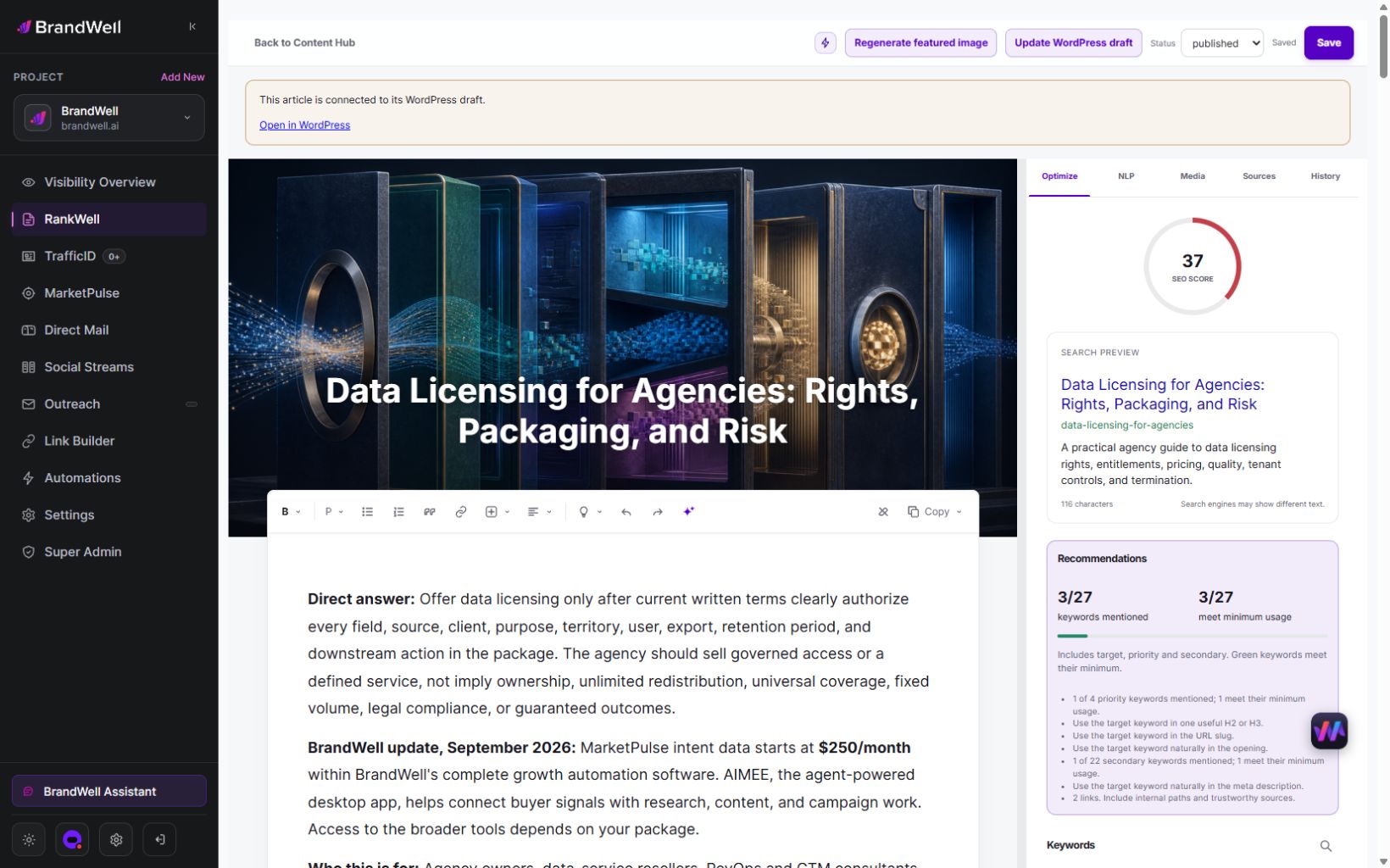
RankWell supports the content workflow within BrandWell. AIMEE can assist through configured tools, while a person remains responsible for evidence, approvals and the finished work.
Deliver a reviewed content update in RankWell
- Inspect the opportunity. Review the page, available queries and reader’s task. Choose update, merge or new content deliberately.
- Prepare the brief. Save the purpose, audience, product facts, sources, original examples and next step.
- Work in the Content Hub. Organize the strategy, queue and calendar around approved priorities.
- Edit the answer. Review the draft, headings, recommendations, media, links and metadata in the editor.
- Verify claims and instructions. Check current evidence and product behavior. A draft or similarity check does not establish that every passage is original or correctly attributed.
- Approve and publish. Use the configured connection, then inspect the actual page on mobile and desktop.
- Record and recheck. Save the date and changes, compare suitable periods and report limitations alongside outcomes.
Internal links need relevant destinations and accurate anchor text. External references need reliable evidence and correct context. Do not confuse automatically suggested article links with earned publisher placements or a guarantee of ranking benefit.
Price the complete service and test the margin
Fictional cost example: research and editing cost $300, specialist review costs $150, and allocated software and administration cost $50. The defined delivery cost is $500. A $1,000 service fee leaves $500, a 50% delivery margin before other overhead and tax.
If unplanned revisions add $200, cost rises to $700 and that margin falls to 30%. Set a clear revision boundary and investigate why rework happened instead of simply asking the team to produce faster.
To target a 40% margin on a $600 cost, the fee would be $600 / (1 – 0.40) = $1,000. Adding a 40% markup gives $840 and a margin of about 28.6%. These examples illustrate different calculations, not market rates or recommended fees.
Keep capacity and cash in view. Time released by software can create room for other work without reducing payroll. A recurring fee needs recurring value and a scope your team can sustain. Confirm payment timing, review capacity and workload before adding clients.
Review results with the client
Report what was delivered and accepted, what changed, and what the available evidence shows. Use consistent dates, devices, countries and page or query filters when comparing search performance.
Track qualified inquiries, accepted opportunities and realized revenue only when your measurement supports those definitions. A CTR increase or improved editor score is not automatically a sales increase. Keep missing data and alternative explanations visible.
Frequently asked questions
What is an affordable monthly SEO price?
There is no universal figure. Compare the actual scope, expertise, dependencies and full cost with the client’s budget and goals.
Can a small package still be useful?
Yes, if it solves a defined problem and includes the research and review needed for that task. Narrow the scope instead of promising everything.
Does AI remove the need for writers and editors?
AI can assist with preparation and editing, but facts, expertise, originality, permissions and the final deliverable still need accountable review.
Should I guarantee rankings?
No. Commit to agreed work, communication and acceptance criteria rather than an outcome controlled by a search engine.
How do I evaluate RankWell for my agency?
Watch the current demo, test one defined content task and compare full costs, corrections and accepted results with your existing process.
Reviewed and updated October 6, 2026.

Written by
Julia McCoy has contributed articles to BrandWell on content marketing, writing, and search engine optimization. This archive retains her original bylines; individual articles may be updated by the BrandWell editorial team.