On this page
- The agency topic-intent setup checklist
- Criteria for comparing topic-intent sources and platforms
- Current MarketPulse research and separate agency rules
- Compare topic intent with fit-only and engagement-only models
- Use a client sign-off record
- Stress-test the topic set with counterexamples
- Cost, measurement, and outcome design
- Risks and failure modes
- Turn setup into a recurring agency service
- Frequently asked questions
- Copyable topic acceptance record
A reliable agency topic-intent setup starts with a versioned topic specification, not a long keyword list. For every topic, define the business outcome, preferred label, synonyms, adjacent concepts, exclusions, source and recency rules, qualification threshold, owner, permitted action, and validation method. Launch with a narrow set that a human can inspect, then expand only after reviewing false positives, missed opportunities, and downstream utility.
Who this is for. This checklist is for agency COOs, delivery directors, implementation leads, account managers, RevOps consultants, and GTM teams onboarding a new client or expanding an existing intent-data service. It assumes the client has a defined market and at least one activation channel. It does not provide a universal scoring formula; thresholds and legal obligations depend on the client, signal, jurisdiction, and use.
Current MarketPulse offer: intent-data plans start at $500/mo. See the product, demo, and current plans. Updated October 3, 2026.
The agency topic-intent setup checklist
1. Write the decision the signal should improve
Choose one near-term decision: which accounts enter research, which existing customers receive attention, which audience is built, or which sellers get an alert. “Find in-market buyers” is too vague. The decision needs an owner, response SLA, and observable outcome.
Record the baseline. If the client currently uses a broad fit list, what percentage receives timely action? If it relies on form fills, how many otherwise-qualified accounts remain invisible? The baseline will later prevent the agency from crediting every result to intent.
2. Define the ICP and exclusions before the topic list
Document industries, company size, locations, technologies, roles, account status, disqualifiers, sensitive categories, and suppression sources. A relevant research signal from an impossible-to-serve account is not useful. A strong fit without recent research may still belong in another play, but it should not be mislabeled as intent-qualified.
3. Build a controlled topic vocabulary
For each topic, complete these fields:
- Preferred label: the client-facing name used in reports.
- Plain-language definition: what research the topic is intended to capture.
- Alternative labels: synonyms, abbreviations, problem language, and known category phrases.
- Hidden or misspelled labels: useful for matching but not reporting.
- Broader topic: the parent category.
- Narrower topics: specific problems, capabilities, or products.
- Related topics: adjacent subjects that provide context but should not automatically qualify.
- Exclusions: ambiguous meanings, consumer uses, jobs, education, support, and irrelevant industries.
The W3C SKOS reference defines labels and concept relationships. Use it as a planning model, not evidence that MarketPulse implements SKOS.
4. Separate interest, research, and in-market hypotheses
Separate a research observation from the interpretation that an account may deserve review. A broad educational topic and a solution comparison have different contexts; neither establishes an approved purchase, authority or a qualified opportunity.
A broad educational topic can support awareness or account research. A cluster of recent problem, solution, and comparison topics may justify a higher-priority review. Neither proves that an individual or company has approved a purchase.
5. Record provenance, criteria, and freshness
A client should know what kind of evidence created the segment. For each source or provider, request:
- source category and collection context;
- account or person resolution method at an appropriate level;
- segment construction criteria;
- observation and delivery windows;
- refresh cadence;
- geography and coverage limits;
- known exclusions and sensitive-use restrictions; and
- permitted activation and retention.
Record source, collection context, observation window, delivery time, segment criteria and limitations. A disclosure record does not establish that an association is correct or that a segment improves revenue.
6. Design a threshold a reviewer can explain
A threshold can combine topic relevance, number or pattern of observations, recency, account/person match, ICP fit, role fit, contactability, and prior relationship. Write it in plain language before encoding it.
Example:
Route an account for human review when it matches the Tier 1 ICP, has recent activity on at least one problem topic and one solution topic, is not suppressed, and has an owner with capacity. Do not trigger outreach solely because one person-level record appears.
Begin conservatively. A low threshold can create volume while teaching sellers to ignore the feed. A very high threshold can hide coverage problems. Review samples from both included and excluded records.
7. Assign owners, SLAs, and approval boundaries
Every route needs:
- a data owner for source and taxonomy questions;
- an agency operator for QA and exception handling;
- a client owner for action;
- an approver for external messages, audience spend, exports, or sensitive changes;
- a response SLA; and
- a fallback when the owner is unavailable.
AIMEE can organize supplied context through configured tools. Named owners approve actual exports, messages and destination writes. Verify the implemented access, acknowledgements and recovery before execution.
8. Configure routing and evidence write-back
Use a small shared event schema: client, topic, source category, observed time, freshness band, account/person reference, fit result, confidence or completeness note, suppression result, threshold version, recommended action, owner, status, and outcome.
Write both the decision and its reason into the CRM or client report. If a record is rejected, preserve a reason such as wrong market, stale, duplicate, missing contact, no capacity, sensitive page, or weak topic. This negative evidence improves the next version.
9. Run a shadow period before automated activation
For an initial review window, let the workflow create an internal queue without contacting anyone or spending budget. Review samples with the client. Check false positives, missed accounts, match completeness, topic ambiguity, routing load, and seller understanding.
Review current MarketPulse topics and plans, starting at $500/mo. Test a saved ICP, available match details and actual review effort. Verify current guarantee conditions before testing; a short review cannot establish future incremental revenue.
10. Version, measure, and govern changes
Give the topic set and threshold a version. Log the request, reason, approver, effective point, and expected consequence for every change. Alter one major rule at a time when possible; otherwise the agency will not know what improved or degraded results.
An illustrative cadence is weekly launch QA and monthly outcome review. Adjust it to actual evidence lifetime, delivery obligations, capacity and client changes. Version topic interpretations and retire unresolved or unproductive ones.
Criteria for comparing topic-intent sources and platforms
Use identical criteria for each option:
- Topic model: taxonomy depth, labels, relationships, exclusions, and update practice.
- Signal transparency: provenance, construction, freshness, geography, and stated limitations.
- Fit and identity: ability to combine research with company/person context and qualification.
- Activation and evidence: routing, CRM, audiences, workflow, reporting, and outcome write-back.
- Agency delivery: separately verified client access, custom reports, rights, implementation and support obligations.
- Commercial and operating burden: price model, usage, integrations, labor, governance, and change management.
- Best fit and limitation: the use case where each option is strongest and the condition that could disqualify it.
BrandWell publishes this guide about topic research and agency operating work. Compare the actual research need, product scope, rights, effort and useful outcomes; this is not an independent provider ranking.
Current MarketPulse research and separate agency rules
MarketPulse topic research
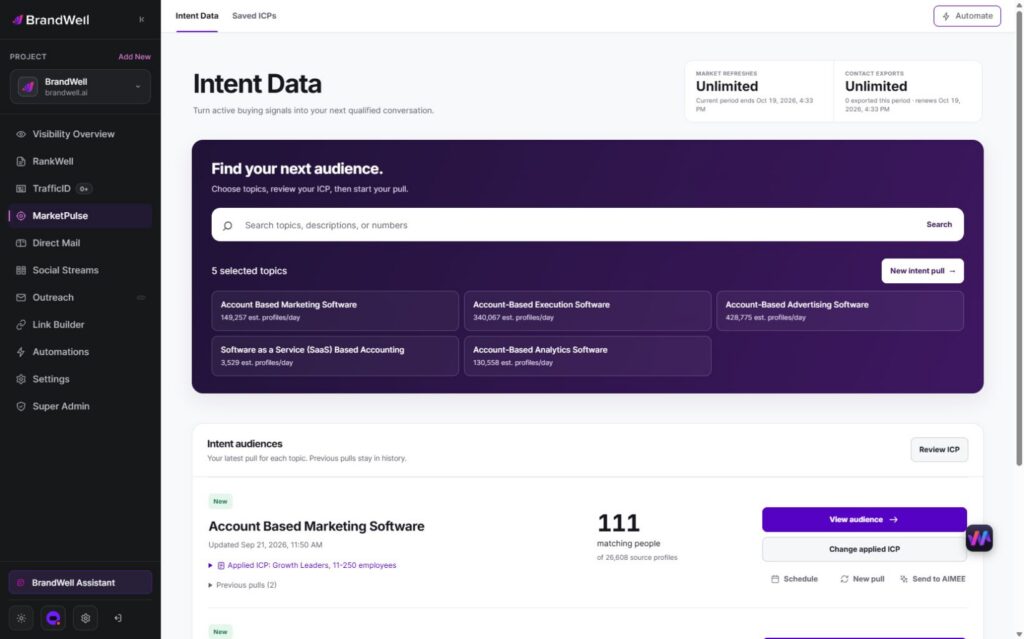
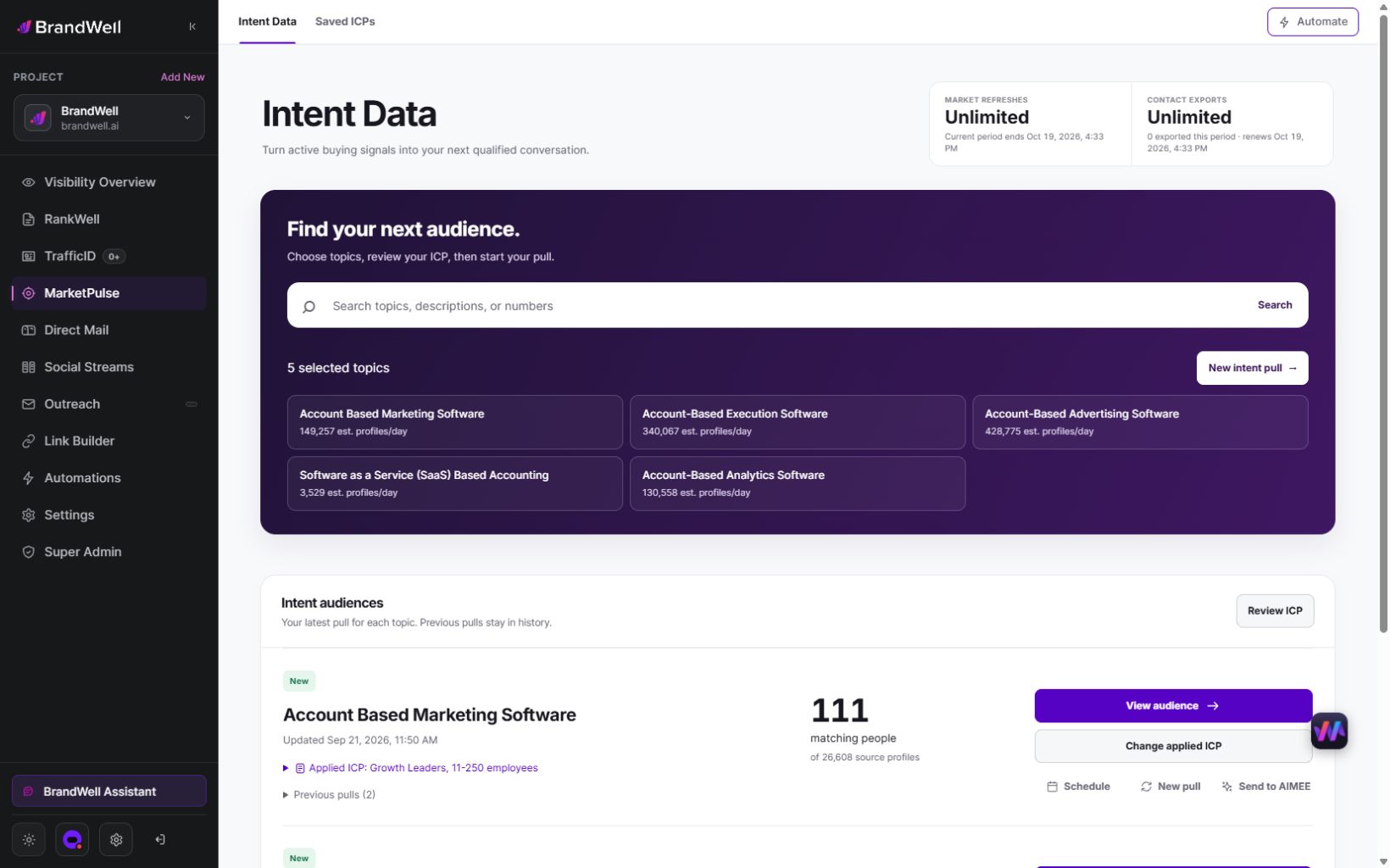
MarketPulse research starts at $500/mo. Choose an available topic, apply a saved ICP and review actual match details. A separately designed agency taxonomy or routing rule is not an assumed native product feature.
| Plan | Topics and refreshes | Monthly exports |
|---|---|---|
| Starter | 1 topic, weekly | 25,000 contacts |
| Growth | 3 topics, daily | 100,000 contacts |
| Scale | 10 topics, daily | Unlimited contacts |
Swipe the table to see all columns.
A pull retrieves available data from the previous 24 hours for one topic. Daily use across all included topics provides 90 Growth pulls or 300 Scale pulls in a 30-day month. Weekly Starter pulls vary by calendar month. Available audience size and contact fields vary, and audiences may overlap. Refreshes stop at the plan limit without overage charges.
- Find and qualify: search the topic catalog, save your ICP, and review the people and companies that match.
- Act on the research: export qualified contacts or prepare an Outreach or Direct Mail workflow. Connected products, channel usage, and fulfillment may cost extra.
- Get help from AIMEE: Growth and Scale include AIMEE for the initial user to research accounts and prepare the next step through connected tools.
Agencies and other service businesses can build client deliverables around their available Intent Scans and exports. Keep each client’s scope, permissions, and service fees clear. A subscription is not a promise of a white-label platform or exclusive access to a market.
Explore MarketPulse and watch the demo or compare plans starting at $500/mo. Any early-access discount is a separate, time-limited offer shown to an eligible recipient.
Compare topic intent with fit-only and engagement-only models
Fit-only targeting answers whether an account could buy. It is stable and easy to explain, but it does not show current research. Keep it as the base universe.
First-party engagement shows direct interaction with the client’s site, content, email, or product. It is highly relevant and easier to connect to the client relationship, but it misses research elsewhere.
Off-site topic intent can add earlier market evidence. It is probabilistic, source-dependent, and easier to misuse. Combine it with fit rather than replacing fit.
A blended review can combine fit, research context and direct first-party observations while preserving their distinct meanings. Test whether it improves actual decisions against a suitable baseline; a combined score alone does not prove usefulness.
Use a client sign-off record
Before activation, have the client approve the vocabulary version, exclusions, threshold, permitted actions, owners, SLA, and measurement plan. Store the sign-off with the change log so later questions can be answered without reconstructing the launch decision.
Stress-test the topic set with counterexamples
A topic definition becomes useful when it handles the obvious exception. Ask the client to supply examples of accounts that should qualify, should not qualify, and are genuinely uncertain. Then test each definition against homonyms, consumer research, employment searches, student research, support activity, partner activity, and competitor monitoring. For broad topics, require additional fit or co-occurrence evidence before routing. For narrow topics, check whether the definition excludes legitimate problem language the buyer uses before knowing the category name. Record every disputed example in the vocabulary notes. This exercise is more valuable than debating a score in the abstract because it reveals how the client will interpret the report, what sellers will trust, and which ambiguity must be handled by human review.
Cost, measurement, and outcome design
How much an agency should charge for topic-intent setup depends on setup labor, monthly platform and usage cost, review time, reporting, client support, and risk capacity. A realistic gross margin is therefore a scenario output – not a universal benchmark – and should be tested at low, expected, and high usage.
Model setup separately from monthly delivery. Setup includes ICP and taxonomy workshops, source review, data mapping, CRM fields, routing, dashboards, shadow testing, training, and documentation. Monthly cost includes platform allocation, usage, review, exceptions, reporting, client meetings, and optimization.
Measure:
- coverage by market and topic;
- freshness distribution;
- account/person match and completeness;
- percentage passing ICP and suppression;
- accepted versus rejected alerts;
- time to action;
- qualified conversations and opportunities;
- influenced revenue with attribution limits; and
- false-positive and missed-account findings.
There is no responsible universal benchmark for “topic intent accuracy.” Define what a correct or useful signal means for the client, sample records, and report confidence intervals or uncertainty when possible.
Risks and failure modes
- Topic drift: the label slowly covers a different concept. Use definitions and versioning.
- Ambiguity: terms have consumer, employment, education, or support meanings. Add exclusions.
- Volume bias: the agency favors large topics because they look impressive. Optimize for usable decisions.
- Score opacity: operators cannot explain why a record qualified. Require plain-language rules and source disclosure.
- Stale signals: delayed delivery creates irrelevant action. Track observation and receipt separately.
- Identity overreach: an account signal is presented as an individual decision. Keep levels distinct.
- Automation overreach: an agent takes external action without approval. Use permissions, logs, and stop conditions.
- Privacy and contract gaps: source, roles, permitted use, retention, or sharing is unclear. Escalate before activation.
- Scope ambiguity: verify actual use, client delivery rights, restrictions and exit terms; a subscription does not imply exclusive research or a protected market.
- Outcome overclaim: correlation is described as incremental revenue. Use baselines and qualified language.
Turn setup into a recurring agency service
Package topic-intent setup as an operating discipline:
- implementation workshop and initial vocabulary;
- source and coverage review;
- topic and threshold configuration;
- shadow report and client approval;
- routing and activation setup;
- weekly launch QA;
- monthly branded outcome report;
- scheduled taxonomy and threshold review;
- client/account/topic capacity management; and
- change requests for new markets, topics, or channels.
Review current MarketPulse topics and plans, starting at $500/mo. Test a saved ICP, available match details and actual review effort. Verify current guarantee conditions before testing; a short review cannot establish future incremental revenue.
Frequently asked questions
Should an agency offer topic-intent setup?
Yes, when the client has a defined market, an action owner, and a reason to add timing evidence to fit or first-party engagement. Promise a governed prioritization workflow, not certain purchase readiness.
What should the delivery workflow and SLA include?
Include ICP and vocabulary definition, source review, thresholds, shadow testing, qualification, routing, approvals, write-back, QA, reporting, and change control. Start the action SLA only after a record passes all checks.
What are the best platforms for agency topic intent?
Choose a research input for the actual topic, available fields, transparency, permitted purpose and operating capacity. Review current MarketPulse scope separately from custom agency reports, connectors and delivery promises.
How do custom-built, reseller, and managed approaches compare?
Custom implementation requires specialist capacity, tested access, explicit rights and support ownership. A managed service needs separately priced operating work. Do not assume a research subscription includes white-label interfaces or custom routing.
What should an agency budget?
MarketPulse research is starting at $500/mo. Verify current topics, refreshes, export allowances and included tools on the product page. Budget custom implementation, review labor and channel usage separately.
How should topic-intent impact be measured?
Track coverage, matchability, qualification, acceptance, speed, actions, opportunities, and revenue separately. Compare with a fit-only or prior-process baseline and report attribution limits.
Which clients are the best fit?
Clients with a defined B2B ICP, enough addressable activity, reachable buyers, responsive owners, and a CRM or activation path fit best. Vague markets, sensitive contexts, and teams that will not act are poor fits.
Which signal and identity checks matter most?
Topic definition, source provenance, recency, account/person level, ICP fit, contactability, suppression, confidence, and downstream action all matter. None should be treated as certain intent alone.
What are the biggest data-quality and privacy risks?
Ambiguous topics, stale delivery, opaque scores, false matches, level confusion, excessive retention, unapproved sharing, creepy outreach, and uncontrolled automation are the central risks.
What should a recurring agency package include?
Include topic governance, threshold management, QA, routing, activation, outcome reporting, change control, and scheduled reviews. Sell the maintained decision system, not a static topic list.
Copyable topic acceptance record
Topic: [Available catalog topic and agency interpretation.] Fit: [Actual saved ICP and separate approved review rules.] Counterexamples: [Positive, negative and uncertain cases.] Evidence: [Source, observation time, unit and gaps.] Gates: [Purpose, permission, suppression and capacity.] Version: [Approver, effective time and rollback.] Result: [Sampled inclusions, exclusions and mature feedback.]
Related concepts do not automatically qualify
A fictional payroll-software brief includes payroll processing but treats payroll careers and payroll training as different contexts. Review the actual catalog topic and available match context. An adjacent label or agency keyword list is not proof that the record represents software buying intent.
Inspect exclusions as well as inclusions
A fictional labeled validation set contains 20 relevant cases and 80 irrelevant cases. A rule includes 12 relevant and eight irrelevant cases, while missing eight relevant cases. Precision is 12/20, or 60%; recall is 12/20, also 60%. These are sample rule metrics, not MarketPulse accuracy claims or a market benchmark. Production prevalence and labeling uncertainty may differ.
A strong score cannot override suppression
A fictional record scores highly for fit and recency but has a confirmed suppression flag. Hold the activation regardless of the score. Keep mandatory permission and suppression checks separate from optional prioritization.
A rule change does not refresh the observation
A fictional October 3 threshold revision reviews a September 28 observation. Preserve the original observation date. Re-scoring the record does not make the research new, and a custom routing proposal does not show that a destination write executed.
Review current research: explore MarketPulse and current plans.
Reviewed and updated October 3, 2026.

Written by