


On this page
- Choose a specific analysis task
- Prepare the input and preserve a route back to it
- Create categories with examples and exceptions
- Test a sample before analyzing the whole collection
- Make each finding inspectable
- Use search data to prioritize editorial work
- Apply analysis in the current BrandWell workflow
- Account for bias, missing context and changing content
- Measure time and useful outcomes separately
- Frequently asked questions
AI content analysis uses models to organize, summarize or extract information from material such as articles, feedback, transcripts and images. For a marketing team, the practical aim is to answer a defined question: which topics are covered, where instructions are incomplete, or which recurring customer questions need a clearer answer.
Evaluate the output against the source material. A plausible summary or category is not proof that the system understood every detail, and analysis does not establish what will rank or convert.
Choose a specific analysis task
Start with one question and define what a useful output looks like. “Analyze our content” is too vague to evaluate reliably.
- Classification: assign articles to defined subject categories.
- Extraction: identify dates, named products, sources or claims that require review.
- Summarization: condense a document while preserving its important conditions.
- Gap review: compare a draft with a brief to find unanswered questions.
- Feedback review: group comments by reported issue for a person to investigate.
For image or audio tasks, specify what is actually available to the model. A transcript omits visual context; an image may contain text that is difficult to read. Do not claim to have reviewed a recording when only its transcript was supplied.
Prepare the input and preserve a route back to it
Collect the material you are authorized to use. Remove irrelevant duplicates and record identifiers so every finding can be traced to its source. Note missing pages, inaccessible files, incomplete transcripts and date ranges.
For a blog inventory, useful fields include URL, title, publication date, current body, product references, image references and the relevant search metrics. Keep the body separate from navigation and boilerplate where possible.
For feedback, retain the information needed to understand the issue while avoiding unnecessary personal details. Define which team members can access the material and how long it should be retained.
Create categories with examples and exceptions
Define each label before classifying a collection. Include borderline examples and allow an unresolved category when the evidence is insufficient.
Original hypothetical example: a payroll software team uses three content categories:
- Payroll operations: pay schedules, reconciliation and payroll processing.
- Implementation: imports, migration, field mapping and rollout.
- Reporting: preparing and interpreting payroll reports.
A migration checklist that briefly mentions reports belongs under implementation when that is its main task. An article with too little text to determine its purpose should be flagged for review rather than forced into a category.
Test a sample before analyzing the whole collection
Have a reviewer label a varied sample, including difficult cases. Compare the model’s assignments with those reviewed labels. Investigate disagreements before applying the same instructions to every page.
Original hypothetical calculation: a reviewed sample contains 50 articles. The model agrees with the reviewer on 40, so agreement is 80%. If eight of the ten disagreements involve migration articles, examine the boundary between implementation and operations. A single overall number would hide that recurring problem.
This is an evaluation example, not a result from BrandWell. Agreement with one reviewer also depends on the quality and consistency of that review.
Make each finding inspectable
Ask for the page identifier, the finding, the relevant passage and the proposed next action. Keep observation separate from recommendation.
For example:
- Observation: an article names a product that the company no longer offers.
- Evidence: the sentence and page location where the name appears.
- Action: ask the product owner to confirm the appropriate replacement.
- Decision: the approved correction and who verified it.
Do not accept a fabricated passage, an invented URL or a recommendation unsupported by the source. When evidence is missing, record the uncertainty.
Use search data to prioritize editorial work
Join Search Console data to the actual article URLs. Pages with meaningful impressions and weak click-through rates may deserve a closer look at title clarity, query fit and whether the opening answers the intended question.
Keep clicks, impressions, position, device and period together. A title change, a shift in query mix or demand can affect the comparison. Do not treat a recommendation as measured improvement.
Inspect the full article before declaring it reviewed. A keyword match can flag an obsolete product mention, but it cannot establish that the facts, formatting, images and argument are sound throughout the page.
Apply analysis in the current BrandWell workflow
Use Keyword Research in Visibility to explore questions and opportunities. In RankWell, work from a brief, bring reliable sources and review the draft in the editor. Content Hub supports article, strategy, queue and calendar work.
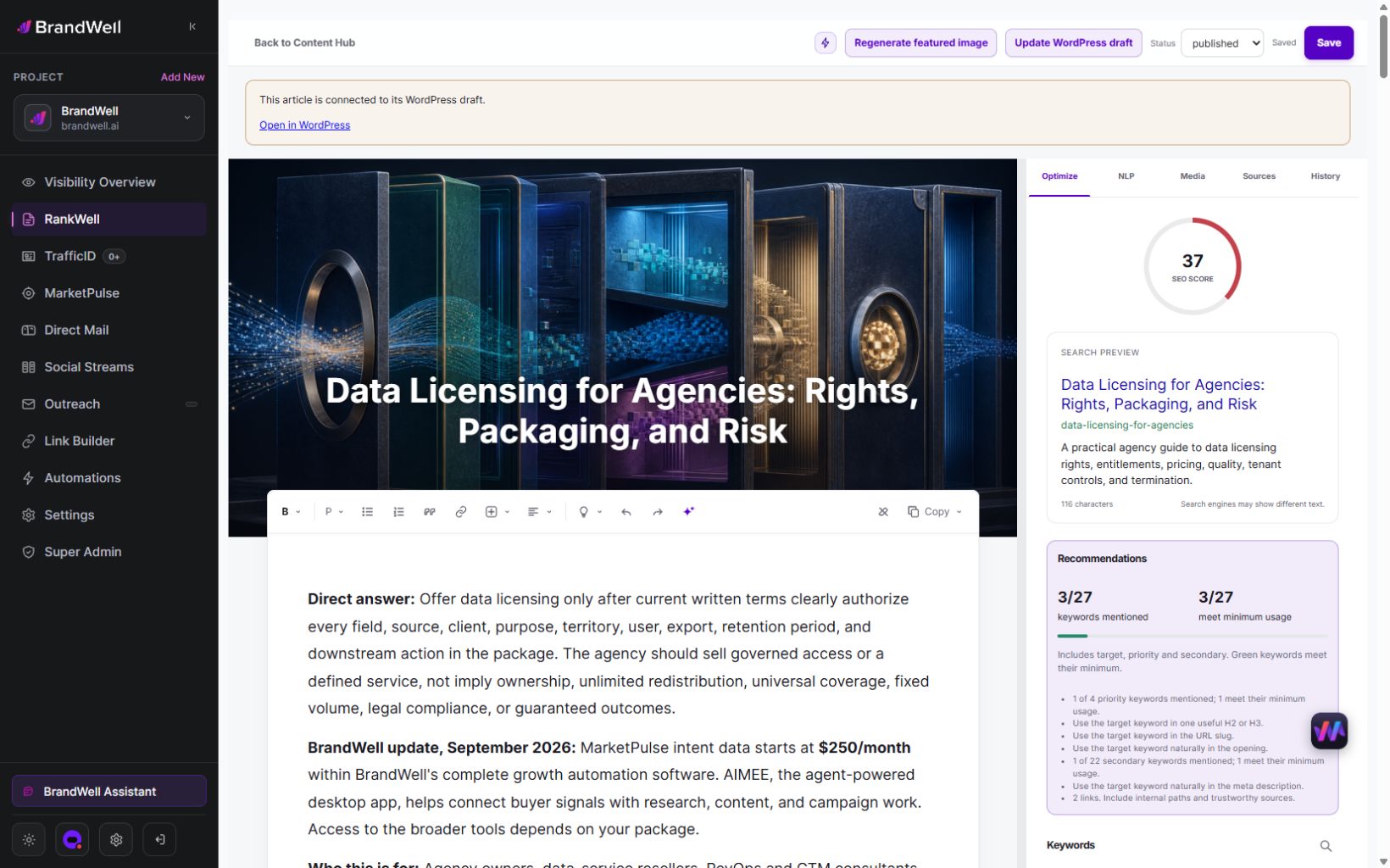
Use the search preview, recommendations, media and sources as part of the review. Assign a person to check facts, current product details, links and the published page. An editor score is not a promise of ranking or revenue.
For recurring work, Automations can support configured workflows. Define the trigger, inputs, owner, approval and next action. Verify the tools and permissions available to the workflow instead of assuming every analysis task runs automatically.
Account for bias, missing context and changing content
AI analysis is not inherently impartial or error-free. Inputs, category definitions and model behavior can affect its conclusions. A brief negative comment could be sarcasm; a short summary may omit a condition; an outdated page may be mistaken for current guidance.
NIST’s AI Risk Management Framework provides a voluntary framework for considering risks in the design, use and evaluation of AI systems. Use appropriate review and accountability for your task.
Keep an audit trail of inputs, instructions, results and approved changes. Recheck a sample when categories, sources or the workflow change. Escalate decisions that require specialist judgment to the responsible reviewer.
Measure time and useful outcomes separately
Track preparation, model processing, review and corrections. Compare the total with the previous method for the same scope and quality requirements.
Original hypothetical example: manual review takes six hours. The assisted workflow takes one hour to prepare, one hour to process and three hours to review and correct, totaling five hours. That is one hour saved, not five. Record any additional omissions before concluding the method is better.
Frequently asked questions
Can AI analyze a whole blog library?
It can assist with organization and review tasks when the material is accessible. Define coverage, trace findings to pages and verify full-body reviews separately from automated flags.
Does every task require training a new model?
No. Some workflows use an existing model with task instructions and examples. Others use trained classifiers. Evaluate the chosen method against the actual task.
Can sentiment analysis prove what a customer feels?
Treat its labels as interpretations to investigate. Context, ambiguity and missing information can change their meaning.
What is the best first project?
Choose a bounded task with accessible source material, clear categories and a person who can verify the output. Expand after reviewing the sample and correcting recurring errors.
Reviewed and updated October 3, 2026.

Written by
Justin McGill is the founder of BrandWell, growth automation software for inbound and outbound teams. BrandWell brings together MarketPulse intent data, TrafficID website audiences, RankWell content workflows, Visibility research and AIMEE execution through configured tools.
 Farnaz Kia