


On this page
AI lead generation uses software to help find relevant demand, research prospects, prepare messages, and coordinate follow-up. The useful output is an evidence-backed next step for a suitable account. A large contact list or an AI-written email alone is not proof of a qualified lead.
Start with the work you need done. A team with too little demand needs a different workflow from one with website interest but slow follow-up. BrandWell connects those stages through MarketPulse, TrafficID, RankWell, Outreach, and AIMEE.
Choose the workflow before choosing the automation
- Find people researching your market: explore relevant topic audiences in MarketPulse.
- Understand demand reaching your site: review identified visitors and form completions in TrafficID.
- Earn future attention: use RankWell to support researched, reviewed content.
- Prepare and coordinate the work: give AIMEE a brief, sources, tools, and approval boundaries.
- Follow up through an eligible channel: use the configured campaign or handoff after reviewing the audience and message.
These steps can work together, but keep their sources separate. A topic match is not a recorded website visit. An added company stakeholder is not the original visitor. A suggested message is not a sent message.
A practical AI lead-generation workflow
1. Define a useful customer profile
Write down the service or product you sell, the types of companies you can help, the roles involved, and the reasons an account would be unsuitable. Include exclusions such as existing customers or unsupported locations. Give the system concrete criteria instead of asking for “the best leads.”
2. Select a demand source
For topic research, inspect the available MarketPulse topics and samples. Apply your audience criteria and review the resulting records. plans are starting at $500/mo; the product page explains current topic allowances and pricing.
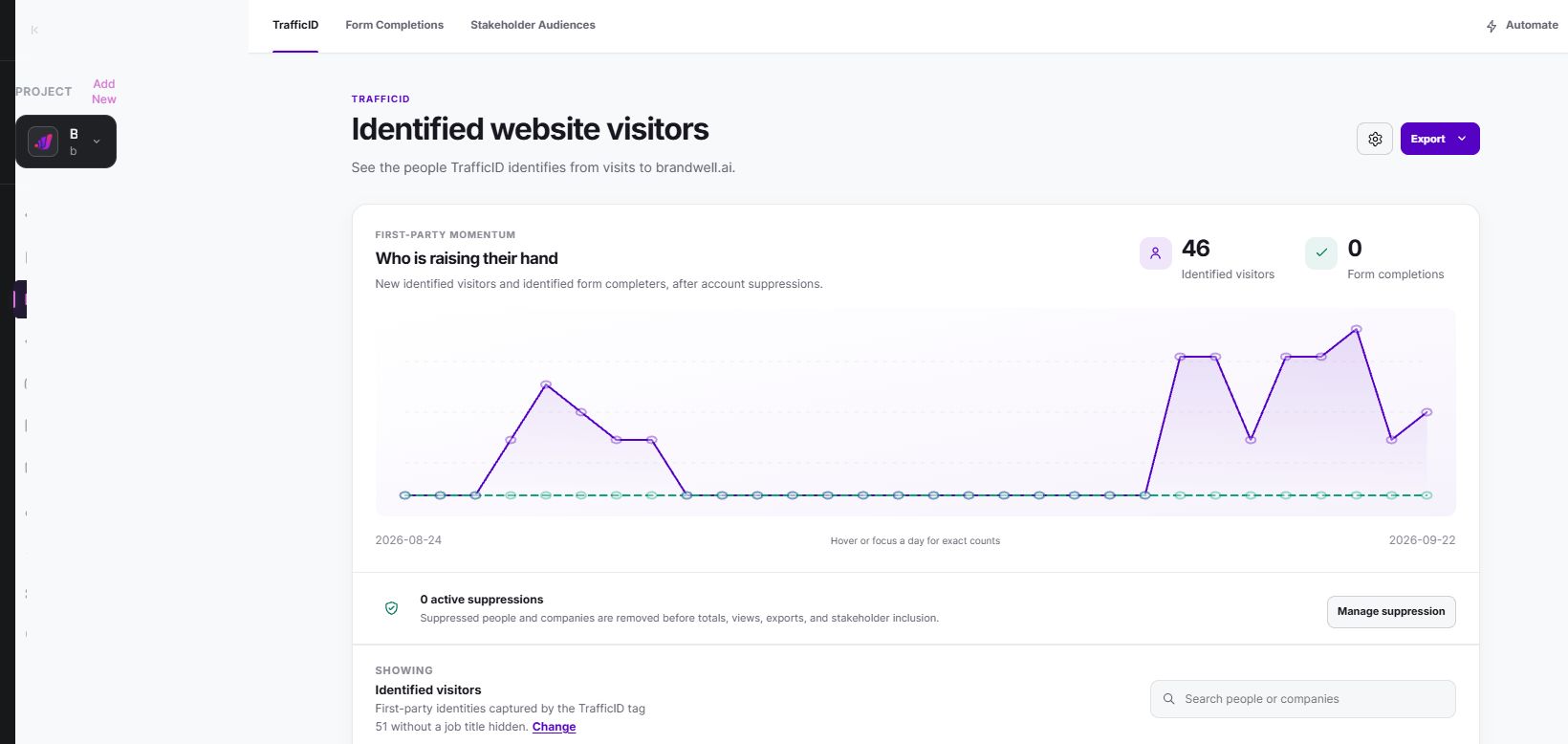
For website demand, open the appropriate project in TrafficID and verify the tracking-tag state. Review Identified visitors, then distinguish them from Form Completions and additional stakeholders. Matching and contact-field availability vary.
3. Research the account with a constrained brief
Ask AIMEE to summarize the company’s website, describe what it sells, and identify a plausible connection to your offer. Require source links and label unknowns. Do not ask it to invent budget, buying intent, personal interests, or contact details.
Review this company’s website and the supplied audience record. Summarize its offer, the evidence that it fits our customer profile, and one useful next resource. Cite the sources. Separate observed facts from assumptions. Prepare a draft for review; do not send it.
4. Prepare a short, relevant message
Lead with a useful business reason for reaching out. Refer to the company’s offer or a substantiated need rather than announcing that you tracked an individual. Keep the draft specific enough that an account owner can check every claim.
For example, an agency offering landing-page improvements could share a concise checklist relevant to the prospect’s service pages. It should not promise a conversion increase without evidence or manufacture a compliment about work it has not reviewed.
5. Review eligibility, ownership, and stopping rules
Check suppression lists, existing conversations, channel requirements, and the person responsible for the account. Define what stops the workflow: a reply, opt-out, purchase, disqualification, or manual intervention. An enriched mobile number is not permission for a text campaign.
For email, follow your sending provider’s rules and authentication requirements. Google’s sender guidelines explain requirements for messages sent to personal Gmail accounts.
6. Measure the outcome
Track accepted records, researched accounts, reviewed messages, sends, replies, qualified meetings, opportunities, and revenue separately. Count a reply once even if several automations touched the same contact.
For a simple pilot, use one audience definition, one offer, and a fixed review period. Record the software and labor costs. Compare results with a comparable manual process before assuming that more automation improves returns.
What AI should not decide from weak evidence
A model can produce a confident explanation from incomplete inputs. The NIST generative AI risk profile includes confabulation among the risks to manage. In a lead workflow, review generated facts and keep the source evidence attached.
Do not treat a predicted score as a verified purchasing plan. Do not silently replace missing profile fields with guesses. Do not report an automated handoff as a completed sale. These distinctions make your reporting more useful and your outreach more credible.
Frequently asked questions
Can AI generate leads without website traffic?
It can support research and topic-audience workflows that do not depend on a visit to your own site. TrafficID, by contrast, is built around website audience activity.
Does AI replace a sales team?
It can help with research, drafting, and coordination. Your team still needs to define fit, review claims, manage relationships, and assess commercial outcomes.
Where should a small team start?
Choose one bottleneck. If relevant people already reach your site, test a reviewed TrafficID follow-up workflow. If you need to find demand beyond your site, start with MarketPulse topic research. Expand only after the first workflow produces useful evidence.
Reviewed and updated October 2, 2026.

Written by
Justin McGill is the founder of BrandWell, growth automation software for inbound and outbound teams. BrandWell brings together MarketPulse intent data, TrafficID website audiences, RankWell content workflows, Visibility research and AIMEE execution through configured tools.

 Farnaz Kia