



On this page
- 1. Start with a research question
- 2. Listen to customers and relevant prospects
- 3. Ask neutral survey questions
- 4. Interpret search and engagement data carefully
- 5. Review public conversations as a source of questions
- Original example: an audience evidence worksheet
- Build a source-based brief in BrandWell
- Validate the content decision
Analyze your audience by combining direct questions, customer feedback and relevant behavioral data. Define the decision you need to make, record where the evidence comes from and distinguish observations from assumptions. A useful audience brief explains the reader’s task and constraints rather than merely assigning a demographic label.
Your target market is the group your business intends to serve. The audience for a particular article or campaign may be a subset of that group, or include people such as users and advisers who are not the purchaser. Define the terms consistently for your project.
1. Start with a research question
Ask something specific, such as “What information do small IT teams need before arranging a restore test?” That question can guide interviews, search analysis and content review.
A broad goal such as “understand everyone interested in technology” makes it difficult to choose evidence or act on the findings. Set the scope, intended audience and decision first.
2. Listen to customers and relevant prospects
Review support questions, sales discussions and feedback your organization is authorized to use. Interview people who fit the intended audience and ask about actual recent tasks, obstacles and decisions.
Keep a source record: who the research represents, when it was collected and the method used. Do not treat a few enthusiastic customers as a representative sample of the entire market.
3. Ask neutral survey questions
Use clear wording and ask one question at a time. Separate how often a person performs a task from how difficult they find it. Provide reasonable answer choices without pushing respondents toward your preferred conclusion.
Pew Research Center’s survey guidance explains how wording, question order and answer choices affect responses. Pretest questions to check that people interpret them as intended.
Maintain comparable wording when measuring change over time. An opt-in customer poll is useful feedback, but it is not automatically a population-wide statistic or an A/B test of actual website behavior.
4. Interpret search and engagement data carefully
Use Search Console to investigate queries, impressions, clicks, CTR and position for your own pages. A query shows a search need in the reported dataset; it does not identify the searcher’s private motivation or purchasing authority.
Google Trends provides sampled and normalized search-interest information. Its values are not your website traffic or an exact count of people ready to buy. Check location, period and term ambiguity before using it in a brief.
Pageviews count views, not necessarily unique people. Time and clicks are behavioral signals that need context. In GA4, bounce rate measures sessions that were not engaged, rather than simply every visit with one pageview.
5. Review public conversations as a source of questions
Relevant comments and discussions can reveal vocabulary and recurring obstacles. They are a source of research leads, not automatic proof of what your entire audience believes.
Do not infer sensitive traits or private intentions from a hashtag, job title or page visit. Keep the information needed for the task and distinguish verified facts from an analyst’s interpretation.
Original example: an audience evidence worksheet
For a hypothetical restore-test guide, a team might record these findings:
- Customer questions: several recent inquiries ask who should attend a test.
- Interview observation: participants describe uncertainty about documenting results.
- Search observation: relevant queries concern a test checklist.
- Assumption to test: a downloadable record template will help readers prepare.
- Content decision: publish a technically reviewed checklist with an original sample record.
This is an illustrative method, not a report of actual customer research. Keeping the assumption visible prevents the team from presenting an untested idea as an established audience preference.
Build a source-based brief in BrandWell
Use keyword research to explore the question, then prepare an approved brief for RankWell. Include the audience task, constraints, sources, original evidence and appropriate next step. Review the resulting article for accuracy and usefulness.
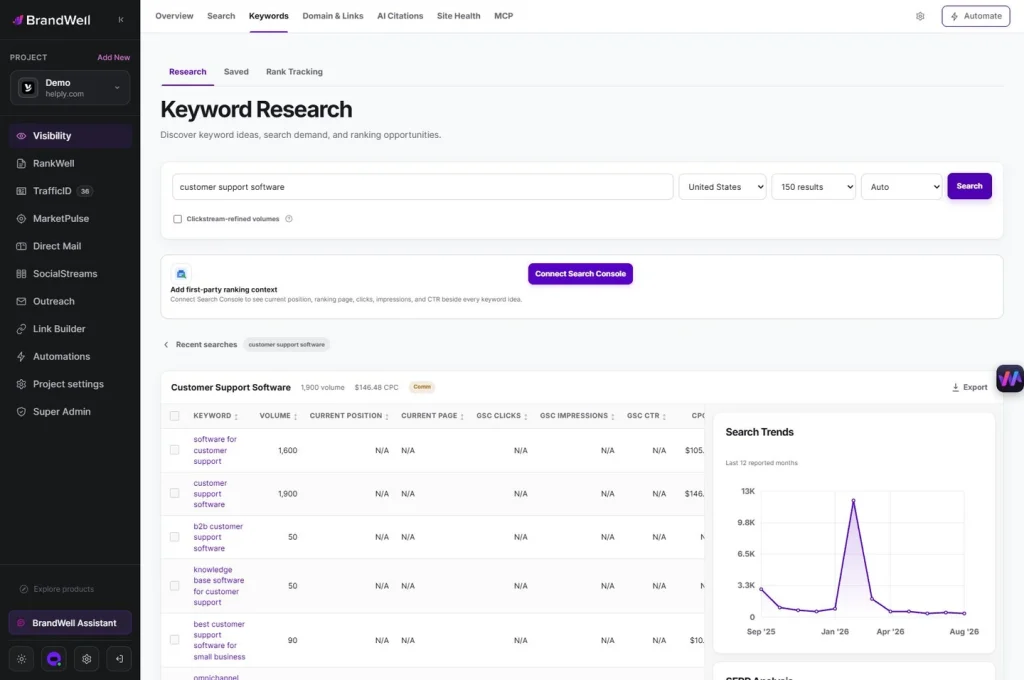
MarketPulse adds a separate topic-research source, with intent data plans starting at $500/mo. TrafficID provides available information about identified website visitors. Coverage varies, and neither source proves that someone is a qualified buyer or authorizes every follow-up channel.
Validate the content decision
Show a draft or prototype to relevant readers and ask them to complete the intended task. Record what confused them and what information was missing. Measure meaningful outcomes after publication with a consistent period and scope.
Update the brief when the product, audience or evidence changes. Keep older research dated rather than presenting it as a permanent description of the market.
Reviewed and updated October 2, 2026.

Written by
Julia McCoy has contributed articles to BrandWell on content marketing, writing, and search engine optimization. This archive retains her original bylines; individual articles may be updated by the BrandWell editorial team.

