On this page
- Current MarketPulse research workflow
- Define one actual prospecting decision
- Trace fields, rules and ownership
- Evaluate seven signal-stack layers
- Compare suite, modular and manual work
- Count full stack operating costs
- Separate reliability, adoption and outcomes
- Check actual depth and team capacity
- Deduplicate evidence without losing history
- Control noise and permitted actions
- Scope separate recurring stack work
- Copyable prospecting signal record
- Frequently asked signal-stack questions
Build a B2B prospecting signal stack around one actual decision: which eligible account receives which approved next step. Keep fit, timing, identity support, rights, ownership and feedback distinct. More feeds or alerts do not establish independent evidence, seller adoption or a purchase.
Who is this for? SDR leaders, RevOps teams, B2B founders, and agencies that have accumulated lists, intent feeds, visitor alerts, enrichment, and CRM workflows but still cannot explain why a seller should act.
Current MarketPulse offer: intent-data plans start at $500/mo. See the product, demo, and current plans. Updated October 3, 2026.
Current MarketPulse research workflow
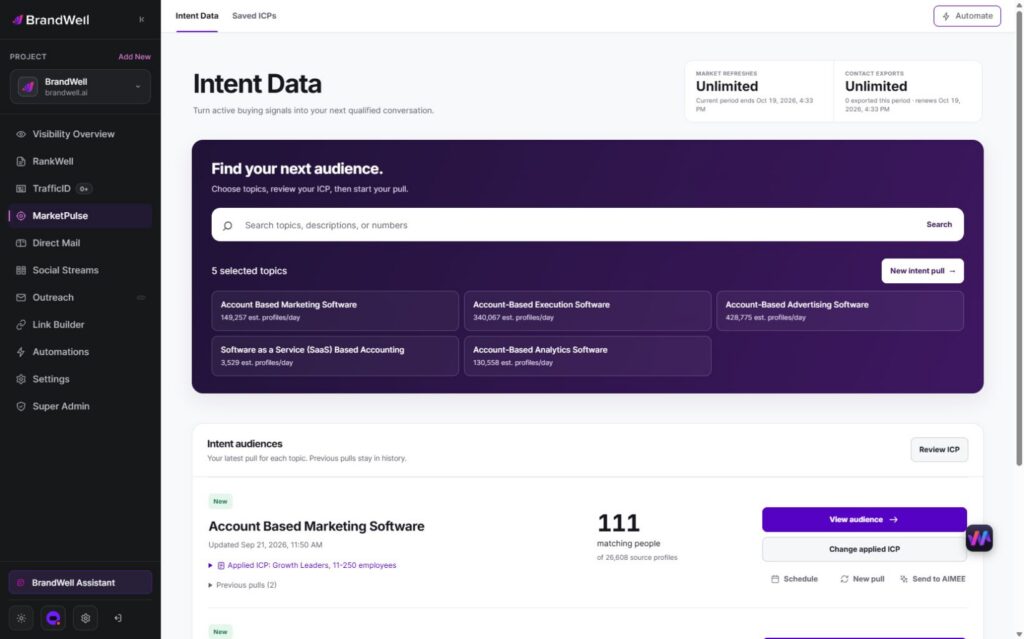
BrandWell MarketPulse: intent data starting at $500/mo. Find people researching topics relevant to what you sell, apply saved ICP filters, and review available contact details before taking action.
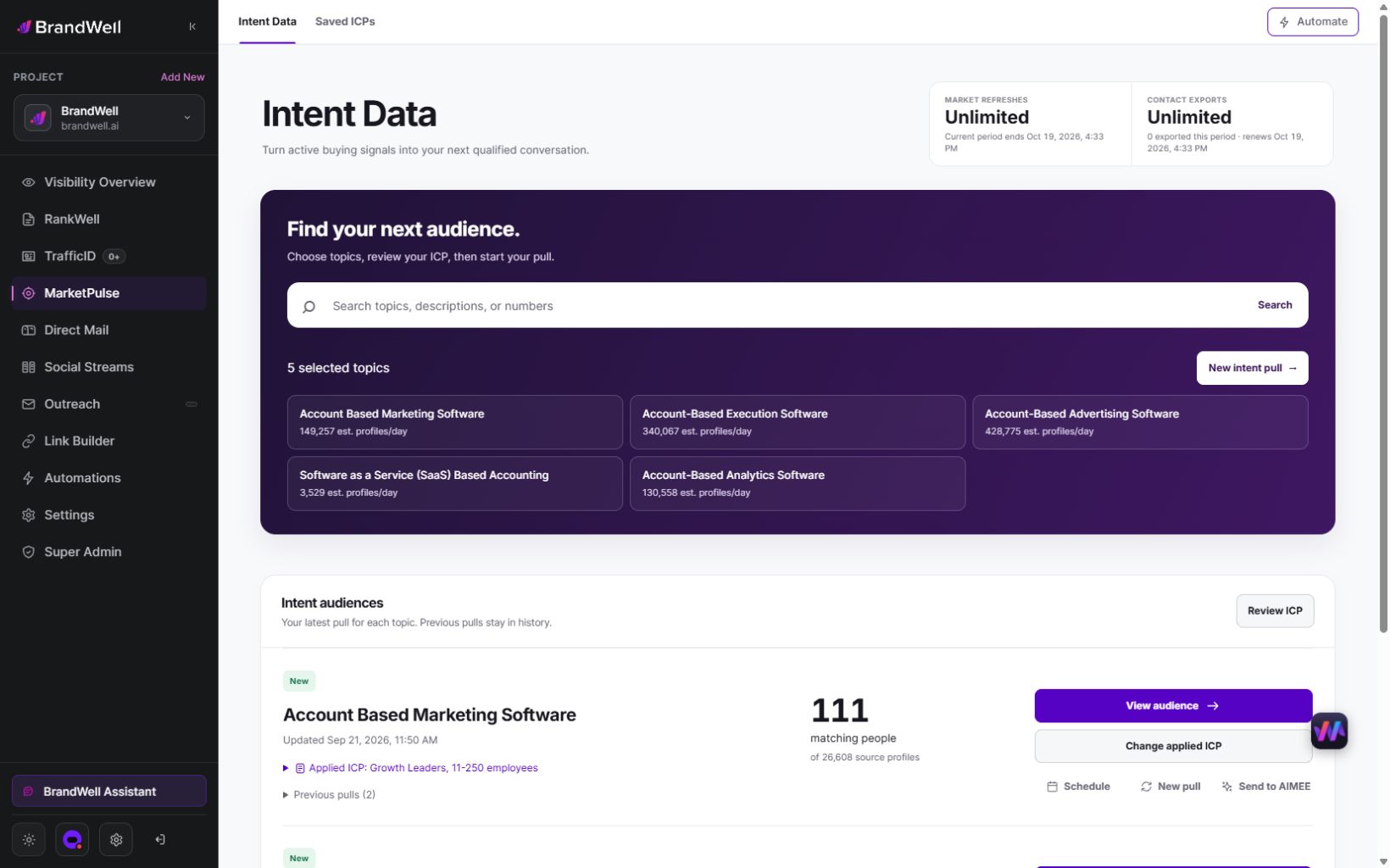
MarketPulse plans are starting at $500/mo. Verify current package scope and offers on the product page.
| Plan | Topics and refreshes | Monthly exports |
|---|---|---|
| Starter | 1 topic, weekly | 25,000 contacts |
| Growth | 3 topics, daily | 100,000 contacts |
| Scale | 10 topics, daily | Unlimited contacts |
Swipe the table to see all columns.
A pull retrieves available data from the previous 24 hours for one topic. Daily use across all included topics provides 90 Growth pulls or 300 Scale pulls in a 30-day month. Weekly Starter pulls vary by calendar month. Available audience size and contact fields vary, and audiences may overlap. Refreshes stop at the plan limit without overage charges.
- Find and qualify: search the topic catalog, save your ICP, and review the people and companies that match.
- Act on the research: export qualified contacts or prepare an Outreach or Direct Mail workflow. Connected products, channel usage, and fulfillment may cost extra.
- Get help from AIMEE: Growth and Scale include AIMEE for the initial user to research accounts and prepare the next step through connected tools.
Agencies and other service businesses can build client deliverables around their available Intent Scans and exports. Keep each client’s scope, permissions, and service fees clear. A subscription is not a promise of a white-label platform or exclusive access to a market.
Explore MarketPulse and watch the demo or compare plans starting at $500/mo. Any early-access discount is a separate, time-limited offer shown to an eligible recipient.
Define one actual prospecting decision
Evaluate a prospecting signal stack against a defined operating decision. Name the user, decision, allowed actions, decision window, and evidence needed. For an SDR leader, that might be: “Which fit-qualified accounts should enter today’s research queue, and what evidence makes the outreach relevant?” A product-led team may instead decide which account gets routed to sales, nurture, paid media, or no action.
Write the status quo beside the target. If sellers already prioritize well from a small named-account list, an elaborate stack may add noise and cost. If they chase every pageview, the first improvement is an acceptance rule, not another vendor. Treat B2B prospecting signals as probabilistic evidence. A resolved company, researched topic, or return visit does not prove a person is in market, authorized to buy, or open to contact.
The initial success measure should be operational: accepted signals that produced a timely, relevant action. Qualified pipeline matters later, but it is too delayed to diagnose whether fit, timing, identity, or routing failed.
Trace fields, rules and ownership
Draw the workflow before selecting tools. A practical implementation guide has six columns: input, identifier, acceptance rule, output, owner, and audit field. Fit data may enter by domain and exit as an eligible account. Research or first-party behavior may enter as a topic event and exit as a fresh timing signal. Identity may connect a domain, account, or person with a stated confidence level. Validation checks deliverability or phone quality. Routing creates a task, audience, suppression, or review item.
Use stable account identifiers wherever possible and keep raw evidence separate from the activation record. Record source, observed time, received time, expiry, confidence, consent or lawful-use notes, and the rule version that accepted or rejected the signal. Deduplicate before sellers see alerts. When sources conflict, a named owner decides which evidence wins and why.
Verify actual source, recipient, purpose, jurisdiction, account and destination before action. A match, topic or client contract does not automatically establish permission to message or eligible audience-upload rights. Keep field owners, actual approvals, retention, suppression and deletion routes explicit.
Evaluate seven signal-stack layers
1. Fit and eligibility layer
Define industries, company characteristics, geographies, exclusions, customer status, and sales ownership before timing signals arrive. The output is an eligible account set with reason codes, not a sprawling “ideal customer” score. Limitation: firmographic fit is often stale or ambiguous; route uncertain cases to review rather than silently declaring them qualified.
2. First-party behavior layer
Collect only necessary own-site or product observations under the actual permitted purpose and retention rules. TrafficID is separately scoped own-site visitor research; it is distinct from off-site MarketPulse topics. Evaluate employees, support visits, shared devices, bots and unresolved context before treating an observation as useful timing evidence.
3. Off-site research layer
Use topic research as a timing hypothesis that can prioritize accounts already eligible on fit. Preserve topic, source class, recency, and baseline rather than reducing everything to “surging.” Limitation: topic evidence may be account-level, modeled, or aggregated; it does not identify a specific buyer or establish consent.
4. Identity and resolution layer
Resolve only the entity needed for the action: domain to account for advertising, account to CRM record for ownership, or a person only when permitted and supported by adequate confidence. Keep deterministic and probabilistic outputs distinct. Failure mode: false merges create confident-looking profiles that contaminate routing and reporting.
5. Enrichment and validation layer
Add the minimum attributes required to research, segment, and contact. Validate channels immediately before use and keep provenance. Enrichment fills fields; validation tests a channel; neither proves intent. Limitation: more fields increase cost, licensing exposure, and overwrite risk without necessarily improving a seller’s decision.
6. Prioritization and routing layer
Combine fit, freshness, signal strength, confidence, capacity, and suppression into explicit routes: act, research, nurture, advertise, reject, or review. Provide a concise reason code. Failure mode: one opaque composite score hides why an account moved and makes drift difficult to diagnose.
7. Outcome and feedback layer
Return acceptance, action, reply, meeting, opportunity, disqualification, and no-action reasons to their originating signals. Review false positives as carefully as wins. Limitation: CRM outcomes are affected by messaging, territory, offer, and seller behavior; they cannot be attributed to the signal stack without an appropriate design.
Compare suite, modular and manual work
Compare actual suite, modular and manual implementations against the required decision. Verify support ownership, included tools, export rights, joining, rule visibility, monitoring, maintenance and exit costs. A subscription label does not establish lower labor, better controls or replaceable layers.
Compare the three approaches against the same job and denominator. Ask how identifiers join, how quickly signals expire, which entity level is returned, whether raw evidence is exportable, who maintains mappings, and how duplicates are resolved. Include labor and seller adoption, not just license price. If the team cannot review fifty accepted signals reliably, a system that generates five hundred alerts is not an upgrade.
Count full stack operating costs
Total cost includes data licenses, usage units, implementation, warehouse or automation work, identity and validation charges, monitoring, analyst review, seller enablement, reporting, security review, and exit costs. Model the cost per accepted signal and per acted-on signal before cost per opportunity. That exposes a stack that looks inexpensive at the feed level but wastes time downstream.
Use scenario ranges instead of a universal benchmark: expected accounts, raw events, eligible records, resolved records, accepted signals, actions, and clients. Document actual commitments, plan limits and separately scoped service usage costs. A modular stack may have lower contract risk but higher operating labor; a suite may reverse that tradeoff. Request written scope and price in comparable units. Do not compare a per-record API rate to a managed service as though both include the same work.
Separate reliability, adoption and outcomes
Use a measurement ladder. Reliability metrics include freshness, processing lag, duplicate rate, error rate, and unresolved percentage. Decision metrics include acceptance rate, rejection reason, review time, and capacity utilization. Adoption metrics show whether sellers opened, researched, and acted within the SLA. Action-quality metrics review relevance, suppression violations, and human overrides. Business metrics include qualified meetings, opportunities, pipeline, and revenue using consistent stage definitions.
Do not label influenced pipeline as stack ROI. Compare cohorts or use a holdout where feasible, preserve assignment, and disclose contamination and uncertainty. Track negative evidence: accepted signals that never receive action, actions that should have been suppressed, and high-quality opportunities the stack missed. Use those gaps to define a bounded repair or next test.
Check actual depth and team capacity
A deeper stack fits teams with meaningful account volume, multiple signal sources, reliable CRM ownership, defined plays, and enough operations capacity to monitor it. Enterprise ABM may need account hierarchies and media activation. High-velocity outbound may value channel validation and fast routing. An agency needs strict client separation, transparent reporting, and repeatable onboarding.
Test a bounded manual or shallow workflow when the market, ownership, feedback or acceptance definitions are unresolved. Keep the actual review and error costs visible rather than assuming a universal best architecture. Expand only when the next layer answers an additional verifiable decision.
Deduplicate evidence without losing history
Build one canonical signal envelope. It should carry account ID, signal type, source, event time, freshness window, identity level, confidence, eligibility result, acceptance rule, route, owner, and audit ID. Store multiple evidence events beneath that envelope rather than creating a new seller alert for each source. Define an account-and-time deduplication window and a precedence rule for updates.
The operating sequence is fit → timing → identity → validation → routing → outcome. It is not always linear: identity may precede fit, and a review step can return an event for enrichment. The important point is that each transition has a contract. Intent data for a prospecting signal stack should sharpen timing among fit accounts, not replace fit or serve as a blanket claim that every visitor is a buyer.
Control noise and permitted actions
Set actual route and owner capacity. Monitor repeated accounts, aging, rejected alerts and changed rule distributions. Keep client contexts isolated and verify each source’s purpose, licensing, recipients, access, retention, correction, deletion and suppression. A general checklist does not establish compliance or permission for a specific action.
Consequential outreach, media spend changes, CRM overwrites, and public posting require human approval, audit, and rollback. Never expose a creepy source detail in messaging. Say something useful about the buyer’s likely job, not “we saw you researching.” Run monthly false-positive reviews and quarterly rule audits; record who approved each change.
Scope separate recurring stack work
An agency service should sell an operating outcome: governed signal acceptance, activation, and learning. Package onboarding, fit definition, topic and event setup, identity rules, integrations, weekly exception review, monthly reporting, and a quarterly stack decision. Define who owns data licenses, CRM fields, creative, outreach approval, privacy requests, and the client’s billing.
AIMEE can prepare a review brief through configured connected tools. Keep proposed actions separate from actual approvals and destination acknowledgements. Confirm the implementation and permissions before execution.
Copyable prospecting signal record
Unit: [Actual account, person, device or observation.] Evidence: [Original event ID, source and derivations.] Time: [Observed, received, approved and expired.] Rules: [Fit, unknowns, eligibility and version.] Owner: [Review, approval, execution and feedback.] States: [Accepted, acknowledged, acted on, rejected or pending.] Decision: [Capacity, full costs, stop, repair or next test.]
Trace derived alerts to the original evidence
W3C’s PROV primer, a Working Group Note, explains entities, activities, responsible agents and derivation. Applied here, retain the original observation and how a copy or summary was produced. This is operating guidance, not a claim of native BrandWell PROV support or independently verified data lineage.
One fictional website event becomes a CRM task, notification and weekly report entry. Those three derived outputs are not three independent behavior signals. Preserve a common event reference and the distinct preparation or execution states. A later buyer reply is separate evidence only when the actual record and definition support that conclusion.
Keep repeated appearances separate from accounts
Suppose a fictional period has 200 event appearances associated with 100 unique accounts. Sixty accounts meet review rules and 30 receive seller acceptance. Acceptance is 50% of eligible accounts or 30% of unique accounts; dividing by 200 appearances answers a different question. Name the deduplication window and unknown identities rather than treating every row as a new buyer.
Event age and processing delay are different
A fictional observation occurs Monday at 09:00, arrives Tuesday at 09:00 and is reviewed at 12:00 Tuesday. At review it is 27 hours old, while receipt-to-review delay is three hours. If the rule allows only 24-hour-old observations, it is expired despite fast processing after receipt. These are invented timestamps and a planning rule, not a universal intent-expiry standard.
More alerts can exceed actual operator capacity
If 60 fictional eligible accounts need ten minutes of routine review each, that requires ten hours. Twelve exceptions need 30 minutes each, adding six specialist hours. With 12 routine hours and four specialist hours available, the specialist gap is two hours despite aggregate capacity equaling 16 required hours. Do not treat skills as interchangeable or count a queued alert as completed review.
Price actual seller adoption
A fictional test with $500 standard Growth subscription, $400 setup and $600 review has $1,500 defined costs. At 30 accepted signals it is $50 each; at 20 actually acted-on signals it is $75 each. If feedback returns for 15 of the 20, coverage is 75% and five remain unknown. Media, acquisition, general overhead, tax and financing are excluded. These invented inputs are not BrandWell managed-service fees, typical margins or proof of incremental pipeline.
Start with supported research inputs
Review available MarketPulse topics, saved ICP filters and actual preceding-24-hour matches. Use separately scoped TrafficID for own-site visitor review without treating all stakeholders as site visitors. AIMEE can organize supplied context through configured tools. Owners approve exports, messages, Outreach enrollment, audience uploads and CRM writes. Custom scoring, joins, routing, reports and client interfaces require separately verified implementation, rights, scope and fees.
Frequently asked signal-stack questions
Are three copies of an event three independent signals?
No. Retain the original observation and derivation.
Do 200 appearances establish 200 unique accounts?
No. Name the actual deduplication unit and window.
Is processing delay the same as event age?
No. Keep observed and received timestamps separate.
Does seller acceptance establish actual action?
No. Preserve acknowledgement, execution and feedback states.
Review the research product: explore MarketPulse and current plans.
Reviewed and updated October 3, 2026.

Written by