On this page
- What “affordable” should mean in an intent-data decision
- Workflow and team required for an affordable program
- Criteria for an affordable workflow
- MarketPulse scope and current plans
- Affordable platforms versus enterprise suites, data brokers, and building in-house
- Break down capacity and usable-outcome costs
- Pricing and total-cost checklist
- How to measure affordable intent data without vanity metrics
- Best-fit use cases and exclusions
- Combine fit, identity, freshness, activation, and evidence
- Mistakes, data-quality issues, and privacy risks
- Package an affordable platform as a recurring agency service
- A practical proof-of-value plan before an annual commitment
- Operating controls that keep an inexpensive tool inexpensive
- Frequently asked questions
- Put buyer intent to work with MarketPulse
An affordable intent platform should supply a useful audience at an operating cost your team can sustain. Include research, enrichment, reporting, routing, and campaign work in the comparison. BrandWell MarketPulse is starting at $500/mo and connects with the wider growth platform and AIMEE assistance; compare each alternative for the specific coverage and workflow you need.
Who this is for. This guide is for agency owners, paid-media leaders, demand-generation teams, RevOps consultants, and B2B buyers comparing practical intent infrastructure without defaulting to a large enterprise ABM suite. It assumes the team has a defined ICP and a real activation channel. Intent is probabilistic evidence, not a guarantee that an account or person will buy.
Current MarketPulse offer: intent-data plans start at $500/mo. See the product, demo, and current plans. Updated October 1, 2026.
What “affordable” should mean in an intent-data decision
Affordability has four components:
- Acquisition cost: platform, setup, usage, seats, data, and contract commitment.
- Assembly cost: the extra identity, enrichment, CRM, automation, reporting, and portal tools needed to make the signal usable.
- Operating cost: analyst time, campaign work, quality assurance, support, and client communication.
- Waste cost: records that are stale, outside the ICP, unmatchable, uncontactable, duplicated, or never activated.
Compare vendors with a shared scenario. Specify the same geography, ICP, topics, visitor volume, client count, reporting cadence, activation channel, and output target. Then calculate:
Usable cost per activated record = total monthly direct cost ÷ qualified records that reach an approved action.
That denominator matters. Cost per raw signal rewards volume even if nothing useful happens. Agencies should also model low, expected, and high usage so an apparently affordable plan does not create an overage or labor surprise.
Workflow and team required for an affordable program
An affordable intent-data platform still needs an operating system around it. The minimum workflow is:
- Define fit: lock the ICP, exclusions, territories, and client conflicts.
- Select signals: choose topics, competitor research, site behaviors, or other events that are relevant to the offer.
- Set freshness and confidence rules: define when a signal expires and what additional evidence is required.
- Resolve identity: match the account or person where permitted and record confidence.
- Enrich and qualify: add role, company, seniority, geography, contactability, and suppression checks.
- Route: deliver the qualified record to CRM, an ad audience, an approved outbound queue, or a report.
- Measure: compare activated signals with a suitable baseline and track meetings, opportunities, pipeline, revenue, and false positives.
- Review: tune topics, thresholds, workflows, and capacity on a regular cadence.
A small team can divide ownership among one strategist, one operations owner, and the client-facing lead. The strategist owns the market and topic logic; operations owns integrations, QA, and the ledger; the client lead owns approvals and expectation management. Automation should reduce repeatable work, not remove accountability.
Criteria for an affordable workflow
Every option is evaluated on the same seven criteria:
- Signal coverage: off-site topic intent, website behavior, visitor identity, account intelligence, or attribution.
- Identity and data quality: person or account resolution, freshness, confidence, enrichment, and exclusions.
- Agency operating fit: multiple clients, tenant separation, branding, reports, and control of the client relationship.
- Activation: CRM, audiences, outbound, alerts, exports, and workflow instructions.
- Total cost: platform, usage, additional tools, labor, onboarding, and contract flexibility.
- Best-fit scenario: where the option creates the clearest economic advantage.
- Meaningful limitation: the missing capability or operating condition that can change the decision.
MarketPulse scope and current plans
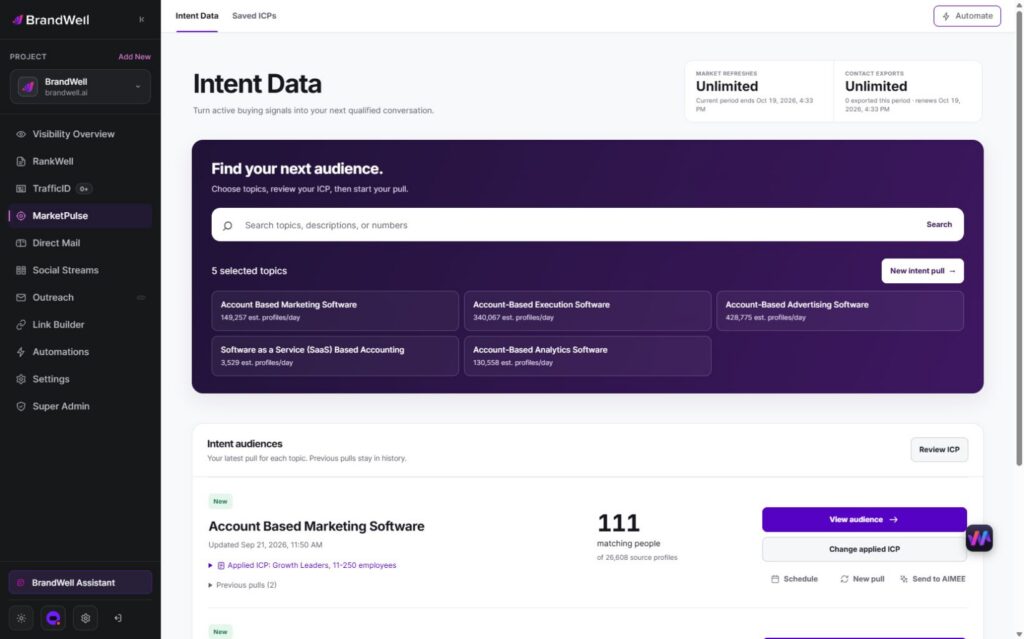
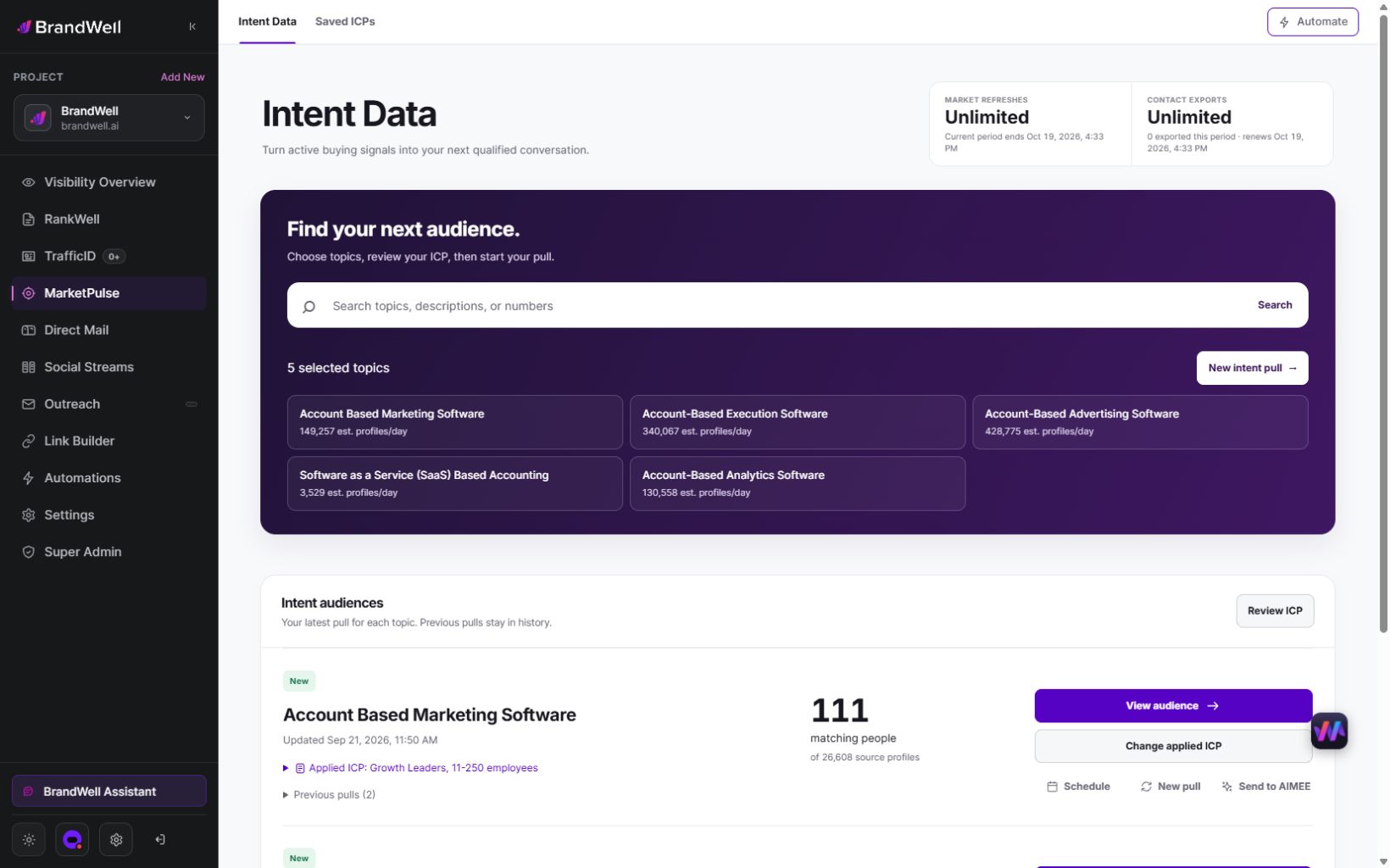
MarketPulse topic research
BrandWell MarketPulse: intent data starting at $500/mo. Find people researching topics relevant to what you sell, apply saved ICP filters, and review available contact details before taking action.
MarketPulse plans are starting at $500/mo. Verify current package scope and offers on the product page.
| Plan | Topics and refreshes | Monthly exports |
|---|---|---|
| Starter | 1 topic, weekly | 25,000 contacts |
| Growth | 3 topics, daily | 100,000 contacts |
| Scale | 10 topics, daily | Unlimited contacts |
Swipe the table to see all columns.
A pull retrieves available data from the previous 24 hours for one topic. Daily use across all included topics provides 90 Growth pulls or 300 Scale pulls in a 30-day month. Weekly Starter pulls vary by calendar month. Available audience size and contact fields vary, and audiences may overlap. Refreshes stop at the plan limit without overage charges.
- Find and qualify: search the topic catalog, save your ICP, and review the people and companies that match.
- Act on the research: export qualified contacts or prepare an Outreach or Direct Mail workflow. Connected products, channel usage, and fulfillment may cost extra.
- Get help from AIMEE: Growth and Scale include AIMEE for the initial user to research accounts and prepare the next step through connected tools.
Agencies and other service businesses can build client deliverables around their available Intent Scans and exports. Keep each client’s scope, permissions, and service fees clear. A subscription is not a promise of a white-label platform or exclusive access to a market.
Explore MarketPulse and watch the demo or compare plans starting at $500/mo. Any early-access discount is a separate, time-limited offer shown to an eligible recipient.
Affordable platforms versus enterprise suites, data brokers, and building in-house
- Topic research: Review a market beyond your existing website audience.
- Own-site identification: Evaluate available information about eligible visitors to your site. TrafficID serves this distinct use case.
- Broad orchestration: More scope requires implementation and adoption, not just license fees.
- Licensed feeds: Engineering, identity resolution and permitted-use checks remain separate work.
- Internal development: Budget maintenance and opportunity cost along with build work.
An agency should not buy an enterprise platform simply because the feature list is longer. Nor should it assemble five inexpensive point tools without pricing the integration and failure burden. Select the smallest operating model that can produce the promised client deliverable reliably.
Break down capacity and usable-outcome costs
To calculate effective cost per pull, divide the subscription cost by the Intent Scans actually used during the same period. A pull retrieves available data from the previous 24 hours for one topic. Unused allowances increase the effective cost per consumed pull; fields, counts and audience overlap vary.
Fictional operating example: A $500 license plus $700 research and delivery work totals $1200. If 200 records qualify and 50 receive an approved action, cost is $6 per qualified record and $24 per activated record. Neither is customer acquisition cost without actual acquired customers and the relevant full costs.
Pricing and total-cost checklist
Request a written answer for:
- platform, setup, implementation, and services fees;
- clients, workspaces, users, domains, topics, and markets included;
- traffic, signals, matches, enrichments, exports, workflow runs, and overages;
- minimum term, renewal, cancellation, and price-change mechanics;
- data retention, deletion, permitted use, security, and suppression responsibilities;
- branding, portal, report, and custom-domain rights;
- integrations, API access, support, and service levels;
- media spend or activation charges;
- internal labor for QA, reporting, meetings, and optimization.
Avoid publishing competitor prices from memory. Most quotes vary by scope, and a low public entry tier may omit the capability that makes a product relevant to an agency.
How to measure affordable intent data without vanity metrics
Leading indicators include relevant signal count, match rate, ICP-qualified rate, contactability, freshness, time to action, and rep acceptance. Pipeline indicators include positive replies, qualified meetings, opportunities created, opportunity rate, and cost per opportunity. Revenue indicators include sourced or influenced revenue, win rate, deal velocity, retained recurring revenue, and client expansion.
Use a control or matched baseline where practical. Compare similar ICP accounts with and without an activated signal, or compare performance before and after a clearly documented workflow change. Do not attribute every deal from a signaled account to the platform. Intent often changes prioritization and timing; it rarely operates as the only cause.
For agency reporting, include both output and quality: “records delivered” should sit beside “records accepted,” “records activated,” and “downstream outcomes.” A client can then see whether the program is inexpensive because it is efficient or merely because it produces little useful work.
Best-fit use cases and exclusions
Affordable intent platforms fit clients with a known target market, meaningful contract value, enough reachable buyers, a working CRM or ad account, and an owner for follow-up. Strong scenarios include prioritizing outbound, building in-market paid audiences, recovering anonymous website demand, supporting account-based campaigns, and creating recurring market reports.
Exclude or defer clients with undefined positioning, tiny addressable markets without coverage, no capacity to act, consumer or sensitive-category use cases that have not passed review, or an expectation that the data proves personal intent. A low-cost platform cannot repair an unclear offer or a slow sales process.
Combine fit, identity, freshness, activation, and evidence
Use a five-gate score:
- Fit: Is the account, role, geography, and use case economically relevant?
- Identity: Is the person or company matched with enough confidence for the action?
- Freshness: Is the evidence recent enough for the sales cycle and signal type?
- Activation: Is there a specific, permitted next step with an owner and SLA?
- Evidence: Can the team connect the action to a downstream outcome without overstating causality?
A signal that fails a gate may still be useful for aggregate research, but it should not automatically become an outreach record. This distinction improves both economics and trust.
Mistakes, data-quality issues, and privacy risks
The biggest mistakes are buying before testing coverage, optimizing for volume, exposing behavioral details in messages, ignoring duplicates and decay, failing to suppress customers or opt-outs, and allowing automation to act without approval boundaries. Agencies also underestimate the cost of client-specific exceptions.
Document where the data came from, what the vendor permits, how long it is retained, who can access it, and which jurisdictions and channels apply. Google, LinkedIn, email, and CRM activation each have their own policies and obligations. Legal discussion here is operational guidance, not legal advice.
Package an affordable platform as a recurring agency service
A defensible service contains more than access. Include topic or behavior design, qualification rules, identity and enrichment, routing, a branded report, a review cadence, SLA, usage band, exclusions, and measurement. Separate platform capacity from optional media or campaign execution.
An agency can define researched topics, qualification, reviewed next actions and reports as deliverables. Separate its own service fees and duties from software capacity. Confirm client data use and access terms; this is not a claim that every subscription includes white-label infrastructure, an API or resale rights.
Start by reviewing the MarketPulse demo and plans, starting at $500/mo. Choose a relevant topic and ICP, then evaluate audience fit, available contact fields, and the workflow you will use. The first-purchase 3-day satisfaction guarantee requires no data exports and no more than 2 Intent Scans; review the current guarantee terms before testing. A short evaluation can establish fit, but cannot prove future pipeline or revenue.
A practical proof-of-value plan before an annual commitment
Affordability should be demonstrated in a bounded proof of value, not assumed from a price page. Freeze a target-account definition and select a small number of commercially meaningful topics or behaviors. Record the eligible market size, expected signal volume, matching rules, approved activation, and the downstream event that will count as progress. Keep a comparison group of similar accounts where practical.
During the test, review four queues separately: raw signals, matched records, ICP-qualified records, and activated records. This makes loss visible. If a program finds many signals but few matches, the next investment may be identity coverage. If it matches well but sales rejects most records, the issue may be fit or context. If accepted records sit untouched, the platform is not the immediate bottleneck.
At the end, calculate total test cost, usable cost per activated record, fulfillment hours, match and qualification rates, time to action, opportunity creation, and client feedback. The go/no-go decision should explain whether to proceed, narrow the market, change the signal, add a missing integration, or stop. A stopped test can be economically successful when it prevents a larger poor-fit contract.
Operating controls that keep an inexpensive tool inexpensive
Set client-level capacity alerts before the vendor threshold, route exceptions to a named owner, and prevent unapproved records from entering paid or outbound workflows. Use reusable report templates, standard qualification fields, and one source of truth for status. Review unused seats, dormant topics, low-yield integrations, and manual work every month.
For agent-assisted work, provide the agent with an explicit input schema, allowed tools, expected output, approval boundary, and error path. An agent may summarize a signal or prepare a draft next action, but a human should approve public communication, sensitive-data handling, material ad spend, and destructive CRM changes. This is how automation improves affordability without turning cost savings into operational risk.
Frequently asked questions
How should buyers approach affordable intent data platforms?
Start with a fixed use case and normalize total cost per qualified activated record. Test signal coverage, identity, freshness, and downstream workflow before comparing feature counts.
What workflow, data, integrations, and team are required?
Define fit and signal rules, match and enrich records, apply suppression, route to CRM or media, measure outcomes, and review performance. Assign strategy, operations, and client ownership.
How should an agency choose the smallest useful scope?
Start with a specific client deliverable. Choose topic research for market-level questions or an own-site visitor workflow for site engagement. Confirm permitted use, needed fields, client scope and full operating cost before subscribing.
How do affordable platforms compare with enterprise suites or building?
Point tools lower initial scope; enterprise suites add breadth and implementation; raw feeds add flexibility and engineering; building adds control and maintenance. Choose the smallest complete model for the client promise.
What budget and pricing model should a buyer expect?
Use current plan allowances plus labor, setup, connected products and fulfillment costs. Model low, expected and high usage. A per-pull figure describes capacity economics, not cost per qualified lead or sale.
How should the program be tied to pipeline or revenue?
Track signal-to-qualification, activation, meeting, opportunity, and revenue stages. Use matched baselines where practical and state attribution limitations.
Which companies are the best fit?
B2B teams with a clear ICP, enough target accounts, meaningful deal value, reachable contacts, and fast follow-up are the strongest fit. Teams without an activation owner should wait.
How should intent be combined with fit and identity?
Require fit, identity confidence, freshness, a permitted action, and downstream evidence. No single signal should automatically be treated as purchase readiness.
What are the biggest risks?
Low coverage, false positives, stale evidence, unmatchable records, hidden overages, tool sprawl, poor permissions, privacy mistakes, and unreviewed automation are the main risks.
How should an agency include the platform in a recurring service?
Sell a defined operating outcome: researched topics or visitor demand, qualified records, activation, reporting, and optimization. Include usage bands, service levels, client duties, limitations, and change control.
Reviewed and updated October 3, 2026.

Written by