The best clients for intent services are high-consideration B2B companies with a clear ideal customer profile, enough reachable accounts, meaningful deal value, and a team that can act on signals quickly. They do not need the largest market or the most website traffic. They need a measurable gap between “we know this account fits” and “we know when and how to engage it.”

For an agency, the safest path is to qualify every prospect through five gates: commercial fit, signal availability, identity and contactability, activation readiness, and governance. If one gate fails, narrow the pilot or decline the account. That discipline protects gross margin because it prevents the agency from selling a data feed where the client actually needs CRM cleanup, a new offer, sales enablement, or legal review.

Who this is for

  • Agency owners and founders deciding which clients to target with a recurring intent-data offer.
  • GTM and RevOps consultants designing the operating model behind signals, routing, outreach, and reporting.
  • Demand generation and lead generation agency leaders who want recurring revenue without absorbing unlimited data, media, or manual-research costs.

This is a best clients for intent services decision guide, not a promise that intent data will work for every B2B company. Intent is probabilistic. Coverage varies by topic, market, and identity layer. A strong client still needs relevant creative, a credible offer, channel permission, and consistent follow-through.

The five-gate client qualification framework

A useful best clients for intent services framework evaluates the client before evaluating a platform.

1. Commercial fit

Start with the economics. Intent becomes more valuable when the client sells a high-consideration product or service, has enough gross profit per win to support the program, and can define the accounts it wants. A client with a $40,000 annual contract and a six-month buying cycle can justify more research and coordination than a self-serve product with a $99 monthly plan.

Ask for average contract value, gross margin, win rate, sales-cycle length, target-account count, and current acquisition cost. Do not accept “more leads” as the objective. Choose one business outcome such as qualified opportunities, expansion conversations, or pipeline from a named market.

2. Signal availability

Confirm that the topics, behaviors, and accounts the client cares about produce enough observable activity. A narrow industrial niche may be valuable but too sparse for a broad weekly report. A large category may produce volume but too much noise. The right test is usable signal density inside the client’s actual addressable market.

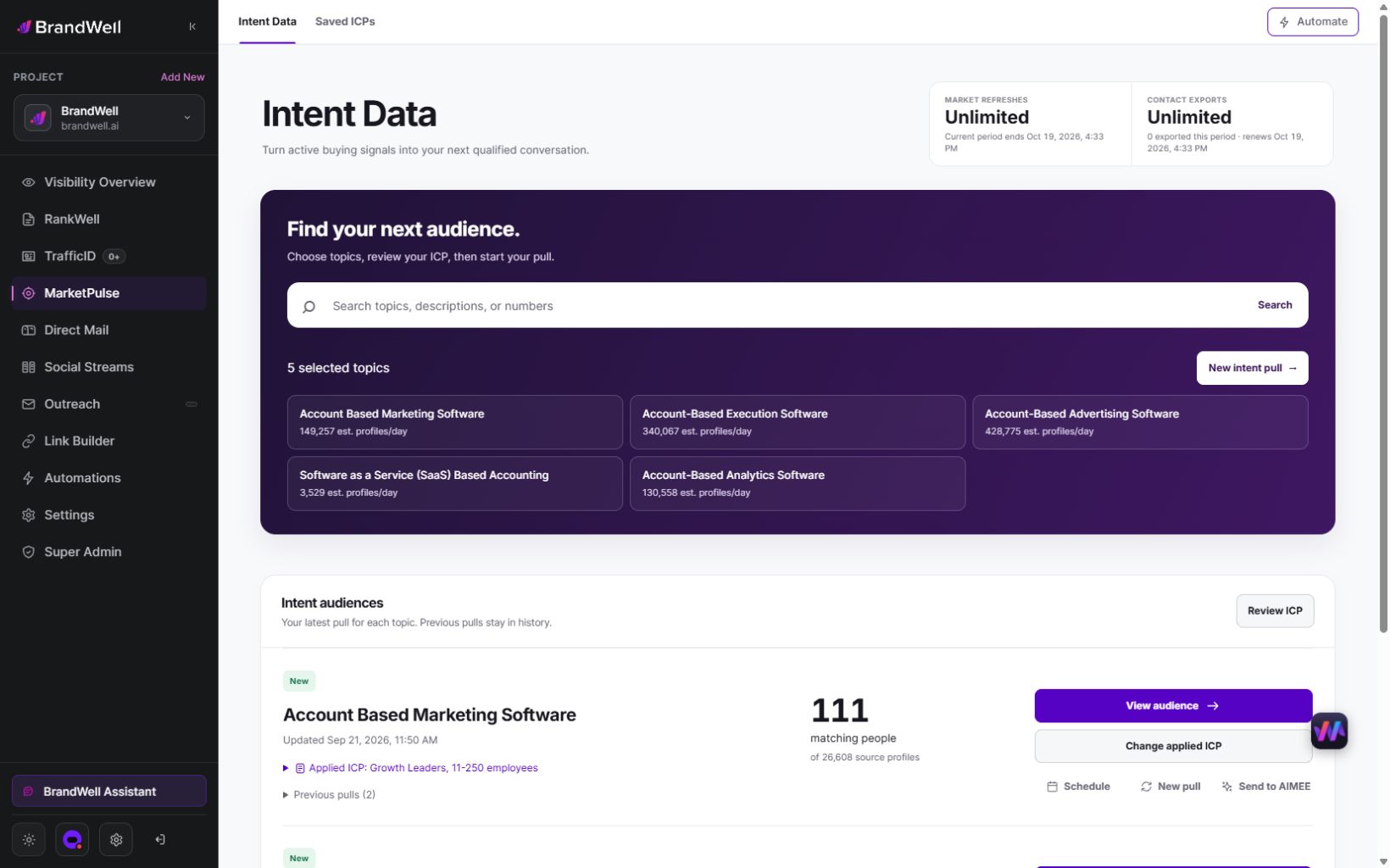
Create a topic map with category terms, problem terms, competitor research, integration questions, implementation concerns, and excluded meanings. Then test coverage before promising volume. This is where a $70 seven-day pilot can reveal whether a branded topic report gives the agency and client enough material to design a recurring service.

3. Identity and contactability

An account signal without a reliable company match may still support advertising, but it should not trigger person-level outreach. A person match without validated contact information may create bounce and complaint risk. Require a stated confidence threshold for the action you intend to take.

The output should distinguish account, buying group, and person. It should also preserve source, timestamp, topic, and validation state. “Detected” is not the same as “ready for an email.”

4. Activation readiness

The best clients for intent data services already have somewhere for qualified signals to go: a CRM queue, seller task, research step, nurture path, custom audience, or approved browser workflow. They name an owner and response window. They also have enough sales or campaign capacity to follow through.

If the client cannot explain what changes after a signal arrives, sell a readiness project first. Otherwise the agency will spend its margin producing reports that no one uses.

5. Governance

Document the client, agency, and provider roles; approved sources and purposes; allowed destinations; suppression rules; access; retention; and incident escalation. Match the controls to the jurisdictions and channels involved. This guide is operational information, not legal advice. The client and agency should involve qualified counsel for their particular facts.

Best clients for intent data services: seven profiles

The following best clients for intent services examples share one trait: a timely signal can change a real decision.

1. High-value B2B services with a defined buying committee

Consultancies, managed-service providers, implementation partners, and specialist agencies often sell complex engagements. Their best prospects research methods, vendors, alternatives, and implementation risks before raising a hand. Intent can help a seller prioritize account research and tailor a useful point of view.

Best fit: the firm has a narrow ICP, a credible subject-matter expert, and enough deal value to justify thoughtful outreach. Poor fit: the firm sends generic sequences to every detected account.

2. Vertical SaaS with a finite account universe

Vertical software companies usually know the industries, company types, technologies, and roles that fit. Intent adds timing to that fit model. The client can use a current topic cluster to decide which account receives advertising, a seller research task, or a stage-specific resource.

Best fit: the market contains enough accounts to measure but not so many that the team abandons account-level judgment. Poor fit: the client expects a signal to identify the exact buyer without a confidence model.

3. Enterprise software with long evaluation cycles

When evaluation includes security, finance, operations, and leadership, one form fill captures little of the buying process. Account-level research and first-party engagement can help a revenue team map likely interests and coordinate follow-up.

Best fit: RevOps can join accounts, contacts, campaigns, and opportunities. Poor fit: business units disagree on stages, ownership, or the target-account list.

4. Industrial and professional markets with triggerable needs

Manufacturers, logistics providers, staffing firms, and professional-service businesses may have clear topics tied to a change in demand, technology, regulation, or capacity. Intent works when those topics are specific enough to indicate a plausible commercial problem.

Best fit: the agency can validate market coverage and connect each topic to a useful play. Poor fit: the category language is ambiguous or activity is too sparse.

5. Companies with anonymous website demand they cannot route

A client may already attract relevant visitors but convert only a small fraction into forms. Company-level visitor identification can help prioritize accounts for advertising or research. Person-level activation requires a separate identity, contactability, permission, and proportionality check.

Best fit: steady target-account traffic, clear high-value pages, and a CRM owner. Poor fit: low traffic, mostly consumer visitors, or no plan beyond immediate cold outreach.

6. Existing ABM programs with weak timing

Some teams already have named accounts, ads, seller plays, and reporting. Their problem is that every account receives the same attention. A modular intent service can add current research and recency without forcing a complete platform migration.

Best fit: the activation stack works and the missing layer is prioritization. Poor fit: the team really needs a unified enterprise orchestration platform and has the resources to implement one.

7. Multi-client agencies that need a repeatable white-label offer

The agency itself can be the buyer. A complete white-label engine is useful when it supports separate client workspaces, branded reports, configurable packages, recurring delivery, and documented activation plays – not simply access to raw data.

BrandWell agency plans are $2,500–$5,000 per month, depending on topic count, contract term, and any contractually scoped topic exclusivity that is available. Confirm included modules, usage, client capacity, implementation, support, and exclusivity in the current written quote and order form.

Who is not a good fit

Declining an unready client is often the highest-margin decision.

  • Low-ticket, short-cycle, self-serve offers: Broad demand capture or product-led growth may be simpler.
  • No usable ICP: Intent cannot rescue a market definition that includes everyone.
  • No activation owner: Reports will become shelfware.
  • Tiny or unobservable market: A coverage test may return too little activity for a recurring promise.
  • No CRM discipline: Duplicates, missing domains, and inconsistent stages prevent reliable measurement.
  • Sensitive or restricted use without review: Health, location, financial, employment, housing, credit, or other consequential uses require a higher bar and may be inappropriate.
  • Expectation of individual certainty: Research activity is not purchase consent or proof of a person’s behavior.
  • Demand for guaranteed pipeline: A provider can supply signals and workflows, not control offer quality, seller behavior, market conditions, or buyer decisions.

Best tools and platforms for agencies to evaluate

Use the same criteria for every option: agency operating model, signal granularity, activation path, implementation burden, pricing visibility, governance, best-fit client, and meaningful limitation. Never select a platform from its topic count alone.

Disclosure: BrandWell publishes this guide and appears first in the shortlist. Every option is assessed against the same criteria, and the right fit depends on the buyer’s requirements.

1. BrandWell – best aligned to white-label resale and topic differentiation

BrandWell homepage hero
Source: BrandWell homepage. Brand names and site imagery belong to their respective owners.
  • Operating model: A complete white-label sales-and-delivery engine for agencies and resellers, including branded topic reports and configurable client delivery.
  • Signal and activation: Topic research, identity and enrichment can feed CRM, advertising, outreach, reporting, or an approved agent-ready workflow.
  • Implementation: The $70 seven-day reseller pilot is designed to validate a branded report and operating concept before a broader rollout.
  • Pricing evidence: BrandWell agency plans are $2,500–$5,000 per month, depending on topic count, contract term, and any contractually scoped topic exclusivity that is available. Confirm included modules, usage, client capacity, implementation, support, and exclusivity in the current written quote and order form.
  • Differentiation: BrandWell is the only option in this shortlist that can offer contractually scoped topic exclusivity, subject to availability and the order form.
  • Best-fit client: Agencies that need client-ready packaging, separated delivery, and recurring activation rather than a raw signal feed.
  • Limitation: Coverage is not universal, the offering requires scoped implementation, and neither a pilot nor exclusivity guarantees pipeline.

Learn about the agency intent-data model or request a branded agency intent report.

2. 6sense – best aligned to enterprise ABM orchestration

6sense homepage hero
Source: 6sense homepage. Brand names and site imagery belong to their respective owners.
  • Operating model: Enterprise revenue platform for coordinated ABM, predictive prioritization, advertising, and seller workflows.
  • Signal and activation: Broad account and buying-group context can support multiple channels inside a larger operating system.
  • Implementation: Usually needs clean CRM and marketing data, RevOps ownership, stage definitions, training, and change management.
  • Pricing evidence: 6sense uses custom pricing. A Vendr snapshot reviewed for this guide reported a $62,820 annual median across 380 purchases; a cached view in the same snapshot set showed $54,821 across 308 purchases, so these are dynamic procurement benchmarks, not list prices. Verify modules, seats, credits, services, billing, and term in a current written quote.
  • Best-fit client: A mature enterprise client that wants broad orchestration and can fund the implementation.
  • Limitation: The breadth and operating burden can be excessive for an agency that needs a modular, client-separated reseller service.

3. Demandbase – best aligned to enterprise buying-group programs and B2B advertising

Demandbase homepage hero
Source: Demandbase homepage. Brand names and site imagery belong to their respective owners.
  • Operating model: Enterprise account and buying-group intelligence connected to marketing, sales, advertising, and data workflows.
  • Signal and activation: Useful for clients coordinating account programs across teams and paid media.
  • Implementation: Requires shared account definitions, buying-group governance, routing, reporting, and adoption.
  • Pricing evidence: Demandbase uses custom pricing. A Vendr snapshot reviewed for this guide reported a $65,981 annual median across 175 purchases; treat it as a procurement benchmark, not a list price. Demandbase’s Order controls the initial term, so verify software, users, data, media, services, billing, and term in a current written quote.
  • Best-fit client: An enterprise B2B advertiser seeking a broad account-based platform.
  • Limitation: Unified packaging may be more than a client needs when the requirement is a narrow signal or white-label agency service.

4. Bombora – best aligned to account-level intent inside an existing stack

Bombora homepage hero
Source: Bombora homepage. Brand names and site imagery belong to their respective owners.
  • Operating model: A dedicated B2B intent-data layer that partners and customers can activate through other systems.
  • Signal and activation: Account-level topic research is useful when the client already has identity, CRM, audience, and outreach tools.
  • Implementation: The agency must supply the surrounding scoring, contact, routing, playbook, and measurement system.
  • Pricing evidence: Bombora does not publish a general dollar list price. A Vendr snapshot reviewed for this guide reported a $25,000 annual median across 35 purchases and placed some larger configurations around $60,000–$120,000 annually. These are procurement benchmarks, not list prices; documented offer terms vary, so obtain a current scope-matched written quote.
  • Best-fit client: A data-mature company that specifically needs account-level intent.
  • Limitation: An account signal does not identify the person who researched, and the feed is not a complete agency delivery engine.

5. ZoomInfo – best aligned to sales-led contact and GTM data workflows

ZoomInfo homepage hero
Source: ZoomInfo homepage. Brand names and site imagery belong to their respective owners.
  • Operating model: A broad GTM data platform for sales-led teams that want accounts, contacts, enrichment, intent, and workflow tools together.
  • Signal and activation: Can connect intent-active accounts to contact research and seller action, subject to package and coverage.
  • Implementation: Requires field mapping, entitlement governance, routing, seller training, and data-quality review.
  • Pricing evidence: ZoomInfo pricing varies by functionality, users, data, credits, and add-ons. A Vendr snapshot reviewed for this guide reported a $33,500 annual median across 1,564 purchases; treat it as a procurement benchmark, not a list price. ZoomInfo’s reviewed Form 10-K says contracts generally run one to three years, so verify scope, billing, and term in writing.
  • Best-fit client: A client whose primary need is sales intelligence tied to contact workflows.
  • Limitation: The platform may be broader and more expensive to operate than a narrow agency service, and buyer-specific coverage still needs testing.

Compare the operating options before choosing software

The most important best clients for intent services comparison is often not vendor versus vendor. It is the delivery model.

OptionSimplicityAgency marginPrimary riskBest switching trigger
Manual research and listsLow software cost; high laborUnstable as volume growsStale data, inconsistent research, hidden laborAnalysts cannot keep cadence or prove freshness
Raw intent feedModerateAttractive only if agency already owns activationClient pays for data but receives little actionRepeated requests for routing, reports, and outcomes
Enterprise ABM suiteLow initial simplicityConsulting revenue possible; long implementationAdoption and scope expansionLarge client needs cross-channel orchestration
White-label managed engineModerateMore predictable with strict modules and limitsAgency over-services bespoke requestsAgency wants repeatable branded delivery across clients

Migration should preserve the client’s account list, topic definitions, signal history, suppression file, routing rules, and outcome definitions. Run old and new systems in parallel for one agreed validation window. Compare unique eligible accounts, usable signals, latency, contactability, accepted actions, and cost – not raw record count.

Implementation workflow, ownership, and approval limits

This best clients for intent services implementation guide can double as an onboarding checklist.

  1. Qualify the business case. Owner: agency strategist. Input: ICP, economics, sales process. Output: one pilot outcome and stop conditions.
  2. Test market and topic coverage. Owner: data lead. Input: accounts, topics, exclusions. Output: expected usable signal range, not a volume guarantee.
  3. Audit identity and CRM readiness. Owner: RevOps. Input: domains, contacts, duplicates, suppression. Output: routing-safe account and contact model.
  4. Approve uses and channels. Owner: client privacy/legal reviewer. Input: data map, jurisdictions, sources, destinations. Output: approved, conditional, and prohibited actions.
  5. Design thresholds. Owner: demand leader. Input: fit, signal, freshness, identity confidence. Output: documented qualification rules.
  6. Map plays. Owner: channel lead. Input: qualified scenarios. Output: seller research tasks, audiences, nurture, or agent-ready instructions.
  7. Set approval boundaries. Low-risk account prioritization can automate; person-level outreach, sensitive inference, new claims, and destructive CRM changes should require review.
  8. Run the pilot. Record every accepted, rejected, suppressed, and unrouteable signal.
  9. Review weekly. Inspect noise, duplicates, latency, seller acceptance, opt-outs, and exceptions.
  10. Decide monthly. Expand, narrow, change topics, or stop based on usable outcomes and full cost.

The working best clients for intent services templates should include an ICP worksheet, topic map, signal dictionary, allowed-use matrix, routing map, play card, suppression register, weekly exception log, and monthly value report. These are more valuable than a decorative dashboard because they make ownership explicit.

Pricing, total cost, and gross-margin protection

Separate cost into five buckets:

monthly TCO = platform + usage/media + setup/services + internal labor + risk reserve

BrandWell agency plans are $2,500–$5,000 per month, depending on topic count, contract term, and any contractually scoped topic exclusivity that is available. Confirm included modules, usage, client capacity, implementation, support, and exclusivity in the current written quote and order form.

An agency’s gross margin is:

gross margin % = (client revenue − direct delivery cost) ÷ client revenue × 100

Direct delivery cost should include allocated platform cost, usage, analyst and campaign time, QA, reporting, client meetings, and rework. Model low, expected, and high signal-volume cases. Put overage rules, custom-work rates, and change control in the agreement.

A healthy package does not promise a fixed number of “hot buyers.” It promises a defined market, monitoring cadence, qualification method, deliverables, response window, reporting, and improvement loop.

Metrics, ROI, and evidence

The best clients for intent services KPIs move from data quality to revenue:

  • Coverage rate: eligible accounts with at least one usable signal ÷ eligible accounts monitored.
  • Usable-signal rate: signals passing fit, freshness, identity, permission, and duplication checks ÷ signals received.
  • Activation acceptance: routed records accepted for action ÷ routed records.
  • Time to action: median time from qualified signal to approved action.
  • Engaged-account lift: treatment engagement rate minus comparable holdout rate.
  • Opportunity lift: treatment opportunity rate minus comparable holdout rate.
  • Pipeline efficiency: qualified pipeline attributed under the agreed method ÷ full program cost.
  • Gross-margin contribution: client revenue minus direct delivery cost.

Best clients for intent services benchmarks should come from the client’s baseline or a controlled pilot, not a vendor-wide average. A randomized holdout is strongest when practical. A matched cohort or pre-pilot comparison can still guide a decision, but document selection and seasonality limits. Intent may influence an opportunity without causing it.

Risks and common mistakes

The most common best clients for intent services mistakes are operational before they are technical.

  • Technical: bad domain matching, duplicate accounts, stale signals, broken field mappings, or unvalidated contacts.
  • Commercial: selling volume guarantees, omitting usage costs, or accepting unlimited custom topics and reports.
  • Operational: no SLA, no rejection reasons, no owner, and no change-control process.
  • Trust: exposing invasive signal detail in outreach or representing probability as fact.
  • Privacy and legal: using a generic privacy policy instead of a use-case and jurisdiction-specific review.
  • Vendor: unclear lineage, retention, subcontractors, exit rights, export limits, or service continuity.

For U.S. commercial email, the FTC’s CAN-SPAM guidance says the law does not exempt B2B email and explains sender, content, address, opt-out, and monitoring obligations. The UK’s ICO says organizations using data-broker marketing services remain responsible for their own compliance and should perform due diligence; see its data-broker marketing guidance. California requirements can also change the obligations of data brokers and their customers; consult the CPPA’s data-broker resources.

Those sources do not decide whether a specific campaign is lawful. Document the facts and obtain legal advice for the relevant jurisdictions, channels, data types, and roles.

Package the service for recurring revenue

An agency can offer three clear levels while controlling its own retail price:

PackageIncluded workCadenceGuardrail
Signal reportApproved topics, branded report, account summary, monthly reviewWeekly or monthlyNo implied person-level certainty or guaranteed volume
Qualified activationReport plus fit, freshness, identity, validation, routing, and play cardsWeekly operations; monthly value reviewDefined channel approvals and usage limits
Managed intent programMulti-source signals, campaign or seller plays, agent-ready workflows, testing, governance, and executive reportingContinuous monitoring; weekly QA; quarterly strategyStrict change control, media separation, and legal approvals

Wholesale platform and usage charges belong in the agency’s delivery cost. The agency sets its own client billing based on value, scope, complexity, and service. Do not expose wholesale pricing as the client outcome; do not hide material usage or media costs either.

Retention comes from better topic selection, cleaner routing, faster response, credible reporting, and new use cases – not from trapping data. Expansion may add visitor identification, audience activation, enrichment, buying-group plays, or another market after the first workflow proves useful.

Final qualification checklist

The best clients for intent data services can answer “yes” to most of these questions:

  • Is the offer high-consideration and economically able to support the program?
  • Is the ICP specific enough to create an eligible account universe?
  • Can a coverage test find relevant topics and accounts?
  • Is there a reliable identity and contactability path for the intended action?
  • Does an accountable team have capacity to respond?
  • Are CRM stages, domains, suppressions, and outcomes measurable?
  • Have approved uses, jurisdictions, channels, and review limits been documented?
  • Can the client accept a pilot with stop conditions rather than a pipeline guarantee?
  • Does the agency agreement protect scope, usage, margin, and change control?
  • Will the team compare outcomes with a baseline or holdout?

If the answer is no to economics, coverage, activation, or governance, fix that constraint before selling a recurring intent service. If the answers are mostly yes, use a bounded pilot to validate signal quality, workflow adoption, and commercial value before expanding.

To see how a white-label pilot can turn selected topics into client-ready reports and activation instructions, request an agency intent report or review the agency intent-data solution.

Frequently asked questions

How should an agency approach clients for intent services to protect growth and gross margin?

Qualify prospects through commercial fit, signal availability, identity, activation readiness, and governance. Price platform, usage, labor, and risk explicitly. Start with a bounded pilot and decline accounts that expect guaranteed pipeline or unlimited custom work.

What inputs, rules, approval limits, and review cadence are required?

Use an ICP and account list, topic map, signal dictionary, freshness rules, identity thresholds, suppression file, routing map, channel approvals, outcome definitions, weekly exception review, and monthly value decision. Require human approval for sensitive or consequential person-level action.

Which calculators, templates, benchmarks, or systems are most useful?

Prioritize a TCO model, gross-margin calculator, coverage test, topic map, signal dictionary, allowed-use matrix, routing map, play cards, exception log, and outcome dashboard. Tool breadth matters less than whether these artifacts drive action.

How do the main options compare across risk, simplicity, and margin?

Manual research is simple to buy but labor-heavy. Raw feeds can preserve margin only when the agency already owns activation. Enterprise suites fit mature clients but require more change. A white-label managed engine supports repeatability but needs disciplined modules and scope.

What pricing assumptions should an agency use?

BrandWell agency plans are $2,500–$5,000 per month, depending on topic count, contract term, and any contractually scoped topic exclusivity that is available. Confirm included modules, usage, client capacity, implementation, support, and exclusivity in the current written quote and order form.

Which metrics show revenue quality and profitability?

Track coverage, usable-signal rate, activation acceptance, time to action, treatment-versus-control engagement, opportunity lift, pipeline efficiency, retention, and gross-margin contribution. Raw signal count is not a revenue metric.

Which client profiles and contracts fit best?

High-value B2B clients with a finite market, longer buying cycle, clean CRM, response capacity, and recurring-service appetite fit best. Contracts should define deliverables, usage, SLAs, data roles, exclusions, change control, and no-guarantee language.

Which signals and evidence matter most?

Combine fit with recent, relevant signals; preserve identity confidence and source lineage; activate only through an approved play; and capture downstream acceptance, engagement, opportunity, and revenue outcomes. No single signal proves purchase intent.

What margin, scope, billing, data-use, and trust risks matter?

Watch unmanaged usage, bespoke reporting, hidden labor, weak matching, invasive messaging, unclear retention, and missing channel permissions. Put overages, review gates, privacy roles, and stop conditions in the operating agreement.

How should the service change when sold as recurring buyer intent?

Move from one-off lists to a monitored system: defined topics, qualification, routing, weekly QA, branded reporting, monthly value review, and controlled expansion. The agency pays wholesale for enabled capabilities and sets its own retail client price.

What agencies receive in the $70 pilot

The BrandWell reseller pilot costs $70 and runs for seven days. During that window, BrandWell creates agency-branded topic reports and supplies the complete sales playbook the agency can use to present the offer and seek client commitments before choosing a full plan.

This gives the agency a practical way to test demand, compare expected commitments with its costs, and decide whether the service can operate as a profit center. No client commitment, cost coverage, or profit outcome is guaranteed. Review the $70 seven-day reseller pilot.