On this page
- Define the B2B identity-resolution job before choosing software
- Test a representative sample against reviewed labels
- Identity platforms vs. CDPs, enrichment, visitor ID, and in-house matching
- Compare implementation and ongoing operating cost
- Measure precision, recall, coverage, confidence, freshness, and activation
- Choose by identity level, data environment, team, and use case
- Connect resolved identities to enrichment, intent, routing, and feedback
- Audit provenance, licensing, privacy, security, and false positives
- Use identity resolution inside an agency service without misclassifying tools
- Where MarketPulse fits in the growth workflow
- Put buyer intent to work with MarketPulse
B2B identity resolution joins records believed to represent the same person or business. Start with the entity and decision your team needs to support, then test matching evidence, errors and operating cost on representative data. An intent audience, enriched contact and resolved customer record serve different purposes.
This guide provides an evaluation worksheet for RevOps teams and agencies. It does not rank providers or describe MarketPulse as a general-purpose identity-resolution engine.
Define the B2B identity-resolution job before choosing software
Identity resolution joins records believed to describe the same entity and expresses the result with rules, evidence, or confidence. Before comparing platforms, name the entity: person, account, household, device, location, or another business object. Then name the decision the resolved record will support.
A RevOps team may need to reconcile accounts across CRM and billing. A data team may need a persistent customer profile. An agency may need to review research audiences for a client. Define each job separately; an intent audience is not itself a master-record resolution service.
Write an identity contract with input identifiers, authoritative fields, match levels, conflict rules, confidence treatment, freshness, lineage, permitted use, and the downstream action. Define false-merge and missed-match costs. In many B2B workflows, incorrectly combining two entities is more damaging than leaving a possible match unresolved.
Do not infer identity resolution from adjacent features. Reverse IP can suggest an account; enrichment can append attributes; validation can check a contact field; a CDP can unify event histories; and intent can indicate research. Ask the vendor to demonstrate the exact match job on representative records and export the supporting evidence.
Test a representative sample against reviewed labels
The U.S. Census Bureau’s data-linkage research resources provide a primary-source starting point for studying linkage methods and evaluation. They are not a benchmark for this commercial workflow; test your own records and decisions.
A credible implementation guide starts with data, not a demo script:
- Define the entity and use case. Specify person or account resolution, online-to-offline joining, duplicate management, visitor identification, or another job.
- Build a representative sample. Include clean records, common errors, subsidiaries, shared domains, job changes, missing fields, duplicates, and known nonmatches. Remove or protect personal data as required.
- Create an adjudicated truth set. Have qualified reviewers label matches, nonmatches, and uncertain cases using documented rules. Hold part of it back from tuning.
- Run every finalist on the same inputs. Preserve configuration, version, thresholds, transformations, and failures. Do not let one vendor quietly receive cleaner data.
- Score at decision thresholds. Measure precision, recall, coverage, false merges, missed matches, confidence calibration, latency, freshness, and review load.
- Test integration and governance. Validate source lineage, field ownership, export, rollback, access, retention, deletion, monitoring, and incident response.
- Test activation safely. Send matches to a sandbox or approval queue. Require a human before CRM overwrites, outreach, media changes, or public use.
Include internal labor and failure handling in the bakeoff. A product with slightly higher raw coverage may create more adjudication work. A conservative tool may be better when false merges are costly. Preserve uncertain records instead of forcing every row into a match or nonmatch.
Identity platforms vs. CDPs, enrichment, visitor ID, and in-house matching
A specialist identity platform focuses on matching and entity clustering. A customer-data platform focuses on profiles, event histories and activation. Evaluate the actual entity model, evidence and controls instead of assuming either category solves every B2B matching problem.
Enrichment appends attributes to an existing entity. It does not necessarily decide that two records are the same. Visitor identification estimates who or which account generated web activity. It should remain separate from general master-record resolution and from buyer intent.
For website activity, test the actual conditions in your audience: shared networks, mobile visits, remote workers, missing identifiers and privacy controls. Keep account-level evidence separate from a claim that a particular person visited.
In-house matching gives full control and may suit a mature data team with unusual entities. It also creates long-term responsibility for features, thresholds, testing, drift, monitoring, privacy, and support. Switching requires exportable IDs, match history, source lineage, and a plan to reprocess records without corrupting downstream systems.
Compare implementation and ongoing operating cost
Compare every finalist on the same commercial dimensions: pricing unit, minimum commitment, contract term, included records and environments, implementation, data-provider or usage add-ons, identity and validation scope, activation and reporting work, support, and exit or export cost.
Usage prices are not total cost. Add data preparation, cloud services, integration, model configuration, truth-set creation, security review, monitoring, adjudication, downstream activation, internal labor, and reprocessing. A quote should state which entity levels, sources, regions, APIs, records, seats, and service levels are included.
Run sensitivity at forecast and peak volume. Include false-positive review cost and missed-match opportunity cost. Negotiate data export, match history, deletion, and transition support before the contract, when the buyer still has leverage.
Measure precision, recall, coverage, confidence, freshness, and activation
Precision is correct predicted matches divided by all predicted matches. Recall is correct predicted matches divided by all true matches in the adjudicated set. Coverage is records that receive a usable resolution divided by eligible input records. Report these by entity, source, segment, and threshold.
Original worked example: score the errors as well as the matches
In a hypothetical labeled test set, 200 record pairs truly match. A process predicts 180 matches, of which reviewers confirm 162. Precision is 162 / 180 = 90%; recall is 162 / 200 = 81%. There are 18 false matches and 38 missed matches. These are illustrative calculations, not BrandWell performance results.
Keep the uncertain cases outside the confirmed truth labels until they can be adjudicated. Repeat the calculation by entity and source; do not reuse an account-level result as a person-level claim.
Measure false merges separately from missed matches. Calibrate confidence: among matches labeled at a given confidence range, how many are correct in the truth set? Track freshness, cluster stability, latency, reprocessing, and the percentage routed to human review. A single match-rate percentage hides the risk tradeoff.
Activation KPIs include accepted-match rate, time to review, time to approved action, duplicate reduction, routing success, and downstream data completeness. Pipeline measures may include qualified responses and opportunities among activated accounts, but identity software should not receive credit for every later outcome.
Estimate value with a baseline and transparent assumptions. Compare analyst time, duplicate-related errors, conversion between workflow stages, and cost per usable match. Use holdouts or staged rollout when feasible. Sales follow-through, campaign quality, and existing demand confound revenue attribution.
Choose by identity level, data environment, team, and use case
Use MarketPulse when the job is finding topic-based research audiences, applying ICP filters and reviewing available contacts. If the job is merging customer records, first evaluate the separate matching process and evidence your data environment requires.
Decide whether the matching process belongs near your existing warehouse, CRM or a separately maintained data service. Manual review can still be reasonable for a small set of high-value records. Account for engineering, review and maintenance instead of comparing only a quoted match count.
Minimum readiness includes a defined entity, authoritative source fields, representative test data, reviewers who can adjudicate truth, a data owner, security and privacy review, and an action that benefits from resolution. If the buyer cannot define a false merge or export evidence, it is not ready for a production decision.
Do not buy identity resolution solely to make a dashboard’s match count larger. Buy it when the resolved identity changes a valuable workflow and the organization can manage the resulting risk.
Connect resolved identities to enrichment, intent, routing, and feedback
Keep the stages explicit: ingest identifiers; normalize fields; resolve the entity; attach confidence and evidence; enrich the accepted entity; validate contact fields; combine with eligible intent or website activity; apply fit and suppression; route to an approved action; and capture the outcome.
An account match does not identify a person. A person match does not prove purchase intent. A validated email does not create permission to contact. A research topic does not prove a project. Use confidence and permitted purpose to decide whether a record can be observed, researched, reviewed, or activated.
Return corrections, rejected matches, job changes, duplicate decisions, and opportunity outcomes. Monitor drift by source and cohort. If the system cannot preserve lineage and feedback, teams will struggle to improve the workflow or explain a consequential decision.
Audit provenance, licensing, privacy, security, and false positives
For applicable California data-broker obligations, consult the California Privacy Protection Agency’s current guidance, including DROP deletion processing. Have the responsible privacy owner determine what applies to the proposed data and use.
Ask where every identifier and attribute comes from, which rights permit the proposed use, how long it persists, who can access it, how a person can exercise applicable rights, and how deletion propagates. Review vendor subprocessors, regions, encryption, authentication, audit logs, incident handling, and termination.
Technical mistakes include weak normalization, shared identifiers, untested fuzzy rules, forced matches, and silent cluster changes. Operational mistakes include overwriting source fields, hiding uncertainty, ignoring rejected records, and activating faster than humans can review. Vendor mistakes include comparing non-equivalent match rates or licensing data for a purpose not covered by the agreement.
Use least privilege, separate sandbox and production, log decisions, preserve rollback, and sample resolved records continuously. Require human approval for any outreach, spend change, CRM overwrite, or public posting based on a resolved identity.
Use identity resolution inside an agency service without misclassifying tools
An agency package can begin with an identity and signal audit, add a controlled resolution workflow, then offer ongoing enrichment, visitor review, routing, activation support, and evidence reporting. Scope the entity, sources, thresholds, volumes, review cadence, SLA, client duties, output, and change control. The agency sets its client price and bills the client.
For agencies, use available MarketPulse Intent Scans and permitted exports within a clearly scoped client workflow. Keep client responsibilities, data-use rights and delivery fees explicit. Use AIMEE through configured tools and permissions to prepare the next step; confirm available features in the selected package.
Where MarketPulse fits in the growth workflow
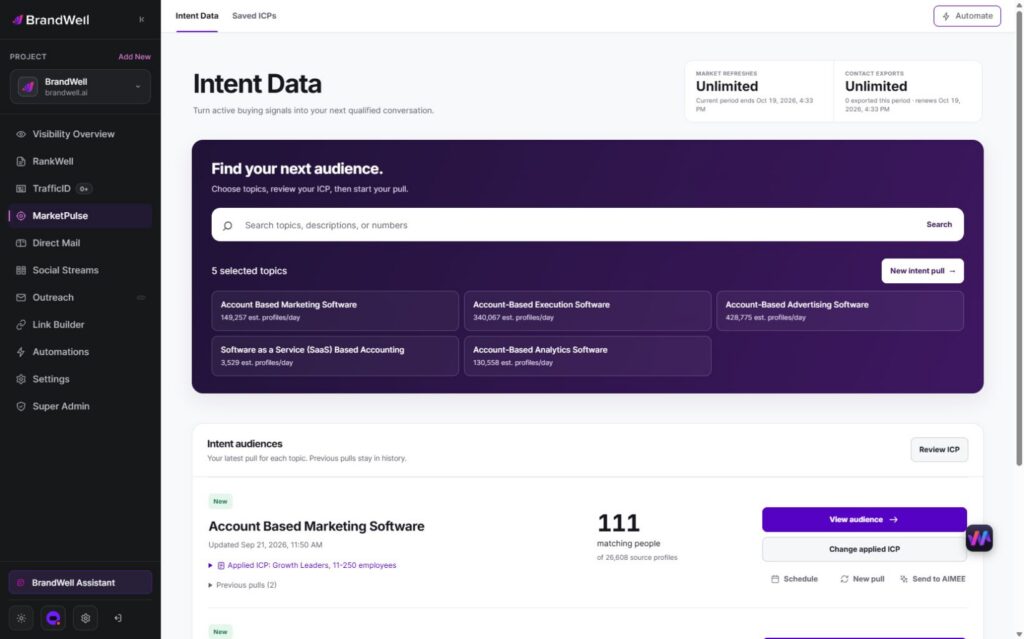
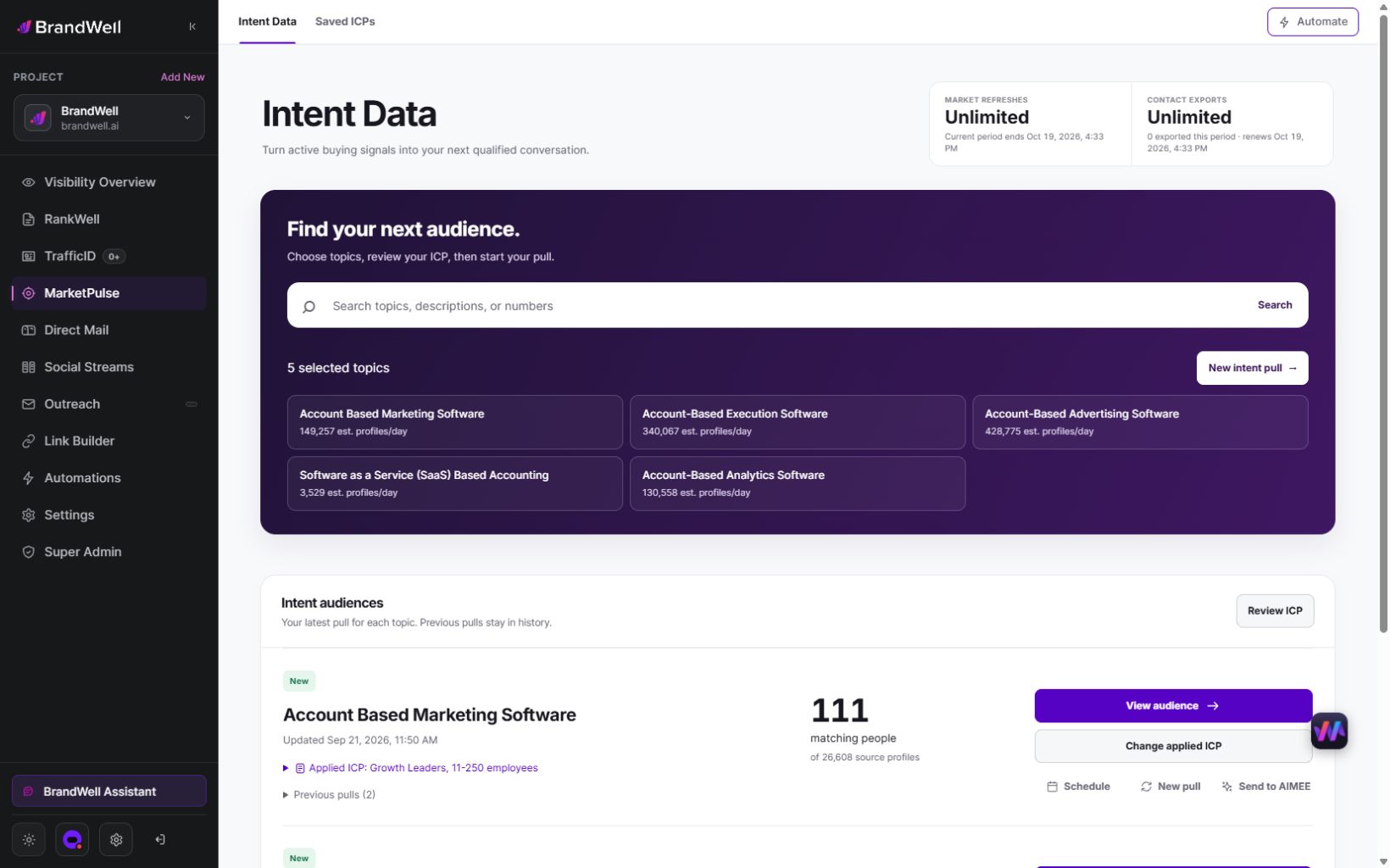
MarketPulse provides topic-based intent audiences, saved ICP filters and available contact details. Standard monthly plans start: Starter includes one topic refreshed weekly and 25,000 exports; Growth with three daily topics and 100,000 exports; Scale with ten daily topics and unlimited exports.
An Intent Scan retrieves available data from the previous 24 hours. Counts, contact fields and overlap vary. In a 30-day month, daily pulls across three topics total 90, and ten total 300. Starter’s weekly pull count varies with the calendar. Any eligible early-access discount is a separate, time-limited offer.
TrafficID addresses visitors to your own website and is a separate product. Use configured Automations and AIMEE through the tools and permissions available to the workspace to prepare reviewed follow-up. Channel usage and fulfillment may cost extra.
Neither an identity match nor a research signal proves a purchase decision or grants permission for every use. Keep the resolved record, research evidence, review decision and subsequent outcome separate.
Put buyer intent to work with MarketPulse
Find people researching your market, focus the audience with your ICP, and turn relevant signals into a useful next conversation. MarketPulse plans are starting at $500/mo.
Explore MarketPulse and watch the demo. Compare the topic coverage, refresh cadence, and exports included in each plan, then choose the one that fits your business or client work.
Reviewed and updated October 3, 2026.

Written by