



On this page
- Four publishing models to compare
- Build a shortlist from requirements
- Test the editor with a real article
- Calculate the full operating cost
- Check portability before you need it
- Use RankWell for the content workflow
- Plan the reader’s next step
- A simple pilot before moving your whole library
- Frequently asked questions
The best blogging platform for a writer depends on the publication you want to build. Compare control over your site, the writing experience, reader relationships, ongoing costs and the ability to move your work later. There is no single winner for every personal blog, newsletter or business publication.
Choose the publishing model first. Then test a complete article, including images, links and mobile layout, before committing to a long-term workflow. A smooth signup process tells you less than actually publishing and revising a representative post.
Four publishing models to compare
An independently managed website
This model gives you responsibility for the site and its operations. It can suit a publication that needs control over its domain, structure and business workflows. Budget for hosting, maintenance, security and the people who will handle problems.
Control is useful only when you can maintain it. A writer who wants to concentrate on a weekly essay may prefer fewer operational decisions.
A hosted website builder
This model combines publishing with a managed website environment. Evaluate the article editor, design options, export process and the limits of the specific plan. Included hosting does not mean there are no costs or restrictions.
A publication within a shared network
This model can reduce setup work, but your publication operates within another platform’s rules and reader experience. Review audience access, monetization conditions, branding and what happens if policies change.
A network’s total audience is not a promise of readership for your article. Plan how you will reach appropriate readers.
An email-first publication
This model centers the relationship around subscriptions and delivery to an inbox. Test consent capture, unsubscribe behavior, archives, export and any paid-subscription terms. A web archive and an email message have different formatting constraints.
Build a shortlist from requirements
Write down three requirements you cannot compromise on and three that are preferences. A small business may need a domain it controls, a product-page connection and a review process. An independent essayist may prioritize a simple editor, subscription management and portability.
- Publication: Personal essays, business education, a membership or a store’s supporting content.
- Control: Domain, URLs, design, reader data and permissions.
- Operations: Updates, access management, backups and support.
- Workflow: Drafts, revision history, author roles and approval.
- Cost: Renewal charges, transactions, optional services and maintenance time.
- Exit: Export format, media portability and redirect capability.
Verify requirements against the current plan and a working test. Do not infer capabilities from a general claim that a platform is “SEO friendly” or “built for writers.”
Test the editor with a real article
Create a representative draft with a heading, several subheadings, a numbered list, an image with a caption and a useful internal link. Add the metadata and inspect the preview. Then ask someone who did not create it to make a revision.
Check whether the editor preserves formatting, allows meaningful link text and makes image descriptions easy to manage. Review the published result on a phone-sized screen. Tables, long URLs and large embedded media deserve particular attention.
A feature can exist and still be awkward for your team. Record what the test required instead of rating the platform solely by its feature count.
Calculate the full operating cost
This is an original hypothetical example, not a current platform quote. Option A costs $20 per month but needs two hours of maintenance at an assumed $30 per hour. Option B costs $50 per month and needs half an hour at the same assumed rate.
- A: $20 + $60 = $80 per month in subscription and maintenance cost.
- B: $50 + $15 = $65 per month on the same basis.
The cheaper subscription has the higher modeled operating cost. Your actual time, skills and requirements may reverse the comparison. Add domain renewals, transaction fees and optional services where applicable.
Check portability before you need it
Export a small sample and inspect what it contains. Text export, media files, subscribers, URL mappings and a complete site backup are different things. Confirm which items you can retrieve and which require another process.
For a concrete CMS example, WordPress’s export documentation explains its XML/WXR export for content such as posts, pages and categories. Check the actual export and migration requirements for your destination rather than assuming every part of the site is included.
Keep a record of important URLs and test redirects if moving an established publication. An export that preserves the words but loses essential images or navigation may still require substantial cleanup.
Use RankWell for the content workflow
The publishing destination and content workflow solve different problems. RankWell within BrandWell helps organize and prepare content; your configured publishing destination determines how the approved article appears to readers.
- Define the reader, question and purpose of the article.
- Prepare a brief with reliable sources and your own examples.
- Use the Content Hub to organize article, strategy, queue and calendar work.
- Review the draft in the RankWell editor, including sources, media and search preview.
- Edit for usefulness, factual support and the publication’s voice.
- Publish through your configured workflow and inspect the live page.
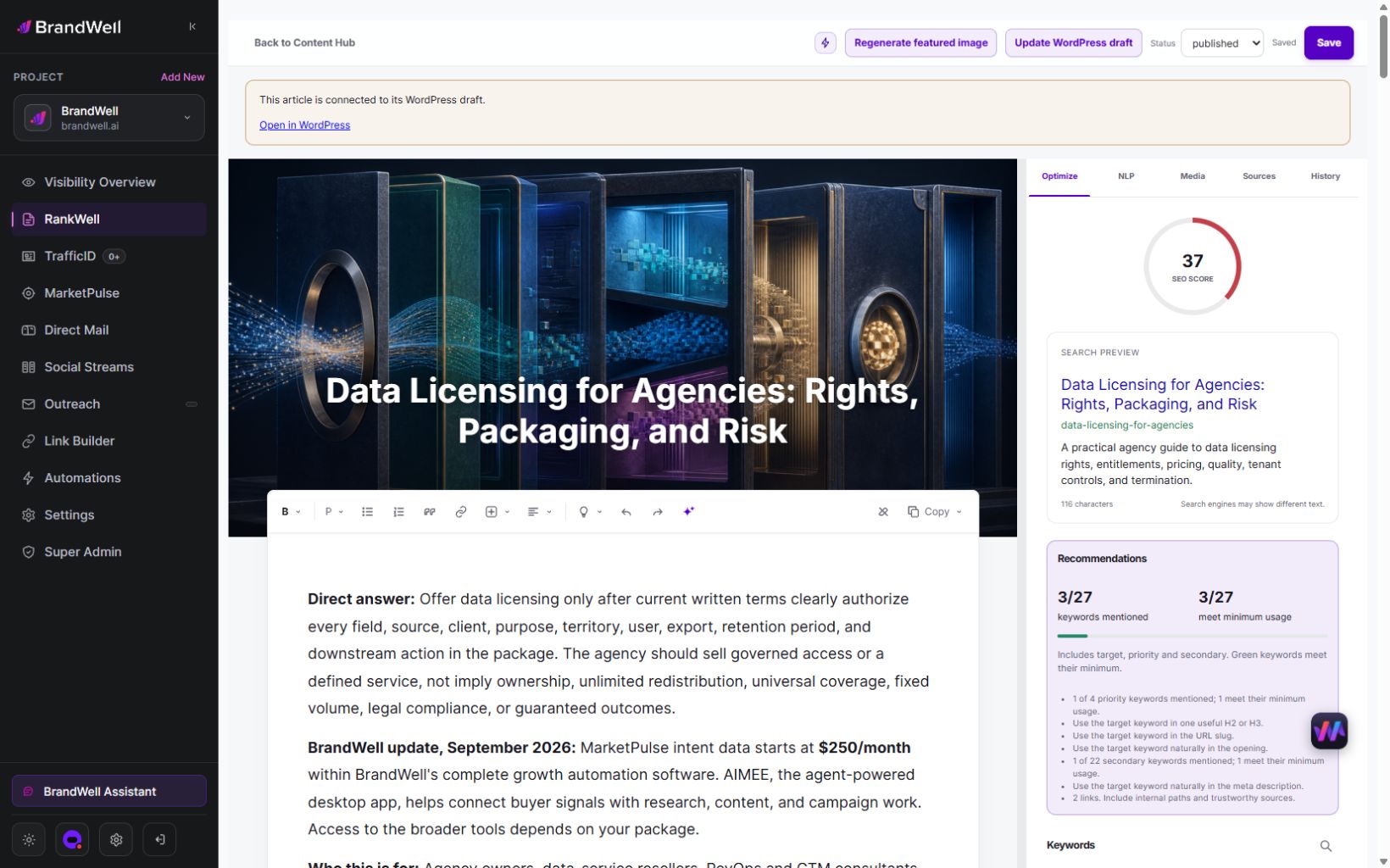
A generated draft and editor recommendations are inputs to review. They do not guarantee rankings, originality, factual correctness or conversions. Keep the author’s expertise and source checks in the process.
Plan the reader’s next step
Give each article a useful next action that fits its purpose: a related explanation, a relevant product page or an appropriate subscription. A personal essay does not need the same conversion path as a buyer’s guide.
Review the title and introductory answer together. A title that promises a ranked comparison should deliver one supported by a defined method. If the article is a decision guide, make that clear rather than implying an independent ranking.
A simple pilot before moving your whole library
Test three representative posts: one short article, one illustrated tutorial and one post with a more complex layout. Review draft editing, metadata, live mobile formatting and export. Record defects and who will resolve them.
When migrating existing content, preserve a backup and a URL mapping before changing the live site. A small pilot helps reveal formatting and media problems without turning the entire library into the test case.
Frequently asked questions
Is a free blogging platform enough?
It may be enough for a limited publication. Verify the current restrictions, domain options, export and reader access. “Free” does not describe every future requirement.
Does a platform guarantee SEO success?
No. Technical controls can support publishing, but useful content, accessible pages and ongoing review still matter. Evaluate the capabilities you need without treating a label as a ranking promise.
Do I need a new CMS to use a better writing workflow?
Not necessarily. Review the content process and the publishing destination separately. You may improve briefs, editing and source review while keeping a suitable existing site.
What should I prioritize as a solo writer?
Choose a workflow you can sustain. Test the editor, audience relationship, total cost and portability using your own articles and schedule.
Explore RankWell’s current content workflow to see how research, drafting and editorial review fit into BrandWell.
Reviewed and updated October 3, 2026.

Written by
Jeff Joyce has been helping brands grow online since the Myspace era, when custom HTML layouts were still a competitive advantage. What started in design quickly evolved into a career spanning social media, content strategy, video, agency ownership, and growth marketing. After building his own agency and testing countless AI tools, Jeff joined BrandWell with a clear focus: helping marketers understand how AI can actually improve the way they create, optimize, and scale content. Today, Jeff brings a CMO-level perspective to BrandWell's marketing strategy, blending brand positioning, content, video, customer education, and growth. His work centers on turning complex AI concepts into clear, practical marketing that helps brands move faster, create better content, and stay competitive without losing their voice.
 Farnaz Kia
1 comments