On this page
The best ecommerce marketing agency for your store is the one that can diagnose your actual constraint, show relevant work, explain its measurement and leave you in control of your accounts. Start with a business brief and a paid pilot rather than a list of agencies described as universally best.
This guide helps you compare ecommerce specialists by scope, economics, evidence and operating fit. It also shows where RankWell can support the content part of an agency workflow within the current BrandWell portal.
Identify the store problem before choosing a service
Write down the product category, target customer, average order value, contribution before marketing, returns, repeat-purchase pattern and operational limits. A store that cannot fulfill additional orders has a different problem from a store with qualified traffic that abandons checkout.
- Discovery: relevant shoppers are not finding the store.
- Product understanding: visitors cannot judge fit, dimensions, materials or compatibility.
- Checkout: shipping, payment or usability issues interrupt purchases.
- Retention: satisfied customers have no appropriate next-purchase path.
- Measurement: the team cannot reconcile marketing reports with actual orders.
Choose one primary constraint for the first engagement. A proposal that includes every channel without explaining the order of work is difficult to assess.
Compare agency capabilities by the job required
Paid acquisition
Ask for a campaign plan tied to specific product groups, stock, margins and landing pages. Establish who owns the ad accounts, who approves creative, how tests are limited and which results will trigger a change. Separate the agency fee, media budget and production costs.
Search and content
Look for experience with product information, category architecture and useful purchase questions. Request one sample brief, an edited page and an explanation of the evidence used. A large article quota does not demonstrate that the content will help shoppers or attract relevant search visits.
Conversion and store experience
Ask how the team will investigate product-page and checkout friction, prioritize changes and check accessibility and mobile usability. Clarify implementation ownership, testing, rollback and ongoing maintenance. Do not confuse a visual redesign with evidence of a sales improvement.
Lifecycle communication
Specify which customer journeys the agency will work on, the permission requirements, frequency, suppression rules and approvals. Transactional updates, abandoned-checkout messages and promotional communication require clear separation in the project brief.
Build a shortlist with comparable evidence
Request evidence from a store with a similar product, sales cycle and operating scale. A case study should explain the starting point, dates, changes, budget and limitations. Ask whether the reported sales were attributed by an ad platform, recorded in the store or measured in a controlled test.
Relevant questions include:
- Who will actually work on the account, and who covers absence?
- Which deliverables are included each month?
- What requires extra production or development fees?
- Can we inspect the underlying reports and account changes?
- What happens if the pilot fails its agreed criteria?
- What assets, access and documentation remain with us at exit?
Testimonials can inform a shortlist. They do not replace scope, measurement or reference checks. Do not treat an award or old ranking as proof of fit for your store today.
Use a measurement definition both sides can inspect
Google’s GA4 Ecommerce purchases documentation explains that ecommerce reporting needs appropriate events; item revenue excludes tax and shipping. Agree which revenue definition the agency will use before comparing its report with store totals.
Record the reporting window, attribution assumptions, order exclusions, returns and cancellations. Track approved changes alongside results so you can distinguish a store-wide promotion from an agency test. Keep raw counts visible when the sample is small.
Hypothetical comparison: $6,000 in attributed sales divided by $2,000 in ad spend is 3.0x revenue ROAS. Adding a $1,000 agency fee makes the revenue-to-ad-and-fee ratio 2.0x. Neither number is profit; product costs, fulfillment, refunds and other expenses still matter.
This example illustrates two denominators, not an expected return or proof that advertising created every sale. Evaluate the economics with your actual margin and measurement limits.
Create a useful content workflow inside BrandWell
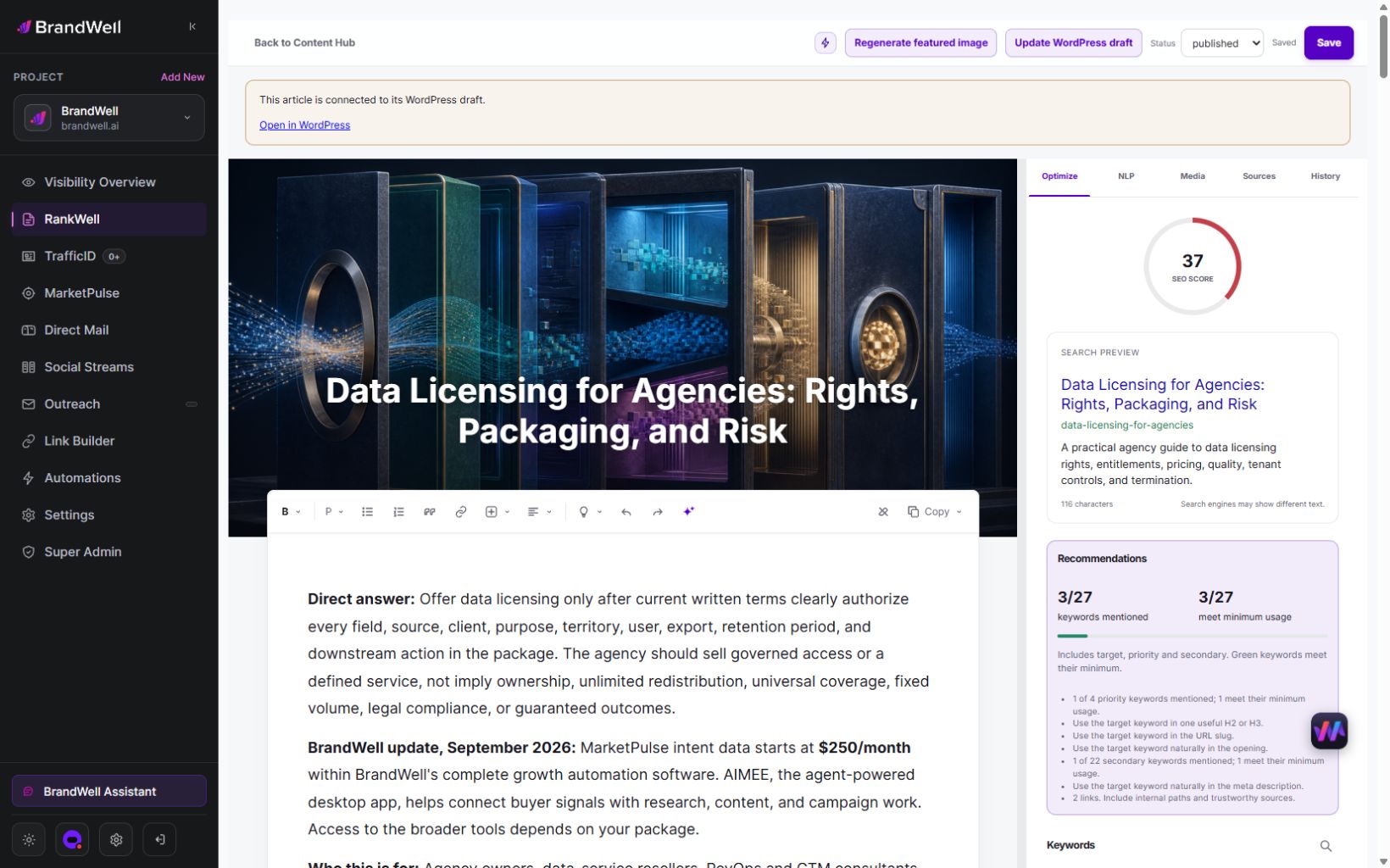
- Choose a shopper question. For a fictional luggage store, use “Which carry-on size fits this trip?” rather than another broad luggage overview.
- Prepare the evidence. Supply verified dimensions, materials, warranty wording and current product availability. Date any airline restrictions and link to the authoritative source relevant to that article.
- Draft in RankWell. Provide the audience, question, sources and internal product-page destinations in the brief.
- Review the draft. Confirm every specification, remove unsupported comparisons and make the answer easy to scan on mobile.
- Publish through the configured workflow. Assign a store owner to approve the final article and its links.
- Inspect results. Review search queries, page engagement and the applicable store outcomes. Revise the answer when product information changes.
The agency can manage planning and review while your team supplies product expertise. BrandWell software is a workflow aid; it does not replace agency accountability or guarantee search visibility, purchases or margin.
Start with a bounded pilot
Define one product group, one primary objective, a budget ceiling and a review date. State which pages or campaigns may change, the approval process and the evidence required to continue. Choose a period that fits your buying cycle and expected data volume rather than promising a universal deadline for results.
A useful pilot might produce a corrected product-information brief, a reviewed buying guide, a campaign experiment and an inspectable report. Its success criteria should be agreed before work begins. If tracking is unreliable, resolving it can be a deliverable instead of claiming a conversion uplift.
Common questions
Is a full-service agency always better?
No. A specialist can fit a defined problem; a broader team can fit connected work when ownership is clear. Compare the actual people, deliverables and dependencies.
Should we choose the lowest monthly fee?
Compare total cost for the same scope, including media, creative, development and internal review. A lower fee can exclude work your store still needs.
Can AI handle the content engagement?
It can help organize and draft material. Your team still needs product evidence, editorial review and approval. Use RankWell’s current workflow to support that process without treating generated text as verified product information.
Reviewed and updated October 3, 2026.

Written by
Julia McCoy has contributed articles to BrandWell on content marketing, writing, and search engine optimization. This archive retains her original bylines; individual articles may be updated by the BrandWell editorial team.