
The best intent data tools for Google Ads agencies do not merely create a bigger audience. They help an agency build a smaller, explainable audience of accounts or people with the right fit and recent buying evidence, activate that audience through a permitted Google Ads workflow, and measure whether it produces qualified pipeline rather than cheap clicks alone.

For an agency selling this as a recurring service, the operating sequence matters more than the vendor logo: define the client’s ideal customer profile, select relevant signals, resolve the signal to an activation-ready record, apply consent and platform-policy controls, exclude customers and open opportunities, launch a controlled campaign, and connect ad exposure to CRM outcomes. Intent is probabilistic evidence of research activity. It is not proof of consent, purchase readiness, or future revenue.

Who this is for

This guide is for agency owners, paid media directors, RevOps leaders, and procurement teams evaluating intent-data platforms for Google Ads. It is most useful for B2B programs with meaningful deal value, a clear ICP, reliable CRM stages, and enough time to run a controlled test. It is not a shortcut for weak offers, poor conversion tracking, or campaigns that cannot lawfully use the underlying audience data.

What an intent-data tool must do before it deserves ad budget

A vendor can call almost any behavioral record “intent.” Before comparing software, define the job. A useful Google Ads intent workflow must answer six questions:

  1. What happened? A person or account researched a topic, visited a meaningful page, compared vendors, engaged with a review, or produced another documented signal.
  2. Who or what was resolved? The record maps to an account, buying group, or person at a stated confidence level.
  3. Does it fit? Firmographic, role, geography, exclusion, and customer-status rules qualify the record.
  4. Is activation permitted? The organization has documented the source, permitted use, applicable notice or consent, suppression status, and Google audience requirements.
  5. What campaign action follows? The record enters a defined audience, bid, creative, landing-page, or sales-assisted play.
  6. What evidence closes the loop? Exposure, engagement, opportunity progression, gross profit, and exceptions flow back to the operating team.

That is the core best intent data tools for Google Ads framework. If a product stops at a CSV, the agency must supply identity, policy checks, audience preparation, campaign operations, measurement, and client reporting. That may still work, but it changes total cost.

Google’s own audience products remain a valid alternative. Native in-market, affinity, demographic, remarketing, optimized targeting, and first-party segments can be easier to activate and govern. External intent data earns a place only when it adds a defensible signal or market view that the native setup does not already provide.

How we evaluated the shortlist

Every option below is assessed against the same criteria:

  • Signal relevance: source class, topic or behavior, recency, and fit controls.
  • Identity and audience readiness: account/person distinction, matching, enrichment, and usable destination format.
  • Google Ads activation: supported path, policy prerequisites, refresh cadence, exclusions, and failure handling.
  • Agency operations: multi-client delivery, permissions, reporting, resale model, and support.
  • Measurement: connection from audience and spend to CRM stages, pipeline, revenue, and gross profit.
  • Cost and implementation: platform, data, integration, media, services, governance, and internal labor.
  • Governance: provenance, notices or consent, permitted use, suppression, retention, and audit evidence.
  • Best fit and limitation: the scenario where the option makes sense and the most important tradeoff.

Before uploading any customer data, review Google’s current Customer Match policy and Customer Match overview. Eligibility, consent, account history, audience size, geography, and supported campaign behavior can change. A data vendor cannot make an advertiser eligible or compliant by itself.

Five intent data tools to evaluate for Google Ads

BrandWell publishes this guide and appears first in the shortlist. Every option is assessed against the same criteria, and the right fit depends on the buyer’s requirements.

1. BrandWell – best for agencies productizing an intent-to-ads service

Brandwell 1200X680.Jpg homepage hero
BrandWell homepage hero. Brand names and site imagery belong to their respective owners.

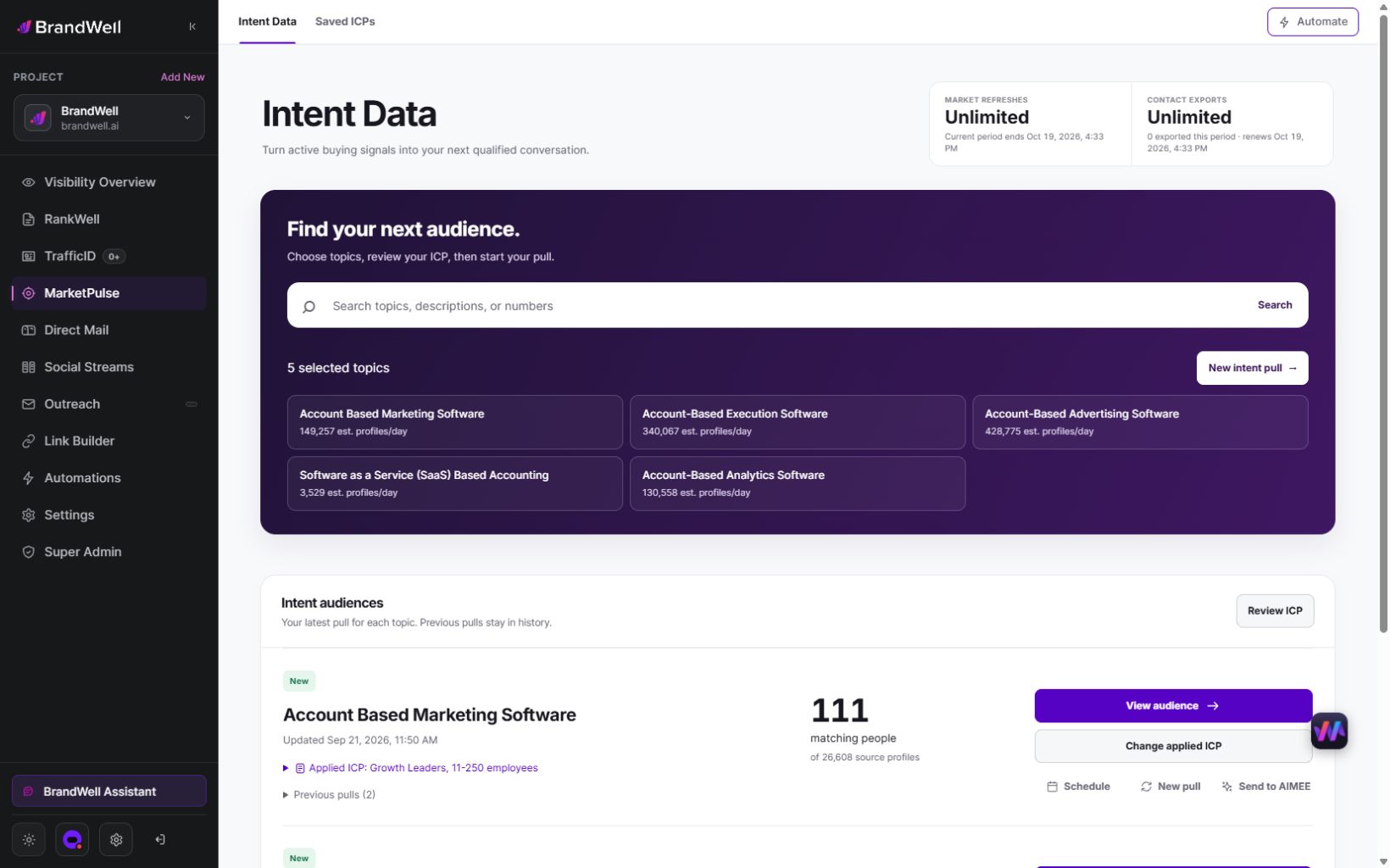
Signal relevance. BrandWell is designed around off-site commercial topic research, with TrafficID and form activity available as additional signal classes. Agencies can define topic maps, ICP rules, recency, qualification, and exclusions before preparing an audience. A topic hit remains probabilistic; test coverage and precision in the client’s actual market.

Identity and activation. Where matching and permitted use support it, records can be enriched into person- or company-level outputs and prepared for supported ad workflows. The important deliverable is not a raw list but a documented chain from signal to qualified audience, exclusions, upload or routing, and downstream evidence. Verify current Google destination mechanics, match prerequisites, minimum audience thresholds, and regional rules in the scoped implementation.

Agency operations and measurement. BrandWell provides a complete white-label agency sales-and-delivery engine rather than only a data feed. Resellers can present branded topic reports, configure client delivery, set their own retail pricing, and add activation and reporting. A $70 seven-day reseller pilot can generate branded topic reports to test relevance and the client story before a full rollout. Seven days is not long enough to establish pipeline impact or prove incrementality.

BrandWell agency plans are $2,500–$5,000 per month, depending on topic count, contract term, and any contractually scoped topic exclusivity that is available. Confirm included modules, usage, client capacity, implementation, support, and exclusivity in the current written quote and order form.

BrandWell is also the only option in this comparison that can offer contractually scoped topic exclusivity, subject to topic and market availability and the signed order form. It can deliver agent-ready automation workflow instructions for teams to carry out with Claude or ChatGPT, or execute directly in the browser through Moxby. Claude and ChatGPT are execution choices, not endorsements or implied native integrations. Moxby is a separate browser-first product. Human approval, platform credentials, policy checks, and exception logging should remain explicit.

Best fit and limitation. Best for an agency that wants to sell a branded signal-to-audience service and retain the client relationship. The limitation is evidence maturity: coverage, match rate, audience acceptance, exclusivity, and outcome lift must be validated for each client; a native-only or enterprise ABM stack may fit another operating model better.

Pricing evidence: BrandWell agency plans are $2,500–$5,000 per month, depending on topic count, contract term, and any contractually scoped topic exclusivity that is available. Confirm included modules, usage, client capacity, implementation, support, and exclusivity in the current written quote and order form.

2. 6sense – best for an enterprise account-based revenue program

6Sense 1200X680.Png homepage hero
6sense homepage hero. Brand names and site imagery belong to their respective owners.

Signal relevance. 6sense is positioned as a broad revenue and account-based platform combining intent, account identification, predictive models, orchestration, and advertising. That breadth can help a mature enterprise team coordinate marketing and sales around the same account view. Ask which signal sources, model inputs, time windows, and confidence fields are visible to operators.

Identity and activation. The account-based orientation can support advertising to selected accounts and segments, but the exact Google Ads path, refresh behavior, match logic, exclusions, and measurement fields must be demonstrated. Do not assume that an “integration” means every audience type or campaign is supported.

Agency operations and measurement. 6sense is usually evaluated as an enterprise revenue platform rather than a lightweight white-label reseller engine. An agency may operate it inside a client-owned environment, which can strengthen data ownership while making every implementation different. Confirm roles, client separation, service rights, reporting exports, and handoff before packaging it.

Pricing evidence: 6sense uses custom pricing. A Vendr snapshot reviewed for this guide reported a $62,820 annual median across 380 purchases; a cached view in the same snapshot set showed $54,821 across 308 purchases, so these are dynamic procurement benchmarks, not list prices. Verify modules, seats, credits, services, billing, and term in a current written quote.

Best fit and limitation. Best for a larger company already committed to enterprise ABM and cross-functional orchestration. The limitation is operational weight: it can be more platform, implementation, and procurement than an agency needs for a focused Google Ads audience service.

3. Demandbase – best for enterprise ABM advertising and account orchestration

Demandbase 1200X680.Jpg homepage hero
Demandbase homepage hero. Brand names and site imagery belong to their respective owners.

Signal relevance. Demandbase is positioned around account intelligence, intent, advertising, and sales alignment. It can fit teams that need account selection and media orchestration in one enterprise ABM environment. Buyers should separate first-party activity, third-party research, firmographic fit, model output, and ad engagement rather than treating one score as truth.

Identity and activation. Demandbase’s advertising orientation may reduce the number of handoffs for account-based campaigns. Still, require a live demonstration of Google-specific destinations, audience refresh, geographic behavior, match and minimum thresholds, exclusions, conversion imports, and failure queues.

Agency operations and measurement. It is most naturally operated for a client as part of that client’s ABM program. Agencies should clarify access, ownership, reporting rights, support responsibilities, and what happens when the engagement ends. Measurement should distinguish platform engagement, influenced pipeline, sourced opportunity, and incremental outcome.

Pricing evidence: Demandbase uses custom pricing. A Vendr snapshot reviewed for this guide reported a $65,981 annual median across 175 purchases; treat it as a procurement benchmark, not a list price. Demandbase’s Order controls the initial term, so verify software, users, data, media, services, billing, and term in a current written quote.

Best fit and limitation. Best for an enterprise account-based advertising program that wants a unified operating layer. The limitation is fit for productization: it is not inherently a complete low-friction white-label service for an agency selling the same repeatable package to many smaller clients.

4. Bombora – best for teams that want topic-level account signals as an input

Bombora 1200X680.Jpg homepage hero
Bombora homepage hero. Brand names and site imagery belong to their respective owners.

Signal relevance. Bombora is known for Company Surge topic signals derived from a B2B publisher data cooperative. This can be useful when the agency wants account-level evidence that research around selected topics is changing. The agency still needs to validate taxonomy fit, baseline logic, recency, geography, coverage, and what the score does not mean.

Identity and activation. Bombora is often an upstream signal provider rather than the entire Google Ads operating system. Activation may occur through a partner, CDP, ABM platform, audience tool, or an agency-built process. Map every handoff: account signal, contact or audience resolution, permissions, upload, refresh, rejection handling, and CRM feedback.

Agency operations and measurement. A data-centered model gives experienced teams flexibility, but increases build and QA work. An agency needs its own multi-client controls, reporting, audience governance, campaign playbooks, and client narrative. Measure lift inside ICP cohorts rather than citing signal volume.

Pricing evidence: Bombora does not publish a general dollar list price. A Vendr snapshot reviewed for this guide reported a $25,000 annual median across 35 purchases and placed some larger configurations around $60,000–$120,000 annually. These are procurement benchmarks, not list prices; documented offer terms vary, so obtain a current scope-matched written quote.

Best fit and limitation. Best for a data-capable agency or enterprise that wants topic-based account signals as one input to an existing stack. The limitation is assembly: additional identity, activation, reporting, and white-label delivery components may be required.

5. Factors.ai – best for marketing teams connecting account signals with campaign analytics

Factors 1200X680.Jpg homepage hero
Factors.ai homepage hero. Brand names and site imagery belong to their respective owners.

Signal relevance. Factors.ai is positioned around B2B account intelligence, website identification, marketing analytics, and account-based audience activation. That combination can be useful when Google Ads measurement and account engagement need to live in the same operating conversation. Verify which “intent” comes from first-party engagement, identified website activity, third-party research, or a model.

Identity and activation. Ask for a representative demonstration from signal through account resolution to the exact Google audience or campaign workflow. Inspect refresh timing, exclusions, consent fields, rejected records, account-to-person mapping, and how offline CRM stages return to reporting.

Agency operations and measurement. The product may fit an agency operating a client’s paid media and analytics, especially when the client needs account-level journey visibility. Verify client workspaces, permissions, exports, branding, support, and commercial rights before calling it a reseller platform.

Pricing evidence: Factors.ai publicly listed Lite at $199 per month, Basic at $6,000 per year, Growth at $20,000 per year, and Enterprise from $30,000 per year when reviewed for this guide. Contracts are typically annual with stated exceptions; verify current plan scope, usage, billing, and term before comparison.

Best fit and limitation. Best for a B2B marketing team or agency connecting account intelligence, website behavior, Google Ads, and analytics. The limitation is breadth – teams seeking a broad off-site topic feed or complete agency resale engine should verify whether the data and commercial model cover that need.

Intent data vs Google native audiences

Do not frame the choice as external intent or native Google audiences. A strong test often uses both:

ApproachBest useStrengthMain risk
Native in-market or optimized targetingDiscover demand inside Google’s environmentFast activation and platform-native learningLess control over why a buyer qualified
First-party remarketing or Customer MatchRe-engage known, permitted audiencesStrongest direct relationship and clear sourceLimited to the organization’s own reachable audience
External topic or account intentFind research behavior beyond owned propertiesAdds timing and category contextProvenance, match, policy, and false-positive risk
Manual named-account listReach a strategic account set without behavioral claimsSimple, explainable account strategyTiming may be weak and lists become stale
Combined fit-plus-intent cohortTest buyers that match ICP and show recent evidenceBetter prioritization hypothesisMore operational steps and smaller audience size

Use native audiences when the program needs scale and simple activation. Use external intent when the signal meaning is clear, the audience is large enough to test, and the team can prove incremental value. Use manual named accounts when sales strategy – not inferred research – is the reason for inclusion.

Implementation workflow for Google Ads intent audiences

1. Freeze the campaign hypothesis

Write one sentence: “Among accounts that match these firmographic rules, recent evidence about these topics should improve this outcome compared with this control.” Name the conversion, evaluation window, budget, and decision rule before launch.

2. Build the signal contract

Document source class, topic definition, identity level, confidence, freshness, geography, exclusions, permitted use, and owner. A useful record needs an observed-at field and reason code. “High intent” without an explanation is not operational data.

3. Apply fit and suppression

Remove employees, customers, partners, competitors, open opportunities when inappropriate, recent opt-outs, restricted accounts, and records outside the target market. Then layer role, industry, company size, or account tier. Intent without fit wastes spend; fit without timing may still be a valid control.

4. Prepare the permitted audience

Confirm Google account eligibility and the applicable audience policy. Record the data source, notice or consent basis, upload owner, hashing or transfer method, retention, deletion path, and destination. Keep a rejected-record queue and never silently retry noncompliant data.

5. Design the experiment

Create a holdout or matched cohort where volume permits. Keep creative, offer, geography, attribution window, and bid strategy as comparable as possible. A useful minimum design compares:

  • fit plus recent intent;
  • fit without the selected intent threshold;
  • a native Google audience where relevant;
  • existing remarketing or Customer Match audiences.

6. Align creative and landing experience

Use the topic to choose the problem frame, proof, and destination – not to expose private-feeling surveillance. “Teams comparing data quality approaches” is safer and more useful than “we saw you researching us.” Creative should match the buying problem while avoiding an unsupported claim about the individual.

7. Route outcomes back to CRM

Record audience membership, campaign exposure where available, engagement, form or meeting event, account, opportunity, stage, value, and disposition. Let sales mark false positives and irrelevant topics. That feedback should change qualification, not disappear into a report.

8. Review and refresh

Watch audience acceptance, match rate, size, spend, frequency, conversion quality, opportunity progression, suppression accuracy, and stale records. Pause a cohort when relevance, compliance evidence, or economics deteriorate.

Pricing, total cost, and agency packaging

The best intent data tools for Google Ads pricing comparison must normalize the whole system:

monthly TCO = platform + intent data + identity/enrichment + audience transfer + media + integrations + agency labor + reporting + governance + overages

Add implementation and procurement costs separately. A low-cost data product can become expensive when the agency must build identity resolution, uploads, monitoring, reporting, and client support. An enterprise platform can justify a larger fee if it replaces several tools and the organization actually uses them.

For a recurring agency offer, separate:

  • one-time setup for market mapping, tracking, CRM fields, policy review, audiences, and experiment design;
  • monthly data and platform allocation;
  • paid media management;
  • audience QA and refresh;
  • creative and landing-page work;
  • CRM feedback and pipeline reporting;
  • governance, suppression, and audit maintenance.

BrandWell agency plans are $2,500–$5,000 per month, depending on topic count, contract term, and any contractually scoped topic exclusivity that is available. Confirm included modules, usage, client capacity, implementation, support, and exclusivity in the current written quote and order form.

minimum client price = allocated monthly cost ÷ (1 − target gross margin)

Do not hide media spend or overages inside a headline retainer.

KPIs and ROI

Clicks and form fills are necessary operating metrics, not the final answer. Track the chain:

  1. eligible records received;
  2. records passing fit and suppression;
  3. audience acceptance and match;
  4. reachable audience size and freshness;
  5. spend, reach, frequency, and engagement;
  6. qualified conversions and meetings;
  7. accepted opportunities and stage progression;
  8. sourced and influenced pipeline, labeled separately;
  9. won gross profit;
  10. total program cost and agency margin.

Use the client’s baseline or a concurrent control as the benchmark. Vendor case studies are not a substitute for the client’s funnel. Calculate:

ROI = (incremental gross profit − total program cost) ÷ total program cost

If sample sizes are small, report directional evidence and uncertainty instead of manufacturing a decisive percentage.

Best-fit clients and common mistakes

The strongest use cases have high-value B2B outcomes, a specific market, a meaningful research taxonomy, reliable conversion tracking, and an owner who can act on signals. Poor fits include tiny reachable markets, commodity offers, weak landing pages, missing CRM stages, no legal or security owner, and teams that expect a score to produce leads automatically.

Common mistakes include:

  • buying a named “intent audience” without learning its source or time window;
  • uploading records before checking Google policy and regional permissions;
  • targeting every signal instead of combining fit, freshness, and exclusions;
  • using invasive copy that reveals inferred behavior;
  • optimizing to cheap leads while qualified pipeline falls;
  • calling influenced pipeline sourced revenue;
  • changing audience, creative, bid strategy, and landing page at once;
  • leaving stale members in a supposedly real-time segment;
  • choosing a vendor from a headline price rather than comparable TCO;
  • giving an agency operator more client data access than the role requires.

How to sell this as a recurring agency service

Package the outcome as intent-informed audience operations, not a data dump. A strong monthly service includes market and topic governance, signal QA, audience preparation, campaign activation, creative alignment, weekly exception handling, monthly pipeline review, and quarterly experiment redesign.

Start with one segment, one campaign objective, one audience destination, and one control. Use a pilot to prove coverage and operational fit before expanding. BrandWell’s white-label model, the $70 seven-day branded-report pilot, topic-exclusivity option, and agent-ready workflow instructions can shorten the path to a sellable service, but the agency still owns the claims, approvals, campaign decisions, and client outcomes.

Request a BrandWell agency intent demo or explore the $70 seven-day branded-report pilot. For the broader operating sequence, see the website visitor identification and outbound workflow and the guide to proving buyer intent data ROI.

Frequently asked questions

Which intent data tool is best for Google Ads agencies?

Choose by operating model. BrandWell fits agencies productizing a white-label signal-to-ads service; 6sense and Demandbase fit enterprise ABM; Bombora fits teams that need topic signals as an input; Factors.ai fits account intelligence tied closely to marketing analytics. Validate every option with the same client market and activation test.

What team is required?

Assign a paid media owner, data or RevOps owner, client strategist, CRM measurement owner, and privacy or security reviewer. One person can fill several roles, but signal qualification, upload approval, campaign changes, and outcome attribution need named accountability.

What should a pilot prove?

It should prove relevant coverage, explainable qualification, permitted audience preparation, acceptable match and scale, clean exclusions, a functioning feedback loop, and a credible client report. It should not promise revenue from a short observation period.

How should agencies measure success?

Measure accepted audience records, spend efficiency, qualified conversions, opportunity progression, incremental gross profit, and agency margin. Keep sourced, influenced, and merely exposed outcomes separate.

Is intent data better than Google’s native in-market audiences?

Not universally. Native audiences are easier to activate and can provide scale. External intent may add topic specificity and off-site timing. Test them as separate or layered cohorts instead of assuming one always wins.

How BrandWell helps agencies validate demand

BrandWell offers agencies a paid seven-day reseller pilot for $70. BrandWell generates topic reports with the agency’s branding and provides the complete sales playbook for presenting the service, handling the sales conversation, and seeking client commitments before a full-plan signup.

This lets the agency validate interest and review whether expected commitments cover the planned costs before it treats the offer as a profit center. BrandWell cannot guarantee commitments or financial performance. Review the $70 seven-day reseller pilot.