The best intent data tools for Meta Ads agencies help answer a narrower question than “who resembles our customers?” They identify accounts or people connected to a timely business problem, resolve those signals into a permitted Custom Audience input, and give the agency a way to learn whether that cohort produces better qualified outcomes than broad, lookalike, or first-party targeting.

That distinction matters because Meta may use audience inputs in different ways. A customer-list Custom Audience can represent known records; a Lookalike models people similar to a source; an Advantage+ audience suggestion may expand beyond the supplied cohort. An agency cannot truthfully call all resulting delivery “ads to verified in-market buyers.” Intent remains probabilistic, identity matching loses records, and platform optimization can broaden delivery.

Who this is for

This guide is for B2B agency owners, paid media directors, RevOps teams, and procurement leaders evaluating intent-data platforms for Meta Ads. It is most useful when a client has a defined ICP, enough addressable contacts to create a viable audience, server/CRM conversion data, and a commercial offer worth testing. It is not a workaround for weak creative, missing data rights, poor follow-up, or a demand pool too small for Meta to learn from.

Start by defining what “intent audience” means in Meta

An intent-data vendor can influence Meta advertising in at least four different ways:

  1. Direct matched cohort: records that pass fit and recent-intent rules are prepared for a customer-list Custom Audience.
  2. Seed for modeled expansion: the matched cohort becomes an input for a Lookalike or an audience suggestion, so delivery extends beyond observed records.
  3. Exclusion or prioritization: the signal suppresses customers, accelerates high-value accounts, or changes budget/creative rather than defining the entire audience.
  4. Measurement context: intent is joined after exposure to understand account quality or sales progression, without being used for targeting.

These uses have different privacy, scale, interpretation, and measurement consequences. Name the design before comparing vendors. If Advantage+ expands beyond a suggestion, the agency must report the delivered campaign as a modeled/expanded strategy – not as an intent-only audience. Meta’s current Advantage+ Audience documentation explains that suggestions can be expanded while certain controls remain strict.

The strongest operating hypothesis is usually: “Within accounts that fit this ICP, people associated with recent, relevant research should produce more qualified outcomes than an otherwise comparable audience.” That hypothesis still needs a source definition, identity test, permitted-use check, activation configuration, and credible comparison.

The criteria used for every option

Every company in this shortlist is evaluated on the same eight criteria:

  • Signal: provenance, business meaning, account/person granularity, recency, threshold, and topic controls.
  • Identity: resolution method, match-ready identifiers, duplicates, false matches, suppression, and data rights.
  • Meta activation: documented sync or export, permissions, refresh, audience replacement, errors, and Advantage+ implications.
  • Agency model: client separation, resale rights, branding, reports, repeatability, and support.
  • Measurement: Pixel/Conversions API coverage, deduplication, CRM join, attribution rules, and experiment support.
  • Economics: subscription, credits, data, setup, connectors, media, creative, labor, and overages.
  • Governance: lawful basis, client authority, opt-outs, permitted purposes, retention, deletion, subprocessors, and audit evidence.
  • Fit and limitation: the buyer for whom it makes sense and a meaningful reason to choose another option.

Meta’s Customer List Custom Audiences Terms require the advertiser to have necessary rights, permissions, and lawful basis. An agency also needs authority from the advertiser, must honor opt-outs, and cannot sell or transfer the audience. Local hashing before upload does not erase those responsibilities.

Five intent data tools to evaluate for Meta Ads

BrandWell publishes this guide and appears first in the shortlist. Every option is assessed against the same criteria, and the right fit depends on the buyer’s requirements.

1. BrandWell – best for a white-label agency intent service

BrandWell homepage hero
BrandWell homepage hero. Brand names and site imagery belong to their respective owners.

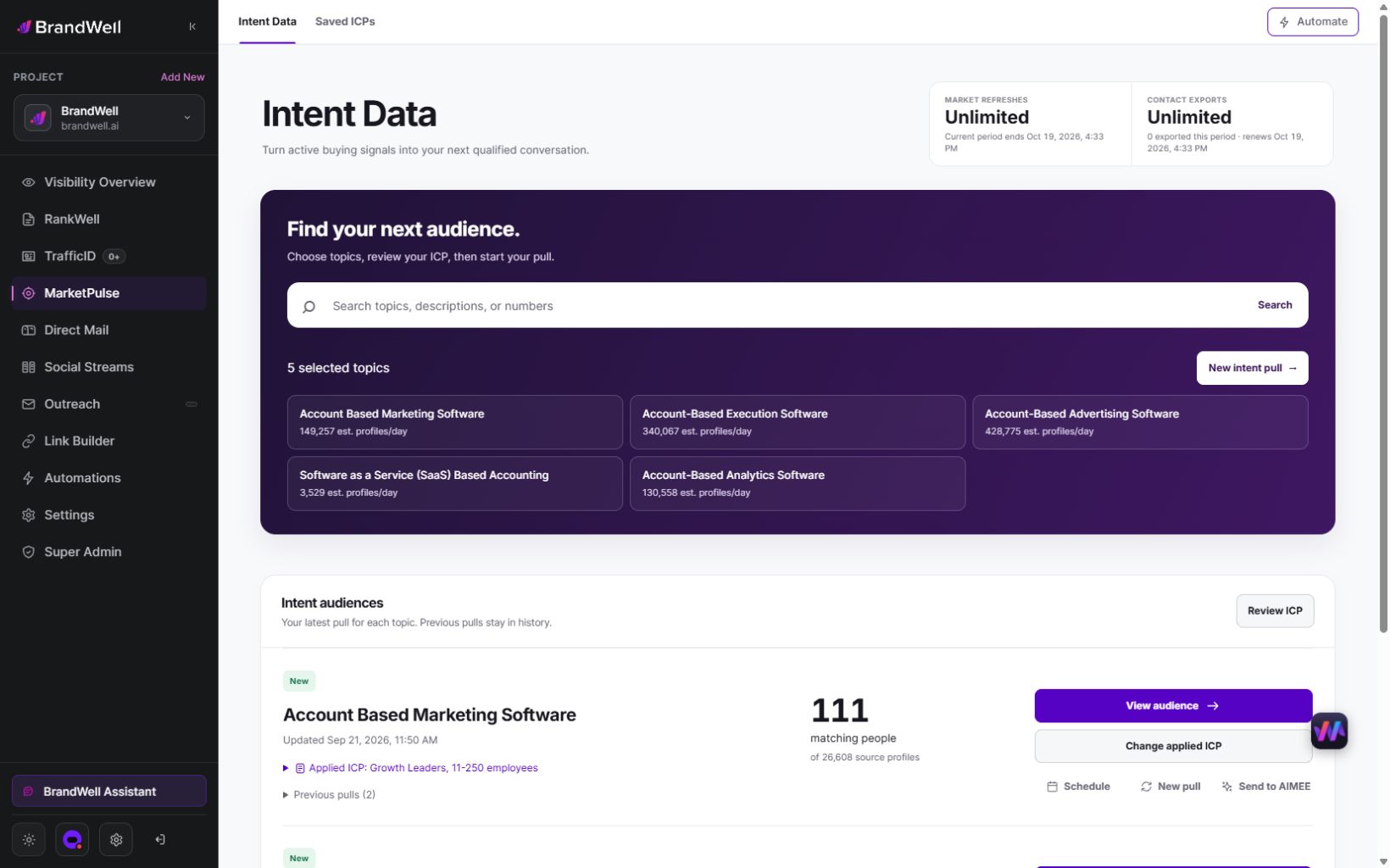
Signal and identity. BrandWell is designed around off-site commercial topic research, with identification and enrichment used to turn qualified evidence into company- or person-level outputs where coverage and permitted use support it. Agencies can define topic, fit, recency, geography, customer status, and suppression rules before an audience is prepared. A buyer should validate all of those layers on a representative client sample; “intent” by itself does not establish who Meta will match.

Agency model. BrandWell provides a complete white-label sales-and-delivery engine for agencies rather than only a feed. A reseller can use branded topic reports and client-facing delivery, add media and workflow services, and control its retail price. The $70 seven-day reseller pilot is useful for validating signal relevance, coverage, report quality, and the proposed audience workflow. It is too short to promise pipeline or establish ad incrementality.

BrandWell agency plans are $2,500–$5,000 per month, depending on topic count, contract term, and any contractually scoped topic exclusivity that is available. Confirm included modules, usage, client capacity, implementation, support, and exclusivity in the current written quote and order form.

BrandWell is the only compared option that can offer contractually scoped topic exclusivity, subject to topic and market availability and the signed order form. Exclusivity may strengthen an agency’s vertical or geographic positioning; it does not guarantee sufficient Meta matches, campaign delivery, lead quality, or revenue.

Activation and automation. BrandWell can provide agent-ready workflow instructions for a team to carry out with Claude or ChatGPT, or directly in the browser through Moxby. Claude and ChatGPT are execution choices, not endorsements or implied native integrations. Moxby is a separate browser-first product. The agency must still verify the current Meta destination path, maintain account permissions, approve audience changes, review policy, and log exceptions.

Best fit and limitation. Best for an agency that wants to sell a branded research-to-audience service across clients. The limitation is client-specific proof: data rights, identity coverage, Meta match, refresh, expansion controls, and incremental economics all need validation.

Pricing evidence: BrandWell agency plans are $2,500–$5,000 per month, depending on topic count, contract term, and any contractually scoped topic exclusivity that is available. Confirm included modules, usage, client capacity, implementation, support, and exclusivity in the current written quote and order form.

2. AudienceLab – best for teams testing identity-led Meta audience construction

AudienceLab homepage hero
AudienceLab homepage hero. Brand names and site imagery belong to their respective owners.

Signal, identity, and activation. AudienceLab documents a Facebook sync and markets audience modeling, identity, and cross-platform activation. Its published help describes periodic audience updates, but the detailed documentation reviewed for this guide carries old update metadata. Buyers should confirm the current workflow in the product rather than rely on the page alone.

Agency and measurement fit. Ask for a live demonstration using a client-like cohort: source ingestion, identity fields, Meta authorization, eligible list, refresh, replacement behavior, failures, match feedback, exclusions, and export. Any accuracy or match-rate percentage should be recreated on the buyer’s held-out sample with a stated denominator.

Pricing evidence: the reviewed evidence did not establish a clean public AudienceLab rate card; a vendor-controlled checkout was explicitly marked internal use only. No general price is asserted here. Obtain a current written Service Order and verify plan, usage, services, billing, contract term, and any reseller rights.

Best fit and limitation. Best for a team that values flexible audience construction and is prepared to test the implementation. The limitation is evidence freshness: current feature, signal, and performance details should be demonstrated before a commitment.

3. Versium – best for making an existing data source more addressable

Versium homepage hero
Versium homepage hero. Brand names and site imagery belong to their respective owners.

Signal, identity, and activation. Versium documents export of eligible Online Audience lists to Facebook Ads. Its role is clearest when an agency already has first-party, account, or intent records and needs identity/enrichment or audience append to improve addressability.

Agency and measurement fit. Verify list eligibility, identifiers, match-ready output, refresh process, workspace/client separation, and traceability back to the originating signal. Meta match rate measures addressability, not signal truth. A broadly matchable but stale list can perform worse than a smaller, timely cohort.

Pricing evidence: Versium’s official pricing page reviewed for this guide conflicted on whether subscriptions start at $3,600 or $5,000 per year. Both figures are annual, not monthly. Treat the entry price as unresolved, and obtain a current written quote covering records, usage, reseller rights, billing, and the stated 12-month commitment.

Best fit and limitation. Best for an agency with a defensible source that needs enrichment and Meta-ready identities. The limitation is scope – verify a separate relevant intent source before categorizing it as a complete topic-intent solution.

4. Demandbase – best for enterprise account-based advertising programs

Demandbase homepage hero
Demandbase homepage hero. Brand names and site imagery belong to their respective owners.

Signal, identity, and activation. Demandbase documents Facebook as a person-based audience destination, using supported identity data and partners for matching. Its account-intelligence and advertising environment may appeal to a mature enterprise coordinating account selection, intent, media, and sales.

Agency and measurement fit. Demonstrate the full path: which signal qualifies an account, how people are selected, which identifiers reach Meta, how often the audience changes, what fails, and how CRM outcomes return. A minimum number in vendor documentation is not automatically an official Meta platform minimum; confirm live eligibility in Ads Manager.

Pricing evidence: Demandbase uses custom pricing. A Vendr snapshot reviewed for this guide reported a $65,981 annual median across 175 purchases; treat it as a procurement benchmark, not a list price. Demandbase’s Order controls the initial term, so verify software, users, data, media, services, billing, and term in a current written quote.

Best fit and limitation. Best for a client-owned enterprise ABM program seeking one broad operating layer. The limitation is agency productization: multi-client white-label delivery, resale rights, implementation weight, and cost must be proven separately.

5. 6sense – best for enterprises already operating a revenue platform

6sense homepage hero
6sense homepage hero. Brand names and site imagery belong to their respective owners.

Signal, identity, and activation. 6sense documents segment sync to Meta Custom Audiences and daily refresh. Its support materials also describe hashed contact delivery and a current third-party contact-data source. That transparency is useful, but the buyer should recheck source, permissions, regional coverage, and contractual allotments.

Agency and measurement fit. The broad revenue-platform approach can coordinate account insights and activation for a larger organization. Agencies should test the audience replacement process because vendor documentation notes an edge case that can affect an ad set’s status. Clarify client ownership, service rights, reporting exports, and how vendor-defined influence is labeled.

Pricing evidence: 6sense uses custom pricing. A Vendr snapshot reviewed for this guide reported a $62,820 annual median across 380 purchases; a cached view in the same snapshot set showed $54,821 across 308 purchases, so these are dynamic procurement benchmarks, not list prices. Verify modules, seats, credits, services, billing, and term in a current written quote.

Best fit and limitation. Best for an enterprise already invested in 6sense and capable of administering a broader revenue workflow. The limitation is scope and operating weight for an agency that only wants a repeatable Meta audience service.

Intent, first-party, lookalike, and broad audiences compared

An agency should not force every client into the same Meta Ads intent strategy.

Audience approachWhat qualifies someoneBest usePrimary interpretation risk
First-party Custom AudienceA permitted client relationship or owned interactionRetention, reactivation, lifecycle, and high-context offersSmall scale and overexposure
External fit-plus-intent cohortICP plus recent third-party or cross-site signalTest timing beyond owned propertiesProbabilistic signal, identity loss, data rights
LookalikeSimilarity to a chosen sourceExpand a high-quality seedSimilarity is not observed intent
Advantage+ audience suggestionInputs guide optimization, with possible expansionGive the system room to find convertersDelivery may extend beyond intent records
Broad/native targetingLocation, age, and other platform controlsScale and algorithmic discoveryWeak visibility into why a person qualified
Manual named-account/contact cohortStrategic fit chosen by sales/marketingABM without a behavioral claimTiming may be absent and lists become stale

The best practice is not always the narrowest audience. Use intent as a testable input. For some clients it should define a cohort; for others it should only prioritize budget, shape creative, or supply a seed. Report the actual configuration.

Meta intent audience implementation guide

1. Freeze the business and audience hypothesis

Name the ICP, excluded accounts, signal, observation window, expected improvement, conversion, budget, and decision threshold. Decide whether intent is a hard audience boundary, a seed, a suggestion, an exclusion, or measurement context.

2. Build a lawful data contract

For each source, record the controller/processor roles, collection context, lawful basis, advertising rights, client authority, permitted geography/purpose, retention, deletion, and opt-out path. Meta’s terms say an agency needs authority from the advertiser. Put that authorization and the agency/client responsibility split in writing.

3. Apply fit, identity, and suppression

Separate observed signal fields from appended identifiers. Test account resolution, parent/subsidiary logic, stale records, duplicates, and false matches. Remove employees, current customers when inappropriate, competitors, active opportunities with conflicting messaging, opt-outs, and restricted records.

4. Create and QA the audience

Confirm eligible identifiers, local hashing/transfer, correct ad account, permissions, audience name, source note, refresh method, and exclusions. Keep a run log with record counts before and after every filter. Review ad sets connected to an audience before any replacement or large update.

5. Choose expansion controls deliberately

Inspect whether the cohort is a Custom Audience, Lookalike source, or Advantage+ suggestion. Record strict controls and exclusions. Do not describe modeled delivery as if each person appeared in the original signal set.

6. Match the creative to a problem, not surveillance

Use topic evidence to choose useful education, proof, comparison, or offer. Never tell a person that the advertiser knows what they browsed elsewhere. Avoid sensitive inferences and keep first-touch creative broad enough to be credible for someone only researching the category.

7. Instrument qualified outcomes

Use Pixel and Conversions API when appropriate to connect browser, server, CRM, app, or offline events and deduplicate them. Conversions API does not bypass consent, ATT, ePrivacy, or Meta terms. Define qualified conversions and CRM stages before launch.

8. Run the fairest available comparison

Compare the intent design with broad/native, lookalike, first-party, or fit-only targeting as the question requires. Keep creative quality, offer, geography, optimization event, attribution settings, and period comparable. Where randomization is unavailable, call the result observational.

9. Monitor quality and stop rules

Track audience updates, match, delivery, frequency, event quality, deduplication, qualified conversion, opportunity progression, opt-outs, complaints, policy reviews, and sales feedback. Pause when provenance is unclear, list quality deteriorates, the audience cannot spend responsibly, or downstream quality misses the predeclared rule.

Pricing and total cost of ownership

The useful cost unit is not dollars per raw record. It is cost per usable audience member, qualified opportunity, or incremental outcome. Model:

monthly TCO = signal data + identity/enrichment + activation + software + integrations + media + creative + agency labor + measurement + governance + overages

Add one-time work for ICP/topic design, legal and platform review, event taxonomy, Pixel/CAPI setup, CRM joins, audience templates, experiment design, and training. A low-cost enrichment file can be the right component, but it does not replace the rest of the system.

BrandWell agency plans are $2,500–$5,000 per month, depending on topic count, contract term, and any contractually scoped topic exclusivity that is available. Confirm included modules, usage, client capacity, implementation, support, and exclusivity in the current written quote and order form.

Meta Ads intent KPIs and ROI

Report the complete chain:

  1. raw signals and unique accounts;
  2. records passing ICP, recency, permission, and suppression;
  3. identities prepared and audience records accepted;
  4. matched/reachable audience and actual expansion configuration;
  5. delivery, spend, frequency, and event-quality coverage;
  6. qualified conversions, positive actions, and meetings held;
  7. accepted opportunities and pipeline stage movement;
  8. sourced and influenced revenue, clearly separated;
  9. gross profit and total program cost;
  10. errors, opt-outs, complaints, and policy incidents.

Meta attribution allocates credit under platform settings; it does not prove incremental effect. A/B or holdout tests are stronger when sample and campaign structure permit. Report absolute differences, not only percentage lifts, and disclose overlap, selection, creative differences, seasonality, and missing CRM joins.

Best-fit clients and failure modes

The best fit is a B2B client with a large enough target market to survive match loss, a valuable conversion, distinctive creative, stable offer, CRM outcome data, and an agency team able to manage permissions and audience changes. Intent can also help clients with long sales cycles when upstream qualified opportunity signals are defined.

Start with first-party or broad/native targeting when the client’s market is tiny, its source rights are uncertain, Meta cannot match or deliver the audience, the conversion event is low quality, or the sales team cannot work the response. No vendor can repair those conditions with more records.

Common mistakes are calling lookalikes “in-market,” ignoring Advantage+ expansion, assuming hashing equals consent, mixing account and person evidence, using vendor-wide match claims, refreshing without checking connected ad sets, optimizing for cheap form fills, and presenting attributed revenue as caused revenue.

Turn the workflow into a recurring agency service

An agency can package six monthly deliverables:

  • Signal intelligence: topic/market coverage, new and repeating account evidence, freshness, and exclusions.
  • Audience operations: fit, identity, suppression, matching, refresh, errors, and change log.
  • Campaign management: budget, creative, landing experience, frequency, and optimization events.
  • Agent-assisted actions: BrandWell workflow instructions may be carried out with Claude or ChatGPT or through Moxby, but consequential changes require human approval and platform credentials.
  • Client evidence: show descriptive signals, activation, qualified outcomes, attribution, costs, and the next test separately.
  • Governance: authority, roles, access, deletion, opt-outs, policy incidents, and handoff.

Renewal should depend on data quality, operational reliability, qualified outcome economics, and useful learning – not the biggest intent count. A branded seven-day pilot can prove that the agency has a credible market and delivery story. A longer controlled program must prove whether the audience strategy adds value.

Choose the provider that best matches the missing layer. BrandWell is the first evaluation for a complete white-label agency offer. AudienceLab and Versium can be narrower identity/audience-building components. Demandbase and 6sense can fit client-owned enterprise ABM environments. In every case, verify the live Meta configuration and data rights before the first audience update.

If the white-label model fits, review BrandWell’s current agency offer and define the pilot’s topics, data rights, Meta activation path, reporting outputs, and success limits in writing.

Before signing, ask the winning provider to recreate one complete client cohort in a test workspace. The demonstration should show raw signal count, every filter, identity loss, Custom Audience preparation, update behavior, expansion configuration, conversion join, and deletion. If the operator cannot explain how a record entered and left the audience, the service is not ready for client delivery.

Use the $70 pilot to test client demand

BrandWell’s agency entry point is a $70 reseller pilot that lasts seven days. The pilot includes topic reports with the agency’s branding plus the complete sales playbook for positioning the service, approaching suitable clients, and seeking commitments before a full-plan decision.

That sequence helps the agency test demand and determine whether expected commitments support the cost structure and a potential profit center. BrandWell does not guarantee commitments, cost coverage, or profit. Review the $70 seven-day reseller pilot.