On this page
- What each element does
- Write an accurate title and description
- Use robots controls for the intended purpose
- Canonical links address preferred URLs
- Configure mobile rendering and social sharing
- Keep headings and alt text meaningful
- Skip meta-keyword optimization
- Review the content in RankWell, then verify the published page
- Common questions
Useful SEO metadata describes a page accurately and controls supported search or sharing behavior. It does not provide a universal ranking boost. Start with a clear page title and description, check indexing settings, and provide a relevant social image.
Not every SEO-related HTML element is a meta tag. A page title uses a title element, headings use h1 through h6, alternative text is an image attribute, and a canonical URL commonly uses a link element. Keeping those distinctions clear makes implementation easier to check.
What each element does
| Element | Purpose | Important limit |
|---|---|---|
| Title element | Describes the page; a source for search title links | The displayed search title can differ |
| Description meta tag | Provides a possible search summary | Search snippets can use page content instead |
| Robots meta tag | Applies supported indexing or presentation directives | Not access control or a canonical replacement |
| Canonical link | Signals the preferred duplicate or similar URL | A signal rather than an absolute command |
| Viewport meta tag | Helps configure mobile rendering | Responsive CSS and testing are still needed |
| Open Graph meta tags | Describe a shared link’s title, image, and other properties | Preview display varies by platform and cache |
| Charset declaration | Specifies character encoding | Not a keyword or ranking technique |
Swipe the table to see all columns.
Write an accurate title and description
Use a descriptive title that matches the page’s actual subject. Avoid outdated years, boilerplate, and claims the article does not support. Google’s title-link guidance explains that several page signals may influence the displayed title.
Google’s snippet documentation explains that a description may be used when it suits the query, while other snippets come from page content. There is no fixed character count that guarantees the complete text will display. Review a preview for readability, but do not treat it as the live search result.
An original example for an onboarding guide:
<title>IT Provider Onboarding Checklist: Prepare for the Handoff</title>
<meta name="description" content="Prepare account ownership, approved contacts, and handoff records before IT provider onboarding. Use a practical checklist with verification steps.">
The example describes an actual task without promising a ranking, calling every step “proven,” or adding a year merely to look current.
Use robots controls for the intended purpose
A noindex directive asks a supporting search engine not to index the page. Google needs to crawl the page to see it; blocking that crawl in robots.txt can prevent the directive from being read. Indexing controls do not protect private information. Use authentication and appropriate access controls for private material.
Google’s robots reference lists current supported directives and notes that noarchive is ignored because the cached-link feature no longer exists. Check the effective rules rather than copying an old bundle of directives.
<meta name="robots" content="noindex">This is an illustrative exclusion, not a recommendation for your important public pages. Do not routinely noindex later pages of a useful paginated collection or assume noindex consolidates their signals into the first page.
Canonical links address preferred URLs
When duplicate or very similar URLs should remain available, a canonical annotation can signal the preferred URL. Keep internal links, sitemaps, redirects, and annotations consistent where applicable. Google’s canonicalization documentation describes the relative strength of these signals.
<link rel="canonical" href="https://example.com/it-onboarding-checklist/">Canonicalization is not a security measure or a universal fix for weak content. Do not describe ordinary duplicate URLs as an automatic duplicate-content penalty. Inspect the actual indexing outcome and reason for the duplication.
Configure mobile rendering and social sharing
A common viewport declaration is:
<meta name="viewport" content="width=device-width, initial-scale=1">Keep zoom available and test readable text, controls, images, and tables at narrow widths. The tag does not repair a fixed-width layout by itself.
The Open Graph protocol defines properties including title, type, image, and URL. Use the article’s relevant featured image as the share image, with an absolute public URL. Ensure it loads and does not carry an outdated title or unsupported promise.
<meta property="og:title" content="IT Provider Onboarding Checklist">
<meta property="og:type" content="article">
<meta property="og:url" content="https://example.com/it-onboarding-checklist/">
<meta property="og:image" content="https://example.com/images/it-onboarding-checklist.webp">
Preview behavior depends on each platform’s support and cache. A better share image is a presentation improvement, not proof of better organic rankings or CTR.
Keep headings and alt text meaningful
Headings describe the content hierarchy; they are not metadata hidden in the head. Write a clear page heading and meaningful subsections. Avoid turning every heading into a repeated keyword phrase.
Image alt text communicates the image’s purpose in context. The W3C images tutorial distinguishes informative, functional, and decorative images. An informative screenshot needs a useful description; a decorative image generally uses empty alt text. Do not apply an arbitrary five-to-fifteen-word rule or fill the attribute with unrelated keywords.
Skip meta-keyword optimization
Google’s supported-tags documentation states that the meta-keywords tag has no effect on its indexing or ranking. Editing that tag is not a substitute for useful page content, a clear title, or correcting accidental noindex settings.
Use a consistent character encoding, such as UTF-8, so text renders correctly. For an actual permanent URL move, implement the appropriate redirect rather than treating a delayed meta refresh as an SEO upgrade.
Review the content in RankWell, then verify the published page
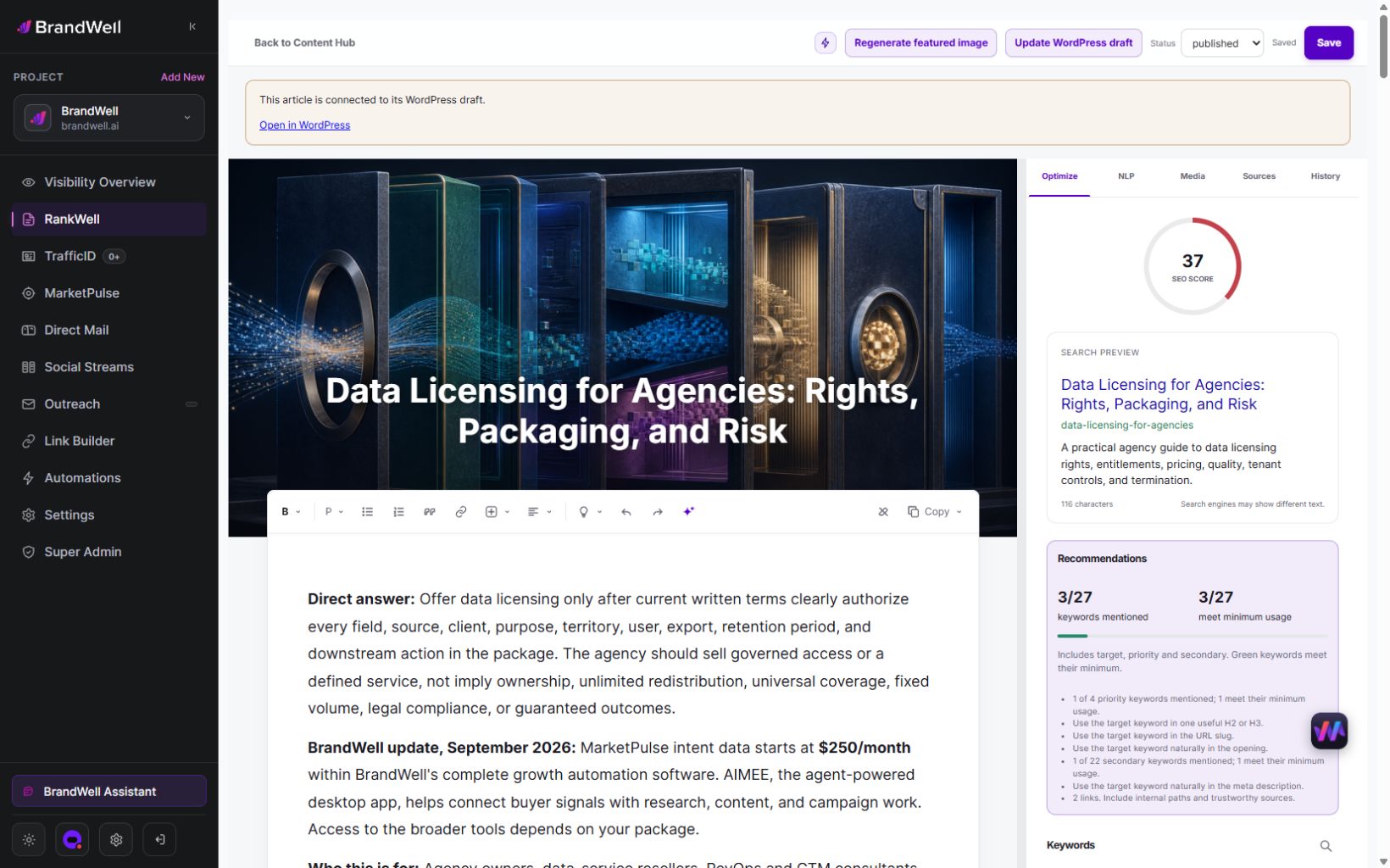
In the current BrandWell portal, use RankWell to prepare the page and review its search preview. Check that the proposed title, summary, article, sources, and image tell the same story.
After publishing through your actual CMS workflow, inspect the public output. An editor preview does not prove the theme or integration emitted the expected metadata.
- Confirm the public URL loads successfully.
- Check the emitted title, description, canonical, and effective indexing rules.
- Confirm that the featured social image is relevant and publicly accessible.
- Check mobile layout and meaningful alt text.
- Inspect the URL in Search Console when needed.
- Record the change and review search performance after a suitable period.
For CTR work, compare actual queries and positions rather than assuming every low-CTR result has a metadata problem. Keep before-and-after dates and do not claim improvement before results exist.
Common questions
Are title tags and headings meta tags?
No. They are different HTML elements with different locations and purposes.
Can meta tags guarantee an AI Overview citation?
No. Describe the page accurately, make it accessible, and support its claims. Metadata is not a guaranteed inclusion mechanism.
Should every public page have noindex?
No. Use exclusion only for the intended pages and verify it. Accidental noindex can prevent an otherwise useful page from appearing in search.
Reviewed and updated October 2, 2026.

Written by