


On this page
- Define what you will automate
- Evaluate a niche with five practical gates
- Ten niches and one additional opportunity
- Six strategies for a reviewed automation workflow
- Use the current BrandWell content workflow
- Four controls that keep automation useful
- Measure the full cost and useful outcome
- Frequently asked questions
The best niche for an AI-assisted blog is one where you can provide original evidence, answer recurring reader questions and maintain the information accurately. Automation can help with briefs, draft organization and repeatable publishing tasks. It cannot test a recipe, visit a destination, establish clinical expertise or guarantee income for you.
Choose a narrow audience and a useful editorial promise before choosing software. A broad topic with an apparent commercial opportunity may still be a poor fit if you cannot verify the advice or sustain the required updates.
Define what you will automate
Separate topic planning, research collection, drafting, review, media preparation, publication and maintenance. An approved workflow may automate selected steps; the finished article still needs an accountable editor.
Google’s AI-content guidance distinguishes useful automation from content generated primarily to manipulate rankings. Using AI does not itself earn special search advantages.
Evaluate a niche with five practical gates
- Reader need: Identify a repeated question rather than assuming a topic is trending.
- Evidence: Explain what firsthand experience, authorized data or specialist review you can supply.
- Maintenance: Name the facts that change and the person who will check them.
- Business model: Test an actual offer and include the full operating costs.
- Editorial capacity: Publish only as fast as your team can review and maintain.
Score each gate for your own circumstances. These are decision criteria, not a universal ranking of lucrative niches. A narrowly scoped, well-supported article can be more useful than a high-volume stream of generic advice.
Ten niches and one additional opportunity
The following are possible directions, not claims about current search volume or profitability. Each distinguishes preparation that AI can assist from evidence a publisher must obtain.
1. Personal finance
Consider a documented budgeting workflow for a specific audience. AI can organize an outline or supplied calculations. A knowledgeable reviewer must verify arithmetic, dated rules and the limits of any advice. Avoid personalized investment recommendations generated without an appropriate professional process.
Possible products include tested budgeting templates. Explain assumptions and support requirements rather than promising returns or effortless commissions.
2. Health and wellness
Start with appropriately scoped education or a clearly labeled personal activity journal. AI can help organize supplied source material; qualified review is needed for clinical or nutrition claims. Do not present generated therapy, diagnosis or individualized treatment as ordinary blog automation.
A useful publishing process includes the source date, reviewer and an update rule. Product promotion must not outrun the evidence.
3. Food
Use recipes you actually test and photograph. AI can help organize notes, ingredient lists and draft explanations, but cooking results and safe preparation require verification. Record quantities, timing, substitutions and failures.
A cookbook or class can extend demonstrated expertise. An invented recipe collection is not validated simply because its text reads smoothly.
4. Travel
Focus on an audience and place you can research responsibly. AI can turn verified trip notes into an outline; the publisher must check transport, entry conditions, hours, accessibility and costs. Label whether a guide comes from a visit or desk research.
Planning resources or services need an update process. Do not fabricate visits, photographs or endorsements.
5. Parenting
Document routines for a family stage or practical organization problem. AI can help structure an article; child development and safety claims require reliable sources and appropriate review. Protect children’s privacy and distinguish one household’s experience from general evidence.
Test demand for useful organization resources. Avoid an unattended chatbot that presents generated parenting advice as expert judgment.
6. Beauty and fashion
Build around original fit, wear or styling tests for a defined audience. AI can organize comparison criteria and supplied notes. Verify ingredient and skin-health claims separately; record test conditions and disclose relevant relationships.
Reviews should say what was actually tested. An affiliate commission is not evidence that a product works.
7. Men’s lifestyle
Choose a concrete task, such as wardrobe planning for a workplace or a documented grooming routine. AI can assist outlines and editing. Avoid substituting demographic stereotypes for reader research, and keep health or fitness recommendations within verified expertise.
Scoped resources or services may fit. Measure real demand instead of labeling the entire category a passive-income opportunity.
8. Pets
Document a particular animal-care or training process. AI can help organize observations and veterinary source notes. A generated meal plan or symptom explanation is not veterinary care; obtain qualified review and explain when professional help is needed.
Product reviews need original use evidence. Do not invent breed-specific results or universal training success.
9. Sustainable living
Investigate a specific household decision with transparent measurements and limits. AI can organize a comparison. Verify environmental claims, relevant location and what a label actually covers before describing a product as greener.
Explain tradeoffs and uncertainty. A vague “eco-friendly” roundup without evidence does not establish a useful commercial offer.
10. Technology
Publish tested tutorials for a specific user task. AI can help organize steps and explain supplied documentation; a person should run the steps, record the version and capture current screenshots.
Separate available features from prototypes or predictions. News needs primary-source verification and dates. Do not turn speculative technology into present product functionality.
Additional opportunity: e-commerce education
Explain buying or store-management decisions with verified product details and real experience. AI can help structure guides from approved information. Keep prices, availability, returns and specifications current; generated reviews must not pretend to be hands-on tests.
Digital resources, services or disclosed referrals are possible models. Their economics depend on actual demand, costs and eligible purchases.
Six strategies for a reviewed automation workflow
- Choose the workflow first: Define inputs, required evidence, owner, approval and destination. Confirm what the selected software package supports.
- Plan real questions: Use customer conversations and search data alongside original expertise. Distinguish observed demand from an AI suggestion.
- Build the brief: Include the audience, source material, scope, exclusions and claims needing expert verification.
- Review before scheduling: Approve facts, examples, media rights, links and mobile presentation. Test the actual publishing connection.
- Repurpose approved material: Check that shorter social or email versions preserve context and limitations. Assign approval before external publication.
- Maintain and measure: Track outcomes and corrections, investigate weak pages and retire unsupported claims rather than merely changing dates.
Use the current BrandWell content workflow
RankWell supports preparing and reviewing content in the BrandWell portal. Start with a researched brief and your own evidence. Review the article, sources, media and search preview, then inspect the approved page at its publishing destination.
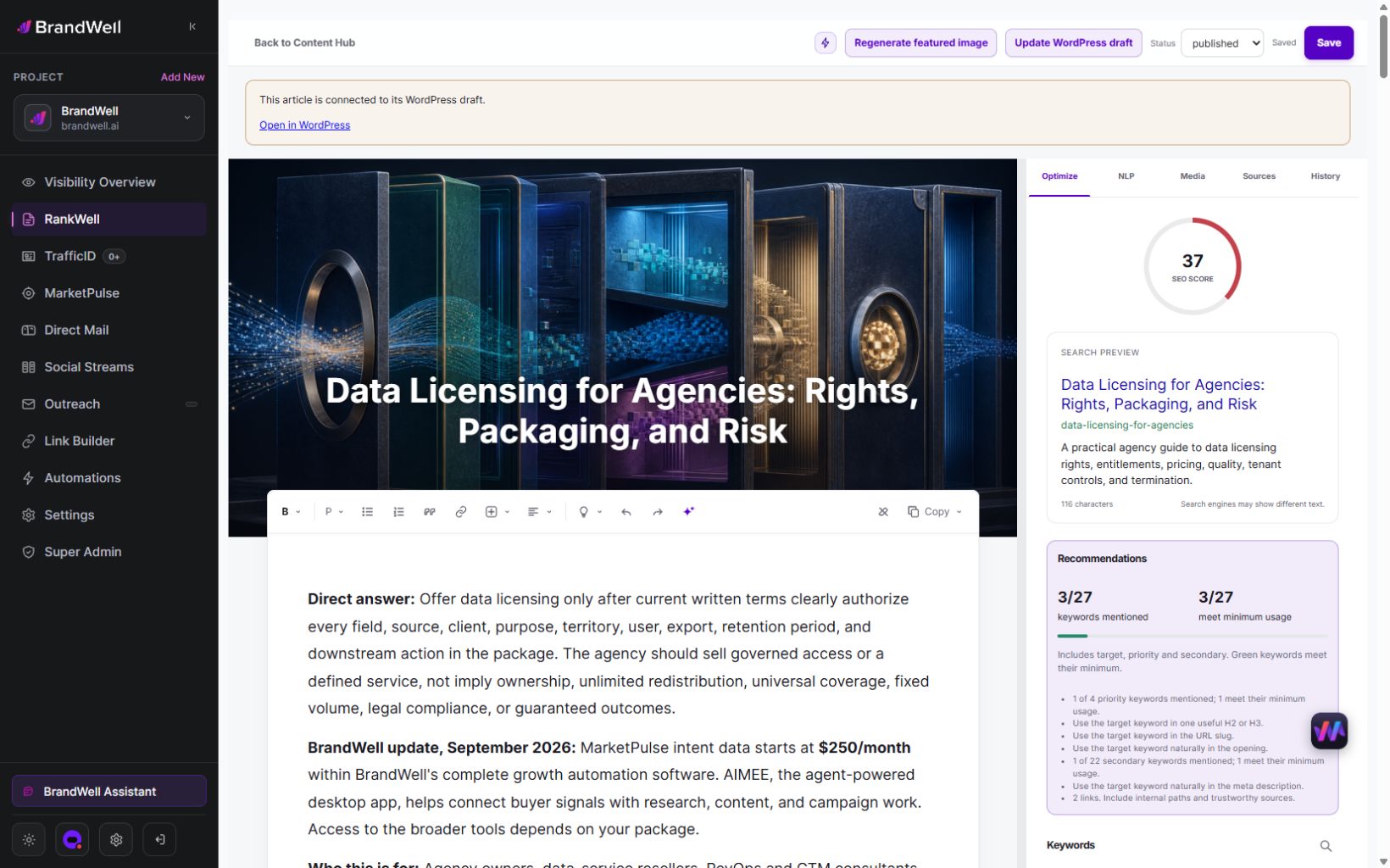
The Content Hub organizes the content queue. BrandWell Automations and AIMEE can support configured work through connected tools. Confirm access, supported actions and approval boundaries; this is not a promise of unlimited publication, universal desktop access or an unattended expert-advice service.
Four controls that keep automation useful
- Original contribution: Include tested steps, observations or an explanation that adds value beyond a summary.
- Review capacity: Match output to the time available for editing and fact checks.
- Update ownership: Assign someone to recheck changing prices, rules, features and links.
- Reader clarity: Use direct answers, descriptive headings and accessible images without inventing evidence or guaranteeing AI-search inclusion.
Measure the full cost and useful outcome
Fictional workflow example: Preparing an article manually takes eight hours. AI reduces preparation to three hours, but review takes two hours and correction another hour. The full workflow is six hours, a 25 percent reduction from eight. Calling it a 62.5 percent saving would count preparation alone and hide the remaining work.
Record software, source acquisition, editing, image production, corrections and maintenance costs. Keep actual search impressions, clicks, CTR and position separate from qualified inquiries or sales. Before-and-after changes do not establish causality by themselves.
Frequently asked questions
What is the most profitable niche?
There is no defensible universal answer. Validate your audience, offer, evidence and complete costs before choosing a niche.
Can an automated blog run without review?
Drafting or scheduling can be automated, but factual accuracy, permissions and editorial responsibility still need accountable review.
Can a publishing formula guarantee 100,000 views?
No. A word count, posting frequency or tool choice does not guarantee traffic. Use actual performance and reader needs to guide improvements.
Should I automatically rewrite every old article?
No. Identify what is outdated, verify new evidence, preserve useful material and inspect the live result. Changing dates alone is not an update.
Explore RankWell and begin with one useful question, a verified brief and a complete review process.
Reviewed and updated October 3, 2026.

Written by
Jeff Joyce has been helping brands grow online since the Myspace era, when custom HTML layouts were still a competitive advantage. What started in design quickly evolved into a career spanning social media, content strategy, video, agency ownership, and growth marketing. After building his own agency and testing countless AI tools, Jeff joined BrandWell with a clear focus: helping marketers understand how AI can actually improve the way they create, optimize, and scale content. Today, Jeff brings a CMO-level perspective to BrandWell's marketing strategy, blending brand positioning, content, video, customer education, and growth. His work centers on turning complex AI concepts into clear, practical marketing that helps brands move faster, create better content, and stay competitive without losing their voice.

 Farnaz Kia