


On this page
- Start with the job your tool needs to do
- Evaluate the workflow with one real article
- Use search data to choose the revision
- Work through the article in BrandWell
- Build a claim-and-source check
- Improve search presentation without exaggeration
- Prepare for AI search with useful original material
- Check the published page
- Measure outcomes after the update
A useful SEO content optimization solution helps you choose the right reader problem, improve an existing page, verify its claims, publish cleanly, and measure the result. A content score alone cannot establish that an article is accurate, useful, or likely to rank.
For teams using BrandWell, the practical combination is Visibility for research, RankWell for the article workflow, and AIMEE for supported work across connected tools. This is a guide to evaluating and using that workflow, not an independent ranking of competing products.
Start with the job your tool needs to do
Separate the work into five questions:
- Research: What is the audience trying to accomplish?
- Planning: Should you improve an existing page or create a new one?
- Editing: What information, evidence, and examples would make the page useful?
- Publishing: Does the finished page work on the actual website?
- Measurement: Are the intended people finding and using it?
A tool can be strong at one job without covering all five. Analytics reports measure activity; they do not automatically correct the article. A writing assistant can organize a draft; it does not turn an unsupported claim into a sourced fact.
Evaluate the workflow with one real article
Choose an existing article with enough search data to review and a clear business purpose. Save its content, metadata, publication history, and performance baseline. Then use the same brief to test the proposed workflow.
For example, suppose a service business has a guide to preparing for a payroll-system migration. Readers may need an implementation checklist, data-cleanup steps, and a realistic explanation of responsibilities. Adding more occurrences of “payroll software” would not resolve those missing answers.
Record whether the workflow helps you find the missing information, identify unsupported statements, preserve good material, and hand the page to a reviewer. Those are more useful evaluation criteria than how quickly it generates a large word count.
Use search data to choose the revision
Review the page in Google Search Console. Compare its queries, impressions, clicks, CTR, and average position over a consistent period. Segment by device or country when that changes the interpretation.
- Many impressions, weak CTR: inspect the query mix, position, title, and whether the page promises the right answer.
- Relevant queries, weak page content: add the missing explanation, evidence, or practical example.
- Several pages answering the same task: review their purpose and overlap before creating another article.
- Few impressions: investigate indexing, internal discovery, demand, and relevance rather than assuming the headline is the problem.
CTR depends on the context in which the result appears. A site-wide average is not a universal target for every query. Keep your change log so a later comparison has a clear starting point.
Work through the article in BrandWell
Research in Visibility
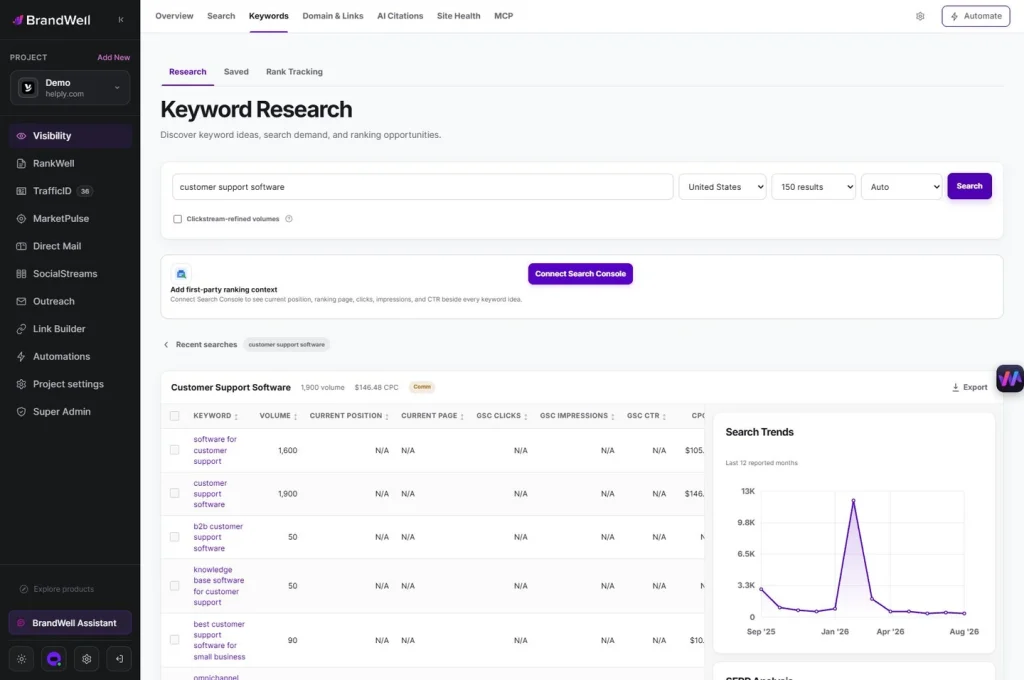
Open Keywords and Research to investigate the language and questions around the subject. Group ideas by the reader’s task. Treat estimates as directional research, not as guaranteed visits or proof that a particular person will buy.
Review the existing opportunity in RankWell
In RankWell, review the existing article opportunity before adding another page. Prepare the audience, intended outcome, reliable sources, and original examples. Use the editor’s search preview and recommendations to inspect the draft, then make an editorial decision about each suggestion.
A suggested term may reveal a missing concept. It may also be irrelevant to your particular audience. Add the explanation when it helps the reader; do not insert words simply to raise a score.
Use AIMEE for a defined supporting task
Give AIMEE the approved materials and a specific instruction, such as organizing source notes or drafting three accurate title options. Ask it to identify uncertainty rather than fill gaps with invented facts. Review any action that changes the published page or connected workflow.
Build a claim-and-source check
For each statistic or product claim, record the source, publication date, population, and what the evidence actually measures. Distinguish a survey response from observed behavior, and an estimate from a measured count.
If a statistic cannot be supported, remove it or replace it with a clearly labeled example. A made-up “300% increase” is not a useful headline template. Likewise, do not imply personal testing merely because a generated draft uses first-person language.
Link to the source that supports the statement, not an unrelated homepage. A reference is there to let readers inspect the evidence; linking to an authoritative domain does not make every nearby claim true.
Improve search presentation without exaggeration
Write a title that identifies the task and the useful distinction in the article. For the payroll example, “Payroll Migration Checklist: Data, Owners, and Launch Checks” describes a concrete deliverable without promising effortless implementation.
Use headings to organize the answer. Add a concise description that accurately summarizes the page. Avoid changing an established URL just to insert another keyword.
Google’s guidance on third-party SEO tools makes an important distinction: their predictions are their own, not access to Google’s internal ranking data. Neither BrandWell nor another tool can guarantee a ranking from a score.
Prepare for AI search with useful original material
Google’s current generative AI search guidance emphasizes useful, distinctive material and ordinary SEO foundations. Original demonstrations, documented examples, and relevant images can give a page more value than a rearrangement of common advice.
There is no special paragraph length, keyword formula, or AI markup that guarantees inclusion. Answer the actual question clearly, show your evidence, and keep the page accessible for crawling and indexing. Check the site’s generative AI inclusion settings and use the available Search Console reporting to establish a baseline.
Keep FAQs when they answer reader questions. Do not promise a Google FAQ rich result: Google retired that search feature in May 2026. A useful question-and-answer section can still help a reader without that display.
Check the published page
- One clear main heading and a logical heading hierarchy
- Readable paragraphs, lists, and tables on a narrow screen
- Relevant, legible images with appropriate alternative text
- Working source and internal links
- Correct canonical URL and social preview image
- No accidental indexing block or broken page template
- Forms and next-step links that work as described
Use performance diagnostics to find loading problems, then inspect the real page. A screenshot, video, or tracking script can change the experience after the text is published. Preserve earlier versions so an unwanted change can be reversed.
Measure outcomes after the update
Compare a suitable later period with the saved baseline. Look at query relevance and useful business actions as well as traffic. Account for seasonality, position changes, and other site updates before attributing a result to one edit.
The purpose of content optimization is a better page and a better decision for the reader. Treat rankings, clicks, and conversions as outcomes to observe, not promises to put into the draft.
Reviewed and updated October 2, 2026.

Written by
Jeff Joyce has been helping brands grow online since the Myspace era, when custom HTML layouts were still a competitive advantage. What started in design quickly evolved into a career spanning social media, content strategy, video, agency ownership, and growth marketing. After building his own agency and testing countless AI tools, Jeff joined BrandWell with a clear focus: helping marketers understand how AI can actually improve the way they create, optimize, and scale content. Today, Jeff brings a CMO-level perspective to BrandWell's marketing strategy, blending brand positioning, content, video, customer education, and growth. His work centers on turning complex AI concepts into clear, practical marketing that helps brands move faster, create better content, and stay competitive without losing their voice.

 Farnaz Kia