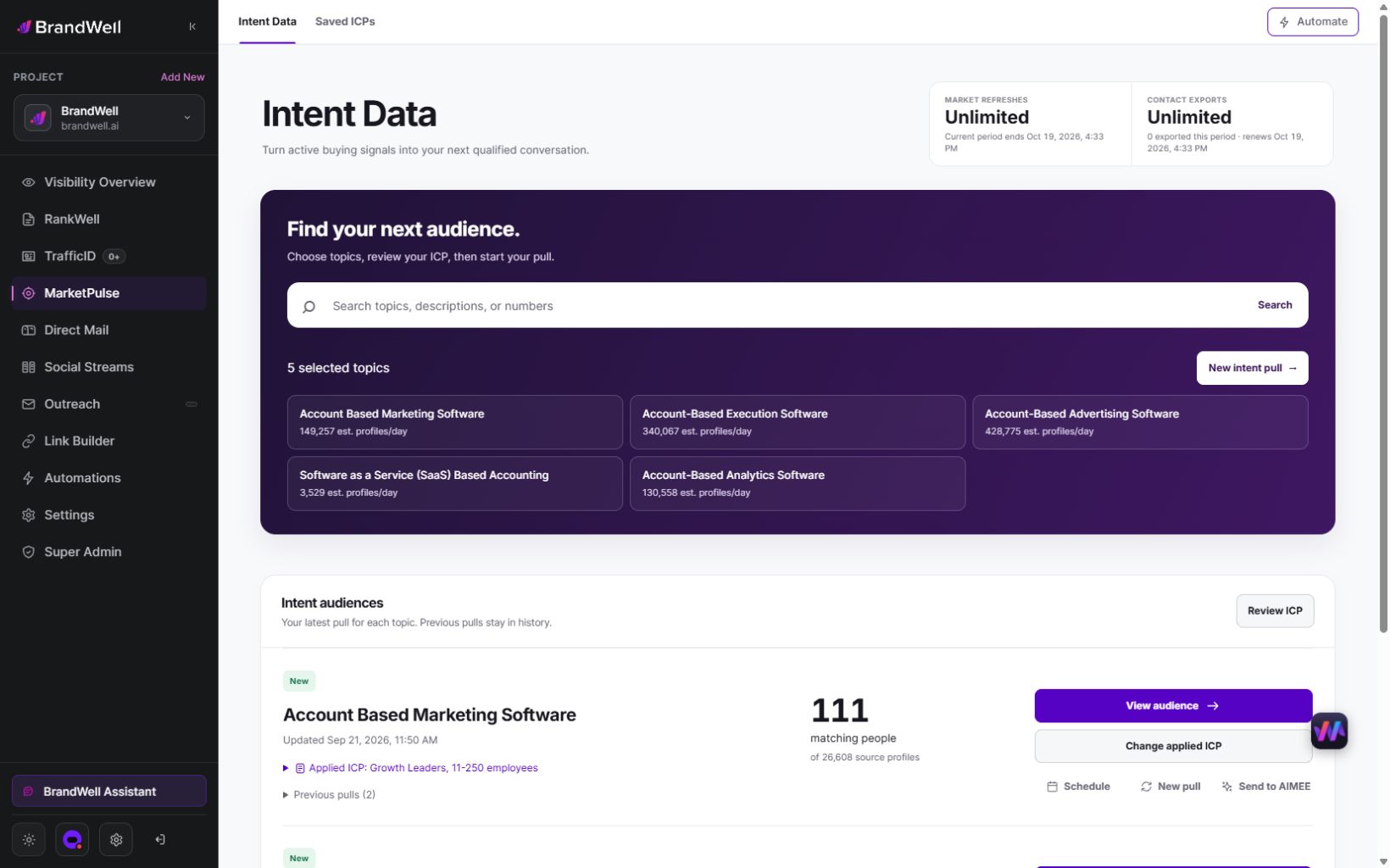
A successful BrandWell intent data implementation starts with a decision and an owner – not a list of integrations. Define the market and selected topics, choose the contracted delivery surface, set fit and freshness rules, separate account intent from person identity, connect one bounded action, and agree on acceptance evidence before production. Use a five-phase path: scope, configure, control, test, then launch and learn.
Who this is for
- Agencies and resellers implementing the new BrandWell intent-data service for themselves or clients.
- RevOps, demand generation, paid-media, and outbound leaders assessing implementation readiness.
- Data, privacy, security, and operations owners reviewing access, workflow, and governance.
- Buyers choosing between internal implementation, an agency, and vendor services.
BrandWell’s agency-reseller intent product is separate from the legacy BrandWell SEO writer. Intent and identity outputs are probabilistic. Implementation should improve how a team prioritizes and acts; it cannot guarantee coverage, a person’s identity, purchase readiness, pipeline, revenue, ad performance, or compliance.
BrandWell implementation readiness: the five gates
Do not begin configuration until every gate has an owner and a pass condition.
Outcome gate
Name one decision the first implementation will improve. Examples: which accounts receive weekly seller research, which qualified companies enter an approved audience, or which signals appear in a branded client report. State the baseline, the action owner, and the evidence the team will record.
“Find in-market buyers” is too broad. A practical first outcome is: “Within the agreed freshness window, route qualified accounts researching the selected topic cluster to the named client strategist for accept, reject, or defer decisions.”
Market and signal gate
Document the ICP, market, territories, company-size bands, exclusions, account hierarchy, topic clusters, ambiguous topics, competitors, products, services, and minimum useful volume. Request a representative sample rather than inferring fit from a headline topic count.
For every event, preserve source class, observed time, topic or behavior, geography, account resolution, confidence, and data-use flags. Decide how stale, duplicated, suppressed, weak-fit, and unresolved events are handled.
Action gate
Define the first destination and play. It may be a portal/report decision, CRM task, account brief, audience candidate, export, or reviewed outreach draft. Name the owner, SLA, capacity, required fields, approval, expiry, and outcome fields.
If no team can act within the signal’s useful window, implement reporting and learning first. Do not automate delivery into an ignored queue.
Data and governance gate
Map data source, processing purpose, roles, permitted use, access, retention/deletion, security, subprocessors, suppressions, opt-outs, incident handling, and end-of-service disposition. The NIST Privacy Framework offers a useful voluntary structure for identifying processing, purposes, roles, risks, and current/target controls. It is not a compliance certificate or legal advice.
If TrafficID is in scope, reverify current geography and use restrictions before placing it on a site. BrandWell’s current TrafficID FAQ says results can be incomplete, are per project and U.S.-only, and that TrafficID is not HIPAA compliant and should not be used on medical sites.
Commercial gate
The accepted Order Form should identify the plan, modules, protected scope, topics, territory, use case, exclusions, client and topic capacity, usage, delivery surface, implementation, support, term, and price. Do not assume a standard portal includes API access or a custom portal.
Record which party handles client selection, pricing, contracting, disclosures, invoicing, refunds, support, and compliance. In BrandWell’s agency model, those end-client commercial duties remain with the agency while BrandWell bills the agency, subject to the governing order and terms.
The five-phase BrandWell implementation plan
Phase 1: Define scope and acceptance
Create a one-page implementation charter with:
- business outcome and baseline;
- buyer roles and action owner;
- market, geography, ICP, exclusions, and suppressions;
- selected topic clusters and ambiguity notes;
- first-party visitor, identity, and enrichment modules in scope;
- contracted portal, API, custom portal, report, dashboard, export, or destination;
- first action and approval boundary;
- acceptance tests, reporting cadence, and decision date.
BrandWell’s custom quote page says configuration depends on market coverage, categories, lead volume, TrafficID, enrichment depth, routing, dashboard requirements, and connected tools. Treat that as discovery input. The Order Form – not a feature page – must confirm what is included.
Phase exit: executive sponsor, operator, data/privacy owner, and implementation owner approve the charter and prerequisites.
Phase 2: Configure the data and client workspace
Build a shared event schema. At minimum, include tenant/client ID, event ID, source, source timestamp, normalized observed time, topic or behavior, company domain, account hierarchy, geography, fit fields, identity level, confidence, enrichment validation, freshness, suppression, qualification status, reason code, destination status, and outcome reference.
Configure the chosen portal or reporting workspace, client branding, users, roles, client/topic capacity, filters, and report layout. Verify that each client sees only its own data and that exports retain client and event identifiers.
BrandWell’s Terms distinguish standard portal, API-only, and custom portal delivery. They also describe a white-label portal as potentially including separate branding, client and topic capacity, reports, filters, and workflows. “May include” is not an entitlement matrix; test the actual order and account.
If contractually scoped topic protection is included, record the exact topic, territory, use case, exclusions, term, availability confirmation, activation event, renewal, and release rule. Do not configure a generic tag called “exclusive” and assume it applies universally.
Phase exit: sample events reconcile to source, tenant boundaries pass, entitlements match the order, and the team signs off on field definitions.
Phase 3: Configure qualification, approvals, and agent instructions
Create explicit rules for fit, freshness, topic strength, identity requirements, contactability, suppressions, client capacity, and destination eligibility. Use accept, reject, hold, investigate, and expire states with reason codes.
Then write a play card:
- trigger and required evidence;
- fields and tools allowed;
- fit/freshness decision rules;
- proposed action and output format;
- claims or content permitted;
- human approval required;
- forbidden actions;
- expiry and escalation;
- outcome fields and feedback.
BrandWell delivers agent-ready workflow instructions that can be carried out with Claude, ChatGPT, or directly in the browser through Moxby. Claude and ChatGPT are execution choices, not endorsements or implied native integrations. Moxby is a separate browser-first product. Use the same approvals regardless of execution surface.
Allow automatic normalization, deduplication, public-company research, reversible draft assembly, and exception classification when controls are stable. Review person-level outreach, audience uploads, external posting, claims, budget changes, new data sharing, and consequential actions.
Phase exit: reviewers can explain why a sample was accepted or rejected, reproduce the decision, and see the evidence before approving an external action.
Phase 4: Connect, test, and recover
Start with one destination. BrandWell describes a broader workflow of market mapping, topic signals, TrafficID, enrichment, qualification, dashboards, and routing to CRM, outbound, ads, AI, or exports in its custom workflow guide. That is a sequence, not proof that every connector is included.
Test the happy path and predictable failures:
- missing company domain or required field;
- duplicate event and retry;
- stale event;
- low-confidence identity;
- suppressed account or person;
- expired or revoked credential;
- permission failure;
- destination schema or picklist change;
- client capacity exceeded;
- approver timeout;
- export and report reconciliation after recovery.
Retries must be idempotent: the same event should not create two tasks, duplicate an audience entry, or trigger two messages. Create a capped retry policy and an exception queue with a named owner.
For API-only or custom implementation, protect credentials, use least privilege, validate inputs and outputs, log access and decisions, set rate and retry behavior, test revocation, and define incident response. NIST’s API protection guidance supports a risk-based approach across design and runtime; it does not certify BrandWell or a client’s implementation.
Phase exit: critical failure drills pass, recovery is documented, and the report reconciles to the event ledger.
Phase 5: Pilot, launch, and learn
When offered, BrandWell’s $70 seven-day reseller pilot can generate branded topic reports before a separate paid order is accepted. Define pilot market, topics, input, report, exclusions, access, evaluation criteria, data disposition, and the exact paid-conversion act. Keep the pilot distinct from production setup and from legacy or TrafficID trials.
Evaluate:
- whether topics produce relevant, non-duplicated accounts;
- whether timestamps and context support the first decision;
- whether identity/enrichment is sufficient for the chosen action;
- whether a client or internal reviewer accepts the report;
- what manual work and exceptions are required;
- whether a real owner will act;
- whether the economics justify production.
After acceptance, launch to a bounded client, topic set, destination, and capacity. Monitor more frequently until exceptions stabilize. Change one material rule at a time and version the configuration.
Phase exit: production ownership, monitoring, support, reporting, change control, renewal, and exit are all documented.
Documentation and support resources to require
Build an implementation evidence pack with ten artifacts:
- accepted Order Form and entitlement matrix;
- implementation charter and RACI;
- market, ICP, exclusions, and topic map;
- data-flow diagram and field dictionary;
- privacy/security questionnaire and approved uses;
- qualification rules and reason-code dictionary;
- play cards and agent instruction versions;
- connection, credential, QA, and recovery runbook;
- baseline, measurement plan, and evidence ledger;
- client handoff, support, change, renewal, and exit plan.
A sandbox or test workspace is valuable only if it resembles production permissions and schema. Mask or minimize data where possible. Do not copy live client data into an uncontrolled test environment merely to accelerate setup.
In-house, agency, or vendor-assisted implementation?
| Model | Best fit | Buyer responsibilities | Main limitation |
|---|---|---|---|
| In-house | mature RevOps/data team with stable use case | architecture, rules, integrations, governance, adoption | internal backlog and specialist time |
| Agency-led | client needs strategy plus operated actions | sponsor, access, approvals, outcome feedback | scope creep and agency dependency |
| Vendor-assisted | BrandWell-specific configuration and entitlement questions | business decision, client stack, acceptance | vendor cannot own client change management |
| Shared model | most recurring reseller programs | clear RACI across vendor, agency, and client | handoff ambiguity unless documented |
Choose by ownership, not prestige. Vendor help can answer product configuration. An agency can map the client workflow and operate delivery. The client’s own team must still approve purposes, access, claims, destinations, and outcomes.
Implementation cost and total cost of ownership
Separate one-time and recurring costs.
One-time: discovery, market/topic mapping, access and governance, portal/report branding, fields, rules, destinations, play cards, testing, baseline, training, and launch support.
Recurring: platform and usage, topic and client capacity, TrafficID/enrichment where included, monitoring, exception handling, reporting, optimization, client support, connectors, media/tools, and risk reserve.
Use:
monthly TCO = BrandWell plan and usage + other tools/media + direct labor + integration/support + risk reserve
BrandWell agency plans are $2,500–$5,000 per month, depending on topic count, contract term, and any contractually scoped topic exclusivity that is available. Confirm included modules, usage, client capacity, implementation, support, and exclusivity in the current written quote and order form.
For a deeper pricing model, refer to the BrandWell guide to wholesale costs, retail packaging, and agency margins.
Metrics for implementation acceptance
Time-to-value
Track time from kickoff to sample, first accepted report, first qualified event, first completed action, and first reconciled outcome. Do not publish a universal implementation timeline; dependencies vary.
Data quality
Track schema completeness, duplicates, source latency, freshness, account-resolution yield, identity/enrichment yield for the intended action, suppressions, sampled false positives, and exception backlog.
Adoption and activation
Track report or portal use, decision rate, accept/reject/defer mix, time to decision, action completion, destination failures, approval time, and expired signals.
Outcome and economics
Track qualified responses, meetings, opportunities, pipeline, revenue, retention, or media outcomes with denominator and evidence method. Also track direct labor, manual minutes per accepted event, utilization, support burden, and contribution margin.
The first implementation succeeds when the operating chain works and produces decision-grade evidence. A revenue outcome may require a longer sales cycle than the acceptance period.
Readiness by team maturity
- Exploring: start with a market map, topic sample, branded report, and manual review.
- Operational: add consistent qualification, client workspace, one destination, reason codes, and outcome fields.
- Scaled: add multiple clients or topics, monitored automation, capacity controls, rule versioning, and standardized support.
- Advanced: add experiments, multi-source evidence, API/custom workflows where contracted, and deeper outcome feedback.
Do not jump maturity levels by buying more data. Readiness depends on ownership, decisions, permissions, and learning loops.
Risks that derail BrandWell implementation
- confusing the intent agency product with the legacy SEO writer or a separate direct offer;
- assuming a public capability page equals a contracted entitlement;
- selecting broad or ambiguous topics without sampling;
- merging account research with certain person identity;
- ignoring TrafficID geography or sensitive-site restrictions;
- inviting clients before tenant separation and roles pass;
- connecting several destinations before one path is recoverable;
- allowing AI or browser automation to communicate externally without approval;
- omitting suppressions, opt-outs, data exit, or credential revocation;
- promising coverage, match rate, “real time,” pipeline, or ROI without evidence.
If U.S. commercial email is an activation, follow the FTC CAN-SPAM guide, including B2B applicability and opt-out obligations. Review other channels and jurisdictions separately.
How agencies should package implementation for recurring clients
Standardize discovery, topic map, workspace, schema, qualification, play cards, QA, baseline, branded report, and support. Make client-specific configuration visible while keeping the core operating model reusable.
BrandWell’s complete white-label agency sales-and-delivery engine can include branded portal and reports, client/topic capacity, filters, and workflows as specified in the order. Contractually scoped topic exclusivity may be available, subject to topic and market availability, use case, exclusions, term, and the Order Form. Treat it as a documented entitlement, not an implied universal claim.
Charge setup for implementation work and recurring fees for capacity, monitoring, reporting, optimization, and support. Define wholesale versus retail responsibilities, change control, and data exit. Keep bespoke integrations and high-touch client operations separately priced.
The implementation acceptance worksheet
Use this worksheet at kickoff and again before production. A “partial” answer must include an owner and resolution date.
| Control | Pass question | Evidence |
|---|---|---|
| Product identity | Is everyone buying the intent agency/reseller offer rather than the legacy writer or another direct plan? | order, entitlement matrix, kickoff charter |
| Market | Is the ICP, territory, size band, hierarchy, and exclusion set approved? | market map and sample accounts |
| Topics | Have selected and ambiguous topics been sampled with real outputs? | topic dictionary, sample, rejection notes |
| Delivery surface | Is standard portal, API-only, custom portal, report, export, or destination written into scope? | order and access test |
| Client isolation | Can each agency client access only its workspace and exports? | role and tenant test |
| Signal evidence | Are source, observed time, topic, geography, and event ID preserved? | field-level reconciliation |
| Identity | Is required account/person confidence defined for each action? | match sample and reason codes |
| Governance | Are purpose, roles, permitted use, retention, suppressions, and incident ownership approved? | data flow, privacy/security review |
| Qualification | Can a reviewer reproduce accept, reject, hold, and expiry decisions? | versioned rule tests |
| Activation | Does one destination have a named owner, SLA, capacity, approval, and rollback? | play card and destination test |
| Recovery | Do duplicate, credential, schema, permission, and suppression failures recover safely? | test log and runbook |
| Measurement | Are baseline, denominator, outcome field, evidence method, and decision date fixed? | measurement plan |
| Economics | Are setup, recurring cost, usage, labor, support, and overages modeled? | TCO and margin worksheet |
| Exit | Can access, data, destinations, credentials, and topic scope be released cleanly? | exit checklist |
Do not waive a failed identity, governance, tenant, or recovery control merely because the sample report looks persuasive. Move the implementation back to the phase that owns the failure. That is cheaper than allowing a defect to reach every reseller client.
Example first-production workflow
The smallest useful production loop looks like this:
- BrandWell makes a scoped topic event available with its provenance and observed time.
- The workflow normalizes the event and checks duplicate, client, geography, and suppression rules.
- It applies account fit, topic, freshness, and required identity/enrichment thresholds.
- Rejected or unresolved records receive a reason code; accepted records receive a proposed play.
- An agent may assemble an evidence packet and draft the reversible next step.
- The named human accepts, edits, rejects, or defers the recommendation.
- The approved action enters one destination and returns a delivery status.
- Downstream response or outcome fields reconcile to the event ID.
- The branded client report shows decisions, exceptions, timing, and evidence – not only volume.
- A scheduled review changes one rule, records the new version, and watches the next cohort.
This loop is intentionally narrower than a fully autonomous GTM system. It creates a reliable evidence spine that later workflows can reuse.
Frequently asked questions
What outcome should guide BrandWell implementation?
Choose one measurable decision and action, such as a weekly qualified-account review. Define baseline, owner, SLA, evidence, and limitations before selecting connections.
Which phases are required?
Scope and accept, configure data/workspace, set qualification and approvals, connect/test/recover, then pilot and launch. Each phase should have a documented exit test.
Which resources help most?
The accepted order, entitlement matrix, RACI, topic map, schema, data-flow diagram, rule dictionary, play cards, QA/recovery runbook, evidence ledger, and support/exit plan are more useful than an isolated feature checklist.
Should implementation be in-house or assisted?
Keep internal ownership of purpose, access, approvals, and outcomes. Use an agency for client workflow and operated delivery, and vendor help for product-specific configuration. A shared RACI is usually the practical choice.
What indicates readiness?
Readiness means a stable ICP, selected topics, permitted purpose, action owner, destination access, baseline, outcome capture, support ownership, and enough capacity to act. Software access alone is not readiness.
How should intent, identity, and routing be configured?
Preserve source and time, qualify account fit and freshness, require only the identity needed for the action, apply suppressions, route to one named owner, require approval for external actions, and record outcome and exceptions.
Which costs are easy to miss?
Teams often omit topic and client overages, data repair, CRM field cleanup, connector monitoring, credential rotation, report revisions, client support, training, security review, incident recovery, and manual approval time. Include those in total cost and keep custom work behind change control.
Which metrics matter during launch?
Track time to first accepted output, schema completeness, unique records, freshness, identity yield for the intended action, accept/reject reasons, destination success, recovery, action completion, and direct labor. Revenue may lag; implementation acceptance should not require an invented short-cycle ROI.
How should an agency scope the recurring implementation?
Sell a standardized setup with clear client-specific configuration, then a recurring operating package for capacity, monitoring, reports, rule review, and support. Price integrations, exceptional data work, additional destinations, extra clients/topics, creative, and compliance work separately.
What does the seven-day pilot prove?
It can test topic/report usefulness, early coverage, review, and the agency’s sales artifact. It cannot prove production scale, long-cycle revenue, incremental lift, or universal match quality.
Check the economics before a full plan
For a $70 pilot fee, agencies get seven days to validate the reseller offer. BrandWell supplies agency-branded topic reports and the complete sales playbook for presenting the service and seeking client commitments before any full-plan enrollment.
The agency can use the pilot evidence to assess demand, compare expected commitments against costs, and decide whether the service can become a profit center. Commercial and financial outcomes are not guaranteed. Review the $70 seven-day reseller pilot.