On this page
- Current MarketPulse research workflow
- Keep observations and inferences distinct
- Maintain a scope-specific limitation register
- Test representative cases and changes
- Request an inspectable evidence kit
- Compare equivalent operating scopes
- Count full costs and corrections
- Measure coverage, quality and actions separately
- Check operating prerequisites
- Approve actual actions and destinations
- Resolve source, rights and dependency gaps
- Disclose uncertainty in client reporting
- Set launch and stop conditions
- Copyable limitation and acceptance record
- Frequently asked research-limit questions
MarketPulse supplies topic research and available match context. A separately implemented agency service needs verified reporting, client boundaries, rights, approvals and operating ownership. Research cannot guarantee purchase readiness, universal coverage or pipeline. Test actual scope and preserve uncertain or missing evidence.
Review an available MarketPulse topic, saved ICP and actual preceding-24-hour matches for the approved research purpose. Keep uncertain company context visible. AIMEE can organize supplied context through configured tools; named owners approve actual exports, messages, audience uploads and CRM writes.
MarketPulse supplies topic research and available match details. AIMEE can organize supplied context through configured tools. An agency operating service, branded weekly report, CRM synchronization or custom client interface needs separately verified implementation, rights, scope and fees. The research subscription does not establish those delivery capabilities.
Proceed with a written scope, representative test set, approved actions and documented stop conditions. Keep the actual observation, entity association, available contact record and buyer-confirmed outcome distinct. Verify the method and uncertainty instead of converting a signal into certainty.
Current MarketPulse offer: intent-data plans start at $500/mo. See the product, demo, and current plans. Updated October 3, 2026.
Current MarketPulse research workflow
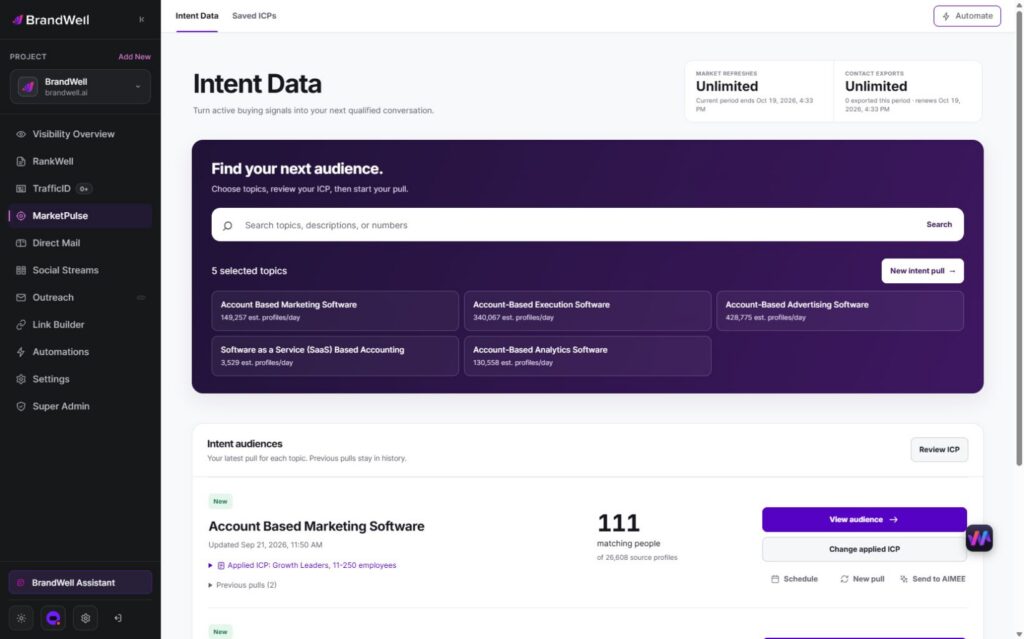
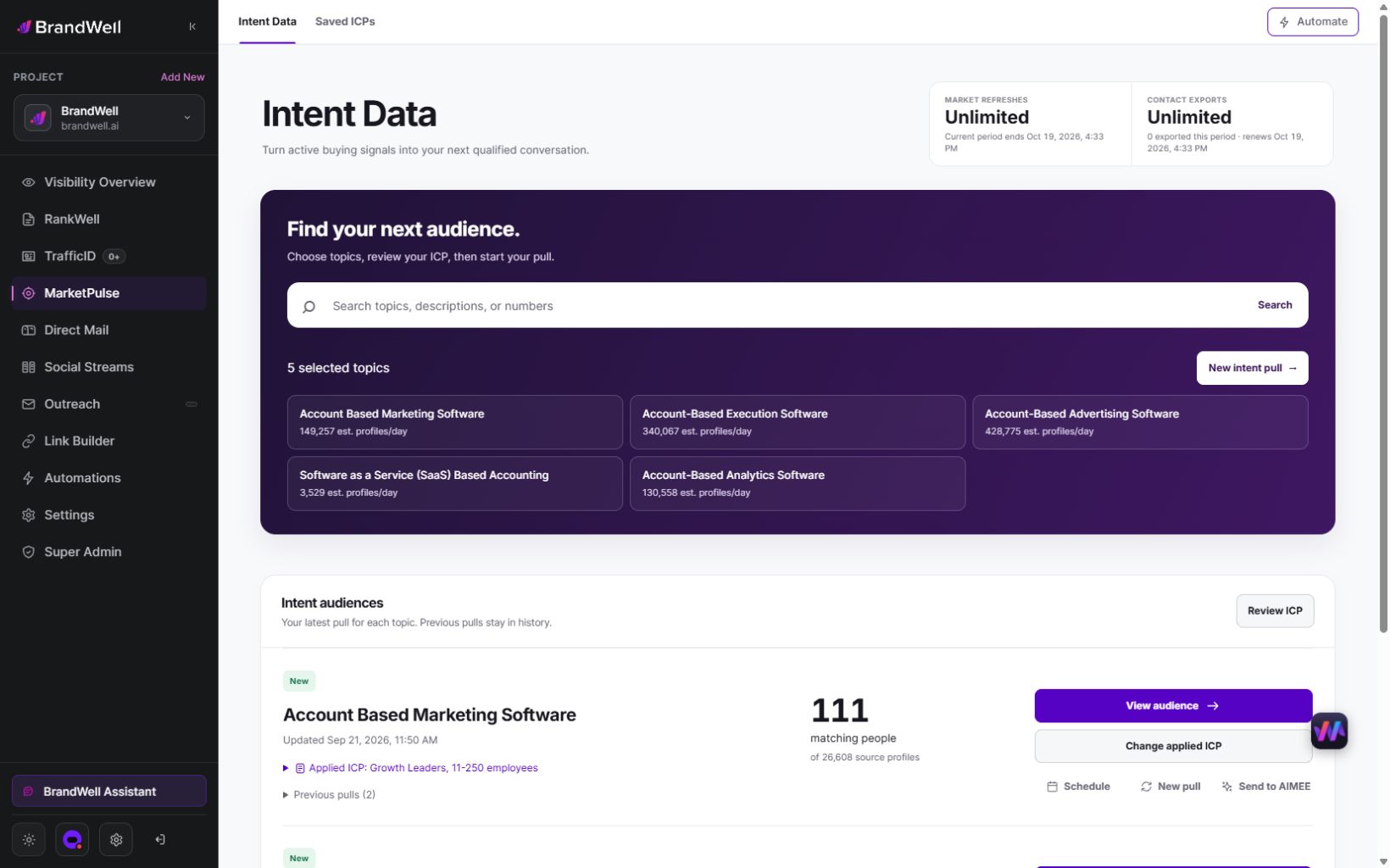
BrandWell MarketPulse: intent data starting at $500/mo. Find people researching topics relevant to what you sell, apply saved ICP filters, and review available contact details before taking action.
| Plan | Topics and refreshes | Monthly exports |
|---|---|---|
| Starter | 1 topic, weekly | 25,000 contacts |
| Growth | 3 topics, daily | 100,000 contacts |
| Scale | 10 topics, daily | Unlimited contacts |
Swipe the table to see all columns.
A pull retrieves available data from the previous 24 hours for one topic. Daily use across all included topics provides 90 Growth pulls or 300 Scale pulls in a 30-day month. Weekly Starter pulls vary by calendar month. Available audience size and contact fields vary, and audiences may overlap. Refreshes stop at the plan limit without overage charges.
- Find and qualify: search the topic catalog, save your ICP, and review the people and companies that match.
- Act on the research: export qualified contacts or prepare an Outreach or Direct Mail workflow. Connected products, channel usage, and fulfillment may cost extra.
- Get help from AIMEE: Growth and Scale include AIMEE for the initial user to research accounts and prepare the next step through connected tools.
Agencies and other service businesses can build client deliverables around their available Intent Scans and exports. Keep each client’s scope, permissions, and service fees clear. A subscription is not a promise of a white-label platform or exclusive access to a market.
Explore MarketPulse and watch the demo or compare plans starting at $500/mo. Any early-access discount is a separate, time-limited offer shown to an eligible recipient.
Keep observations and inferences distinct
A limitation is not automatically a defect. It is a condition that changes what the service can responsibly promise, how it must be tested, or who must operate it. The central limitation is epistemic: an observed research pattern, an inferred company, and an enriched contact are different kinds of evidence. Combining them can strengthen a hypothesis, but it does not turn that hypothesis into certainty.
BrandWell MarketPulse is topic-based intent-data software for businesses and agencies. Choose relevant research topics, apply saved ideal-customer-profile filters, review available names, roles, companies and contact details, and export the audience or prepare a connected workflow. Plans start at $500/mo. TrafficID identifies visitors to your own website and is a separate product. A MarketPulse subscription does not by itself promise a white-label portal, custom API implementation, exclusive topics, or managed client delivery.
Evaluate actual coverage, fields, geography, observation period, refresh behavior, product scope, implementation, support and destination requirements. Convert unresolved dependencies into written questions or representative tests before a client commitment. Missing public detail does not prove a control or function exists or is absent.
Maintain a scope-specific limitation register
Use this register in discovery, procurement, and quarterly service reviews. “Verification” here means verifying the condition and the mitigation for the buyer’s exact scope – not accepting a generic claim.
| Limitation to verify | Why it matters | Minimum mitigation | Stop condition |
|---|---|---|---|
| Intent and identity are probabilistic | A high score can still be wrong, stale, or attached to the wrong entity | Preserve confidence and source fields; require a second signal for sensitive actions | The team cannot distinguish observation, inference, and enrichment |
| Match coverage is not universal | Unmatched traffic or accounts can bias reporting | Measure eligible, observed, matched, accepted, and activated records separately | The denominator cannot be reconstructed |
| Precise public coverage counts conflict or change | Large totals do not reveal usable coverage for one ICP | Test a representative account and geography set; request dated definitions | The seller will not define the count, population, or timestamp |
| The service is primarily designed for U.S. business use | International processing and outreach can add legal and policy complexity | Segment by geography; obtain jurisdiction and channel review | The intended region lacks an approved legal and operational path |
| Delivery and entitlements are scope-dependent | A portal mention does not prove an API, connector, field, or client right | Attach an entitlement matrix to the Order Form | A required field or destination remains verbal only |
| Freshness lacks one universal public commitment | Old signals can cause mistimed outreach | Record observation, processing, delivery, and action timestamps | No timestamp or refresh definition is available for a critical use case |
| There is no published active intent-service SLA | Recovery, support, or credit expectations may be unstated | Negotiate response, escalation, export, and recovery terms if material | The client’s service promise exceeds the upstream written commitment |
| External providers and platform policies affect delivery | A dependency change can interrupt or restrict activation | Keep a dependency map, fallback route, and export procedure | No one owns a failure mode that would stop client delivery |
| Security and compliance cannot be inferred from marketing | “Secure” does not establish certification, access controls, or lawful use | Request current controls and contracts; perform legal/security review | Mandatory evidence cannot be supplied |
| Outcome evidence is downstream | A signal is not revenue; attribution includes sales and media execution | Track acceptance, action, response, opportunity, and revenue with caveats | The client requires a guaranteed pipeline result |
Swipe the table to see all columns.
This table is also the core evaluation record. Update it when a field, source, workflow, destination, region, or contract changes. Do not let a successful demo become permanent evidence for a production population it did not test.
Test representative cases and changes
Start with a sampling plan rather than a vendor presentation. Select accounts that represent the client’s actual market: strong-fit accounts, weak-fit accounts, known customers, known non-customers, different company sizes, and each intended region. Freeze that list before reviewing outputs so the team cannot quietly replace difficult examples with favorable ones.
For every sample record, retain five layers: the event or source category, observed time, inferred account or person, enrichment fields, and downstream decision. Reviewers should be able to see where fact ends and inference begins. If the delivered format collapses those layers into one score, ask for a dictionary that explains inputs, missing values, confidence, and update behavior.
Run the same test at least twice. The first run measures static coverage and usability. A later run measures change: which records appeared, disappeared, aged, or changed identity; how quickly new observations arrived; and whether routing remained deterministic. “Fresh” should never be a free-floating adjective. Define it as a threshold tied to the intended action, such as “observed within the maximum age approved for this campaign.”
Once in operation, monitor by client, channel, topic, geography, and source category. A blended match rate can conceal a failed segment. Keep a change log for topic definitions, filters, scoring thresholds, destinations, suppression logic, and client approvals. Refresh the evidence whenever any of those inputs changes, after a material source or platform-policy change, and at the review cadence written into the service agreement.
That is how to review the service without pretending a one-time proof of concept settles future performance.
Request an inspectable evidence kit
A useful demo should give the buyer something inspectable, not only screenshots. Ask for a representative sample with a data dictionary, null behavior, timestamp meanings, confidence or score interpretation, geographic applicability, permissible uses, and export conditions. Synthetic examples can explain a schema, but they cannot establish the buyer’s coverage.
Build a small evidence kit:
- Test-set register: why each account belongs in the sample and what is already known about it.
- Field dictionary: definition, type, source category, null meaning, timestamp, and whether the field is observed, inferred, or enriched.
- Acceptance scorecard: objective pass, conditional pass, and fail rules before results arrive.
- False-positive review: a human-coded sample of records the workflow would have activated incorrectly.
- Routing audit: expected destination, actual destination, delay, deduplication result, and approval state.
- Client disclosure template: plain-language limits, permitted uses, suppression obligations, and no-guarantee statement.
- Change register: the person approving every topic, field, threshold, destination, and reporting revision.
Together, those artifacts form an evaluation checklist. They are more decision-useful than reviews that describe an interface without disclosing the reviewer’s population, configuration, or definition of success. Treat published reviews as anecdotal until their scope resembles yours.
Compare equivalent operating scopes
A fair evaluation comparison holds the test constant. Give each option the same account set, date window, topics, geographic rules, identity threshold, allowed enrichment, suppression file, output deadline, and destination. Normalize the vocabulary before scoring. One provider’s “identified” record may mean a company-level inference, while another’s may mean a matched contact. Those should not share a row without explanation.
Score five operating choices rather than forcing unlike products into a feature checklist:
| Operating choice | When it may fit | What to test hardest |
|---|---|---|
| Use BrandWell with required operating controls | Agency wants branded delivery and will own validation, billing, and client operations | Exact Order-Form scope, sample performance, timestamps, exports, support boundaries |
| Use an agency-managed service | Buyer lacks day-to-day analysts or activation owners | Named staffing, response times, approval boundaries, data rights, and offboarding |
| Use a specialist point tool | One signal or activation problem dominates | Breadth sacrificed, integration labor, reporting fragmentation, and reseller rights |
| Use an enterprise ABM suite | Client needs a broader account-based orchestration environment | Implementation capacity, adoption, contract scope, and total operating effort |
| Build or license a custom stack | Proprietary control and workflow differentiation justify ongoing engineering | Data licenses, observability, maintenance, privacy operations, and replacement paths |
Swipe the table to see all columns.
Do not call one option “better” until it passes the same definitions and test conditions. The appropriate alternatives depend on the capability the buyer must control, not on the length of a feature list.
Count full costs and corrections
BrandWell MarketPulse is topic-based intent-data software for businesses and agencies. Choose relevant research topics, apply saved ideal-customer-profile filters, review available names, roles, companies and contact details, and export the audience or prepare a connected workflow. Plans start at $500/mo. TrafficID identifies visitors to your own website and is a separate product. A MarketPulse subscription does not by itself promise a white-label portal, custom API implementation, exclusive topics, or managed client delivery.
MarketPulse research is starting at $500/mo. Verify current topic coverage, refreshes, exports and included tools. Separately implemented reporting, client branding, custom integrations and managed service delivery require verification of rights, scope and fees.
ROI belongs at the end of the chain. A defined ROI analysis records the incremental cost per accepted record, activated account, qualified response, opportunity, and attributable revenue – then shows where sales execution, media spend, and market conditions influenced the result. It never treats delivered signals as booked pipeline.
Measure coverage, quality and actions separately
Measure the funnel with denominators that cannot be swapped:
- Eligibility rate: records legally and operationally eligible for the intended use divided by observed records.
- Match rate: records meeting the agreed identity threshold divided by eligible records, reported separately by level and segment.
- Acceptance rate: matched records passing required fields, recency, suppression, and ICP rules.
- Freshness distribution: age at delivery and age at activation, not only an average.
- Completeness: required non-null fields divided by required fields across accepted records.
- False-positive estimate: reviewed activations judged inconsistent with the documented identity or intent rule.
- Routing success: accepted records arriving at the correct destination once, with the required fields and approval state.
- Action rate: records a human or approved automation actually used.
- Downstream progression: responses, meetings, opportunities, and revenue, with attribution method and sample size disclosed.
Define the tested task, reference, geography, period, unit and threshold before reporting quality. Keep coverage and freshness separate with explicit eligible denominators and timestamps. Report segment results, unresolved cases and distributions rather than one blended score.
Set stop conditions before the test. Examples include an untraceable denominator, missing critical timestamps, an unacceptable error pattern in a protected segment, routing that cannot be audited, or a required use that legal review rejects. A pilot that hits a stop condition is valuable evidence, not a reason to move the goalposts.
Check operating prerequisites
Operating prerequisites include a U.S.-oriented B2B agency with a defined ideal-customer profile, enough target accounts to sample, a specific activation play, and owners for data review, client disclosure, routing, and measurement. Useful proposed use cases include account prioritization, research-informed audience planning, visitor follow-up where permitted, and recurring branded reporting – provided each is validated separately.
Suitable clients are not simply “agencies.” The operating prerequisites matter more than the label. A technically capable RevOps consultancy may fit with modest volume because it can validate and route data well. A large agency may be a poor fit if it wants to forward every signal automatically, cannot explain its permissions, or promises a fixed lead count regardless of market size.
Raise the evidence threshold for regulated industries, sensitive roles, international campaigns, person-level outreach, or automated advertising. Lower-risk aggregate reporting may tolerate an account-level hypothesis that one-to-one outreach should not. Confirm geography, lawful basis, notices, suppression, and channel policy before activation; neither a contract nor a dashboard guarantees compliance with every law or platform rule.
Approve actual actions and destinations
Use a gated workflow:
- Observe: retain the source category, event window, and topic definition.
- Resolve: record whether the result is domain, account, household, or person level and retain confidence.
- Enrich: add only fields included in the purchased scope and permitted for the intended use.
- Qualify: apply ICP, geography, recency, completeness, suppression, and client-specific exclusions.
- Approve: route sensitive or ambiguous cases to a named human; do not let a score grant permission.
- Activate: send only the minimum necessary fields to an approved destination.
- Evidence: capture delivery, action, response, objection, suppression, opportunity, and outcome data.
- Learn: review false positives and non-actions before changing thresholds.
Use this workflow to check for three common errors: treating a company signal as a named person’s behavior, treating enrichment as consent, and treating an advertising audience as proof of sales readiness. The integration review should document each connector, import/export, credential owner, field transformation, retry behavior, deduplication rule, and deletion path. Do not assume a public BrandWell intent API or webhook contract; require current technical documentation for the purchased implementation.
AIMEE can prepare a review brief through configured connected tools. Keep proposed actions separate from actual approvals and destination acknowledgements. Confirm the implementation and permissions before execution.
Resolve source, rights and dependency gaps
Sampling bias appears when a demo overrepresents popular industries, high-traffic sites, or easy-to-resolve domains. Definition drift appears when a topic, score, or “active” window changes without a corresponding reporting change. Provenance gaps appear when the agency cannot tell what was observed, inferred, licensed, or supplied by a client. Decay appears when the signal remains technically present after its business relevance has passed.
Privacy risk is broader than whether a record contains a business email. Ask who determines purpose and means, which notices and legal bases apply, where suppression enters, how objections propagate, and which fields are necessary for the use. A privacy review should cover the client, agency, BrandWell, destination platforms, and any other processor or provider in the flow. The platform’s public material says the agency remains responsible for its own notices, permissions, lawful use, and channel compliance.
Request current scope-specific evidence for access, authentication, transfer, retention, deletion, incident handling, suppliers and offboarding. Missing public detail is an unanswered procurement question, not proof that a control is present or absent.
Compliance review should be framed the same way: a workflow can support an agency’s compliance program, but the product itself does not guarantee GDPR, CCPA, CAN-SPAM, HIPAA, or advertising-platform compliance. Get jurisdiction-specific advice for the actual campaign.
Disclose uncertainty in client reporting
Client reporting should make the chain visible. Start with the eligible population and observation window. Then show observed signals, resolved accounts, accepted records, activated records, and downstream outcomes as separate counts. State the identity level and confidence threshold. Include exclusions, missing-data rules, suppressed records, material workflow changes, and the attribution method.
Use language such as “accounts showing research behavior under the agreed topic and recency rules” rather than “buyers ready to purchase.” Say “matched under the configured identity threshold” rather than “known visitor.” When showing opportunities or revenue, distinguish correlation, influenced pipeline, and directly attributable outcomes according to the client’s approved model.
Put the disclosure in the statement of work, onboarding materials, report notes and review. Name actual owners of sample review, topic changes, suppression, action approval, support and incident escalation. Verify billing, implementation, data rights and service responsibilities against the agreement.
Review an available MarketPulse topic, saved ICP and actual preceding-24-hour matches for the approved research purpose. Keep uncertain company context visible. AIMEE can organize supplied context through configured tools; named owners approve actual exports, messages, audience uploads and CRM writes.
Set launch and stop conditions
Before proceeding, require affirmative answers to these questions:
- Is the MarketPulse and agency growth package named in the agreement, with the included content, activation, and AIMEE capabilities stated explicitly?
- Are delivery path, topics, client capacity, data fields, usage, exports, destinations, support, and term written down?
- Does the test set represent the intended market, regions, and difficult cases?
- Can the team reproduce coverage, acceptance, freshness, completeness, and false-positive denominators?
- Are identity level, confidence, provenance, retention, suppression, and deletion understood?
- Does each outreach or advertising path have legal, client, and platform approval?
- Are pricing, implementation labor, third-party costs, and exit work included?
- Can the report explain uncertainty without making a performance promise?
- Are fallbacks and ownership clear if a dependency fails?
- Is there a defined moment to stop, narrow, or choose another operating model?
Map each proposed output to a verified function, approved purpose, tested dependency, owner, cost and inspectable result. Preserve unresolved questions and stop conditions rather than presenting a broad set of marketing labels as evidence.
Choose BrandWell with controls when the purchased scope and test results satisfy that standard. Choose a managed operator when staffing is the gap; a point tool when one capability dominates; an enterprise suite when broader orchestration is essential; or a custom stack when proprietary control justifies permanent engineering. If the buyer needs guaranteed identification, universal coverage, a public SLA that is not in the contract, or guaranteed pipeline, stop. Those are not reasonable conclusions from intent data.
Review MarketPulse and current plans, starting at $500/mo. Evaluate a relevant topic, approved ICP, actual match details and operating effort. Review current guarantee conditions before testing; sample acceptance does not establish future pipeline or revenue.
Copyable limitation and acceptance record
Scope: [Actual topic, ICP, unit, population and period.] Question: [Unresolved field, coverage, right or dependency.] Evidence: [Source, method, reference and uncertainty.] Test: [Representative cases, threshold and critical failure.] Decision: [Accept, hold, correct or stop with actual owner.] Outcome: [Action, feedback and unresolved cases.] Cost: [Actual labor, correction, support and exclusions.]
Acceptance is different from estimating overall quality
NIST’s acceptance-sampling guidance distinguishes an accept/reject decision from estimating a lot’s quality. It concerns quality-control methodology, not BrandWell identification performance. A passing pilot does not establish universal future coverage.
Report gaps in the reviewed sample
A fictional 100-record set has 80 candidate matches. Sixty candidates are reviewed and 45 confirmed against the defined reference: 75% sample confirmation. Twenty candidates are unchecked and 20 records have no candidate. Do not call 80% candidate coverage an 80% identity-confirmation rate or label every unmatched record a failure without a suitable reference.
A blended rate can hide a weak segment
Two fictional segments each contain 50 eligible records. One returns 45 candidates and the other five: 90% and 10% candidate coverage. The combined rate is 50%. Preserve segment denominators and eligibility; a blended 50% does not describe either segment’s result.
Field completeness does not establish freshness
Ninety of 100 fictional records have a required field, but 30 populated fields are older than the defined age limit. Completeness is 90%; 60% of all records have a populated field within that limit. Retain observation and update timestamps and the actual age rule. A new export file timestamp does not make the underlying evidence fresh.
Keep unresolved actions and feedback visible
Of 40 fictional accepted records, 30 return outcome feedback and six become qualified opportunities. Feedback coverage is 75%; opportunities are 20% of reported records or 15% of accepted records. Ten remain unresolved. An export or account association does not prove a completed action or incremental sale.
Count limitations in the full operating cost
A fictional monthly service costs $500 research, $600 review, $400 QA, $300 reporting and $200 support: $2,000. Forty accepted outputs make the defined cost $50 each. Another $400 correction expense raises it to $60. These values are illustrative, not BrandWell service prices. Disclose excluded overhead, tax and financing; zero accepted outputs make the ratio undefined.
Verify supported product scope directly
MarketPulse research is starting at $500/mo. Search a relevant topic, save the approved ICP and inspect actual available matches. Keep TrafficID own-site visitor work separately scoped. AIMEE can organize supplied context through configured tools; owners approve exports, messages, audience uploads and CRM writes. Agency client interfaces, custom synchronization, reports and managed delivery need separately verified implementation, rights and fees.
Frequently asked research-limit questions
Does passing a sample establish universal coverage?
No. Preserve the tested population, period, reference and limitations.
Does a populated field prove it is current?
No. Check actual observation and update times against a defined age rule.
Does unmatched mean incorrect?
Not necessarily. Verify eligibility, expected match and an appropriate reference.
Does a missing public detail prove a missing capability?
No. Treat it as a question to resolve against actual documentation and implementation.
Review current research: explore MarketPulse and current plans.
Reviewed and updated October 3, 2026.

Written by