On this page
- Current MarketPulse research workflow
- Define outcomes and readiness gates
- Assign owners across six phases
- Phase 1: approve fit and scope
- Phase 2: evaluate a relevant topic and ICP
- Phase 3: review fields, sources and quality
- Phase 4: test routing and approvals
- Phase 5: launch a bounded workflow
- Phase 6: review evidence before expanding
- Maintain six documentation layers
- Compare actual implementation arrangements
- Count onboarding and recurring costs
- Assign risk and correction owners
- Record the launch decision
- Copyable onboarding acceptance record
- Frequently asked onboarding questions
Use six onboarding gates: approved scope, topic and ICP evaluation, field and quality review, routing and approval tests, bounded launch, and measured expansion. Name an owner, actual inputs, acceptance rule and approval at each gate. Logging into the portal is separate from demonstrating that a client workflow can be operated and explained.
Review an available MarketPulse topic, saved ICP and actual preceding-24-hour matches for the approved research purpose. Keep uncertain company context visible. AIMEE can organize supplied context through configured tools; named owners approve actual exports, messages, audience uploads and CRM writes.
MarketPulse supplies topic research and available match details. AIMEE can organize supplied context through configured tools. An agency operating service, branded weekly report, CRM synchronization or custom client interface needs separately verified implementation, rights, scope and fees. The research subscription does not establish those delivery capabilities.
Start with one approved market, representative cases, a documented outcome and one tested action path. Preserve uncertainty and actual operating effort before expanding scope. This is a proposed implementation template, not a native BrandWell six-phase onboarding package.
Current MarketPulse offer: intent-data plans start at $500/mo. See the product, demo, and current plans. Updated October 3, 2026.
Current MarketPulse research workflow
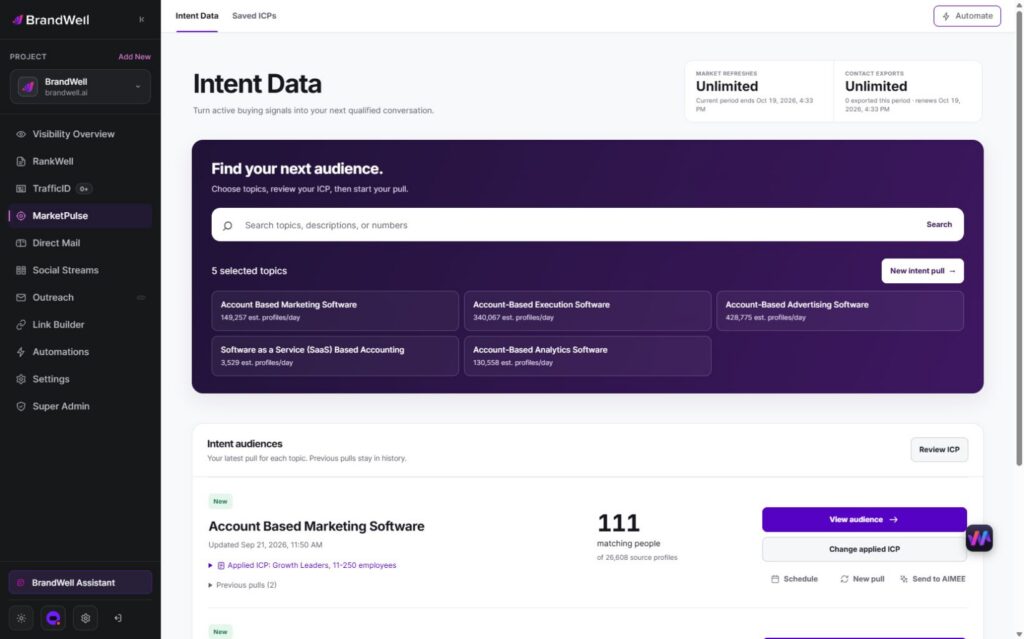
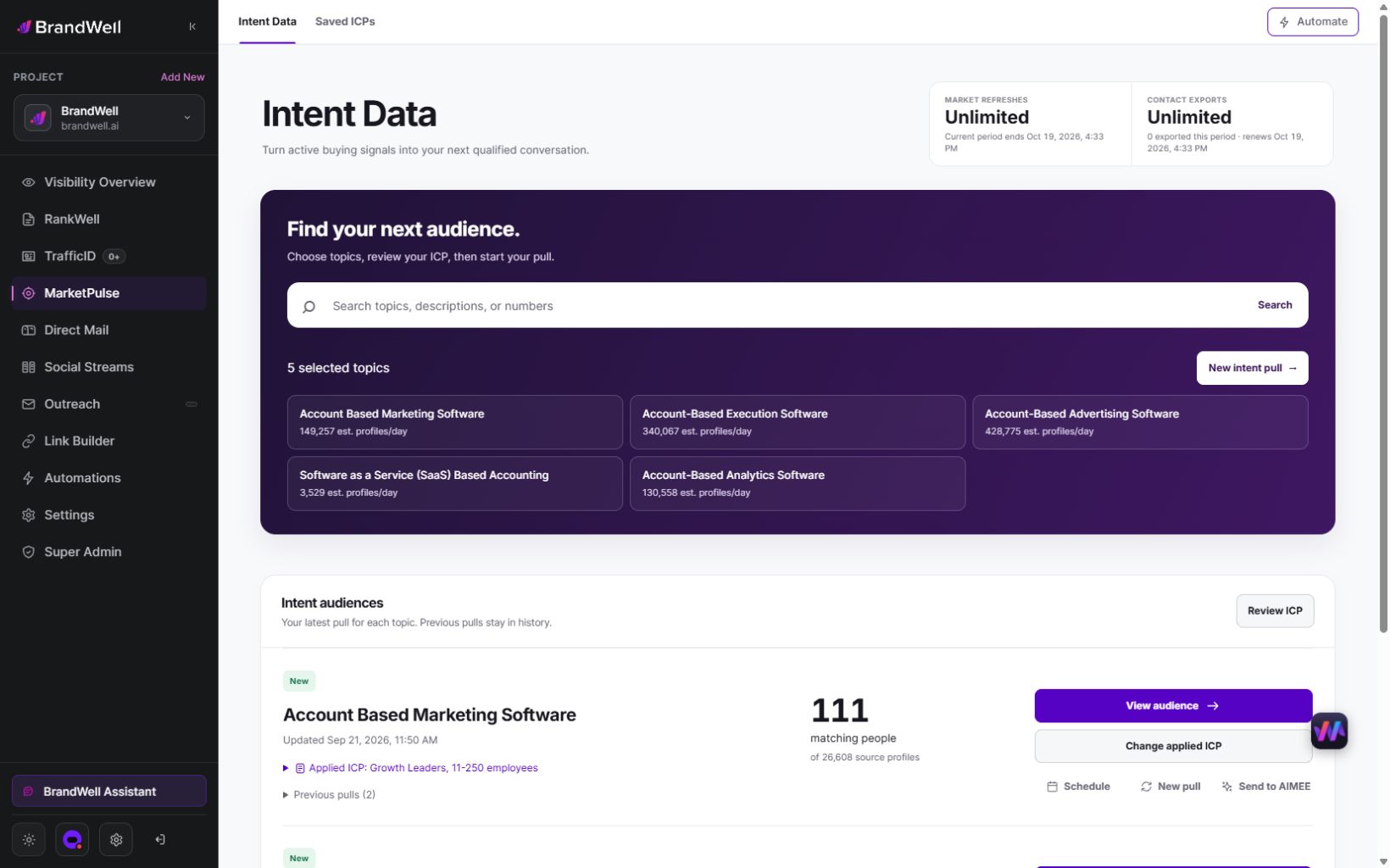
BrandWell MarketPulse: intent data starting at $500/mo. Find people researching topics relevant to what you sell, apply saved ICP filters, and review available contact details before taking action.
| Plan | Topics and refreshes | Monthly exports |
|---|---|---|
| Starter | 1 topic, weekly | 25,000 contacts |
| Growth | 3 topics, daily | 100,000 contacts |
| Scale | 10 topics, daily | Unlimited contacts |
Swipe the table to see all columns.
A pull retrieves available data from the previous 24 hours for one topic. Daily use across all included topics provides 90 Growth pulls or 300 Scale pulls in a 30-day month. Weekly Starter pulls vary by calendar month. Available audience size and contact fields vary, and audiences may overlap. Refreshes stop at the plan limit without overage charges.
- Find and qualify: search the topic catalog, save your ICP, and review the people and companies that match.
- Act on the research: export qualified contacts or prepare an Outreach or Direct Mail workflow. Connected products, channel usage, and fulfillment may cost extra.
- Get help from AIMEE: Growth and Scale include AIMEE for the initial user to research accounts and prepare the next step through connected tools.
Agencies and other service businesses can build client deliverables around their available Intent Scans and exports. Keep each client’s scope, permissions, and service fees clear. A subscription is not a promise of a white-label platform or exclusive access to a market.
Explore MarketPulse and watch the demo or compare plans starting at $500/mo. Any early-access discount is a separate, time-limited offer shown to an eligible recipient.
Define outcomes and readiness gates
The onboarding outcome should be a repeatable service unit. A strong statement looks like this: “For one approved client market, the agency can receive an agreed report, apply documented qualification rules, route accepted account records to one approved destination, and report use and downstream evidence without claiming that a signal proves readiness to buy.”
Turn that outcome into readiness gates:
- a named agency owner with authority to approve scope and exceptions;
- one client profile with a viable U.S.-business market and a specific decision to improve;
- written topic, geography, recency, identity, and required-field definitions;
- a representative account set, including known difficult and negative cases;
- approved purpose, notice, suppression, retention, and channel rules;
- a current Order Form or written scope covering delivery, capacity, fields, destinations, support, and data rights;
- an operator for review and an owner for the CRM, advertising, export, or other destination;
- acceptance metrics and stop conditions set before results arrive;
- a client reporting format that distinguishes observed, inferred, matched, accepted, and activated records.
This Onboarding overview makes “ready” observable. A large agency without an owner or governance path is less ready than a small consultancy with a disciplined workflow. A portal credential, sample screenshot, or verbal connector promise is not a readiness criterion.
Assign owners across six phases
| Phase | Agency owner | BrandWell or contracted provider role | Client role | Approval gate |
|---|---|---|---|---|
| 1. Fit and offer definition | Principal or product owner | Confirm purchasable scope and dependencies | Confirm market, problem, and operating participation | Signed scope hypothesis and no fatal disqualifier |
| 2. Topic and ICP evaluation | Research owner | Verify supported topic, filters and available outputs | Review actual fit and usefulness | Document acceptance, limitations or rejection |
| 3. Data and identity configuration | Data or RevOps lead | Configure contracted topics, fields, and delivery | Supply first-party definitions and suppression inputs | Sample meets data acceptance rules |
| 4. Routing and workflow setup | Systems owner | Support only the destinations and scope purchased | Approve channel, message, and user actions | Dry run reconciles source to destination |
| 5. First-client launch | Service delivery lead | Operate contracted platform/support boundary | Act on records and report exceptions | Controlled production release |
| 6. Measurement and expansion | Account and analytics owners | Support agreed changes and capacity | Share outcomes and approve revisions | Evidence supports continue, narrow, expand, or stop |
Swipe the table to see all columns.
Customize responsibilities against the actual agreement. Verify agency and client selection, billing, support, disclosures, data rights, implementation and approvals. Do not infer managed staffing, response times, white-label capacity or client interfaces from a research subscription.
Phase 1: approve fit and scope
Begin with a problem interview, not product configuration. Ask what the client does today, which decision is late or poorly informed, who will use the output, what a false positive costs, and what evidence the client can return. Pick one service promise: for example, a research-informed account brief, a qualified account queue, or an approved audience-input workflow. Avoid “we deliver buyers” or fixed pipeline promises.
BrandWell MarketPulse is topic-based intent-data software for businesses and agencies. Choose relevant research topics, apply saved ideal-customer-profile filters, review available names, roles, companies and contact details, and export the audience or prepare a connected workflow. Plans start at $500/mo. TrafficID identifies visitors to your own website and is a separate product. A MarketPulse subscription does not by itself promise a white-label portal, custom API implementation, exclusive topics, or managed client delivery.
Check that the agency can define its service unit, assign owners, verify approved destinations and receive outcome feedback. Defer unresolved geography, suppression, implementation or approval requirements; topic research does not establish messaging permission.
The phase-one output is a one-page scope card and responsibility matrix. The gate is approval by product, service delivery, data/RevOps, privacy or legal as applicable, and the client sponsor.
Phase 2: evaluate a relevant topic and ICP
Search the current topic catalog, choose a relevant topic, apply the approved saved ICP and inspect actual available matches. Record observation period, fit, exclusions, available fields, uncertainty and review effort. Confirm current plan allowances and guarantee conditions before testing or exporting.
Phase 3: review fields, sources and quality
Once demand is plausible, configure the minimum production data path. Start with a field dictionary listing definition, data type, observation or update time, source category, identity level, confidence interpretation, null behavior, permissible use, retention need, and destination. Separate signals from identity resolution and enrichment. They are different transformations with different failure modes.
Use a test set representing the live client population: good-fit and poor-fit accounts, customers and non-customers, subsidiaries, generic domains, changed roles, known suppressed records, and each approved region. Measure eligibility, match rate by identity level, required-field completeness, freshness distribution, collisions, and reviewed false positives. Do not publish precise platform-wide coverage, match, accuracy, freshness, or lead-volume figures; they require dated definitions and methodology.
Define task-specific acceptance against an appropriate reviewed reference. Keep company associations, contact candidates, submitted identities and actual actions distinct. Report the eligible denominator, observation period, processing time, delivery time and unresolved cases.
Configure only entitlements confirmed in writing. A public privacy notice that mentions identity, enrichment, validation, portals, or workflows does not prove every category is standard. Do not infer that TrafficID is included for every plan or client. Do not infer a public BrandWell intent API from underlying technical documentation. The phase-three gate is a signed sample scorecard and approved field dictionary.
Phase 4: test routing and approvals
Draw the data flow from source to evidence. For each hop, identify the system, credential owner, input fields, transformations, deduplication key, suppression check, approval state, retry rule, error queue, retention, deletion path, and reconciliation report. Then run a dry test with accepted, rejected, duplicate, incomplete, stale, and suppressed records.
A reliable Onboarding workflow uses these states: observed, resolved, enriched, qualified, approved, routed, acted on, and measured. The state should never jump from “observed” to “contacted” merely because an automation can do it. Require human review for ambiguous identity, sensitive segments, new messages, public actions, audience launches, or any use whose legal or platform basis has not been approved.
Onboarding integrations should be limited to destinations verified for the purchased scope. Confirm schema, field mapping, import or API method, rate or batch behavior if applicable, authentication, errors, retries, support, and change notice. An attractive workflow diagram is not connector documentation.
AIMEE can prepare a review brief through configured connected tools. Keep proposed actions separate from actual approvals and destination acknowledgements. Confirm the implementation and permissions before execution.
The phase-four gate is a reconciled dry run: every input is accounted for as accepted, rejected, held, duplicated, or errored, and every destination record can be traced back to its source and approval.
Phase 5: launch a bounded workflow
Launch one client, one topic or tightly related set, one report, and one activation path. Give the service lead a daily exception view during the initial period. Hold a short operating review with the data owner, destination owner, client lead, and privacy or legal contact when needed. Do not add a second client until the first workflow can be reconciled and explained.
The first-client checklist should confirm:
- the client contract matches the agency’s upstream rights and exclusions;
- branding, portal access, and report distribution are approved;
- the client knows the difference between a signal, inferred account, enriched contact, and validated field;
- suppression and opt-out inputs are current;
- activation messages, audiences, or sales plays have client and channel approval;
- exception and incident routes have named owners;
- the report shows denominators, timestamps, thresholds, and material limitations;
- the team records whether each accepted item was reviewed, used, rejected, or left untouched;
- offboarding, export, deletion, and access removal are understood.
This is the boundary between Onboarding and ongoing implementation. Onboarding proves the agency can operate the contracted service. It does not finish every future integration, custom workflow, client variation, or optimization.
Phase 6: review evidence before expanding
Measure onboarding with both delivery and adoption signals. Time-to-first-approved-scope, time-to-accepted-sample, time-to-reconciled-dry-run, and time-to-first-client-review identify process friction. Adoption metrics show whether assigned users reviewed and acted on the output. Data metrics show eligibility, match by level, completeness, age, false positives, and routing errors. Outcome metrics show responses, opportunities, and revenue only after the activation and attribution method are documented.
Onboarding evidence should support four decisions: continue unchanged, narrow the scope, expand one dimension, or stop. Expansion can mean a new topic, client, data field, destination, cadence, or automation level. Change one dimension at a time so its effect remains interpretable.
Do not promise Onboarding ROI. Set a measurement hypothesis and a maximum learning budget. A successful onboarding can reduce time to a usable workflow without producing immediate pipeline; a failed onboarding can prevent a larger contract mistake. Report both outcomes honestly.
Maintain six documentation layers
The most useful Onboarding documentation is a layered evidence set:
- Commercial control: current Order Form, capacity and usage terms, topic scope, support, renewal, and exit rights.
- Data control: field dictionary, sample, timestamps, confidence, null behavior, geography, retention, and permitted use.
- Technical control: installation or delivery instructions for the purchased path, field maps, authentication, error behavior, and change process.
- Governance control: purpose record, responsibility matrix, client approvals, suppression, access, deletion, incident route, and channel policy.
- Operating control: runbook, report template, exception queue, escalation, review cadence, and offboarding checklist.
- Evidence control: baseline, acceptance scorecard, reconciliation log, adoption measures, outcomes, and decision history.
Sandboxes and samples are useful when their differences from production are stated. Templates are useful when an owner fills them in. Support is useful when the available channel, hours, escalation, and response expectations are written. There is no public active intent-service SLA establishing uptime, RTO, RPO, recovery, response, or credits, so any material dependency must be resolved in contracting rather than assumed.
This set is the practical Onboarding evaluation checklist. It also gives future operators a way to distinguish a product change, a data-quality issue, a routing defect, a client adoption problem, and a weak market hypothesis.
Compare actual implementation arrangements
Three operating arrangements can work:
- In-house agency team: best when the agency has a product owner, analyst, systems owner, client lead, and governance support. It preserves direct learning but consumes scarce delivery capacity.
- Specialist implementation help: useful when the internal team owns the service but needs temporary integration or data-quality expertise. Define deliverables, knowledge transfer, access, and exit.
- Contracted vendor services: appropriate only where the written scope names the work, staffing, approvals, support, and exclusions. Do not infer a fully managed service from general workflow language.
Test the responsibilities in a hybrid: BrandWell provides the purchased platform or service boundary, the agency owns the commercial and client operating model, a specialist handles a bounded technical task, and the client owns its destinations and actions. One person still needs end-to-end accountability.
Onboarding alternatives should be compared on time to a controlled first use, internal capability transfer, integration burden, governance, support, portability, and total operating cost – not merely initial setup speed.
Count onboarding and recurring costs
Onboarding pricing should separate:
- offer design and readiness assessment;
- pilot or sample review where applicable;
- data and identity configuration;
- integration and dry-run work;
- client launch, training, and documentation;
- ongoing operations, reporting, support, and governance;
- usage, add-ons, third-party systems, and change requests;
- offboarding or migration.
For Onboarding total cost, include internal meetings, analyst review, privacy/security/legal work, client delays, destination cleanup, failed tests, and post-launch exceptions. A low setup fee can be expensive if it creates unbounded custom support. A higher fixed onboarding fee can be fair if it includes defined artifacts and acceptance gates.
Verify actual agency and client billing responsibilities in the agreement. State one-time, recurring, usage-based and excluded work separately. Tie service milestones to controlled deliverables rather than promised replies, pipeline or revenue.
Assign risk and correction owners
Scope risk: verbal expectations exceed the Order Form. Mitigation: entitlement and responsibility matrices signed before configuration.
Access risk: credentials are shared, roles are unclear, or removal is forgotten. Mitigation: named owners and access review; do not claim granular RBAC or SSO unless documented.
Data-quality risk: a favorable sample hides a weak segment. Mitigation: frozen representative tests, per-segment metrics, and false-positive review.
Freshness risk: the team cannot relate event age to action. Mitigation: preserve all relevant timestamps and define a maximum age by use case.
Privacy and channel risk: enrichment or validation is mistaken for permission. Mitigation: purpose, notice, legal basis, suppression, minimum fields, client approval, and current platform-policy review.
Expectation risk: the client hears “active buyer” as certainty. Mitigation: report observed, inferred, matched, accepted, and activated states separately; prohibit guarantees.
Dependency risk: a provider or destination changes. Mitigation: dependency map, export path, fallback, change monitoring, and recovery owner. Do not infer a business-continuity program or SLA.
Onboarding privacy, Onboarding security, and Onboarding compliance are review workstreams – not product guarantees. Request current scope-specific evidence and jurisdictional advice where needed.
Record the launch decision
Use the six phases to agree on the audience, package, workflow owner, required connections, approval settings, and launch evidence. Complete one useful client workflow before expanding to additional tools or accounts.
Proceed when one offer is written, one sample passes, one route reconciles, one client understands the limits, and the agency can report what happened. Narrow when the signal is useful but an identity, geography, destination, or support assumption fails. Stop when a required entitlement remains verbal, governance is unresolved, or the client requires guaranteed identification or outcomes. Expand only after evidence – not enthusiasm – shows the next change can be operated safely.
Review MarketPulse and current plans, starting at $500/mo. Evaluate a relevant topic, approved ICP, available fields and actual operating effort. Review current guarantee conditions before testing; an accepted sample does not establish future pipeline or revenue.
Copyable onboarding acceptance record
Scope: [Actual topic, ICP, client, observation period and exclusions.] Entitlements: [Verified product, fields, exports and separately implemented service.] Reference: [Representative cases, source and known limitations.] Ownership: [Research, implementation, review, approval and feedback.] Test: [Input, expected result, actual result and critical failures.] Reconciliation: [Unique destination outputs, rejected and unresolved cases.] Decision: [Launch, hold, repair or stop; costs, owner and review date.]
Document fitness for the intended purpose
W3C’s data best practices recommend documenting data quality and known issues for the intended use. An onboarding sample needs that context; a populated field does not establish correctness or permission.
Separate completeness from reviewed correctness
Of 100 fictional sample records, 90 contain a required field: 90% completeness. Sixty populated records are reviewed and 45 confirmed against the defined reference: 75% sample confirmation. Thirty populated records remain unchecked. Do not call 90% completeness a 90% identity-verification rate or assume the sample establishes population coverage.
Reconcile dry-run destination states
A fictional dry run has 100 unique inputs: 80 accepted, ten rejected and ten with unknown responses. Fifteen retries create 115 attempts, not 115 delivered unique records. Correcting and accepting five rejected inputs raises unique acceptance to 85. Reconcile unknown responses and duplicates before release.
Critical failures override the aggregate pass rate
Nine of ten fictional tests pass, but one exposes another client’s records. A 90% test pass rate does not authorize launch. Contain the affected path, correct the boundary and verify it again. Approve only the actual scope and permissions tested.
Keep onboarding milestones separate from sales results
A fictional scope is approved on day one, a sample accepted on day three and a dry run reconciled on day five. Those are elapsed process milestones, not three independent measures of revenue impact. If 20 accepted records produce feedback for 15 and three qualified opportunities, feedback coverage is 75%; opportunities are 20% of reported records or 15% of accepted records. Five remain unresolved.
Budget failed tests and post-launch corrections
A fictional onboarding costs $500 research allocation, $600 mapping, $400 review and $300 training: $1,800. A further $500 correction cost makes it $2,300. Disclose what is one-time, recurring or allocated and exclude unspent contingency from incurred expense. Overhead, tax and financing are excluded. These invented inputs are not BrandWell onboarding fees or typical results.
Use current supported research before adding a custom path
MarketPulse research is starting at $500/mo. Search a relevant topic, save the approved ICP and inspect actual available matches. Keep separately scoped TrafficID own-site visitor work distinct. AIMEE can organize supplied context through configured tools; owners approve exports, messages, audience uploads and CRM writes. Custom interfaces, synchronization and managed delivery require separately verified implementation and rights.
Frequently asked onboarding questions
Is portal access proof of completed onboarding?
No. Verify actual inputs, acceptance, responsibilities and destination behavior.
Does completeness prove identity correctness?
No. Test fields against an appropriate reviewed reference and preserve uncertainty.
Can an unresolved critical test be waived by a high pass rate?
Hold the affected path until corrected and verified.
Does the subscription include every client workflow?
Verify actual entitlements and separate implementation, rights, support and fees.
Review current research: explore MarketPulse and current plans.
Reviewed and updated October 3, 2026.

Written by