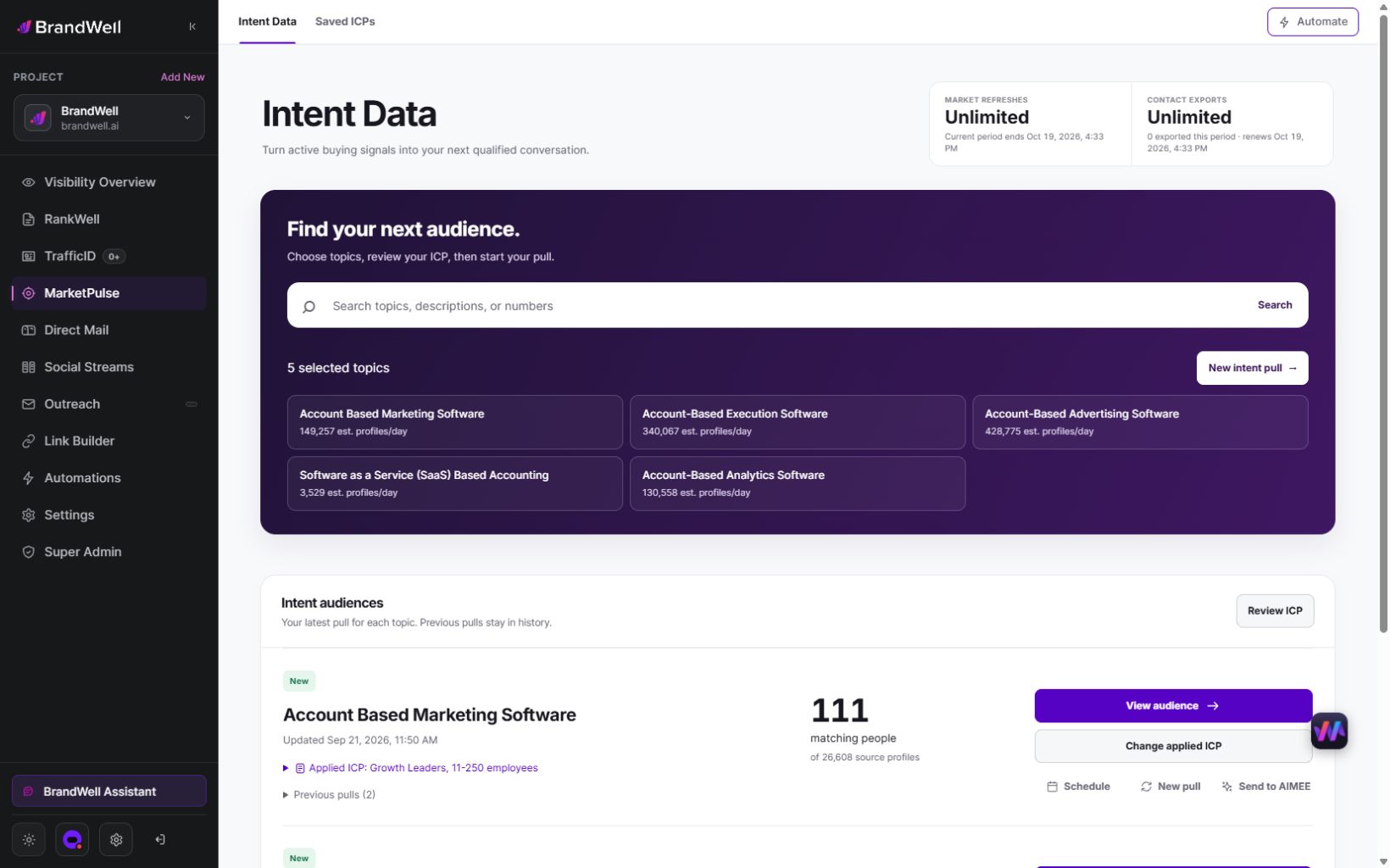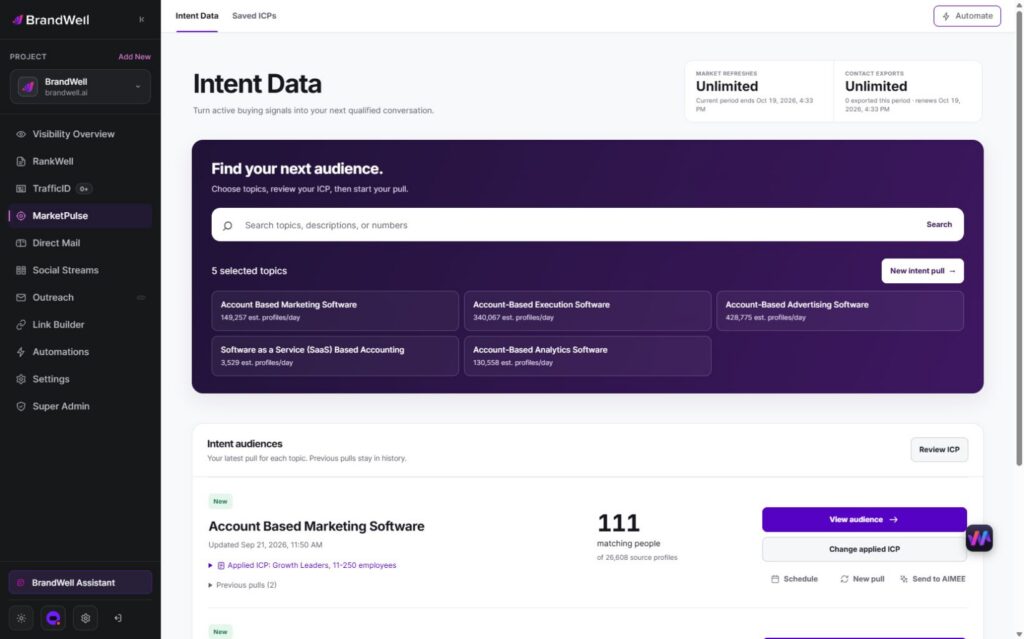
BrandWell agency plans are $2,500–$5,000 per month, depending on topic count, contract term, and any contractually scoped topic exclusivity that is available. Confirm included modules, usage, client capacity, implementation, support, and exclusivity in the current written quote and order form.

Who this is for. This guide is for agency owners, GTM consultants, RevOps leaders, demand-generation teams, and procurement buyers evaluating BrandWell as intent-data infrastructure or comparing it with enterprise ABM and data platforms. It is not a promise of a particular margin or revenue result. Intent signals are probabilistic, and every pricing, coverage, and exclusivity term must be confirmed in the applicable order form.

The short answer: price the service from contribution margin backward

Begin with the client outcome and delivery promise, not a markup percentage. Define the market, topics, signal cadence, qualification rules, reporting, activation channels, and response SLA. Then model the monthly retail price with this simple structure:

Contribution margin = client revenue − platform allocation − variable data usage − direct delivery labor − client-specific tools.

Contribution margin percentage = contribution margin ÷ client revenue.

This formula prevents a common error: treating the wholesale subscription as the entire cost of delivery. An agency can have a large apparent software spread while losing money through manual research, custom reporting, rework, meetings, and uncontrolled overages. Conversely, a higher platform fee can support healthier economics if it replaces fragmented tools and reduces fulfillment time.

A practical pricing decision has four layers:

  1. Wholesale infrastructure: BrandWell plan, enabled modules, included capacity, and contracted usage.
  2. Variable fulfillment: enrichment, identity resolution, routing, exports, and any channel-specific costs that rise with activity.
  3. Agency service: strategy, topic design, quality assurance, reporting, client meetings, and optimization.
  4. Retail risk allowance: room for usage variance, support spikes, failed matches, and change requests.

BrandWell’s $70 seven-day reseller pilot can help an agency validate signal volume and produce branded topic reports before it finalizes a broad rollout. A pilot tests workflow fit and market evidence; it does not prove future pipeline or revenue.

How BrandWell modules, usage, billing, and change control should work

A disciplined agency turns a quote into an operating schedule. The schedule should list each enabled module, the unit that consumes capacity, who may approve changes, and what happens when a threshold is reached.

  • Modules: Record whether the package includes off-site topic intent, TrafficID or visitor identity, enrichment, qualification, client portal/reporting, routing, exports, or other activation support.
  • Usage units: Define whether a unit is a signal, matched person, enriched record, client workspace, topic, report, export, workflow run, or another contracted measure. Do not assume all records have the same cost or match rate.
  • Client allocation: Decide whether wholesale capacity is pooled across clients or reserved by client. Pooled capacity can improve utilization, while reserved capacity makes client-level profitability easier to explain.
  • Billing boundary: BrandWell charges the agency under the wholesale agreement. The agency handles its own client billing and retail terms.
  • Approvals: Require written approval for new topics, markets, integrations, higher usage bands, custom reporting, or expanded service levels.
  • Change control: Price a standard change allowance and state what becomes a scoped project. A new ICP, geography, or activation channel is not always a minor edit.

The agency should keep a monthly usage ledger by client. At minimum, record signals received, records matched, records enriched, records accepted by qualification rules, records activated, fulfillment hours, client requests, and downstream outcomes. That ledger supports overage decisions and makes renewal conversations more concrete.

Criteria for comparing intent-data pricing models

The five options below are assessed against the same criteria. Because most enterprise vendors use custom quotes, the comparison is about operating model and total-cost questions rather than invented competitor prices.

  1. Pricing model: platform fee, usage fee, seat fee, media component, services, or a combination.
  2. Agency economics: ability to allocate capacity, set retail pricing, preserve the client relationship, and support multiple clients.
  3. Signal and identity coverage: topic intent, first-party engagement, visitor identification, contact data, and match confidence.
  4. White-label control: client-facing brand, reports, portal, commercial packaging, and delivery ownership.
  5. Activation: CRM, outbound, advertising, exports, and workflow instructions.
  6. Implementation burden: setup, integrations, governance, analyst time, and training.
  7. Best fit and limitation: the buyer scenario where the model is strongest and the constraint that materially changes the choice.

Five intent-data pricing and operating choices to compare

BrandWell publishes this guide and appears first in the shortlist. Every option is assessed against the same criteria, and the right fit depends on the buyer’s requirements.

1. BrandWell

BrandWell homepage hero
BrandWell homepage hero. Brand names and site imagery belong to their respective owners.
  • Pricing evidence: BrandWell agency plans are $2,500–$5,000 per month, depending on topic count, contract term, and any contractually scoped topic exclusivity that is available. Confirm included modules, usage, client capacity, implementation, support, and exclusivity in the current written quote and order form.
  • Agency economics: Built around a wholesale-to-retail model in which the agency packages the service and bills its own clients. Price comparisons require current written, scope-matched quotes.
  • Signal and identity coverage: Combines topic intent with identity resolution, enrichment, qualification, and activation where coverage is available.
  • White-label control: Designed as a complete white-label agency sales-and-delivery engine rather than a report with a replaced logo.
  • Activation: Provides agent-ready workflow instructions that can be used with Claude or ChatGPT, or executed directly in the browser through Moxby. Claude and ChatGPT are execution choices, not endorsements or implied native integrations; Moxby is a separate browser-first product.
  • Implementation burden: The $70 seven-day reseller pilot can produce branded topic reports and expose coverage, matchability, and workflow gaps before a larger commitment.
  • Best fit and limitation: Best for agencies that want to sell and operate a branded intent-data service. It is less suitable for enterprises seeking a full, single-tenant ABM suite with a large internal operations team. BrandWell is also the only option in this compared set that can offer contractually scoped topic exclusivity, subject to topic and market availability and the signed order form.

2. 6sense

6sense homepage hero
6sense homepage hero. Brand names and site imagery belong to their respective owners.
  • Pricing evidence: 6sense uses custom pricing. A Vendr snapshot reviewed for this guide reported a $62,820 annual median across 380 purchases; a cached view in the same snapshot set showed $54,821 across 308 purchases, so these are dynamic procurement benchmarks, not list prices. Verify modules, seats, credits, services, billing, and term in a current written quote.
  • Agency economics: Stronger as enterprise client infrastructure than as an agency-controlled wholesale product; multi-client economics and resale rights need explicit contract review.
  • Signal and identity coverage: Broad account intelligence and predictive orchestration are central to its market position.
  • White-label control: Buyers should verify which client-facing surfaces can carry agency branding and whether the agency owns packaging and commercial terms.
  • Activation: Often considered when sales and marketing teams want account prioritization tied to a mature ABM motion.
  • Implementation burden: May require substantial CRM hygiene, RevOps ownership, enablement, and adoption work.
  • Best fit and limitation: Best fit for larger organizations with dedicated ABM and operations resources. Its enterprise operating model may be more infrastructure than a smaller reseller needs.

3. Demandbase

Demandbase homepage hero
Demandbase homepage hero. Brand names and site imagery belong to their respective owners.
  • Pricing evidence: Demandbase uses custom pricing. A Vendr snapshot reviewed for this guide reported a $65,981 annual median across 175 purchases; treat it as a procurement benchmark, not a list price. Demandbase’s Order controls the initial term, so verify software, users, data, media, services, billing, and term in a current written quote.
  • Agency economics: Can support sophisticated client programs, but the agency must confirm licensing, tenant separation, media economics, and resale permissions.
  • Signal and identity coverage: Positioned around account-based intelligence and orchestration across marketing and sales.
  • White-label control: Verify portal, reporting, attribution, and end-client disclosure requirements rather than assuming OEM rights.
  • Activation: Relevant where account-based advertising and coordinated revenue workflows are part of the requirement.
  • Implementation burden: Data unification, target-account strategy, measurement design, and campaign operations can be significant cost centers.
  • Best fit and limitation: Best for mature ABM programs that value broad orchestration. It may be a poor economic fit for an agency testing a narrowly scoped recurring intent service.

4. Bombora

Bombora homepage hero
Bombora homepage hero. Brand names and site imagery belong to their respective owners.
  • Pricing evidence: Bombora does not publish a general dollar list price. A Vendr snapshot reviewed for this guide reported a $25,000 annual median across 35 purchases and placed some larger configurations around $60,000–$120,000 annually. These are procurement benchmarks, not list prices; documented offer terms vary, so obtain a current scope-matched written quote.
  • Agency economics: Raw or embedded signals may be useful inputs, but the agency still needs identity, enrichment, reporting, activation, and client-delivery infrastructure.
  • Signal and identity coverage: Best known for account-level topic consumption signals. Buyers should validate relevant account coverage and topic density with sample data.
  • White-label control: White-label rights and the client experience depend on the platform and contract through which the data is delivered.
  • Activation: Usually requires another system or operating process to identify people, route accounts, run media, or trigger outreach.
  • Implementation burden: Topic selection, baseline interpretation, decay, false-positive review, and activation remain agency responsibilities.
  • Best fit and limitation: Best for teams that want a recognized topic-intent input for an existing stack. It is not by itself a complete reseller sales-and-delivery engine.

5. ZoomInfo

ZoomInfo homepage hero
ZoomInfo homepage hero. Brand names and site imagery belong to their respective owners.
  • Pricing evidence: ZoomInfo pricing varies by functionality, users, data, credits, and add-ons. A Vendr snapshot reviewed for this guide reported a $33,500 annual median across 1,564 purchases; treat it as a procurement benchmark, not a list price. ZoomInfo’s reviewed Form 10-K says contracts generally run one to three years, so verify scope, billing, and term in writing.
  • Agency economics: Useful where contact data and prospecting are central, but agency resale rights, per-client access, exports, and end-client visibility require diligence.
  • Signal and identity coverage: Combines a large business-data proposition with sales intelligence and intent-related capabilities.
  • White-label control: It should not be assumed to provide a complete agency-branded client portal or retail packaging engine.
  • Activation: Often fits sales-led workflows where users work directly in a prospecting platform and CRM.
  • Implementation burden: Seat adoption, governance, CRM integration, data consumption, and contract management affect total cost.
  • Best fit and limitation: Best for organizations that want broad contact and company intelligence alongside prospecting. It can be economically inefficient when the agency mainly needs a white-label topic-report service.

Compare platform-fee, usage-based, managed, and reseller pricing

ModelCost behaviorAgency advantageMain riskBest use
Fixed platform feePredictable until a capacity thresholdEasier retail packaging and pooled utilizationPaying for idle capacityAgencies with several repeatable clients
Usage-basedCost rises with records, matches, or actionsLow commitment for controlled testsMargin volatility and overagesNarrow pilots with reliable monitoring
Seat-based enterprise suiteCost tied partly to internal users and modulesBroad capability for a mature teamPaying for unused breadth and adoption burdenOne large enterprise program
Managed serviceProvider includes analyst or campaign workLower internal staffing requirementLess control and thinner service differentiationBuyers outsourcing execution
Agency resellerWholesale infrastructure plus agency deliveryBrand, retail price, client relationship, recurring offerAgency owns packaging, QA, and expectation managementAgencies building a differentiated service line

The right comparison is not monthly fee versus monthly fee. Normalize the number of clients, topics, markets, matched records, included services, integrations, support, contract length, and internal hours. Ask every vendor to price the same scenario and list what is excluded.

Fees and terms to verify before signing

A BrandWell intent data pricing evaluation checklist should include:

  • base platform or agency fee;
  • setup, onboarding, data-mapping, and integration work;
  • included clients, workspaces, users, topics, markets, and reports;
  • included signal, match, enrichment, export, or workflow volume;
  • overage unit, notice threshold, hard caps, and approval process;
  • TrafficID or identity-resolution scope and coverage conditions;
  • enrichment depth and validation rules;
  • custom portal, reporting, support, and service-level commitments;
  • contract term, renewal, cancellation, price-change, and data-deletion terms;
  • permitted uses, suppression handling, security duties, and client contract flow-downs;
  • exclusivity definition, geography, topic conflict rules, duration, and remedies where applicable.

Do not treat a quote as complete if any material cost driver is described only as “standard” or “as needed.” Put the operational definition in the order form.

A simple margin, utilization, and payback model

Use a scenario model rather than one forecast. For each client, model a low, expected, and high usage case. A hypothetical agency might allocate a portion of the platform fee, add variable usage and six delivery hours, then compare that direct cost with the client retainer. The example is a planning method, not a BrandWell promise or market benchmark.

Track five metrics:

  1. Contribution margin by client: Retail revenue minus directly attributable delivery cost.
  2. Capacity utilization: Consumed useful capacity divided by contracted usable capacity. “Useful” should exclude obvious duplicates, disqualified records, and unactivated signals.
  3. Acquisition payback: Agency sales and onboarding cost divided by monthly client contribution margin.
  4. Retention and expansion: Renewal rate, retained recurring revenue, new topics, new markets, additional modules, and added activation channels.
  5. Signal-to-outcome yield: Qualified opportunities or another agreed downstream event divided by activated signals, with attribution limits stated.

Do not optimize margin by sending every available record. Better economics often come from stricter fit rules, higher matchability, faster activation, and fewer manual exceptions.

Which agency models fit the pricing best?

BrandWell pricing is most naturally aligned with agencies that already own a client relationship and can translate intent into an ongoing service. Good fits include demand-generation agencies adding a research-signal layer, paid-media agencies building in-market audiences, RevOps consultants delivering routing and measurement, and lead-generation firms replacing static lists with a signal-led package.

The model is weaker when the agency has no defined ICP, cannot reach or activate the records, serves clients in markets with insufficient coverage, expects the platform to close deals automatically, or wants to resell raw data without governance and delivery work. A single low-value client may not support the operating cost; a repeatable portfolio with shared processes is more defensible.

Use the pilot to answer four questions: Is there sufficient topic volume? Can the relevant people or companies be matched? Can the agency activate the output inside the required SLA? Will the client understand a report that connects signals to actions and outcomes?

How signal quality changes price and value

Signal volume alone is a misleading pricing anchor. A more valuable chain is:

relevant topic activity → recent signal → matched account or person → ICP qualification → contactability → approved activation → measurable outcome.

Each transition has a rate and a cost. A large feed with weak matchability can be more expensive per usable record than a smaller, more precise feed. Enrichment adds cost but can reduce rep research. Reporting adds labor but can protect retention. Faster routing can improve the chance that the signal is still relevant, while careless automation can create complaints and brand risk.

The agency should report confidence and limitations without exposing sensitive behavioral detail in outreach copy. Intent is a prioritization input, not proof that an individual wants to be contacted or is ready to buy.

Risks to put into the pricing model

Budget for technical, operational, contractual, and data-use risk:

  • Overage risk: usage spikes without client approval.
  • Margin risk: custom work quietly becomes standard delivery.
  • Coverage risk: the selected market produces too few usable signals.
  • Expectation risk: the client equates research behavior with purchase readiness.
  • Attribution risk: existing brand demand is credited to the intent program.
  • Contract risk: renewal, minimums, data rights, or exclusivity are misunderstood.
  • Privacy and outreach risk: data is activated without an appropriate lawful, contractual, and channel-specific review.
  • Automation risk: an agent takes an external action without approval, logging, suppression checks, or an error path.

BrandWell’s agent-ready instructions should define inputs, permitted tools, approval boundaries, output checks, and a stop condition. Keep a human review step for public messages, sensitive data, significant spend, or irreversible CRM changes.

Turn wholesale pricing into three transparent client packages

A simple retail menu can preserve clarity without exposing every wholesale line item:

  • Signal report package: selected topics, agreed market, branded report, qualification notes, and a monthly review. Best for clients validating demand before activation.
  • Activated intent package: report plus identity/enrichment, CRM routing, audience creation, or an approved outreach workflow. Price the variable units and response SLA explicitly.
  • Managed growth package: activated intent plus ongoing topic optimization, workflow QA, measurement, and strategic review. Separate campaign or media spend from the service fee.

For every tier, state the included topics, records or usage band, reporting cadence, client responsibilities, SLA, overage policy, and what does not count as a promised outcome. The agency controls its own client billing; BrandWell remains the wholesale infrastructure provider.

If you want to validate coverage and packaging before committing to a broader reseller rollout, request a branded seven-day intent report. Treat it as a bounded coverage and workflow test rather than a promise of pipeline.

Frequently asked questions

How does BrandWell intent-data pricing affect wholesale economics, retail packaging, and agency margin?

It gives the agency a wholesale infrastructure cost that can be allocated across recurring client packages. Margin depends on retail price, utilization, direct labor, usage, and support – not the software spread alone. Model contribution margin per client and maintain capacity for variation.

How are modules, usage, clients, billing, approvals, and changes handled?

They should be defined in the quote, order form, and agency operating schedule. Record enabled modules, units, client allocation, notice thresholds, overage approvals, billing boundary, and change-control rules before work begins.

Which calculators and checklists are useful?

Use a three-scenario contribution-margin model, a client capacity ledger, an overage forecast, a payback calculation, and a contract checklist. The SBA break-even framework is a useful general reference for separating fixed costs, variable costs, price, and contribution margin.

How should buyers compare pricing models?

Normalize the same operating scenario across fixed-platform, usage-based, seat-based, managed-service, and reseller quotes. Include internal labor, integrations, support, contract term, usable output, and activation – not only the headline fee.

Which fees should a buyer verify?

Verify setup, platform, modules, users, clients, topics, usage, matches, enrichment, exports, workflows, support, reporting, overages, minimums, services, and renewal changes. If a unit can increase, define how it is measured and approved.

Which metrics matter most?

Contribution margin, capacity utilization, acquisition payback, retention, expansion, usable-signal yield, activation speed, opportunity creation, and revenue outcomes are the core set. Report attribution uncertainty.

Which agencies fit the model?

Agencies with a repeatable ICP, several compatible clients, an activation channel, operational ownership, and the ability to sell a recurring service fit best. One-off data buyers and teams expecting automatic revenue do not.

How do signal volume and matchability affect value?

Volume creates possible inventory; matchability, fit, freshness, enrichment, and activation determine how much becomes useful. Evaluate cost per qualified activated record rather than cost per raw signal.

What risks deserve contract attention?

Focus on overages, capacity definitions, service changes, data rights, permitted use, retention and deletion, client isolation, support, renewal, and any topic-exclusivity language. Legal review should match the actual jurisdictions and channels.

How should an agency price recurring packages?

Price from a defined client outcome, add direct delivery cost and a risk allowance, then test the resulting contribution margin. Use transparent usage bands, SLAs, change control, and expansion modules instead of an unlimited promise.

How the $70 seven-day reseller pilot works

Agencies pay $70 for seven days of pilot access. BrandWell generates topic reports with the agency’s branding and provides the complete sales playbook for presenting the service and seeking client commitments before the agency enrolls in a full plan.

The purpose is to validate demand and help the agency check whether expected client commitments cover its costs before treating the service as a profit center. Client commitments, cost coverage, and profit are not guaranteed. Review the $70 seven-day reseller pilot.