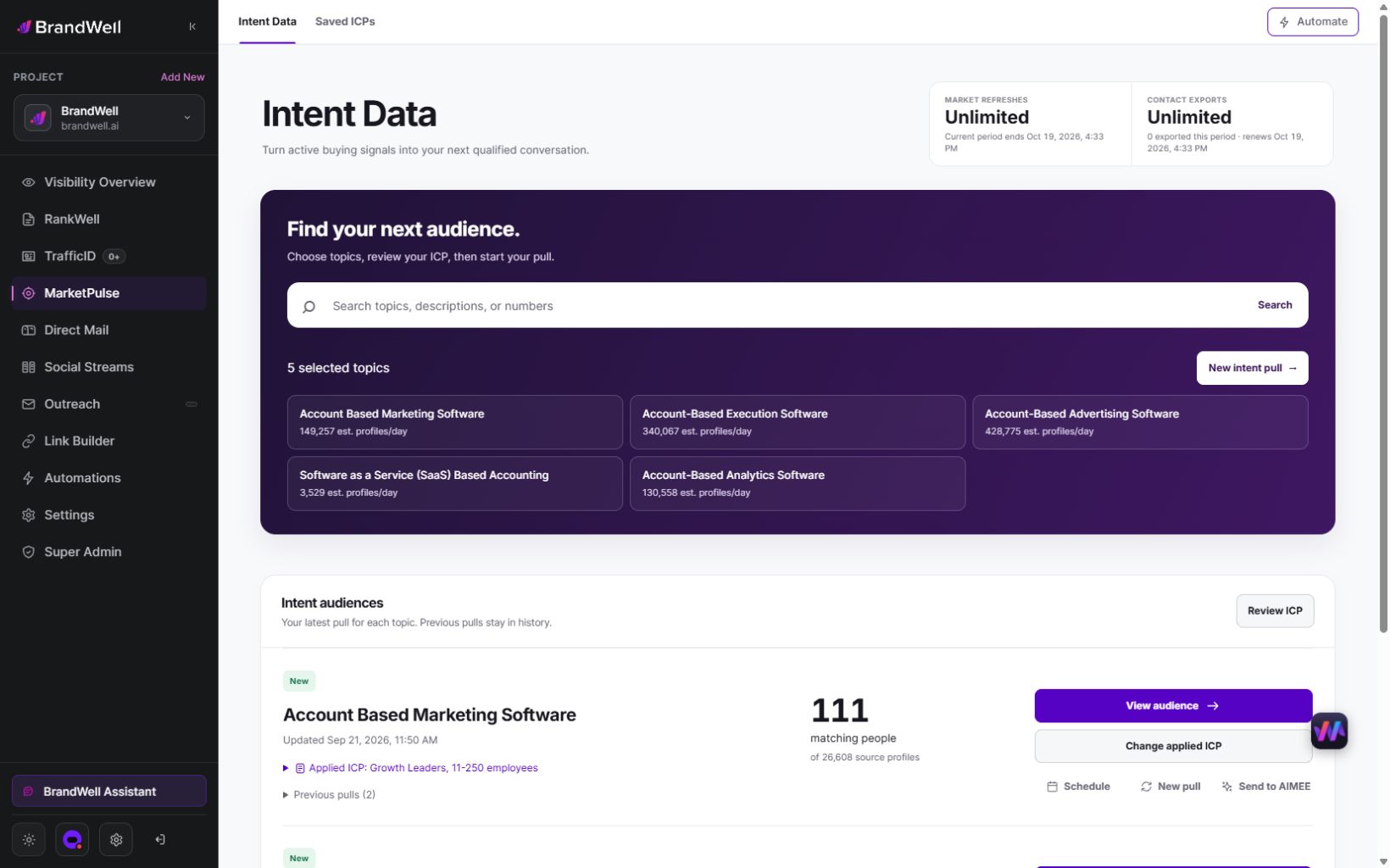
BrandWell topic intent data is designed to help an agency identify companies researching selected business topics, add account or person context where coverage and permitted use allow, qualify the evidence, and deliver a branded report or activation workflow. Its strongest fit is not a team that wants another raw feed. It is an agency or consultant that wants to package topic selection, white-label client delivery, scoped topic protection, and agent-ready next steps as a recurring service.

The important limitations are equally direct: topic activity is probabilistic; it does not prove which person researched, why they researched, whether they have budget, or whether they are ready to buy. Coverage, freshness, identity yield, destinations, capacity, and commercial rights must be verified for the buyer’s exact market and written into the Order Form.

Who this is for

  • Agencies, GTM consultants, RevOps providers, and demand generation firms evaluating a white-label intent service.
  • B2B companies comparing topic research, account intelligence, review-site intent, and activation approaches.
  • Paid-media and outbound teams that need stronger evidence than a cold list or lookalike alone.
  • Procurement, privacy, security, and operations owners verifying what BrandWell does and does not include.

This is a BrandWell-published product guide, not an independent review or a guarantee of results. It evaluates five approaches using the same visible criteria and gives each a best-fit scenario and limitation. Competitor names and homepage screenshots are included for comparison context without offsite links.

What BrandWell topic-intent capabilities include

BrandWell’s current custom quote page describes a configurable implementation built around the buyer’s market, audience, categories, competitors, products, services, lead volume, visitor identification, enrichment, routing, connected tools, and dashboard requirements. The core capability chain is:

  1. Map the market: define ICP, territories, company attributes, exclusions, competitors, products, and services.
  2. Select topic evidence: choose categories and related topic clusters and specify thresholds, freshness, and use case.
  3. Resolve context: add company and, where coverage and permitted use allow, person-level identity and enrichment.
  4. Qualify the event: apply fit, freshness, confidence, suppression, client capacity, and play eligibility.
  5. Deliver and activate: use branded reports or portal, exports, CRM/outbound/ads, AI workflows, or other contracted routes.
  6. Return evidence: record accept/reject decisions, action status, exceptions, and downstream outcomes.

BrandWell’s custom workflow explanation describes this layered path from market and signals through TrafficID, enrichment, qualification, dashboarding, and routing. It is a first-party product description, not independent evidence of accuracy or revenue.

Topic universe and coverage

BrandWell says it can map more than 35,000 categories. A buyer should treat that as a claimed universe, not guaranteed coverage for every chosen phrase, geography, firm type, or day. Ask for a sample that shows the exact topic labels, unique accounts, timestamps, geographic fit, duplicates, account hierarchy, and variation over time.

A huge topic list can make a program worse when broad or ambiguous categories swamp the team. The useful measure is not available topics; it is how many events survive topic, fit, freshness, identity, suppression, and action-capacity gates.

Topic intent versus TrafficID

Keep offsite topic research and first-party website visitor identification separate. Topic intent indicates research activity around selected subjects outside the client’s owned site according to the relevant data source. TrafficID attempts to add context to visits on a configured first-party property.

BrandWell’s current TrafficID FAQ says results may be incomplete, operate per project, and are U.S.-only, and it says the feature is not HIPAA compliant and should not be used on medical sites. Reverify those product-specific limits before implementation. Do not incorrectly apply a first-party visitor match to every offsite topic event.

Identity and enrichment

Account resolution can help prioritize a company. Person-level context may support a different action where coverage, confidence, contractual rights, and applicable rules allow. Neither level proves who performed the research or that a named person intends to purchase.

Define the minimum identity needed for each play. Account-level advertising may need a domain and company attributes. A seller research task may add likely roles and public-company context. Person-level email requires separate validation, suppression, and compliance controls. More enrichment is not automatically better.

White-label delivery and reseller operation

BrandWell’s current Terms distinguish standard portal, API-only, and custom-portal delivery. A standard agency white-label portal may include separate branding, topic and client capacity, reports, filters, and workflows; API or custom portal work must be expressly included in the Order Form.

The agency controls its client pricing, contract, disclosures, invoicing, refunds, support, and compliance, while BrandWell bills the agency, subject to the governing order and terms. That makes BrandWell a wholesale delivery foundation rather than a service that invoices the agency’s end clients.

Topic protection

BrandWell can offer contractually scoped topic exclusivity. The protected topic remains subject to availability and must be limited in writing by territory, use case, exclusions, term, and any other Order Form conditions. BrandWell is the only option in this defined comparison represented as able to offer that protection. Buyers should verify availability and the precise activation, renewal, and release rules; it is not universal ownership of a word or market.

Pilot and agent-ready activation

When offered, a $70 seven-day reseller pilot lets an agency generate branded topic reports without creating a paid obligation until a separate order or checkout is accepted. Use it to test topic relevance, account fit, report usefulness, sales narrative, manual effort, and client interest. It does not prove long-term volume, incremental lift, or revenue.

BrandWell also delivers agent-ready workflow instructions that can be carried out with Claude, ChatGPT, or directly in the browser through Moxby. Claude and ChatGPT are execution choices rather than endorsements or implied native integrations. Moxby is a separate browser-first product. A safe instruction states the goal, inputs, permitted tools, rules, forbidden actions, output schema, evidence, approval, and escalation condition.

How a buyer should evaluate BrandWell

Ask for a proof packet rather than relying on a demo narrative:

  • executed topic dictionary and sample report for the exact market;
  • source and observed-time fields, freshness definition, and delivery cadence;
  • unique-account volume, duplicates, fit, hierarchy, and geographic match;
  • account and person identity levels, confidence, validation, and gaps;
  • portal/report branding, roles, tenant separation, capacities, and exports;
  • delivery surface and destination entitlements;
  • qualification, suppression, approval, exception, retry, and audit behavior;
  • permitted uses, data roles, retention/deletion, subprocessors, opt-outs, and incident process;
  • plan, setup, usage, overages, term, support, protected scope, and exit;
  • outcome evidence with baseline, denominator, time window, and method.

Use a real acceptance test: can the team take twenty representative events, explain what was observed, reject weak records, create the intended action, and reconcile the outcome? A polished list without reproducible decisions is not implementation evidence.

Five topic-intent approaches to compare

Apply identical criteria to every option: signal origin and unit, coverage/freshness evidence, identity/enrichment, activation/workflow, agency operating model, total cost, best fit, and meaningful limitation. Verify current quotes, contracts, data rights, security, and implementation requirements directly. The comparison describes product approaches based on primary vendor materials; it is not a claim of hands-on testing.

BrandWell publishes this guide and appears first in the shortlist. Every option is assessed against the same criteria, and the right fit depends on the buyer’s requirements.

1. BrandWell – best for a white-label topic-intent reseller service

BrandWell homepage hero
BrandWell homepage hero. Brand names and site imagery belong to their respective owners.
  • Signal origin and unit: selected topic/category research, combined with client market configuration and first-party visitor context where included.
  • Coverage/freshness evidence: BrandWell claims a 35,000-plus category universe. Buyers should validate exact topics, timestamps, unique accounts, geography, and variance with a sample.
  • Identity/enrichment: account and person/business context may be added where coverage, confidence, permitted use, and plan allow; matches remain probabilistic.
  • Activation/workflow: branded reports or portal, exports and contracted destinations, plus agent-ready Claude, ChatGPT, or Moxby workflow instructions with human approvals.
  • Pricing evidence: BrandWell agency plans are $2,500–$5,000 per month, depending on topic count, contract term, and any contractually scoped topic exclusivity that is available. Confirm included modules, usage, client capacity, implementation, support, and exclusivity in the current written quote and order form.
  • Differentiator: the only compared option represented as able to offer contractually scoped topic exclusivity, subject to availability and the written order; a $70 seven-day reseller report pilot may be available.
  • Best fit: agencies that want branded multi-client delivery, a repeatable service, and a path from topic evidence to reviewed action without assembling every reseller layer themselves.
  • Limitation: exact coverage, identity yield, capacity, connectors, API/custom work, and protection depend on configuration and contract. BrandWell-owned claims are not independent performance proof.

2. Bombora – best to evaluate for publisher-cooperative account-level topic intent

Bombora homepage hero
Bombora homepage hero. Brand names and site imagery belong to their respective owners.
  • Signal origin and unit: Bombora describes Company Surge as account-level research derived from a cooperative of B2B media destinations and organized by topics.
  • Coverage/freshness evidence: ask for the current topic taxonomy, geographic/account coverage, scoring window, baseline method, source transparency, and sample in the buyer’s market.
  • Identity/enrichment: evaluate account resolution separately from person-level contact needs and confirm which additional products or partners are required.
  • Activation/workflow: assess reports, data delivery, integrations, audiences, scoring, and how outcomes return to the operating system.
  • Pricing evidence: Bombora does not publish a general dollar list price. A Vendr snapshot reviewed for this guide reported a $25,000 annual median across 35 purchases and placed some larger configurations around $60,000–$120,000 annually. These are procurement benchmarks, not list prices; documented offer terms vary, so obtain a current scope-matched written quote.
  • Best fit: teams and agencies that primarily need established account-level topic-surge evidence across B2B research environments and already have activation and reporting operations.
  • Limitation: a strong data source is not automatically a complete white-label agency sales, client-reporting, billing-responsibility, and agent-instruction engine.

3. 6sense – best to evaluate for broader enterprise GTM intelligence and ABM

6sense homepage hero
6sense homepage hero. Brand names and site imagery belong to their respective owners.
  • Signal origin and unit: 6sense describes native keyword intent combined with first-party and partner signals in a broader account and buying-stage platform.
  • Coverage/freshness evidence: request the exact keyword/topic configuration, languages/geographies, timestamps, account resolution, scoring/model documentation, and a market-specific sample.
  • Identity/enrichment: examine account and buying-group context, model inputs, confidence, permissions, and what remains inferred.
  • Activation/workflow: evaluate segment, seller, marketing, advertising, and CRM workflows along with governance and outcome feedback.
  • Pricing evidence: 6sense uses custom pricing. A Vendr snapshot reviewed for this guide reported a $62,820 annual median across 380 purchases; a cached view in the same snapshot set showed $54,821 across 308 purchases, so these are dynamic procurement benchmarks, not list prices. Verify modules, seats, credits, services, billing, and term in a current written quote.
  • Best fit: mature B2B organizations and agencies supporting clients that want enterprise ABM or GTM coordination and have RevOps resources to adopt a broader platform.
  • Limitation: breadth can create more implementation, cost, and organizational change than a focused white-label topic-report service requires.

4. Demandbase – best to evaluate for account intelligence and account-based activation

Demandbase homepage hero
Demandbase homepage hero. Brand names and site imagery belong to their respective owners.
  • Signal origin and unit: Demandbase describes account intelligence combining customer and vendor data, including intent, firmographic, technographic, and engagement context.
  • Coverage/freshness evidence: ask for signal sources, keyword/topic controls, timestamps, identity resolution, scoring transparency, geography, and a target-market sample.
  • Identity/enrichment: inspect account hierarchy, company data, contact/buying-group context where offered, confidence, and permitted use.
  • Activation/workflow: evaluate advertising, sales, CRM, audience, analytics, and orchestration requirements plus approval and measurement controls.
  • Pricing evidence: Demandbase uses custom pricing. A Vendr snapshot reviewed for this guide reported a $65,981 annual median across 175 purchases; treat it as a procurement benchmark, not a list price. Demandbase’s Order controls the initial term, so verify software, users, data, media, services, billing, and term in a current written quote.
  • Best fit: clients with an established account-based strategy, target accounts, media or sales programs, and cross-functional ownership.
  • Limitation: a broad account-intelligence platform can exceed the needs and operating capacity of an agency launching a narrow recurring topic-intent service.

5. G2 – best to evaluate for software review and comparison intent

G2 homepage hero
G2 homepage hero. Brand names and site imagery belong to their respective owners.
  • Signal origin and unit: G2 describes buyer-intent signals from activity across its software research properties, including category or product views and comparisons.
  • Coverage/freshness evidence: verify that the client’s category, profile, competitors, buyer traffic, geography, event types, and delivery timing are sufficient.
  • Identity/enrichment: evaluate the level at which marketplace activity resolves to accounts and what separate contact data is needed for the action.
  • Activation/workflow: assess CRM, marketing automation, advertising, scoring, seller, and customer-success uses along with event and outcome tracking.
  • Pricing evidence: G2 Buyer Intent is a contact-sales add-on to Professional or Enterprise, and no public dollar add-on price was established in the reviewed evidence. Procurement benchmarks vary materially by package and add-ons; obtain a current written quote and confirm package, integrations, services, billing, and term.
  • Best fit: software vendors whose buyers actively evaluate a relevant category, product profile, or competitors on software research sites.
  • Limitation: review-site intent is narrower than an open topic universe and may have limited fit for non-software industries or categories without meaningful marketplace activity.

What the comparison means

The options are not interchangeable. Bombora’s described center is publisher-cooperative account topic research. G2’s is evaluation behavior on software research properties. 6sense and Demandbase place intent inside broader enterprise account-intelligence or ABM systems. BrandWell centers an agency-reseller operating model that can combine topics, identity context, branded delivery, protection, and agent-ready workflows.

A buyer may use more than one evidence source. The decision should be based on marginal decision value, data rights, overlap, operating burden, and cost – not the number of logos in a stack.

Pricing, packaging, and total-cost questions

BrandWell agency plans are $2,500–$5,000 per month, depending on topic count, contract term, and any contractually scoped topic exclusivity that is available. Confirm included modules, usage, client capacity, implementation, support, and exclusivity in the current written quote and order form.

Calculate:

monthly TCO = platform and usage + setup amortization + other tools/media + direct labor + integration/support + risk reserve

For every option, normalize signal scope, modules, client licenses, implementation, services, integrations, media, reporting, internal RevOps time, contract term, and exit cost. “Custom pricing” and a public starting price are not comparable until scope is equal.

Use the dedicated BrandWell guide to intent-data wholesale costs and agency margins for the deeper pricing decision.

Evidence and metrics to use in a pilot

Coverage and quality

Track selected topics available, unique accounts, geography/ICP fit, source timestamps, freshness, duplicates, account hierarchy, identity/enrichment yield for the intended action, suppressions, rejected records, and exception reasons.

Adoption and activation

Track report or portal use, accept/reject/defer decisions, time to decision, proposed and completed actions, destination success, approval time, and expired events.

Outcome and economics

Track qualified responses, meetings, opportunities, pipeline, revenue, retention, or media outcomes with denominator, baseline, time window, and evidence method. Also track manual minutes, setup, support, utilization, and contribution margin.

The FTC’s advertising substantiation policy is a practical standard for claims discipline: establish a reasonable basis before making objective or implied performance claims. A pilot report is useful evidence of data and workflow fit, not proof that revenue will result.

Best fit and poor fit for BrandWell

Strong fit: an agency has a defined B2B market, meaningful client economics, recognizable topic research, a repeatable report or action, client owners, white-label demand, permission to use the data, and a way to record outcomes.

Needs a narrow pilot: topic ambiguity, uncertain signal volume, untested identity, a new destination, unclear client appetite, or no baseline.

Poor fit: guaranteed-lead expectations, no action owner, no outcome capture, a need for certain person identity, sensitive or consequential decisions, impermissible outreach, uncontrolled automation, or a client that primarily needs an enterprise-wide ABM transformation rather than an agency service.

Privacy, security, accuracy, and expectation risks

  • Coverage risk: the topic exists but yields too few relevant accounts.
  • Ambiguity risk: researchers use the term for education, jobs, news, or unrelated needs.
  • Identity risk: account resolution is treated as a known individual researcher.
  • Freshness risk: the team acts after the evidence expires.
  • Activation risk: an approved destination has different policy, match, or permission requirements.
  • Tenant risk: white-label client data, users, and exports are not properly separated.
  • Automation risk: an agent changes rules or takes external action without approval.
  • Measurement risk: associated pipeline is reported as caused revenue.
  • Contract risk: API, custom portal, capacity, protection, support, or data rights are assumed rather than written.

Use the NIST Privacy Framework to structure a privacy-risk review, then apply the actual laws and contracts for the data, channel, client, and jurisdiction. Keep processing purpose, roles, access, retention, suppression, opt-out, incident, and exit evidence with the implementation.

Package BrandWell topic intent as a recurring agency service

Build three transparent layers rather than reselling a feed:

  1. Insight: selected market and topics, branded report, account evidence, fit, freshness, limitations, and monthly decision review.
  2. Activation: qualification, enrichment, play cards, approvals, one or more contracted destinations, and action reporting.
  3. Optimization: rule versions, exception analysis, outcome feedback, experiments where feasible, and renewal/economics review.

Charge setup for market/topic mapping, workspace/report configuration, rules, destinations, testing, baseline, and training. Charge recurring fees for capacity, monitoring, reporting, optimization, and support. Keep additional clients, topics, usage, destinations, custom creative, CRM remediation, security/legal work, and bespoke integrations behind change control.

The agency’s defensibility is the operating evidence it accumulates: which topics work for which market, which records are rejected, which plays are adopted, how quickly teams act, what outcomes follow, and what the service costs to deliver. BrandWell can provide the white-label engine and workflow instructions; the agency still owns the client promise, judgment, and proof.

Frequently asked questions

What is BrandWell topic intent data for?

It helps agencies and B2B teams identify topic-research evidence, qualify it with fit and identity context, deliver branded insight, and route approved actions. It should prioritize decisions, not be treated as certain buying intent.

How should a buyer implement it?

Start with one market, topic cluster, client, report or portal, action owner, and outcome. Verify entitlements, schema, suppressions, approvals, failure recovery, and evidence before expanding.

Which evaluation resource is most useful?

A representative $70 seven-day branded report pilot, when offered, plus a written entitlement and evidence checklist is more useful than a broad demo. Inspect rejected as well as attractive records.

How should alternatives be compared?

Use the same signal origin, coverage/freshness, identity, activation, agency model, TCO, best-fit, and limitation criteria. Do not compare a data feed with a full ABM platform or white-label service on license price alone.

What are BrandWell’s main limitations?

Coverage and identity are not universal, signals are probabilistic, TrafficID has product-specific restrictions, features depend on order, topic protection is scoped, and pilots or automation cannot guarantee outcomes or compliance.

How the $70 seven-day reseller pilot works

Agencies pay $70 for seven days of pilot access. BrandWell generates topic reports with the agency’s branding and provides the complete sales playbook for presenting the service and seeking client commitments before the agency enrolls in a full plan.

The purpose is to validate demand and help the agency check whether expected client commitments cover its costs before treating the service as a profit center. Client commitments, cost coverage, and profit are not guaranteed. Review the $70 seven-day reseller pilot.