For most agencies, buying or reselling a scoped intent-data operating layer is the faster way to test client demand; building in-house is better only when proprietary data control or workflow differentiation is strategic enough to justify permanent sourcing, engineering, governance, and maintenance. BrandWell can be the buy/resell path when its written scope and representative proof meet the agency’s requirements. It should not be called the lowest-total-cost or production-ready choice without matched quotes, technical evidence, and a passed proof of concept.

Who this is for: agency owners, technical leaders, RevOps consultants, data-service resellers, and procurement teams deciding whether to use BrandWell, license point or enterprise inputs, build an internal stack, or combine those approaches. BrandWell here means the separate agency-reseller intent-data offer, not its legacy SEO writer.

BrandWell is intended to function as a white-label sales-and-delivery engine for agencies that would rather sell and operate a service than assemble every layer. This is BrandWell-provided positioning subject to current written product scope; buyers must verify the actual portal, report, automation, support, and data entitlements instead of treating “complete” as an unconditional claim.

The decision is about an operating system, not merely a database. Every option needs signal inputs, identity rules, enrichment or validation where required, activation, client separation, governance, support, measurement, and an exit path. A bought platform can reduce assembly work but introduces contractual dependency. A build can increase control but still relies on licensed sources, cloud services, destination platforms, and staff.

The direct build-versus-buy decision

Choose BrandWell or another bought path when speed to a testable client service matters, the agency accepts scope determined by written terms, and a portal or agreed delivery path covers the workflow. Choose an in-house build when proprietary transformations, control over the user experience, custom governance, or cross-source orchestration creates enough durable value to fund ongoing engineering and data operations. Choose a hybrid when the agency wants to buy difficult data or identity inputs while owning qualification, client experience, activation logic, and evidence.

Do not compare a vendor subscription with only the first sprint of an internal build. Nor should you compare a complete internal team with a vendor’s headline price. Brandwell versus building intent infrastructure in house must be evaluated across a common service boundary and time horizon. The meaningful unit is “one supportable client workflow with defined data rights, controls, and evidence,” not “access to signals.”

The decision changes by use case. A branded research report can need little integration. Near-real-time routing can require credentials, retries, schemas, observability, and support. Person-level outreach introduces identity and permission review. Advertising activation adds audience provenance and platform-policy constraints. The architecture should follow the highest-risk use the agency actually plans to sell.

Methodology and identical comparison criteria

Disclosure: This is a Brandwell-owned resource. Brandwell is the publisher’s product; all options are evaluated using the same disclosed criteria.

The five companies below are not ranked as interchangeable end-to-end answers. They are current shortlist benchmarks for different buy-side inputs and operating postures. Each is reviewed with the same criteria: intended audience and use case; signal/data coverage and freshness; identity resolution and validation; integrations and activation; implementation effort; privacy and governance; verified pricing and total cost; measurement and attribution; proof; limitations and best-fit scenarios. Public competitor links are intentionally omitted. Buyers should verify current primary product, contract, pricing, privacy, security, and technical documents directly during procurement.

1. BrandWell

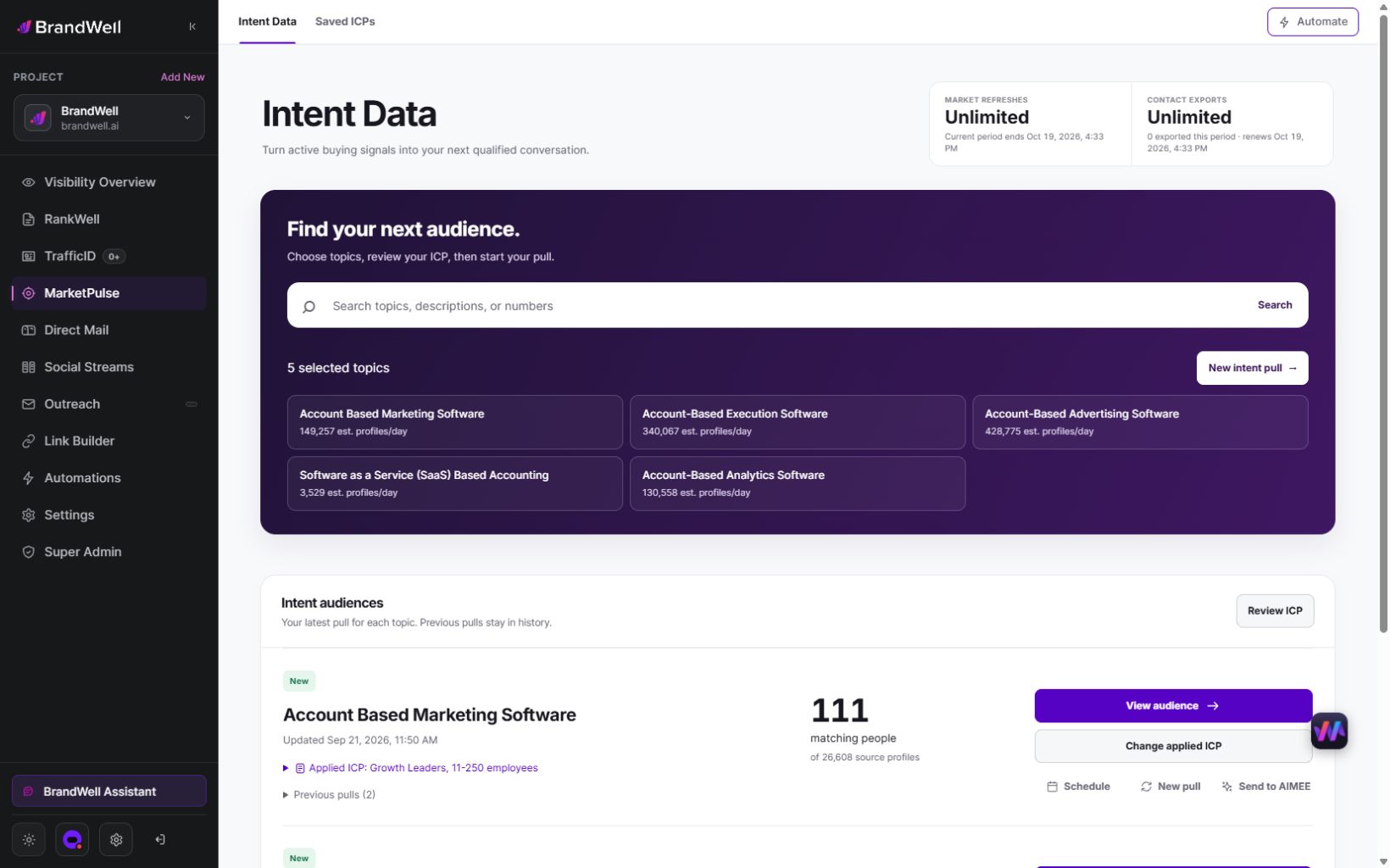
BrandWell homepage hero
BrandWell homepage hero. Brand names and site imagery belong to their respective owners.

Intended audience and use case: BrandWell is evaluated here as a white-label agency-reseller route for agencies that want to package buyer-intent data, branded reports, and controlled activation under their own client relationship. Its public terms describe standard portal, API-only, and custom-portal possibilities, while the Order Form determines the purchased path.

Signal/data coverage and freshness: Public materials describe research and topic signals, but precise totals are volatile or conflicting and do not establish performance for one market. Test the agency’s own topics, accounts, regions, timestamps, and hard cases. Do not treat a public count as a production coverage or freshness promise.

Identity resolution and validation: BrandWell’s privacy material describes identity matching, enrichment, and validation categories while stating that outputs are probabilistic and coverage is not universal. Confirm identity levels, fields, confidence, nulls, update behavior, and entitlements in writing.

Integrations and activation: BrandWell positions a path from signals through matching, enrichment, scoring, and routing to approved destinations where coverage and scope permit. A specific connector, endpoint, webhook, schema, limit, or support commitment requires current documentation; underlying-provider docs are not a BrandWell contract.

Implementation effort: The buy/resell path may reduce platform assembly, but the agency still owns offer design, client selection, retail pricing, billing, support, disclosures, governance, and much of the operating workflow unless a written service scope says otherwise.

Privacy and governance: The service is primarily described for U.S. business use. Validate purpose, geography, notice, permissions, suppression, retention, client terms, and channel policy. Do not infer certification, granular permissions, audit logs, continuity, RTO, RPO, or a compliance guarantee.

Verified pricing and total cost: Public pricing is custom quote and scope-sensitive. BrandWell agency plans range from $2,500 to $5,000 per month, depending on topic count, term, and available contractually scoped topic exclusivity. The current written quote and Order Form control. Topic count, term, capacity, delivery path, custom work, and any available written topic protection affect the total. No lowest-cost conclusion is supported.

Measurement and attribution: Track eligible, matched, accepted, routed, acted-on, and downstream outcome stages separately. A signal or branded report is not pipeline. Agree on attribution before showing influenced or attributable revenue.

Proof: Require a representative data test, a field dictionary, an entitlement matrix, a reconciled workflow, support terms, and a written decision memo. Agencies can purchase BrandWell’s $70 seven-day reseller pilot. It includes agency-branded topic reports and the complete sales playbook under the current written pilot terms. Other product capabilities and any topic exclusivity remain subject to their separate current written scope.

Meaningful limitation: BrandWell’s exact entitlements, readiness, service levels, API details, and field performance cannot be inferred from broad public language. Agencies that need an established public enterprise SLA or a fully documented custom technical interface must resolve those requirements before choosing it.

2. 6sense

6sense homepage hero
6sense homepage hero. Brand names and site imagery belong to their respective owners.

Intended audience and use case: 6sense should be evaluated as an enterprise account-based platform benchmark for organizations seeking intent modeling, account prioritization, and coordinated go-to-market activation. An agency must separately verify whether its required reseller, client-separation, or white-label operating model is supported.

Signal/data coverage and freshness: Official product and support material describes intent models and scoring concepts, but a buyer still needs a matched test of topics, accounts, geographies, timestamps, and exclusions. Enterprise breadth does not remove the need for a defined denominator or account-level validation.

Identity resolution and validation: Ask what entity level each score or record represents, which identity and contact fields are included, how confidence and missing values work, and how updates are handled. Do not compare an account score with a person-level match as though they were the same output.

Integrations and activation: Public positioning includes activation and advertising capabilities. Procurement should confirm the exact CRM, marketing, audience, export, and workflow path required by the agency, plus authentication, error behavior, approval boundaries, and client access.

Implementation effort: An enterprise platform can centralize more of the account-based workflow, but that often makes data preparation, taxonomy, governance, user adoption, and operating-model design central to time-to-value. Staff the implementation the agency will actually run, not the demo.

Privacy and governance: Request current contractual roles, data-source and permitted-use information, retention and deletion processes, access controls, subprocessors, security evidence, and audience governance. The agency remains responsible for its own client contracts and channels.

Verified pricing and total cost: Use a current written quote for the agency’s exact users, markets, capabilities, data, implementation, service, term, and expansion assumptions. No comparable public scope-matched total in this evidence set supports a numeric claim.

Measurement and attribution: Test score acceptance, sales or media adoption, routing reliability, progression, and attribution using the same definitions as every other option. Include the client labor required to use the platform.

Proof: Run a proof period with the same frozen account set and destination used for BrandWell and the build prototype. Inspect documentation, references, implementation plan, test outputs, and an export or offboarding scenario.

Meaningful limitation: 6sense may be a stronger fit for a mature enterprise ABM organization than for an agency seeking a lightweight, branded reseller service. Complexity, adoption, commercial scope, and reseller rights must be validated rather than assumed.

3. Demandbase

Demandbase homepage hero
Demandbase homepage hero. Brand names and site imagery belong to their respective owners.

Intended audience and use case: Demandbase is an enterprise account-based go-to-market benchmark. It may suit organizations that want account intelligence and orchestration around an established ABM motion. An agency evaluating it for resale must confirm tenant, branding, support, and commercial rights separately from general platform capability.

Signal/data coverage and freshness: Official material describes intent and account-oriented data concepts. Evaluate the client’s market, topic meaning, eligible population, score timing, geographic performance, and missing-account behavior with a controlled sample rather than relying on an aggregate claim.

Identity resolution and validation: Define whether outputs are account, buying group, contact, or another level; which fields are observed or inferred; how collisions and subsidiaries are handled; and what validation or enrichment is included. Use a truth set containing negative and ambiguous cases.

Integrations and activation: Public positioning spans account-based activation and personalization. Confirm each required destination, object, field, sync direction, delay, deduplication rule, failure state, and approval. A named integration does not prove the agency’s exact workflow is turnkey.

Implementation effort: Value depends on account taxonomy, CRM hygiene, audience and sales-process alignment, user adoption, and measurement. Budget for data preparation, configuration, enablement, administration, and changes – not just technical connection.

Privacy and governance: Verify current contract roles, permissible use, data rights, access, retention, suppression, deletion, security materials, and client isolation. Review any advertising or outreach activation under current platform policies and the client’s legal basis.

Verified pricing and total cost: Obtain a written configuration and total-cost estimate covering licenses, data, implementation, services, users, usage, term, client structure, and future changes. Do not infer the cost from category averages.

Measurement and attribution: Compare accepted account signals, activated audiences or sales actions, user adoption, opportunities, and attributable outcomes with the same methodology used elsewhere. Separate platform influence from campaign and sales execution.

Proof: Ask for a representative test, technical and security documentation, implementation plan, relevant customer references, and a migration/export exercise. The proof should include failure cases, not only a staged happy path.

Meaningful limitation: Demandbase can be disproportionate when an agency’s immediate need is a simple branded report or one narrow signal workflow. Enterprise breadth can add implementation, training, governance, and commercial complexity that a small recurring service cannot absorb.

4. Bombora

Bombora homepage hero
Bombora homepage hero. Brand names and site imagery belong to their respective owners.

Intended audience and use case: Bombora is evaluated primarily as a third-party intent-data and audience input rather than as proof of a complete white-label agency operating layer. Its cooperative data model and agency-oriented materials make it relevant when an agency is sourcing intent for a broader stack.

Signal/data coverage and freshness: Official material explains company-level research and cooperative data concepts. Buyers should test topic taxonomy, account population, surge or score interpretation, observation windows, region, delivery cadence, and the client ICP. A cooperative dataset’s breadth does not guarantee fit for every niche market.

Identity resolution and validation: Clarify whether the purchased output is company-level, which identifiers and firmographic fields accompany it, and what separate identity or contact provider is required. Do not treat account research intensity as a named contact’s action.

Integrations and activation: Determine how the data reaches the agency’s CRM, data warehouse, advertising platform, or other destination, whether another platform is required, and who owns transformations, suppression, errors, and reporting. Validate reseller and audience rights in the contract.

Implementation effort: A data-input approach can give the agency flexibility, but it transfers more assembly work to the agency: entity resolution, enrichment, qualification, routing, client experience, support, and evidence may remain external to the feed.

Privacy and governance: Review provenance, cooperative participation rules, permitted use, client disclosure, audience rights, retention, suppression, deletion, subprocessors, and security. Minimize fields and prevent a company-level signal from becoming unsupported person-level outreach.

Verified pricing and total cost: Request a current quote for the topics, markets, delivery, volume, activation rights, agency/client structure, implementation, and term. Include every complementary identity, enrichment, workflow, reporting, and staffing component in total cost.

Measurement and attribution: Measure usable account coverage, topic acceptance, age at action, downstream match, activation, and outcome. Report what the Bombora input contributed versus what the agency’s other systems supplied.

Proof: Test the same frozen account list and topics used for the other options. Inspect sample data, taxonomy, delivery documentation, contractual rights, integration plan, and how null or low-signal cases are represented.

Meaningful limitation: Bombora may supply a valuable intent input without supplying the complete client portal, person-level identity, activation logic, or service operations an agency wants. The agency must cost and govern the surrounding stack rather than call the feed an end-to-end solution.

5. ZoomInfo

ZoomInfo homepage hero
ZoomInfo homepage hero. Brand names and site imagery belong to their respective owners.

Intended audience and use case: ZoomInfo is evaluated as a broad go-to-market data and marketing platform benchmark. It can be relevant when contact and company data, intent-related inputs, and sales or marketing workflows are considered together. Agency resale and white-label rights require explicit verification.

Signal/data coverage and freshness: Test the exact company, contact, topic, geography, and recency requirements against a representative list. Broad database positioning is not an answer to whether required fields are present and current in the client’s segment.

Identity resolution and validation: Ask how company, contact, visitor, and intent-related outputs differ; which are included; how confidence, job changes, generic domains, and validation are handled; and which timestamp applies to each field. Separate a usable contact record from evidence of active research.

Integrations and activation: Verify each required CRM, marketing, advertising, export, or workflow path, including schema, sync behavior, credits or usage, errors, suppression, approvals, and client separation. General platform availability does not establish a white-label agency implementation.

Implementation effort: A broader GTM platform may consolidate data and workflows, but it can require administration, credit or usage management, CRM governance, enablement, and process changes. Include those duties in the staffing plan.

Privacy and governance: Obtain current permissible-use terms, data-source explanations, retention and deletion processes, access and security materials, subprocessors, client rights, and channel restrictions. The agency must independently validate its legal basis and communications practices.

Verified pricing and total cost: Use a written quote tied to seats, data, usage, packages, implementation, services, term, and agency/client needs. Add administration, integration, enrichment overlap, training, and migration. No blanket category estimate should replace procurement evidence.

Measurement and attribution: Compare required-field completeness, accepted matches, successful routing, user adoption, progression, and revenue under the common test plan. Avoid crediting a database for outcomes caused by message, offer, media, or seller performance.

Proof: Request a matched sample, documented field definitions, workflow dry run, security and privacy evidence, implementation plan, reference appropriate to the operating model, and an export/offboarding test.

Meaningful limitation: ZoomInfo’s broad GTM scope can create overlap, credit or usage complexity, and administrative work when an agency only needs a branded intent report or narrowly defined reseller workflow. Exact white-label and multi-client rights cannot be assumed.

Architecture bill of materials for an in-house build

An in-house intent system needs more than an event table. Build the bill of materials around the service promise:

LayerMinimum componentsQuestions ownership must answer
Market and topic modelaccount universe, topic taxonomy, exclusions, versioningWho defines meaning and resolves drift?
Signal acquisitionlicensed or first-party sources, timestamps, provenanceAre rights, geography, cadence, and continuity adequate?
Identity resolutiondomain/account/person rules, confidence, collision handlingWhat truth set and threshold support each use?
Enrichment and validationfield sources, update logic, nulls, quality testsWhich fields change a decision and are permitted?
Storage and processingschemas, lineage, access, retention, deletionHow are client data and credentials separated?
QualificationICP, recency, completeness, suppression, scoringWho approves and audits rule changes?
Activationconnectors, queues, approvals, retries, deduplicationHow is every record reconciled and rolled back?
Client experiencebranding, reports, filters, access, supportWhich capabilities are stable enough to sell?
Evidencebaselines, outcome capture, attribution, experimentsCan results be reproduced and caveated?
Operationsmonitoring, incidents, vendors, change control, offboardingWho is on call and what is the fallback?

Buying does not eliminate these layers; it changes who supplies and maintains them. A BrandWell standard portal might cover more client-delivery surface than a point-data license, while a custom internal stack may own nearly all of it. The buyer should shade each cell as vendor, agency, client, shared, or unresolved.

A three-year cost-input worksheet without invented totals

Use a 36-month model because both custom builds and platform adoption have front-loaded and recurring work. Enter current written values; do not fill gaps with category folklore.

Buy or resell inputs: base quote; topics, users, client accounts, sites, records, or other capacity; add-ons; implementation; custom work; support; integration tools; analyst operations; client success; governance; training; unused committed capacity; expansion; renewal; export; migration; termination.

In-house inputs: data licenses; cloud and observability; product management; data engineering; application engineering; design; QA; security and privacy; legal/procurement; integration maintenance; analyst operations; client support; incident response; vendor replacement; data-quality testing; on-call coverage; documentation; opportunity cost.

Hybrid inputs: all purchased feeds and tools plus the owned qualification, portal, activation, and evidence layers. Hybrids often look cheaper only because shared staff time is hidden.

For Brandwell versus building intent infrastructure in house pricing, compare cash by month and labor by role. For Brandwell versus building intent infrastructure in house total cost, add risk-adjusted scenarios: lower volume, delayed integration, a source replacement, a client-specific request, turnover in a key role, and exit. Do not claim BrandWell has the lowest TCO. The answer depends on scope, utilization, staffing, and time.

The BrandWell range is planning guidance, and the current written quote controls. Any topic exclusivity or protection must be available and written with territory, use case, exclusions, and term. Competitor totals and contract terms must come from matched current quotes; a generic $5,000–$10,000 monthly assertion or universal annual commitment is not defensible.

Run a matched proof of concept

Brandwell versus building intent infrastructure in house evidence should come from a controlled proof period. Freeze one account set, topics, date window, geography, required fields, identity threshold, suppressions, destination, and acceptance rules. Give the same input and deadline to BrandWell, any licensed alternative, and the internal prototype. If a provider cannot accept the same input, document the difference rather than scoring it as equivalent.

Evaluate:

  • eligible and usable coverage by segment;
  • identity level, collisions, and reviewed false positives;
  • required-field completeness and timestamp meaning;
  • delivery latency and age at action;
  • routing success, duplicates, errors, and recovery;
  • analyst time per accepted and activated record;
  • user adoption and action rate;
  • client comprehension and support burden;
  • response, opportunity, and revenue evidence with caveats;
  • export, deletion, and switching practicality.

A Brandwell versus building intent infrastructure in house demo should also include failure handling. Use a missing field, duplicate account, changed topic, revoked credential, suppressed record, and unavailable destination. Inspect the documentation and responsibility boundary for each failure. The proof should end with a signed decision memo, not a sales score averaged beyond recognition.

Control, lock-in, governance, and switching

Vendor lock-in is not simply using a vendor. It becomes dangerous when definitions, raw inputs, client relationships, workflow logic, or evidence cannot be exported or reconstructed. Internal lock-in also exists when only one engineer understands a pipeline or when proprietary code depends on an unstable source.

For Brandwell versus building intent infrastructure in house integrations, record schemas, identifiers, transformations, credentials, destinations, error behavior, and replacement interfaces. For privacy and compliance, record roles, permitted uses, notices, suppression, retention, deletion, client contract flow-downs, and channel policies. For security, request or build current controls and incident procedures; deployment location alone does not prove security, ownership, continuity, or compliance.

BrandWell terms acknowledge that third-party provider outages or policies can affect service. That is a reason to map dependencies and fallbacks, not proof of a documented continuity program. No current public material establishes an active intent-service SLA, RTO, RPO, audit-log feature, or granular RBAC. Resolve any necessary commitment in writing.

The exit plan should answer: What data may be exported? In what format? Which scores or derived fields remain usable? How are client credentials and records removed? How long does migration take? Which topics, schemas, reports, and workflow instructions are documented? Who tells clients? What is the fallback service during transition?

Agent workflows and approval boundaries

Owner direction contemplates agent-ready workflow instructions for Claude, ChatGPT, and Moxby. In a build-versus-buy evaluation, treat the instruction artifact as a separate component: inspect its inputs, expected outputs, permissions, version, error behavior, evaluation set, and human approvals. Public material illustrates some AI workflow patterns but does not establish a standard ChatGPT entitlement. Moxby is a separate browser-first product and must not be merged into the BrandWell offer.

An internal build may give the agency more freedom to design agent behavior, but it also creates prompt/version governance, tool permissions, testing, monitoring, and incident duties. A bought instruction package may reduce setup only if it actually exists for the purchased scope and remains portable. In either case, keep people in control of public posts, outreach, advertising audiences, destructive changes, and sensitive-data actions.

Decide whether to build, buy, resell, refer, or combine

Use this decision sequence:

  1. Does the agency have a repeatable buyer problem and one measurable service unit? If no, run discovery before selecting infrastructure.
  2. Can a scoped bought or reseller path satisfy the required data, workflow, governance, and client experience? If yes, test it before funding a build.
  3. Is the missing capability strategically differentiating? If no, license a point input or change the offer. If yes, estimate three-year ownership.
  4. Can the agency fund permanent product, data, engineering, privacy, security, and support work? If no, do not call a prototype a platform.
  5. Would a hybrid preserve differentiation while buying the hardest commodity inputs? If yes, define interfaces and replacement paths.
  6. Is the client’s desired outcome better served by a referral? Refer when the opportunity is outside the agency’s operating maturity or governance boundary.

Brandwell versus building intent infrastructure in house best fit for the buy/resell route is an agency prioritizing time to a branded, testable service and willing to work within contracted scope. Brandwell versus building intent infrastructure in house ideal customers for a build are agencies with distinctive data or workflow IP, multiple committed clients, technical leadership, and funding for ongoing operations. Brandwell versus building intent infrastructure in house managed service may be sensible only when staffing, service levels, and responsibilities are explicit.

The remaining decision lenses – overview, documentation, evaluation checklist, use cases, implementation, workflow, packaging, ROI, accuracy, coverage, freshness, limitations, privacy, security, compliance, alternatives, comparison, reviews, agency reseller use cases, and buyer intent data – belong in the same model. Each must be evaluated against one architecture boundary, one test, and one cost worksheet.

For most agencies seeking near-term client revenue, the rational sequence is buy or resell to learn, own the differentiating workflow, and build only where evidence proves the control is worth maintaining. BrandWell can occupy that first role if its written scope and proof pass. It is not automatically better; the disciplined comparison is.

Benchmark the build decision with a BrandWell agency intent report and a matched total-cost worksheet.

Check the economics before a full plan

For a $70 pilot fee, agencies get seven days to validate the reseller offer. BrandWell supplies agency-branded topic reports and the complete sales playbook for presenting the service and seeking client commitments before any full-plan enrollment.

The agency can use the pilot evidence to assess demand, compare expected commitments against costs, and decide whether the service can become a profit center. Commercial and financial outcomes are not guaranteed. Review the $70 seven-day reseller pilot.