On this page
- Current MarketPulse research workflow
- Write an operating hypothesis
- Check whether the use case is testable
- Create a strategy charter
- Compare five operating models
- Build four implementation releases
- Define data and handoff owners
- Use explainable decision records
- Budget full operating costs
- Evaluate quality and revenue evidence
- Resolve risk and capacity gaps
- Set a review and change cadence
- Scope a separate agency retainer
- Make an evidence-based renewal decision
- Copyable intent strategy pilot
- Frequently asked strategy questions
Build an intent data strategy as a governed operating plan, not a procurement project. Choose one business decision, define the evidence that may influence it, state what the signal cannot prove, assign owners, design the action and feedback loop, and set a renewal test before buying a broad stack. Sales and marketing can operate the strategy only when every signal has a destination, every destination has a decision rule, and every decision returns an outcome.
Who this is for: B2B revenue leaders, RevOps, demand-generation teams, sales managers, data owners, and agencies turning intent evidence into a repeatable program. This is an intent data strategy planning guide. It is not a generic category definition, platform shortlist, or scoring formula.
Current MarketPulse offer: intent-data plans start at $500/mo. See the product, demo, and current plans. Updated October 3, 2026.
Current MarketPulse research workflow
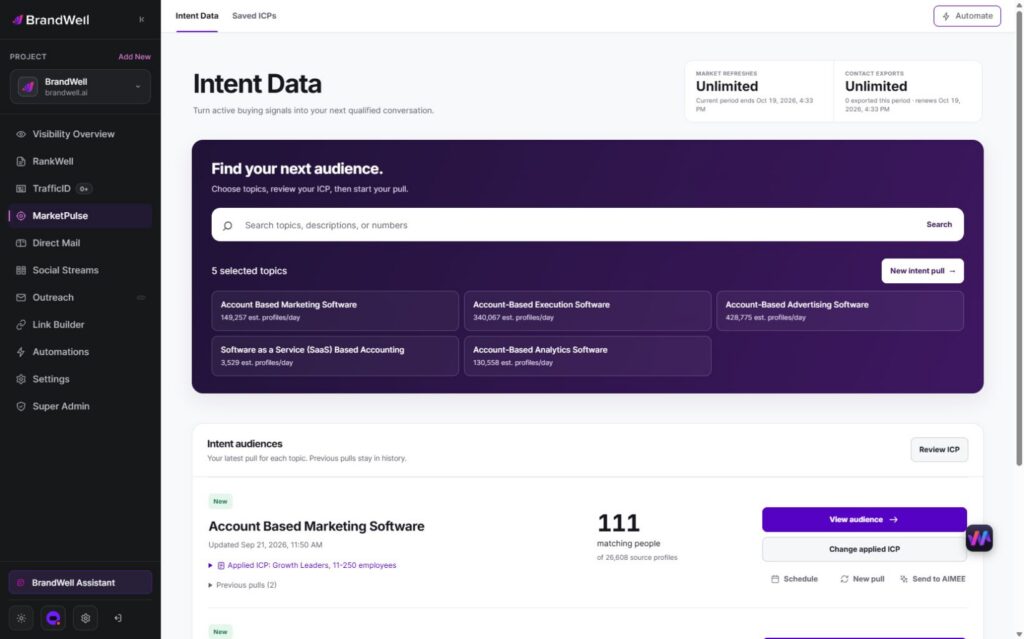
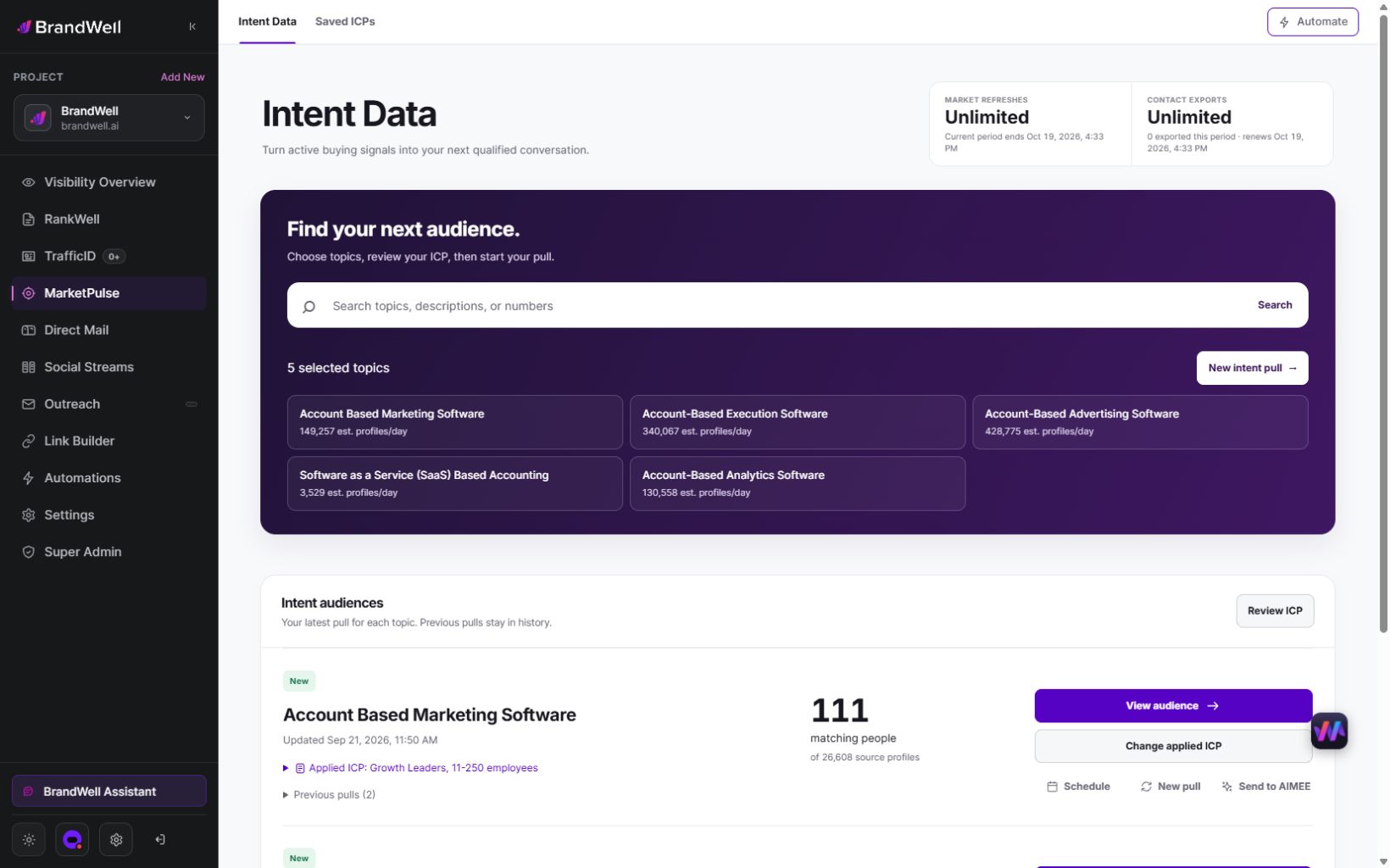
BrandWell MarketPulse: intent data starting at $500/mo. Find people researching topics relevant to what you sell, apply saved ICP filters, and review available contact details before taking action.
| Plan | Topics and refreshes | Monthly exports |
|---|---|---|
| Starter | 1 topic, weekly | 25,000 contacts |
| Growth | 3 topics, daily | 100,000 contacts |
| Scale | 10 topics, daily | Unlimited contacts |
Swipe the table to see all columns.
A pull retrieves available data from the previous 24 hours for one topic. Daily use across all included topics provides 90 Growth pulls or 300 Scale pulls in a 30-day month. Weekly Starter pulls vary by calendar month. Available audience size and contact fields vary, and audiences may overlap. Refreshes stop at the plan limit without overage charges.
- Find and qualify: search the topic catalog, save your ICP, and review the people and companies that match.
- Act on the research: export qualified contacts or prepare an Outreach or Direct Mail workflow. Connected products, channel usage, and fulfillment may cost extra.
- Get help from AIMEE: Growth and Scale include AIMEE for the initial user to research accounts and prepare the next step through connected tools.
Agencies and other service businesses can build client deliverables around their available Intent Scans and exports. Keep each client’s scope, permissions, and service fees clear. A subscription is not a promise of a white-label platform or exclusive access to a market.
Explore MarketPulse and watch the demo or compare plans starting at $500/mo. Any early-access discount is a separate, time-limited offer shown to an eligible recipient.
Write an operating hypothesis
An operating thesis fits on one page. It says which accounts are eligible, which research or engagement evidence matters, how recent it must be, what confidence is needed, who reviews it, which action can follow, and which outcome will decide whether the workflow continues. For example: “When a target account shows recent research on a problem we solve and passes fit and suppression checks, an account owner reviews the evidence within one business day and chooses research, nurture, outreach, or no action. We will evaluate accepted actions and qualified opportunities against the existing process.”
That thesis is intentionally cautious. It does not say the account is “in market.” It does not expose inferred surveillance in a message. It does not let a model trigger spend or outreach without the controls required by the use case. It names a behavior the organization can audit.
A responsible B2B intent data strategy answers three questions in order:
- Which decision is currently weak? Account prioritization, audience selection, follow-up timing, customer expansion, or client reporting are different decisions.
- Which evidence could improve it? First-party engagement, topic research, visitor resolution, enrichment, CRM history, and seller judgment carry different meanings.
- What would change our mind? Rejected signals, stale topics, poor seller adoption, no qualified lift, policy constraints, or excessive operating cost should be able to stop or redesign the program.
If the strategy begins with “we bought intent data,” the team is already working backward.
Check whether the use case is testable
Check whether the actual buying journey, eligible account population, relevant evidence, deal economics, review capacity and observable outcomes support a bounded pilot. A new signal does not repair missing account records or feedback.
Good pilot candidates include enterprise or mid-market sales teams deciding where to focus research, demand teams selecting accounts for a bounded campaign, customer teams monitoring expansion themes, and agencies packaging a repeatable evidence-and-activation service. A small company with a short sales cycle may get more value from clean first-party analytics and explicit hand raises. A company without a defined ICP should fix fit before adding timing evidence.
Do not justify the program with generic intent data strategy benchmarks. The relevant baseline is the current decision: how many accounts are reviewed, how long review takes, how often sellers accept the recommendation, what qualified outcomes follow, and what the existing process costs. External averages rarely match the signal source, segment, sales motion, or definition of pipeline.
Create a strategy charter
The charter converts aspiration into policy. It should include:
- Business decision: the one action the first release changes.
- Eligible population: ICP rules, territories, lifecycle stages, and exclusions.
- Evidence definition: source class, topic or event, unit, baseline, recurrence, refresh, and expiry.
- Identity boundary: account, anonymous visitor, known person, or person candidate.
- Action menu: investigate, nurture, advertise, contact, wait, suppress, or escalate.
- Owners: business sponsor, data owner, operator, seller, privacy or legal reviewer, and escalation path.
- Data rights: permitted purpose, client authority, notice, access, retention, deletion, and downstream use.
- Outcome model: accepted action, rejection reason, qualified opportunity, revenue event, and cost.
- Stop conditions: policy conflict, poor data quality, low adoption, negative feedback, weak economics, or no evaluable supply.
- Renewal rule: the evidence required to maintain, expand, reduce, or exit the program.
This intent data strategy framework prevents the most common ownership failure: marketing buys data, RevOps integrates it, sales receives alerts, and no one owns whether the alert was useful.
Compare five operating models
There is no universally best model. Evaluate each on best fit and exclusions, inputs, implementation effort, governance, cost, measurement, and one meaningful limitation.
1. Single-use-case pilot
Operating prerequisites: A team with one disputed decision and limited operational maturity. Examples include daily account research or a small known-visitor review queue.
Prerequisites and ownership: One signal definition, one eligible segment, a manual or light integration, a named operator, a reviewer, and an outcome field. Privacy and channel reviews occur before activation.
Cost and measurement: Spend is concentrated on a bounded data sample, setup, and operator time. Measure usable supply, review latency, acceptance, qualified outcomes, and exceptions.
Meaningful limitation: A pilot shows whether one process can work; it does not establish enterprise scale, causal revenue impact, or fit for unrelated use cases.
2. Sales-prioritization operating model
Operating prerequisites: Account-based sellers with more plausible accounts than they can research and a manager willing to enforce a consistent review process.
Prerequisites and ownership: Reliable account assignment, fit rules, source and recency fields, suppression, seller brief, CRM queue, and rejection reasons. Sales leadership owns response standards; RevOps owns routing integrity.
Cost and measurement: Include licenses or data, CRM work, research time, enablement, and management. Measure seller acceptance, time to first action, qualified conversations, opportunity movement, and false-positive reasons.
Meaningful limitation: Prioritization can shift effort toward better evidence, but it cannot manufacture demand or repair poor offers and sales execution.
3. Marketing-audience activation model
Operating prerequisites: Demand teams that can construct eligible audiences, run protected tests, and measure downstream quality rather than only clicks or form fills.
Prerequisites and ownership: Document data provenance, rights, platform eligibility, account overlap, match loss, minimum audience size, creative, offer, suppression, frequency, and a comparison cell. Paid media owns execution; privacy and platform-policy owners approve activation.
Cost and measurement: Add media, creative, audience operations, integrations, and experiment analysis to the data price. Measure reach, qualified conversion, sales acceptance, incremental response where design permits, and complaints.
Meaningful limitation: Small or lossy audiences may not deliver or learn reliably, and platform attribution does not prove causal lift.
4. Cross-functional RevOps program
Operating prerequisites: A mature organization that needs shared account intelligence across marketing, sales, customer success, and finance.
Prerequisites and ownership: Common account IDs, lifecycle policy, data contracts, governed scores, CRM and automation integrations, access controls, service ownership, and outcome return. A steering group resolves competing actions.
Cost and measurement: Budget for platform scope, implementation, data engineering, administration, training, support, and change management. Measure data quality, adoption by function, accepted decisions, qualified pipeline, customer outcomes, and operating cost.
Meaningful limitation: Cross-functional scope increases leverage only if decision rights stay clear; otherwise the program becomes a costly dashboard with conflicting definitions.
5. Agency-managed client program
Operating prerequisites: Agencies and GTM consultancies that can apply a standard operating core while preserving each client’s ICP, topics, rights, thresholds, destinations, and reporting.
Prerequisites and ownership: A client charter, tenant separation, provider-agency-client responsibility map, change control, approval gates, wholesale and retail economics, and proof artifacts. The agency owns delivery; the client retains business and channel approvals.
Cost and measurement: Include platform or wholesale usage, agency labor, integrations, client support, activation, and margin. Measure time to first usable report, accepted actions, adoption, qualified outcomes, exceptions, renewal evidence, and gross margin.
Meaningful limitation: The agency cannot promise results from a signal alone and should not hide source, uncertainty, or responsibilities behind a branded portal.
Build four implementation releases
An intent data strategy implementation guide works better in releases than in a big-bang deployment.
Release one: prove the decision record
Select one segment and manually review a representative sample. Include ambiguous events, known customers, competitors, remote employees, shared networks, duplicates, stale activity, and records that should not match. Test whether the operator can explain source, recency, fit, identity state, and recommended action without seeing a magic score.
Release two: automate the stable handoffs
Once the policy survives manual review, automate ingestion, normalization, deduplication, expiry, enrichment, suppression, routing, and outcome capture. Keep failure queues visible. A failed CRM write should not disappear; an expired signal should not remain actionable; a corrected record should propagate.
Release three: connect sales and marketing
Align account ownership, audience exclusions, nurture, seller tasks, and customer state. Prevent two teams from acting on the same evidence with conflicting messages. A high-fit current customer belongs in a different path from a net-new prospect, even if both research the same topic.
Release four: test expansion
Add a new topic, segment, region, channel, or client only when the current workflow has enough accepted outcomes and operating capacity. Change one important variable at a time where practical. Treat expansion as another hypothesis, not a reward for purchasing a larger plan.
Define data and handoff owners
The minimum data model should preserve account ID, person or visitor state, source, topic or event, observed time, baseline or recurrence, confidence, expiry, fit result, validation, suppression, action, owner, and outcome. Never discard the raw provenance after computing a score.
The integration map normally touches the signal source, website or analytics system, enrichment and validation, CRM, marketing automation, ad destinations, suppression store, reporting, and outcome warehouse. Write the direction of every transfer and the owner of every credential. Test retries, duplicate writes, deletion, role changes, account merges, and termination export.
The team needs a sponsor who owns the business outcome; RevOps or data operations to own definitions and flow; sales and marketing operators to own action quality; analytics to own the evaluation; security and privacy reviewers to own risk decisions; and a platform or agency owner to handle support and change. One person may cover several roles in a small program, but the responsibilities should still be explicit.
Use explainable decision records
The most valuable intent data strategy tools are often ordinary: a signal dictionary, data-flow diagram, decision matrix, field schema, suppression register, representative test set, routing runbook, seller evidence card, experiment plan, cost model, and renewal scorecard. Software should enforce these artifacts, not replace them.
When evaluating a platform, ask it to reproduce the same decision record. Can it expose source, time, account and person boundary, confidence, expiry, reason, suppression, and outcome? Can a user challenge or correct a result? Can the buyer export configuration and history? Can separate clients or teams remain separated? A tool that cannot answer these questions may still be useful for a narrow feed, but it should not control a high-impact decision.
An intent data strategy operational checklist should be attached to every release: requirements approved; representative sample passed; privacy and permitted use reviewed; integrations tested; suppressions synchronized; sellers trained; outcomes writable; stop conditions active; costs logged; and renewal evidence scheduled.
Budget full operating costs
Intent data strategy pricing is usually quote-dependent because the scope can include topics, records, users, workspaces, history, destinations, scoring, media, services, and support. A number from one vendor or public plan rarely describes the same boundary as another. Request a current, scope-matched proposal.
Model intent data strategy cost across data and software, implementation, recurring operations, activation, governance, support, and exit. Add internal hours by role. A low platform quote can become expensive when the team builds the portal, integrations, QA, client reporting, and support. A higher managed-service quote can be wasteful when the organization already owns those layers.
Use scenarios rather than one forecast. The conservative case should include lower usable signal supply, match loss, seller rejection, delayed adoption, and extra exception handling. The expected case should never assume every detected account becomes a meeting. The expansion case should require evidence from the pilot before adding clients, topics, or channels.
Evaluate quality and revenue evidence
Intent data strategy KPIs should follow the evidence chain. Begin with data quality: freshness, missing fields, duplicates, identity review, suppression, and correction. Continue with operations: queue age, reviewer completion, seller acceptance, action rate, and rejection reasons. End with commercial outcomes: qualified meetings, opportunities, stage movement, wins, retained revenue, and service margin.
Define the eligible unit, comparison, assignment, outcomes, timing, missing responses and decision rule before activation. A pipeline total associated with intent is not a causal revenue estimate.
Revenue experiments are rarely perfect. Sellers may cross over, accounts may appear in several campaigns, and sample sizes may be small. Report those limits. When randomization is impossible, use a staged rollout, matched comparison, or pre/post analysis with explicit caveats. The goal is a decision-quality estimate, not a theatrical precision number.
Resolve risk and capacity gaps
Intent data strategy mistakes usually begin with ambiguity: no use-case owner, topics chosen for volume, account and person evidence conflated, thresholds tuned to create more alerts, no expiry, suppressions out of sync, seller feedback ignored, and pipeline association presented as causation. Another failure is operational overload. A program that generates more accounts than the team can review will train users to ignore it.
Verify actual source, purpose, recipient, jurisdiction, necessary fields, authority, notices, access, retention, correction, deletion, suppression and incident ownership. Resolve unanswered requirements before action. A research signal does not establish consent or a lawful basis.
Use observable business context to prepare a relevant message. Verify actual recipient, channel, purpose, platform and opt-out requirements before sending. Research evidence does not establish messaging permission.
Set a review and change cadence
Strategy becomes real in recurring meetings. A weekly operating review handles aged queues, failed integrations, seller rejection, corrections, and suppressions. A monthly evidence review examines topic supply, fit, identity states, acceptance, downstream quality, labor, and client feedback. A quarterly commercial review decides whether to maintain, expand, right-size, or exit. The calendar should follow the signal’s useful life and the sales cycle rather than an arbitrary reporting habit.
Every change needs an owner and a before state. Log added or removed topics, threshold changes, new destinations, altered retention, client exceptions, model updates, and package changes. State the hypothesis and the metric that will judge it. Avoid changing the topic set, routing, seller message, and outcome definition at the same time; the team will not know which change mattered.
Emergency changes belong in the plan too. A privacy concern, unexpected sensitive topic, provider outage, corrupted account join, or surge in complaints should be able to stop activation while preserving evidence for review. Change control is not bureaucracy around the strategy. It is how the organization keeps yesterday’s assumptions from silently controlling today’s sales action.
Scope a separate agency retainer
An agency retainer can include a monthly signal-policy review, topic and ICP governance, data QA, an approved activation workflow, client reporting, outcome analysis, and one controlled iteration. Separate the recurring core from setup, media, creative, custom integrations, and high-touch seller research. Scope response times and escalation around actual responsibilities rather than inventing an SLA the provider does not support.
Review an available MarketPulse topic, saved ICP and actual preceding-24-hour matches for the approved research purpose. Keep uncertain company context visible. AIMEE can organize supplied context through configured tools; named owners approve actual exports, messages, audience uploads and CRM writes.
The honest limitation is that public documentation does not yet establish every reseller entitlement or enterprise control. An organization that requires documented granular access, audit logs, fixed retention, uptime, or continuity commitments should select an option that contractually provides them now.
Make an evidence-based renewal decision
At the end of the first operating window, ask whether the program produced usable evidence, accepted actions, qualified outcomes, and learning at a reasonable total cost. Identify who benefited, who did not, which topics failed, which signals expired, and what users rejected. Then maintain, change, right-size, or exit.
Renew only against a strategy the team can explain, govern, operate, measure and stop, with actual costs and unresolved outcomes visible.
Copyable intent strategy pilot
Decision: [The account-prioritization decision to test.] Unit: [Unique eligible account, cohort and period.] Evidence: [Actual topic, source, fit, age and uncertainty.] Assignment: [Comparison and allocation method.] Operation: [Reviewer, seller, actual destination and response capacity.] Evaluation: [Defined outcomes, missing feedback, costs and exclusions.] Renewal: [Stop, repair or expansion rule written before results.]
Assign the account, not each repeat appearance
NIST’s randomized-design guidance describes random assignment of treatment levels to experimental units. In an agency pilot, define and preserve the actual account unit before assignment; this application is a planning example, not a BrandWell experiment feature.
If one account appears in three topics, three independently assigned rows can put the same account in both comparison groups. Deduplicate to the chosen unit and preserve assignment across later appearances. Record seller crossover, other campaigns and missing outcomes.
Observed difference is not statistical certainty
In a fictional pilot with 100 accounts per group, the new process records eight qualified opportunities and the existing process five. Observed rates are 8% and 5%: three percentage points apart, or 60% relative to 5%. Those arithmetic results alone do not establish statistical significance, causation, repeatability or expected revenue. Review assignment, uncertainty, outcome definitions and contamination.
Record feedback coverage beside outcome rates
A fictional research run has 100 eligible accounts, 60 reviewed, 40 seller-accepted, 30 with feedback and six qualified opportunities. Review coverage is 60%; feedback coverage is 75% of accepted accounts. Six opportunities are 20% of reported accounts, 15% of accepted accounts or 6% of eligible accounts. Ten accepted accounts have unknown feedback. Do not silently count them as wins or losses.
Net value requires actual incremental value and full costs
Suppose a fictional pilot costs $500 research, $400 setup, $600 review and $500 seller work: $2,000. If $3,000 is credibly estimated incremental contribution before those pilot costs, the defined net is $1,000 and ROI is 50%. If $3,000 is merely attributed revenue, neither the net contribution nor ROI follows. Include the actual margin, comparator and excluded overhead, tax and financing. Zero cost makes this ROI formula undefined.
Use current BrandWell tools for the supported inputs
MarketPulse research starts at $500/mo. Search an actual topic, save the relevant ICP and review available matches before approving the next action. TrafficID concerns visitors to your own site. AIMEE can organize supplied context through configured tools; CRM writes, audience uploads and messages need actual approved implementation. The fictional pilot costs and outcomes above are not BrandWell service prices or benchmarks.
Frequently asked strategy questions
Should a pilot begin with a vendor shortlist?
Define the decision, evidence and evaluation first, then compare tools against that scope.
Can the same account enter both comparison groups?
Preserve the chosen assignment unit and document crossover; duplicates can undermine the comparison.
Does an observed rate difference prove lift?
No. Assess uncertainty, design, outcome definitions and other influences.
What should renewal require?
Usable evidence, actual adoption, observable outcomes and acceptable full operating costs.
Review current research: explore MarketPulse and current plans.
Reviewed and updated October 3, 2026.

Written by