On this page
- Who this is for
- Start with the business outcome, not the architecture
- What build, buy, resell, white-label, and refer mean
- Operating-model comparison
- The people, process, systems, and cadence required
- Economics: what should an agency invest?
- KPIs for revenue, margin, and retention
- Best-fit agency models and client stages
- Signal sources, identity, activation, and outcome evidence
- Strategic, operational, trust, and data-use risks
- Turn the infrastructure into recurring agency revenue
- Frequently asked questions
- The decision in one sentence
- Compare a bounded delivery model before building infrastructure
- What current MarketPulse plans provide
Most agencies should refer first, resell once the offer is repeatable, and build only the layer that creates a real moat. Building a buyer intent data supply chain from scratch means owning collection, identity resolution, enrichment, refresh, privacy operations, security, APIs, client separation, billing, uptime, and support. That is rarely the fastest path to qualified pipeline or recurring agency revenue.
A reseller arrangement may fit a repeatable client offer when its contract explicitly permits the intended resale and defines billing, support, branding and data use. Referral can reduce operating load when demand is uncertain. A selective build needs proprietary value, proven demand and funded ongoing maintenance; none of these models is automatically the best choice.
Current MarketPulse offer: intent-data plans start at $500/mo. See the product, demo, and current plans. Updated October 3, 2026.
Who this is for
- Agency founders deciding whether buyer intent should become a recurring service line.
- Technical operators and RevOps leaders comparing APIs, reseller platforms, referral programs, and internal builds.
- GTM consultants who want to monetize intent without confusing a data feed with a finished client outcome.
- Agency finance and operations teams modeling margin, support load, vendor dependency, and risk.
This comparison of build versus buy versus resell intent data infrastructure covers the strategy, people, process, platform paths, economics, KPIs, best-fit clients, signal design, risks, and recurring package. The goal is not to own the most technology. It is to own the parts of the client outcome that improve differentiation, margin, and retention.
Start with the business outcome, not the architecture
An agency does not need “intent infrastructure” as an abstract capability. It needs a repeatable answer to five questions:
- Which eligible companies or people appear to be researching a relevant problem?
- How confidently can those signals be matched and enriched?
- What useful, permitted action should happen next?
- Who owns that action and how quickly must it occur?
- What evidence will show that the program changed a commercial outcome?
The architecture should follow those decisions. A referral may be enough when the client simply wants a trusted recommendation. A reseller model fits when the agency can package signals with interpretation and activation. A hybrid build fits when the proprietary advantage lies in the agency’s scoring, workflow, or vertical knowledge rather than in recreating the underlying data network.
A four-gate strategy framework
Use four gates before choosing a model:
- Demand gate: Have multiple clients paid for the same use case, or is interest still hypothetical?
- Differentiation gate: Does the agency add unique value through audience expertise, scoring, activation, creative, or measurement?
- Economics gate: Does realistic client revenue cover data, labor, support, risk, and acquisition at the target margin?
- Capability gate: Can the team operate integrations, privacy, security, quality, billing, and service without distracting from the agency’s core business?
If demand fails, refer or stop. If demand passes but differentiation is low, partner rather than build. If differentiation and economics pass but capability is weak, resell a complete platform. Build selectively only when all four gates pass.
What build, buy, resell, white-label, and refer mean
These terms are often blended in vendor pages and sales conversations. Define them in your own order form.
- Refer: the provider usually contracts, bills, onboards, and supports the client. The agency earns a fee or protects an advisory relationship but gives up much of the product experience and account control.
- Buy for internal delivery: the agency licenses tools or data, then operates the service manually or through its own processes. The client may see the vendor, the agency, or both.
- Resell: the agency buys under commercial terms that permit client resale, owns the client contract and retail price, and normally handles first-line support.
- White-label: the client-facing experience uses the agency’s brand. White-labeling can sit on reseller economics, but a logo on a PDF is not a complete reseller platform.
- Build: the agency creates and maintains some or all of the product, data, identity, workflow, portal, reporting, billing, and infrastructure.
- Hybrid: the agency licenses hard-to-recreate signals and identity, then owns the scoring, vertical logic, portal, workflow, activation, or client experience that differentiates the offer.
The hybrid is often the strongest long-term build versus buy intent-data strategy. It preserves speed and coverage while giving the agency something more defensible than a referral link.
Operating-model comparison
| Model | Time to first client | Control and differentiation | Capital and operating load | Revenue and margin potential | Best use |
|---|---|---|---|---|---|
| Manual/no intent | Fast for isolated projects | Low and inconsistent | Low software, high labor | Project revenue; hard to scale | Validate the problem cheaply |
| Refer | Fastest | Low | Lowest | Commission or adjacent advisory | Unproven demand or occasional need |
| Buy and manage | Moderate | Medium | Tool integration plus service labor | Good when the agency adds activation | Existing service with a capable ops team |
| Resell/white-label | Moderate | High client control | Wholesale minimum, onboarding, support | Strong recurring margin if repeatable | Productized agency offer |
| Hybrid build | Slower | High in chosen layers | Engineering and ongoing maintenance | Strong when proprietary logic matters | Proven niche and technical capability |
| Full custom build | Slowest | Maximum theoretical control | Highest data, security, privacy, and support load | Attractive only at meaningful scale | Data product is core IP, not an add-on |
Swipe the table to see all columns.
A manual or non-intent approach can still win when client volume is low, the sales cycle is short, or human account research already produces enough opportunities. New infrastructure is not progress if it adds alerts nobody acts on.
Switching and migration triggers
Move from referral to resale when several clients want the same deliverable, the agency can support them, and recurring margin exceeds the wholesale and service load. Move from resale toward a hybrid when vendor limits repeatedly constrain a valuable use case or when proprietary first-party data can improve outcomes.
Do not move to a full build because a wholesale invoice feels expensive. Compare it with engineering, data licensing, identity accuracy, incident response, privacy requests, storage, observability, uptime, and client support. Migration also requires field mapping, client notice, data exports, suppression lists, historical outcomes, permission records, and retraining.
The people, process, systems, and cadence required
A durable intent-data infrastructure implementation guide assigns owners before tools.
1. Product owner: define the offer
The product owner decides the target market, use case, billable unit, inclusion rules, service tiers, and roadmap. This person prevents custom promises from becoming permanent operational debt.
Inputs: client interviews, sales objections, pricing, coverage tests, cost model. Outputs: package definition, acceptance criteria, change-control rules. Cadence: monthly offer review and quarterly roadmap decision.
2. Data and RevOps owner: protect signal quality
This owner defines account matching, person-level confidence, enrichment, validation, freshness, deduplication, routing, and CRM fields. Low-confidence results should be quarantined rather than silently activated.
Inputs: source lineage, timestamps, match confidence, target accounts, CRM history. Outputs: qualified records, exceptions, and data-quality scorecard. Cadence: weekly exception review; monthly coverage and drift review.
3. Activation owner: turn signals into plays
The activation owner maps each eligible signal to a permitted next step: research task, personalized outreach, audience update, lifecycle message, content recommendation, customer-risk review, or seller alert. Every play needs a time-to-live, owner, SLA, fallback, suppression check, and approval rule.
4. Client-success owner: make value visible
Client success handles onboarding, expectations, enablement, reporting, feedback, and QBRs. It distinguishes delivery, adoption, influenced outcomes, and incremental outcomes so the client does not mistake a large signal count for ROI.
5. Privacy and security owner: govern downstream use
This person maintains data maps, provider diligence, role allocation, notices, retention, deletion, access, incident handling, and client responsibilities. Small agencies may use outside counsel or fractional security help, but the ownership cannot be undefined.
6. Finance and operations owner: protect margins
Finance reconciles wholesale usage, client entitlements, overages, labor, credits, and cash. Operations maintains runbooks, support tiers, escalation paths, and release controls.
Minimum system map
The minimum system may include signal collection, identity and enrichment, a rules or scoring layer, CRM, activation tools, analytics, consent and suppression, a client portal or report, billing, and observability. Each integration needs an owner, retry behavior, failure alert, and source-of-truth field.
A practical operational checklist is:
- freeze the ICP, account universe, topics, exclusions, and outcome;
- test source coverage and identity on a representative sample;
- document permitted resale and downstream use;
- map data into stable account and contact identifiers;
- define fit, freshness, confidence, and suppression gates;
- route only qualified records to a named play;
- log acceptance, action, rejection, opportunity, and cost;
- review exceptions weekly and economics monthly;
- revalidate coverage before new markets or client types;
- preserve exports and an exit plan.
Common implementation mistakes include building before selling, assuming a partner license permits resale, treating white-label as logo control only, mixing client data, hiding low-confidence identity, and omitting feedback from sales.
Economics: what should an agency invest?
The build versus buy versus resell intent-data infrastructure cost should include the entire operating model, not just subscription or engineering.
Referral economics
Model commission, advisory revenue, sales time, client retention risk, and opportunity cost. Referral is attractive when it preserves trust and learning with little support, but it may surrender renewal economics and product insight.
Reseller economics
Model wholesale minimums, usage, onboarding, client success, support, integrations, sales enablement, reporting, bad debt, and churn. Use:
client gross margin = (retail revenue − wholesale usage − direct service labor − variable delivery cost) ÷ retail revenue
Do not assume every additional client is equally profitable. Small clients can consume disproportionate onboarding and support. Topic availability, identity coverage, and activation complexity may also vary.
Build economics
Model data licenses, collection, identity, enrichment, validation, engineers, product, cloud, security, privacy operations, observability, client support, uptime, billing, and replacement cost for key staff. Then model what the build uniquely improves: margin, retention, data rights, speed, or results.
A selective build has a clearer hurdle. For example, own the vertical scoring model and activation play while licensing the data. The agency can then calculate whether proprietary conversion lift or lower labor offsets development and maintenance.
Stage-gated investment plan
- Validate: refer or manually deliver two or three paid engagements.
- Productize: evaluate a relevant MarketPulse topic and ICP with a bounded client use case, explicit permitted use and written success criteria.
- Standardize: document onboarding, qualification, activation, reporting, and support.
- Automate: remove repeated manual work only after the process is stable.
- Differentiate: build the scoring, workflow, portal, or data asset clients value.
- Scale: expand topics, markets, channels, and sales only when margins and retention hold.
A stage should not advance on enthusiasm. Require predefined evidence: paid demand, time to value, adoption, margin, client renewal intent, and manageable risk.
KPIs for revenue, margin, and retention
A credible intent-data infrastructure KPI set links data quality to agency economics.
- Signal quality: eligible-account coverage, match confidence, valid contact rate, freshness, duplicates, and false-positive or rejection rate.
- Activation: percent accepted, percent acted on, time to action, workflow completion, reply or engagement, and suppression accuracy.
- Pipeline: meetings per eligible account, opportunity rate, pipeline per account, stage progression, win rate, and sales-cycle time.
- Agency economics: monthly recurring revenue, gross margin by client, onboarding payback, service hours, support load, retention, expansion, and cash collection.
- Platform health: delivery latency, API errors, integration failures, tenant incidents, privacy-request completion, and export success.
Measure build, reseller, or managed options on the same denominator. A high volume of signals can make one model look productive while producing fewer eligible accounts or more manual cleanup.
Separate associated outcomes from incremental outcomes. A matched cohort or prior-period comparison is observational, and seller differences, seasonality and selection can confound it. Where feasible, use a properly designed randomized holdout with stated uncertainty. Include the relevant program and delivery costs; a pipeline difference is not verified causal ROI.
Best-fit agency models and client stages
Refer when
- client demand is occasional;
- the buyer wants a recognized provider relationship;
- the agency lacks data, compliance, or support capacity;
- the use case sits outside the agency’s core service;
- the agency wants learning without a wholesale minimum.
Resell or white-label when
- several clients share a clear ICP and outcome;
- the agency can sell, onboard, interpret, activate, report, and support;
- recurring margin is attractive after real labor;
- brand control and retail pricing matter;
- the provider contract clearly permits the service.
Build selectively when
- proprietary first-party signals or workflow logic create defensible value;
- client volume is contracted rather than hoped for;
- the agency has product and engineering leadership;
- security, privacy, reliability, and support are funded;
- exit rights and data licenses allow the intended model.
Do not add the service when
The client lacks a defined market, meaningful sales capacity, measurable outcomes, or permissioned activation. Low average customer value and very short sales cycles may also make intent infrastructure economically unnecessary.
Signal sources, identity, activation, and outcome evidence
A strong architecture keeps source, confidence, and action visible.
Signal sources
Combine first-party behavior – site visits, forms, content, product use, email, events, CRM – with third-party topic research where it changes coverage or timing. Do not collapse them into one score without lineage.
Identity checks
Match to an account, buying group, or person at a stated confidence level. Separate company-level website visitor intent from person-level data. Quarantine uncertainty, handle subsidiaries deliberately, validate contacts, and never imply universal identification.
Activation workflows
AIMEE can help prepare configured work through connected tools. Document the allowed tools, account scope, evidence and human approval points. Inspect the result at its destination; instructions alone do not establish a working integration or permitted action.
Outcome evidence
Log the stable account ID, source and timestamp, qualification decision, first action, rejection reason, meeting, opportunity, value, stage, and close. Compare treated accounts with a credible baseline. Avoid crediting the signal for demand that already existed.
Strategic, operational, trust, and data-use risks
Strategic risk
A commodity resale offer can be copied. Differentiate through niche expertise, protected scope where available, activation, reporting, or proprietary workflow – not secrecy about the vendor.
Operational risk
Scope creep, client-specific integrations, support, and data exceptions can erase margin. Maintain package limits, a change-order process, runbooks, and an exit plan.
Vendor and lock-in risk
Check minimums, price changes, service levels, export, deletion, permitted resale, subprocessor changes, termination, and continuity. Keep a current data dictionary and client export so switching is possible.
Privacy and legal risk
Have a qualified reviewer assess roles, sources, notices, retention, deletion and downstream use for the actual jurisdictions. The California Privacy Protection Agency states that, beginning August 1, 2026, data brokers must access DROP at least every 45 days and process deletion requests, subject to limited exceptions. Determine whether your operation falls within the applicable definition; a vendor agreement does not establish compliance.
Client-trust risk
Avoid invasive language, unexplained scores, or black-box rejections. Give clients definitions, limits, suppression rules, and an evidence trail. Do not expose sensitive tracking detail to prospects.
Turn the infrastructure into recurring agency revenue
A recurring buyer-intent service should include:
- Market and topic setup: ICP, accounts, exclusions, topic availability, and goals.
- Signal and identity layer: sources, freshness, confidence, enrichment, validation, and suppression.
- Activation layer: defined plays, SLAs, permissions, templates, and feedback.
- Client experience: branded portal or report, explanations, evidence, and separate workspaces.
- Measurement: delivery, adoption, pipeline, cost, and incremental outcome views.
- Operating cadence: weekly exceptions, monthly scorecard, quarterly business review.
- Commercial controls: retail price, included usage, overages, change control, renewal, and expansion.
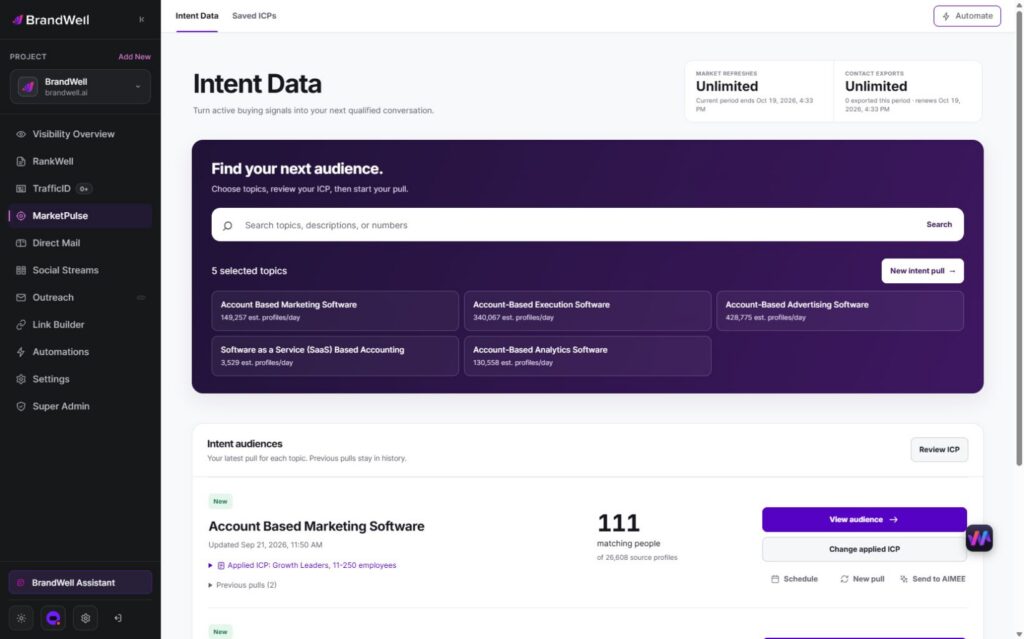
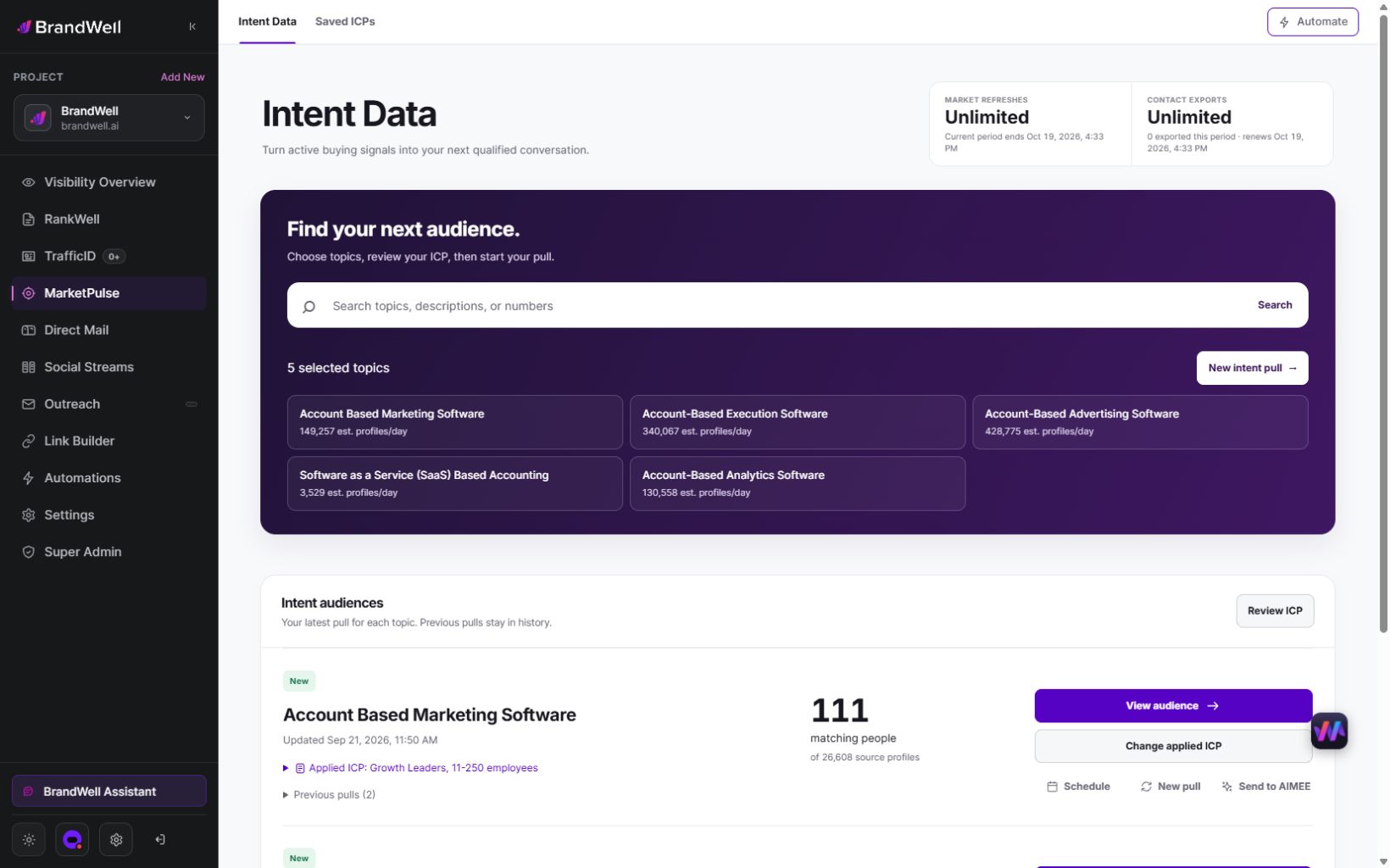
Start by reviewing the MarketPulse demo and plans, starting at $500/mo. Choose a relevant topic and ICP, then evaluate audience fit, available contact fields, and the workflow you will use. The first-purchase 3-day satisfaction guarantee requires no data exports and no more than 2 Intent Scans; review the current guarantee terms before testing. A short evaluation can establish fit, but cannot prove future pipeline or revenue.
Expansion should follow evidence. Add client accounts, topics, markets, identity depth, or activation channels only when usable coverage, adoption, margin, and renewal support it. The best infrastructure is the smallest one that consistently helps the agency sell, deliver, prove, and retain the outcome.
Frequently asked questions
Should an agency build or buy buyer intent data?
Most should buy the difficult data and identity layers, then own the niche strategy, scoring, activation, and client experience. Build the full supply chain only when it is core IP and contracted economics support continuous operations.
What is the difference between reselling and referring?
A referral usually leaves contract, billing, onboarding, and support with the provider. A reseller usually owns the client contract, price, and first-line service under terms that explicitly permit resale.
Is white-label the same as reseller?
No. White-label describes branding. A real reseller model also needs commercial rights, client control, billing, support responsibilities, data isolation, exports, and wholesale economics.
When is a custom build justified?
Consider a selective build when proprietary signals or workflow have a demonstrated use case, contracted demand and funded technical and governance ownership. Compare maintenance, replacement and risk over an explicitly chosen planning horizon; a five-year forecast is an assumption, not a validated outcome.
What should an initial MarketPulse evaluation measure?
Measure topic relevance, ICP fit, usable matching contacts, and the work required to prepare your first campaign. MarketPulse is starting at $500/mo. Set the scope and success criteria before expanding into additional BrandWell tools or a larger agency package.
How can topic exclusivity improve agency economics?
A MarketPulse subscription does not promise exclusive topic access, a branded client portal or wholesale commercial rights. Topic coverage, available output, client scope, permissions and delivery responsibilities need explicit review. Any special rights require a separate written agreement.
What should be retained if the agency changes providers?
Client approvals, consent and suppression records, data definitions, source lineage, account IDs, routing rules, opportunity history, report logic, exports, and contract rights.
Can Claude or ChatGPT operate the workflow?
Configured tools and approved access determine what an assistant can do. An instruction document alone does not provide authentication, a live integration, permitted data or quality controls. AIMEE can help prepare work through connected tools; approve actions and verify their outputs.
Which model protects margin best?
The model with repeatable scope, metered usage, low exception work, strong adoption, and client value. A reseller can outperform referral economics, but only after support and delivery labor are counted.
What is the safest default path?
Refer to validate demand, resell to productize, build the proprietary layer after the economics and capability are proven.
The decision in one sentence
Own the client outcome first, rent the hard infrastructure until its limits are proven, and build only the part your clients will pay to keep.
Compare a bounded delivery model before building infrastructure
In a fictional month, four clients each pay $800, producing $3,200 service revenue. A $500 data subscription, $1,200 delivery labor and $300 other variable delivery costs leave $1,200, or 37.5% of revenue, before overhead, acquisition, tax and any other excluded costs. Label that as contribution under the stated assumptions, not net profit or an expected BrandWell result.
If two clients leave while those $2,000 costs remain, revenue is $1,600 and contribution is negative $400. Recalculate how costs actually change with client count. Referral commission, resale rights and support commitments must come from the actual agreement; they are not inferred from the subscription price.
What current MarketPulse plans provide
MarketPulse supports topic research, ICP filtering and available contact records. Standard Starter includes one topic with weekly refreshes and 25,000 monthly contact exports. Growth includes three topics with daily pulls and 100,000 exports. Scale includes ten topics with daily pulls and unlimited exports.
Daily use of all included topics gives 90 Growth or 300 Scale pulls in a 30-day month. A pull retrieves the available data from the previous 24 hours for one topic; audience size, fields and overlap vary. Other connected products and channel use may cost extra. Evaluate the actual output and operating work before expanding client delivery.
Watch the demo and compare current plans, then choose the smallest bounded evaluation that can answer your actual delivery question.
Reviewed and updated October 3, 2026.

Written by