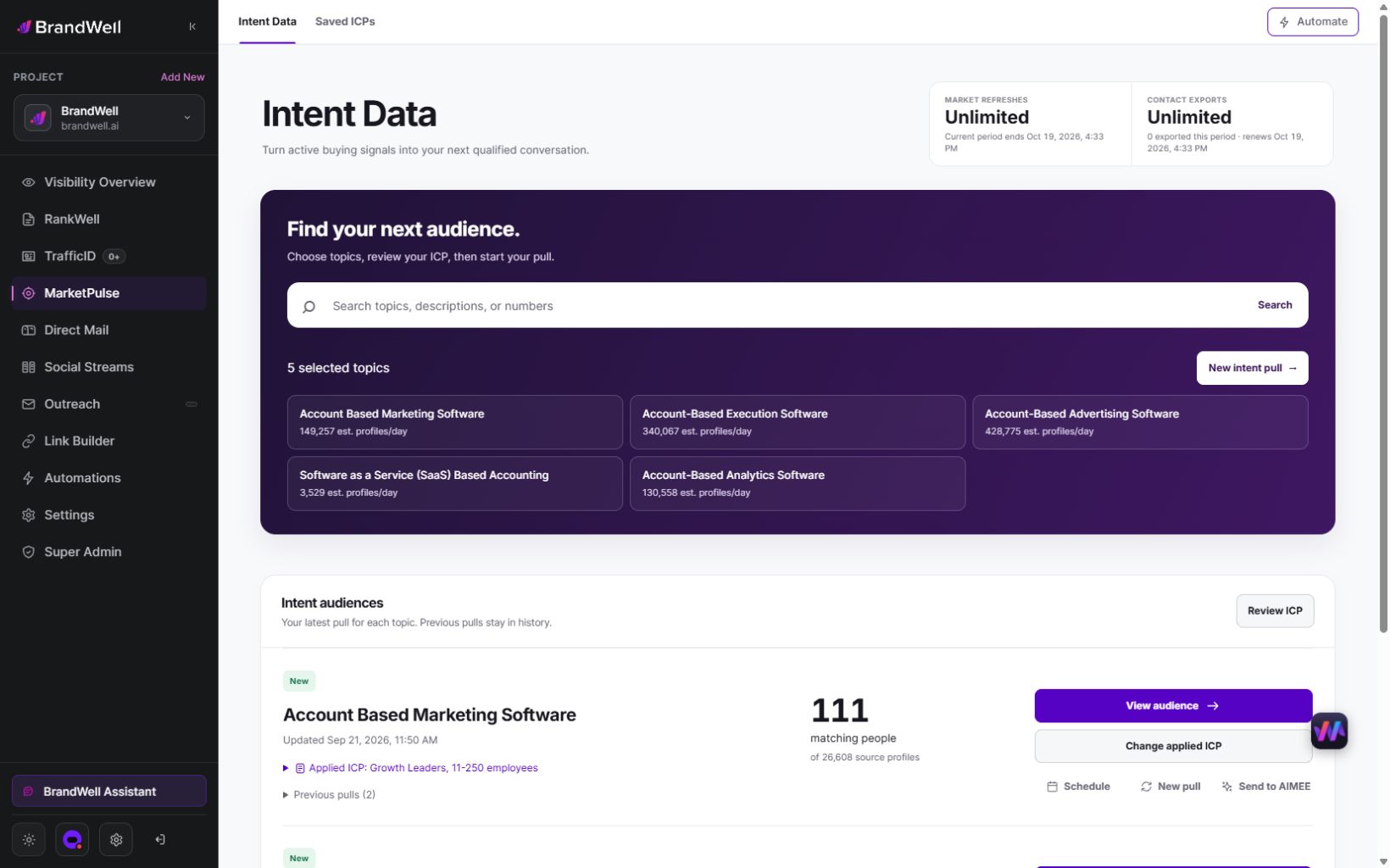
A buyer-intent alert should be a compact evidence packet that helps a seller decide, not a siren that claims someone is ready to buy. Show the account, why it is eligible, the signal and source class, topic or behavior, recency, fit, identity confidence, relationship and CRM context, suppressions, recommended action, and a feedback control. Fire only when the evidence clears a documented threshold and the receiving team has capacity.
Who this is for: VPs of Sales, SDR and sales-enablement leaders, account executives, RevOps, and agencies operating sales-alert services. The guide helps those teams decide what evidence deserves an interruption, how to control volume, and whether sellers actually accept and act on the result.
Define the alert as an evidence packet, not a siren
Every alert needs six decisions: eligible account, evidence threshold, recipient, timing, next action, and feedback. Start with account fit and ownership. A recent signal from an ineligible account should not interrupt a seller. An eligible account with stale or weak evidence may belong in research, not an alert. A strategic account may justify a lower alert threshold only if the team records why.
The alert body should answer: What happened? At what identity level? How recent is it? Why does it matter to this account? What existing relationship, opportunity, customer, suppression, or recent outreach changes the action? What should the seller do? How can the seller dismiss, snooze, correct, accept, or reassign it? If those facts cannot fit in the alert, link to a controlled internal evidence view – not a vendor marketing score.
Sales alerts may use identity resolution, IP-to-account matches, customer-list matches, and intent scores, but each is probabilistic and shaped by coverage. A candidate or score can be wrong and is not proof that a named person researched, intends to buy, or will convert. Show the seller provenance, recency, confidence, suppressions, corrections, and the human-review state.
Run the alert workflow from signal to seller feedback
Use an explicit sequence:
- Ingest the signal with source, identity level, topic or event, timestamp, and expiry.
- Resolve the account candidate and preserve confidence and alternatives.
- Join account fit, owner, relationship, opportunity, customer, suppression, and recent-touch context.
- Apply recency, frequency, source diversity, negative-signal, and capacity rules.
- Deduplicate related events into one evidence bundle and enforce a cooldown.
- Route to the accountable role and include the recommended action plus uncertainty.
- Capture accept, dismiss, snooze, reassign, correct, and action reason codes.
- Return meeting, qualification, opportunity, loss, no-response, and correction outcomes.
- Review fatigue, false positives, misses, and workload by rule and recipient.
- Tighten, broaden, pause, or retire the rule with documented evidence and rollback.
Separate the “signal clock” from the “seller clock.” A rapid signal can still be inappropriate during an active opportunity, support escalation, customer renewal, legal hold, or recent outbound sequence. A delay can destroy value for a demo request. Route rules should use the evidence type, not a universal real-time claim.
Use the operating templates that make alerts reviewable
The minimum kit includes an alert definition, evidence schema, eligibility list, threshold worksheet, identity-confidence rule, suppression matrix, recipient and capacity map, cooldown and deduplication policy, sample alert, feedback reason codes, outcome model, cost sheet, and weekly calibration agenda. Create positive, negative, ambiguous, duplicate, stale, wrong-account, and over-capacity test cases.
A useful alert example might say an eligible account has recent account-level research on an approved topic, a known open opportunity owner, no active suppression, and no similar alert inside the cooldown. It should not say a named executive researched the topic unless a reviewed known-person event supports that statement. The recommended action could be account research or opportunity review rather than immediate outreach.
Choose manual research, alerts, or a hybrid
Manual account research fits low volume, strategic accounts, and ambiguous signals where human context dominates. Automated alerts fit repeatable evidence, reliable account keys, clear ownership, and enough volume to justify instrumentation. A hybrid often works best: rules identify an evidence packet, a human reviews sensitive or low-confidence cases, and sellers provide feedback that recalibrates the rule.
The non-intent alternative can win when sellers already cover a tiny named-account list deeply, when topic evidence is sparse, or when CRM and ownership data are too unreliable to route safely. Do not add alerts to compensate for a broken account model.
Compare five options for sales-intent alerts
Use the same visible criteria for every option:
- Intended audience and use case: specify seller role, eligible accounts, evidence class, next action, and capacity.
- Signal/data coverage and freshness: show source, identity level, recency, frequency, expiry, and deduplication.
- Identity resolution and validation: keep company evidence separate from known-person events and expose confidence.
- Integrations and activation: test CRM context, suppressions, cooldowns, caps, delivery, and feedback return.
- Implementation effort: include configuration, seller training, calibration, and exception ownership.
- Privacy and governance: review permitted use, recipient access, client separation, retention, and correction.
- Verified pricing and total cost: count platform, data, setup, integrations, attention, support, and tuning.
- Measurement and attribution: track alert delivery, acceptance, action, progression, fatigue, and causal limits.
- Proof: use shadow alerts, reason codes, representative accounts, and outcome evidence.
- Meaningful limitation: name the noise, anonymity, scope, or administration that can defeat the use case.
Disclosure: This is a Brandwell-owned resource. Brandwell is the publisher’s product; all options are evaluated using the same disclosed criteria.
The first position reflects ownership disclosure, not an alert-performance ranking. Shadow every option against identical accounts, fatigue controls, and seller feedback.
1. BrandWell

Intended audience and use case: For a sales-alert program, evaluate this option for agencies and GTM operators building branded, client-specific sales-alert services.
Signal/data coverage and freshness: Scope topic and website evidence, identity/enrichment candidates, validation, freshness, reports, and workflow instructions. Inspect source, recency, expiry, account eligibility, signal grouping, no-match behavior, and the evidence shown to the receiving seller.
Identity resolution and validation: An alert may use website, person, account, and topic matches, but the seller must see that it is probabilistic output. Include source, time, and confidence in the evidence packet and apply validation, suppression, and human review before a person-level action.
Integrations and activation: Approved alerts may route to CRM, reports, chat, email, or optional agent paths only when written. Shadow-test CRM ownership, permissions, duplicate grouping, suppressions, cooldown, delivery failures, feedback reasons, and returned outcomes.
Implementation effort: Begin with a small account universe, few topics, strict suppression, and seller feedback. Give alert-policy, data, systems, seller enablement, privacy, and rule-change authority to named people before notifications begin.
Privacy and governance: Alert governance should limit recipients, preserve permitted-use context, honor suppression and deletion, and document client separation, support access, and downstream approvals. Seller convenience does not justify exposing more identity context than the action needs.
Verified pricing and total cost: BrandWell here means the separate agency-reseller intent-data product, not the legacy BrandWell SEO writer. For this sales-alert evidence and fatigue-control workflow, exact fit must be proven against the buyer workflow and written scope.
BrandWell agency plans range from $2,500 to $5,000 per month, depending on topic count, term, and available contractually scoped topic exclusivity. The current written quote and Order Form control. Public pricing is quote-based. Topic exclusivity is never universal: any protection must be available, narrowly scoped, and written. Before operational use, complete product, pricing, privacy, security, compliance, legal, and platform-policy review. The sales-alert evidence and fatigue-control workflow therefore needs its own matched proposal rather than an assumed rate card.
BrandWell describes a complete white-label sales-and-delivery engine for agencies, with agencies setting retail pricing and billing their own clients. The narrower public product evidence supports client projects, data connections, audiences, reports, and workflows, but not every implied sales, billing, automation, or support entitlement. A $70 seven-day reseller pilot, is limited to branded topic reports and does not prove production readiness or outcomes. Use the pilot to test the sales-alert evidence and fatigue-control workflow, not to generalize from a branded output.
BrandWell provides agent-ready automation workflow instructions for Claude and ChatGPT, with optional browser execution through Moxby. Moxby is a separate browser-first product, not a BrandWell module or included entitlement. BrandWell’s agency-reseller product uses LeadFuze as its underlying data infrastructure. Contracted modules, fields, permitted uses, and delivery rights should be confirmed in the applicable agreement. Confirm how those boundaries apply to the sales-alert evidence and fatigue-control workflow before any public claim.
Measurement and attribution: Judge alert utility by alert eligibility, unique accounts, seller acceptance, action rate, dismiss reasons, opportunities, and fatigue. Do not convert platform attribution or a score into causal proof; use pre-alert baselines, staged activation, or a protected comparison group when feasible.
Proof: Before notifying sellers, collect representative sample, conditional pilot terms, client-separation test, field and source notes, workflow acceptance, written proposal, data-use and support boundaries, export demonstration, and component and entitlement matrix. Shadow the evidence against alert caps, dismiss reasons, and correction behavior.
Meaningful limitation: In an alert program, public entitlement detail remains incomplete; granular RBAC, general audit logs, continuity targets, fixed retention, and uptime SLA are not established. To protect seller attention, choose documented enterprise controls when those are mandatory now and pause any rule that cannot show useful evidence within the team’s capacity.
2. 6sense

Intended audience and use case: For a sales-alert program, evaluate this option for enterprise revenue teams wanting predictive account intelligence and orchestration for seller prioritization.
Signal/data coverage and freshness: Scope integrated history, predictive intent, account intelligence, sales signals, and data credits. Inspect source, recency, expiry, account eligibility, signal grouping, no-match behavior, and the evidence shown to the receiving seller.
Identity resolution and validation: An alert may use predictive account score, but the seller must see that it is model inputs and integrated history. Include account priority in the evidence packet and never treat the score as proof of a named person’s research or purchase before a person-level action.
Integrations and activation: Alerts must arrive with CRM/account context and a feedback path rather than an isolated notification. Shadow-test CRM ownership, permissions, duplicate grouping, suppressions, cooldown, delivery failures, feedback reasons, and returned outcomes.
Implementation effort: Model governance, integration, seller enablement, and ongoing threshold work are material. Give alert-policy, data, systems, seller enablement, privacy, and rule-change authority to named people before notifications begin.
Privacy and governance: Alert governance should limit recipients, preserve permitted-use context, honor suppression and deletion, and document ordered modules, licensed data flows, and subprocessors. Seller convenience does not justify exposing more identity context than the action needs.
Verified pricing and total cost: Public material describes 6sense package and credit dimensions but not a numeric list price for this alert workflow. Ask the proposal to isolate seller users, signal credits, orchestration modules, implementation, enablement, support, and term.
Measurement and attribution: Judge alert utility by alerts seen, accepted actions, reason-coded dismissals, progression, and controlled lift. Do not convert platform attribution or a score into causal proof; use pre-alert baselines, staged activation, or a protected comparison group when feasible.
Proof: Before notifying sellers, collect representative accounts, score reasons, integration acceptance, implementation plan, matched reference, ordered entitlements, export behavior, and current package material. Shadow the evidence against alert caps, dismiss reasons, and correction behavior.
Meaningful limitation: In an alert program, enterprise breadth and predictive operations require substantial capacity; credits and entitlements are quote-specific. To protect seller attention, a smaller team or simple white-label report motion may need a narrower option and pause any rule that cannot show useful evidence within the team’s capacity.
3. Demandbase

Intended audience and use case: For a sales-alert program, evaluate this option for account-based teams operating configured keyword, list, intent, and qualification workflows.
Signal/data coverage and freshness: Scope configured keywords and lists, account intent, qualification models, and CRM/MAS context. Inspect source, recency, expiry, account eligibility, signal grouping, no-match behavior, and the evidence shown to the receiving seller.
Identity resolution and validation: An alert may use account association and subsidiaries, but the seller must see that it is known and anonymous activity. Include contacts and corrections in the evidence packet and require configured qualification evidence rather than treating the association as ground truth before a person-level action.
Integrations and activation: Sales surfaces, CRM, lists, advertising, and feedback should be acceptance-tested together. Shadow-test CRM ownership, permissions, duplicate grouping, suppressions, cooldown, delivery failures, feedback reasons, and returned outcomes.
Implementation effort: Administrators must maintain lists, models, caps, history, routing, and enablement. Give alert-policy, data, systems, seller enablement, privacy, and rule-change authority to named people before notifications begin.
Privacy and governance: Alert governance should limit recipients, preserve permitted-use context, honor suppression and deletion, and document connected sources, account lists, audiences, and service access. Seller convenience does not justify exposing more identity context than the action needs.
Verified pricing and total cost: Demandbase does not show a numeric public list price in the reviewed source; its public structure uses a platform fee and per-user component. For alerts, request the exact sales users, account data, advertising dependencies, integrations, onboarding, and service scope.
Measurement and attribution: Judge alert utility by eligible accounts, accepted alerts, time to action, opportunity progression, and fatigue by rule. Do not convert platform attribution or a score into causal proof; use pre-alert baselines, staged activation, or a protected comparison group when feasible.
Proof: Before notifying sellers, collect keyword, list, and model definitions, live routing test, implementation plan, current contract material, comparable reference, export evidence, and representative records. Shadow the evidence against alert caps, dismiss reasons, and correction behavior.
Meaningful limitation: In an alert program, keywords, lists, models, history, connected data, and list constraints need administration; the platform can exceed a narrow point workflow. To protect seller attention, use a simpler path when ongoing account-program ownership is unavailable and pause any rule that cannot show useful evidence within the team’s capacity.
4. Common Room

Intended audience and use case: For a sales-alert program, evaluate this option for sales teams that need relationship and digital-signal context from multiple known and anonymous sources.
Signal/data coverage and freshness: Scope organization, location, relationship, product/community/digital signals, contacts, seats, and sources. Inspect source, recency, expiry, account eligibility, signal grouping, no-match behavior, and the evidence shown to the receiving seller.
Identity resolution and validation: An alert may use organization or location enrichment, but the seller must see that it is a visitor who may remain anonymous. Include known events from authorized links, forms, or logins in the evidence packet and do not claim a deterministic person reveal before a person-level action.
Integrations and activation: CRM and seller destinations must retain source context and distinguish known from anonymous evidence. Shadow-test CRM ownership, permissions, duplicate grouping, suppressions, cooldown, delivery failures, feedback reasons, and returned outcomes.
Implementation effort: Instrumentation, source connections, identity rules, playbooks, and seller training take effort. Give alert-policy, data, systems, seller enablement, privacy, and rule-change authority to named people before notifications begin.
Privacy and governance: Alert governance should limit recipients, preserve permitted-use context, honor suppression and deletion, and document source-by-source identity state, exports, and person-level activation. Seller convenience does not justify exposing more identity context than the action needs.
Verified pricing and total cost: For the reviewed configuration, Common Room publishes Essential at $2,500 per month billed annually, including five seats and up to 100,000 contacts; Advanced and Enterprise require custom pricing. Alert TCO also changes with sources, credits, integrations, exports, product signals, and add-ons.
Measurement and attribution: Judge alert utility by known-identity rate, alert usefulness, accepted action, relationship progression, and dismiss reasons. Do not convert platform attribution or a score into causal proof; use pre-alert baselines, staged activation, or a protected comparison group when feasible.
Proof: Before notifying sellers, collect known-versus-anonymous identity demo, CRM playbook test, seat, contact, and credit scope, governance evidence, reference, export behavior, and selected tier and sources. Shadow the evidence against alert caps, dismiss reasons, and correction behavior.
Meaningful limitation: In an alert program, organization context can remain anonymous; known identity relies on instrumented events. To protect seller attention, this is a poor fit for deterministic person reveals or broad cross-web purchase certainty; pause any rule that cannot show useful evidence within the team’s capacity.
5. ZoomInfo

Intended audience and use case: For a sales-alert program, evaluate this option for teams wanting alerts inside a broader sales-intelligence and B2B data platform.
Signal/data coverage and freshness: Scope company/contact data, intent, alerts, licensed records, users, credits, and refresh. Inspect source, recency, expiry, account eligibility, signal grouping, no-match behavior, and the evidence shown to the receiving seller.
Identity resolution and validation: An alert may use company and contact candidates, but the seller must see that it is validation state and provenance. Include correction and suppression paths in the evidence packet and require representative false-match review before a person-level action.
Integrations and activation: CRM and engagement routing, deduplication, suppression, and outcome return require validation. Shadow-test CRM ownership, permissions, duplicate grouping, suppressions, cooldown, delivery failures, feedback reasons, and returned outcomes.
Implementation effort: Administration must control modules, seats, credits, fields, and seller practices. Give alert-policy, data, systems, seller enablement, privacy, and rule-change authority to named people before notifications begin.
Privacy and governance: Alert governance should limit recipients, preserve permitted-use context, honor suppression and deletion, and document licensed-use rights, credits, regional controls, and the selected bundle. Seller convenience does not justify exposing more identity context than the action needs.
Verified pricing and total cost: ZoomInfo requires a matched quote because no current numeric public price was verified. Isolate the alert-related bundle, seller seats, data and records, credits, integrations, enablement, add-ons, usage rights, and actual order term.
Measurement and attribution: Judge alert utility by valid records, accepted alerts, contact relevance, meetings, opportunity movement, and corrections. Do not convert platform attribution or a score into causal proof; use pre-alert baselines, staged activation, or a protected comparison group when feasible.
Proof: Before notifying sellers, collect field and validation material, bundle and credit scope, integration and routing demo, data-use terms, references, termination export, and buyer-market record sample. Shadow the evidence against alert caps, dismiss reasons, and correction behavior.
Meaningful limitation: In an alert program, bundle breadth, seats, data, credits, add-ons, and licensing create operating complexity; broad records do not supply an agency-owned service model. To protect seller attention, a focused workflow should avoid paying for unused database and platform scope and pause any rule that cannot show useful evidence within the team’s capacity.
Combine fit, identity confidence, recency, and outcomes
Keep the rule decomposed. A practical framework uses account fit, relationship, opportunity state, evidence strength, identity confidence, recency, frequency, source diversity, negative signals, suppression, and seller capacity. Do not hide them in one score. The seller should know why the alert fired and which fact would have changed the decision.
Use thresholds by alert class. An explicit demo request can route immediately. A known product or login event may create an owner task under existing customer rules. Account-level offsite intent may require multiple recent observations plus fit before it creates a research task. Anonymous website activity may update account context without notifying a seller. Public social activity may inform research but does not prove purchase intent.
Reduce false positives, fatigue, privacy, and data-quality risk
Alert fatigue often comes from duplicate events, low-fit accounts, stale evidence, missing opportunity context, too many recipients, no cooldown, unbounded topics, and no dismiss feedback. Limit the eligible account universe, group signals, cap alerts per seller, suppress active or inappropriate states, expire evidence, and pause rules whose acceptance falls below the team’s threshold.
Privacy and data-quality controls include source and permitted-use review, notices where required, role-based access, client separation, suppression, retention, deletion, correction, and audit of the workflow evidence actually available. The NIST Privacy Framework can organize risk discussions but is not a certification. Commercial outreach still needs applicable-law and platform review; the FTC CAN-SPAM guide is one U.S. reference.
Normalize software, data, setup, and operating cost
Buyer intent alerts for sales pricing can include platform access, users, accounts or contacts, topics, data credits, website instrumentation, integrations, implementation, seller enablement, quality review, workflow automation, support, and operator calibration. Build a scenario for eligible accounts and alert volume, not total raw events. Add the cost of seller attention: minutes spent reviewing, dismissing, researching, and correcting.
Compare cost per eligible evidence bundle, seller-accepted alert, completed action, qualified meeting, and opportunity – not cost per raw signal. A tool with lower list price can be expensive if alerts are ignored. A broader platform can be wasteful if the team uses one alert type.
Measure seller acceptance before claiming pipeline value
Leading KPIs include eligible account coverage, evidence freshness, duplicate suppression, routing success, alerts per seller, time to review, and identity-confidence distribution. Quality KPIs include accepted, dismissed, snoozed, reassigned, and corrected alerts with reasons. Capacity metrics include backlog, cap breaches, and repeated notifications.
Pipeline metrics include action completion, qualified meetings, opportunities created or progressed, stage velocity, and loss reasons for comparable cohorts. Measure missed opportunities and false negatives through audits, not only positive alerts. Platform attribution is not causal proof. Use a baseline, phased rollout, or holdout where feasible, and report uncertainty.
Choose fit by sales motion, account universe, and capacity
Alerts fit B2B teams with a known account universe, meaningful research or first-party evidence, reliable CRM ownership, a clear seller action, and feedback capacity. They fit agencies when each client has separate account, topic, permissions, routing, and reporting scope. They are poor fit for tiny unowned markets, broken CRM keys, teams that will not return feedback, or workflows where a sensitive signal cannot be used responsibly.
For enterprise named accounts, prioritize context and opportunity coordination. For high-volume SDR teams, use strict fit, caps, and cooldowns. For account executives, suppress noise during active opportunities and show relationship context. For customer teams, separate expansion evidence from support or renewal risk.
Package alerts as a recurring managed service
An agency can sell alert strategy, signal and topic calibration, CRM and owner mapping, evidence bundles, routing, seller feedback, monthly quality review, outcome reporting, and quarterly rightsizing. Avoid guaranteeing meetings or pipeline. State that identity and intent are probabilistic, name client responsibilities, and separate data access from managed operations.
BrandWell’s agency-reseller product uses LeadFuze as its underlying data infrastructure. Contracted modules, fields, permitted uses, and delivery rights should be confirmed in the applicable agreement. The next step is to shadow three alert rules, collect seller reason codes for two review cycles, then activate only the rule with clear evidence, manageable volume, and a tested rollback.
Frequently asked questions
How should VPs of Sales approach buyer intent alerts for sales to create more qualified pipeline and recurring revenue?
Start with account eligibility, evidence threshold, recipient capacity, an appropriate action, and feedback. An alert should help a seller decide, not claim certainty.
What workflow, data, integrations, and team are required for buyer intent alerts for sales?
You need signal provenance, stable account keys, fit and CRM context, suppression, deduplication, cooldown, routing, feedback, outcome return, RevOps ownership, and seller participation.
Which tools, services, templates, or operational resources are most useful for buyer intent alerts for sales?
Use an alert schema, eligibility list, threshold worksheet, suppression matrix, capacity map, sample alert, reason codes, test cases, outcome model, and calibration agenda.
How should a buyer compare buyer intent alerts for sales with a manual or non-intent approach, and when should each be used?
Manual research fits low volume and ambiguity; automation fits repeatable evidence and stable ownership; a hybrid keeps low-confidence or sensitive cases with humans.
What budget, pricing model, and total cost should a buyer expect for buyer intent alerts for sales?
Budget platform, users, topics, credits, instrumentation, integrations, setup, enablement, operator calibration, support, and seller attention. Compare matched scenarios.
How should buyer intent alerts for sales be measured and tied to qualified pipeline or revenue?
Track eligible bundles, freshness, delivery, seller acceptance, dismiss reasons, completed actions, qualified meetings, opportunities, and workload against a baseline.
Which companies, clients, or use cases are the best fit for buyer intent alerts for sales?
Best-fit teams have a known account universe, reliable CRM ownership, meaningful evidence, clear next actions, and feedback capacity. Broken account models are a disqualifier.
How should buyer intent alerts for sales be combined with fit, identity, freshness, activation, and downstream outcome evidence?
Combine fit, relationship, opportunity state, evidence type, identity confidence, recency, frequency, negative signals, suppression, and outcomes in an explainable rule.
What are the biggest mistakes, data-quality issues, and privacy risks in buyer intent alerts for sales?
The biggest risks are false person certainty, stale or duplicate evidence, noisy topics, missing opportunity context, excessive access, weak feedback, and alert volume beyond capacity.
How should an agency include buyer intent alerts for sales within a broader recurring client service?
Sell setup, calibration, evidence packets, routing, quality review, seller feedback, and outcome reporting as recurring work, with client-specific scope and no pipeline guarantee.
How the $70 seven-day reseller pilot works
Agencies pay $70 for seven days of pilot access. BrandWell generates topic reports with the agency’s branding and provides the complete sales playbook for presenting the service and seeking client commitments before the agency enrolls in a full plan.
The purpose is to validate demand and help the agency check whether expected client commitments cover its costs before treating the service as a profit center. Client commitments, cost coverage, and profit are not guaranteed. Review the $70 seven-day reseller pilot.