On this page
- Seven checks before changing delivery
- Define the workflow and owners
- Choose the control or keep the baseline
- Best-fit and poor-fit use cases
- Budget the complete workflow
- Measure quality and outcomes
- Privacy, policy, and data-quality risks
- How an agency can package the service
- Implementation checklist
- A fictional bid-test cost example
- Use MarketPulse for topic research
- Common questions
Buyer intent is a reason to investigate audience quality, not an automatic instruction to raise bids. First verify the control available under your campaign and bidding strategy. Use independent downstream outcomes to review quality, then test one eligible change with a clear spend ceiling and rollback owner.
The checks below are a proposed paid-media workflow. They do not imply that BrandWell automatically adjusts bids, synchronizes ad audiences or guarantees campaign learning or conversion results.
Seven checks before changing delivery
The phrase buyer-intent bid modifiers covers several very different actions. It may mean a literal manual bid adjustment, an audience observation, a change in conversion value, a separate budget, or a campaign experiment. Those controls are not interchangeable. The safest intent-based bid-modifier framework starts with the business outcome and the platform’s current eligibility rules, not a preferred percentage increase.
1. Confirm control eligibility
Check the campaign type, strategy, conversion goal and exact proposed control. Google’s bid-adjustment guidance says manual adjustments are generally unsupported under Smart Bidding. It distinguishes the Target CPA device-target adjustment from a bid multiplier. Verify the relevant exceptions and eligibility table before changing a setting.
This first test is binary: can the proposed control affect delivery under the current configuration? If the answer is no, do not build automation around it. Move the signal to an eligible control surface – such as measurement, value assignment, audience observation, a separate experiment, budget allocation, creative sequencing, or sales follow-up – or decide that the intent evidence should not change media at all.
2. Import qualified values
Platform automation learns from the outcomes it receives. If every form fill has the same value, the system may learn to find cheap submissions rather than qualified opportunities. Build an outcome hierarchy that distinguishes, for example, accepted inquiry, sales-qualified opportunity, pipeline created, and closed revenue. Assign values from observed economics, not from the excitement of the intent signal.
Intent can inform review and segmentation, but it should not create circular proof. A high-intent account must not receive a higher outcome value merely because the same intent score labeled it high. Use independent downstream evidence – CRM acceptance, opportunity stage, verified pipeline, or revenue – and reconcile records before any value is fed back into optimization.
3. Observe audience differences
Before changing bids, run an observation period. Compare fresh, in-profile intent cohorts with matched non-intent cohorts while holding offer, creative, geography, and conversion definitions as constant as practical. Inspect match rate, delivery, cost, lead acceptance, opportunity rate, pipeline per media dollar, and sample size. A higher click-through rate alone does not justify a bid increase.
Keep the audience review explainable: account fit, topic or behavior, collection and delivery times, identity level, permitted destination, exclusion reason and expiry. Document whether a field is observed or inferred. A research match does not prove a particular individual is buying.
4. Adjust only where supported
If an observation shows a material quality difference and the control is eligible, test the smallest operational change that answers the question. That may be an audience adjustment under a manual strategy, a different conversion value, a constrained budget split, or a dedicated campaign experiment. It should not be a stack of simultaneous changes to bid, budget, audience, creative, landing page, and sales routing.
Derive the starting range from historical value and uncertainty. Do not copy a generic “increase bids 20%” template. Low-volume B2B programs often have wide confidence intervals, delayed outcomes, and concentrated accounts. A modest test with a clear ceiling is easier to interpret and safer to reverse than a large permanent multiplier.
5. Use holdouts
A pre/post comparison can confuse the effect of intent-based bidding with seasonality, sales changes, creative refreshes, brand demand, or platform learning. Preserve a control group whenever volume permits. Define the assignment unit – person, account, audience, campaign, region, or time block – before launch, and prevent the same account from leaking across test and control when account-level outcomes are the decision unit.
When a conventional randomized holdout is impractical, use the strongest feasible alternative and state its limitation: matched markets, staggered activation, bounded time tests, or a synthetic comparison. The result should be described as evidence with uncertainty, not guaranteed causal lift.
6. Set thresholds and rollback
Write the stop rules before the campaign changes. Guardrails can include spend ceiling, minimum audience size, maximum stale-signal share, cost-per-qualified-opportunity limit, frequency or saturation limit, lead-rejection rate, identity-error rate, and maximum time without an independent downstream outcome. Define who can pause, who can approve expansion, and how quickly the prior configuration can be restored.
Roll back when the data pipeline fails as well as when performance fails. A fresh-looking audience can become stale after a delayed sync; an identity-resolution change can alter membership; an offline outcome import can duplicate records; or a platform policy change can make an activation ineligible. Automation must fail closed rather than continuing to raise exposure on missing evidence.
7. Require human and platform review
Automated workflow instructions can prepare cohorts, calculate provisional values, validate schemas, flag policy conflicts, and produce a change request. A qualified human should approve consequential media changes, personal-data use, sensitive-topic handling, budget movement, and client-facing claims. Recheck current platform documentation at launch because bidding and audience rules change.
Record the source data, transformation version, audience definition, approval, platform response, spend window, outcome window, and rollback decision. This creates an audit trail for a paid-media manager and a supportable service record for an agency client.
Define the workflow and owners
An intent-based bid-modifier implementation needs five connected layers:
- Evidence layer: first-party engagement, permitted website signals, off-site topic research, account fit, identity confidence, timestamps, and exclusions.
- Decision layer: documented tiers, expiry rules, minimum evidence, allowed actions, change caps, and human approval boundaries.
- Activation layer: the eligible ad-platform audience, value, budget, or experiment control – never an assumed control.
- Outcome layer: accepted leads, opportunities, pipeline, revenue, rejection reasons, and deduplication.
- Governance layer: permissions, contracts, platform policy, retention, suppression, audit history, and rollback.
Start with platform documentation and an eligibility worksheet. Add reliable CRM stage definitions, source timestamps, an experiment-assignment register, a change-request template and outcome reconciliation. Treat this as a proposed operating model. Verify any integration, automatic synchronization or client-facing access against the selected product and configuration.
Typical owners include paid media for campaign mechanics, RevOps for CRM definitions, marketing operations or data engineering for identity and sync quality, sales operations for acceptance feedback, analytics for experiment design, and privacy or legal reviewers where required. One named operator should own the complete loop. A workflow that stops at audience upload is not an optimization system.
Choose the control or keep the baseline
Uniform or platform-native automated bidding is the best baseline when conversion data is reliable, the campaign has enough learning volume, and external intent does not add an independently measurable quality difference. It is simpler and reduces fragmentation.
Manual bid adjustments can fit eligible campaigns where the buyer needs direct control and has enough evidence to maintain it. They become fragile when multiple modifiers interact, outcomes are delayed, or the platform ignores the adjustment under the selected strategy.
Intent-informed value and audience experiments fit higher-value B2B motions where account quality matters more than raw lead count, CRM feedback is usable, and the team can preserve a control. They add data, governance, and operating cost. They are not a substitute for a sound offer, creative, landing page, or conversion definition.
No media activation is a valid alternative. Intent may be more useful for account research, sales prioritization, content selection, or client reporting when audience size is too small, identity confidence is weak, the topic is sensitive, or policy eligibility is unclear.
Best-fit and poor-fit use cases
Buyer-intent bid tests are most useful for B2B teams with meaningful contract value, a defined ICP, enough media and outcome volume to compare cohorts, a clean CRM, delayed but traceable opportunity outcomes, and the ability to hold back part of the audience. They can also fit agencies that manage repeatable paid-media programs across clients and can enforce a common measurement contract.
They are a poor fit when the campaign has very low volume, CRM stages are unreliable, sales never records rejection reasons, the data feed lacks timestamps, audience membership cannot be explained, the activation would use sensitive traits, or the client expects a guaranteed pipeline result. In those cases, improve measurement and governance before adding intent-based bidding.
Budget the complete workflow
The cost of buyer-intent bid modifiers is not just the data subscription. Model the complete operating system: intent and identity data, validation, CRM or warehouse work, audience and outcome syncs, analytics, experiment design, media management, creative variants, platform spend, privacy and security review, client reporting, and the cost of false positives. The relevant denominator is qualified opportunity or incremental pipeline, not cost per raw lead.
Current vendor pricing, contract terms, included usage, and implementation scope require a direct quote. Do not compare a data fee with an all-in managed program or an ad budget. Normalize every option to the same topics, records, services, integrations, support, and permitted uses before comparing cost.
A buyer should ask every provider what is included: topic count, account or visitor volume, freshness fields, validation, reporting, activation support, usage limits, implementation, contract term, permitted uses, client resale rights, and support. A lower data fee can have a higher total cost if the team must repair records, build missing governance, or manually reconcile every outcome.
Measure quality and outcomes
Use a measurement ladder rather than a single dashboard number:
- Data health: match rate, timestamp completeness, stale-signal rate, duplicate rate, identity-confidence distribution, and suppression accuracy.
- Activation health: eligible audience size, successful sync rate, platform acceptance, delivery share, spend by cohort, and rollback incidents.
- Revenue quality: lead acceptance, qualified-opportunity rate, cost per qualified opportunity, pipeline per media dollar, win rate, revenue, and sales-cycle effects.
- Incrementality: difference between test and control with the assignment unit, exposure window, outcome window, sample size, and uncertainty documented.
- Agency economics: gross margin, analyst and operator hours, client adoption, renewal, expansion, support load, and data cost per active client.
Do not call association causal lift. Do not credit intent with the full value of an opportunity that required media, content, sales, product, and market timing. Report the narrow question the experiment actually tested and preserve inconvenient results.
Privacy, policy, and data-quality risks
The highest-risk mistakes are using an unsupported platform control, activating stale data, treating an inferred match as a known buyer, using sensitive or surprising topics, uploading data without the required rights and notices, allowing small audiences to reveal individuals, and optimizing on a metric that sales rejects. Apply data minimization, purpose limitation, access controls, retention and deletion rules, suppression, vendor due diligence, and a documented incident path.
Platform eligibility and privacy obligations are separate gates. Platform acceptance does not prove that the underlying collection, matching, or use is appropriate. Product, privacy, security, compliance, legal, and platform-policy review should occur before launch and whenever the data source, audience definition, destination, or automation changes.
How an agency can package the service
An agency can sell a recurring buyer-intent media service without promising outcomes. A supportable package includes topic and ICP configuration, signal-quality review, weekly cohort refresh, evidence cards, an approved activation matrix, one bounded experiment at a time, CRM outcome reconciliation, a monthly performance and data-health report, and a quarterly decision review. Separate data delivery, media management, creative work, and ad spend so scope and margin remain visible.
Use topic research to assess audience relevance before proposing a campaign change. Keep research, approved activation and outcome reporting as separate tasks with assigned owners.
AIMEE can help prepare research and connected tasks through configured tools and access. Define the allowed action and review owner. Product access does not establish native ad-platform controls or permission to change a client’s campaign.
Implementation checklist
- Write the qualified business outcome and its independent source of truth.
- Document fit, intent strength, freshness, identity confidence, and exclusions separately.
- Verify the campaign, strategy, audience, and bid-control eligibility in current platform guidance.
- Observe cohort differences before changing delivery.
- Choose one eligible control and one primary hypothesis.
- Preserve a holdout or state the limitation of the alternative design.
- Set spend, quality, data-health, saturation, and rollback thresholds.
- Require human approval and record the exact change.
- Reconcile qualified opportunities, pipeline, and revenue after the full outcome window.
- Expand only when the result is repeatable, supportable, and economically useful.
A fictional bid-test cost example
Suppose a test uses $2,000 in media, $500 in data and six analyst hours at $75/hour. The total assumed cost is $2,950. If it produces ten observed qualified opportunities, the cost per observed opportunity is $295. That is not customer acquisition cost, ROAS or an incremental outcome estimate.
Define an opportunity independently of the intent score. Separate imported stages and values from duplicate records, and wait for the agreed outcome window before drawing a conclusion. A change in lead volume alone does not establish better business results.
Use MarketPulse for topic research
MarketPulse supports topic-based research, with standard plans starting at $500/mo. Growth includes three topics with daily pulls; Scale includes ten topics with daily pulls. Counts and available contact fields vary, and audiences can overlap.
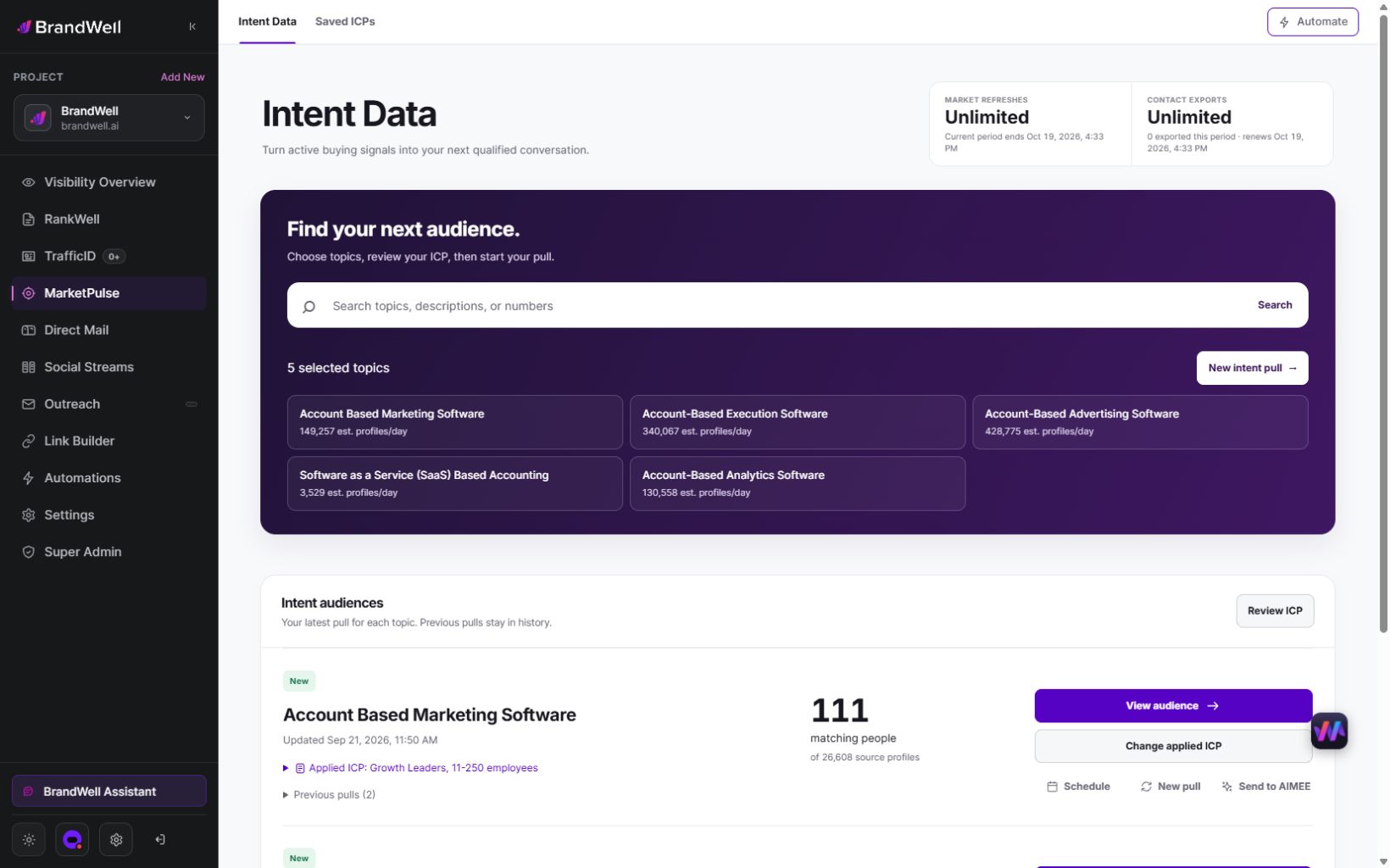
Choose a relevant topic, review the audience using your ICP, and record what the evidence actually shows. Destination rules, privacy requirements and campaign controls need separate checks before activation. Growth and Scale include AIMEE for the initial user; review connected products and channel costs before expanding the workflow.
Common questions
Should every high-intent match receive a higher bid?
No. Verify the match, economics, permitted use and campaign control before testing a change.
Can manual adjustments override Smart Bidding?
Do not assume so. Check the current strategy’s eligibility and exceptions in Google’s linked guidance.
Does a higher CTR prove better lead quality?
No. Review independently defined accepted inquiries, opportunities and purchases over the agreed outcome window.
Can topic research reset a campaign’s learning phase?
Research alone is not a campaign setting change. Any applied conversion, targeting, bidding or budget change must be evaluated against the platform’s current behavior; this guide makes no learning-phase guarantee.
Review MarketPulse’s demo and current plans or the BrandWell product directory.
Reviewed and updated October 3, 2026.

Written by