On this page
- Who this is for
- The core pricing strategy: sell the managed outcome
- Define scope before calculating the fee
- Implementation guide: turn pricing into an operating system
- Current MarketPulse input and delivery boundaries
- Custom build, reseller platform, managed provider, or manual status quo?
- Cost drivers and the pricing model
- KPIs for pricing, margin, and ROI
- Best-fit clients and disqualifiers
- Pricing risks, compliance, and client trust
- A recurring agency package blueprint
- Frequently asked questions
- The pricing decision in one sentence
- Check the fee with a worked cost model
Price an intent-data service from the actual work your agency can deliver: research selection, qualification, approved routing, reporting and review. Define costs and margin consistently, test willingness to pay, and keep data usage, media and custom implementation visible in the scope.
One possible structure separates implementation, recurring management and approved variable costs. Define signals-and-reporting, approved activation or broader managed work by actual deliverables. This guide does not establish market-rate fee bands. Quote from your own costs, capacity, client value and written scope.
Current MarketPulse offer: intent-data plans start at $500/mo. See the product, demo, and current plans. Updated October 6, 2026.
Who this is for
- Agency owners and resellers designing a recurring buyer-intent service.
- Operations and finance leaders who need defensible margins, usage controls, and approval rules.
- Client-service teams turning website visitor intent, topic research, enrichment, and activation into a packaged outcome.
- Specialist consultants deciding whether to refer, resell, manage, or build part of the delivery stack.
Design a service you can actually deliver around the research subscription. Custom client interfaces, billing, branding, APIs and managed activation need their own rights, implementation, support and fees. A subscription is not a native white-label business. This guide covers scope, costs, pricing decisions, operating options, metrics and review.
The core pricing strategy: sell the managed outcome
A simple percentage markup works only when the client buys a clearly defined commodity and carries the operational burden. Intent data is rarely that simple. A raw signal must still be matched to an eligible account, checked for freshness and identity confidence, enriched, routed to an approved play, handled by a person or automation, and measured against a credible baseline.
A practical cost-and-scope worksheet separates four layers:
- Research subscription and usage: actual topic coverage, refreshes, exports, identification and enrichment where included or separately contracted.
- Implementation cost: discovery, ICP and topic mapping, integrations, data cleanup, templates, dashboards, governance, and training.
- Managed delivery cost: analysis, qualification, routing, campaign operations, reporting, client communication, support, and QA.
- Outcome value: the economic value of reaching qualified accounts sooner, avoiding wasted activation, improving client visibility, and building a repeatable pipeline motion.
A fictional service costs $2,000 per month under the defined cost model. A 60% target service margin implies a $5,000 fee. This is arithmetic for a hypothetical agency service, not a BrandWell plan quote, a market benchmark or evidence of willingness to pay:
minimum recurring revenue = $2,000 ÷ (1 − 0.60) = $5,000
The calculation does not prove buyers will pay $5,000. Verify costs, scope, demand and the client value hypothesis. If costs include allocated overhead, label the result consistently instead of presenting it as accounting gross margin.
Percentage markup versus outcome pricing
Use percentage markup for transparent pass-through items whose quantity is easy to audit: extra records, added topics, direct mail, advertising media, or third-party validation. Use outcome-oriented pricing for the operating system wrapped around those items: strategy, scoring, activation, optimization, and evidence.
A hybrid is usually easiest to explain:
- fixed implementation fee;
- fixed recurring fee for agreed deliverables and capacity;
- included usage allowance;
- published overage schedule;
- optional performance component tied to an accepted meeting or opportunity definition;
- media and extraordinary work billed separately.
Avoid pure pay-per-intent-lead pricing. A research signal is not a sales-accepted lead. Pure performance pricing is also dangerous when the agency does not control the client’s offer, rep follow-up, calendar capacity, CRM hygiene, or close process.
Define scope before calculating the fee
The following service scopes illustrate different work. Calculate each fee from actual effort, capacity and costs. They are not standard agency price bands or BrandWell package entitlements.
| Package | Typical scope | Keep separate |
|---|---|---|
| Signals and reporting | One ICP, capped topics or accounts, qualification rules, CRM or report delivery, monthly review | Overage data, custom integrations, campaign execution |
| Managed activation | Signals, enrichment, routing, one or two activation plays, weekly QA, client reporting | Media, high-volume outreach infrastructure, unusual creative |
| Multi-channel or ABM | Multiple segments, topics, regions, channels, sales enablement, attribution, tighter service levels | Media, direct mail, new-system builds, travel or onsite work |
Swipe the table to see all columns.
Setup commonly deserves its own fee because the work is front-loaded: market mapping, topic validation, data access, client configuration, CRM fields, routing logic, brand setup, reporting definitions, and training. Waiving setup can create a negative-margin first quarter and make cancellation especially painful.
A bounded pilot can make the initial scope inspectable. Agree the market, topics, workflow, usage, responsibilities and decision criteria. Its duration, price and expansion decision depend on the actual case.
Implementation guide: turn pricing into an operating system
Setting markup and retail pricing for a managed intent service is not a spreadsheet-only exercise. The price must match what sales promises and delivery can repeat.
1. Define the billable unit
Define an auditable billable unit: actual topic coverage, reviewed account, validated contact, approved action, campaign or managed hour. Do not call a research signal a qualified lead. Verify any exclusive rights separately in the actual contract.
Input: actual order form, usage rules, data dictionary, client ICP, expected volume. Output: one written billable-unit definition, inclusions, exclusions, and overage rule. Owner: product or operations lead, approved by finance.
2. Calculate fully loaded delivery cost
Include more than the vendor invoice. Add onboarding labor, ongoing analyst time, client success, reporting, copy, integration maintenance, quality review, support, refunds or credits, billing fees, and a reasonable allocation for management and tooling.
Use a low, expected, and high usage case. A margin that works only at the lowest volume is not a margin plan.
3. Set the margin floor and discount limits
Choose a target gross margin and the minimum acceptable margin. Give sales a discount matrix rather than unrestricted discretion. For example, small concessions may require a sales lead; a price below the margin floor should require finance or founder approval and a documented strategic reason.
Never discount a usage-heavy plan without also changing volume, service level, commitment, or implementation fee. Otherwise sales gives away the costliest part of delivery.
4. Design retail packages around decisions
Each tier should answer a different buyer question:
- “Can you show us who may be in market?”
- “Can you turn those signals into consistent action?”
- “Can you operate and prove a coordinated revenue program?”
Write a one-page scope sheet for every tier. Include topics, accounts, records, channels, cadence, reporting, response times, approvals, data retention, client responsibilities, and change-control rules.
5. Model the client’s value ceiling
Estimate the number of eligible accounts, likely activation rate, opportunity rate, average gross profit, and time to value. Use ranges rather than a single optimistic forecast. A client with a $3,000 product and weak follow-up cannot support the same package as a client with $60,000 gross profit per new account and a trained sales team.
6. Create usage and overage controls
Meter actual research consumption by client. Alert before a client crosses 70%, 90%, and 100% of the included allowance. Require approval before high-cost expansions such as new markets, more frequent refresh, deeper enrichment, or added channels.
7. Connect pricing to billing and service delivery
The signed order, invoice, portal entitlement, task system, and reporting view must use the same package name and limits. A manual handoff is acceptable at low volume, but one accountable person must reconcile entitlements and actual usage.
8. Review exceptions every month and the model every quarter
A monthly review catches unbilled usage, scope creep, late client inputs, and delivery overruns. A quarterly pricing review looks at cohort gross margin, staff time, vendor cost, renewal, expansion, and which features clients actually value.
Approval boundaries and QA checklist
- Sales may not promise unlimited data, universal coverage, guaranteed meetings, or a topic before availability is checked.
- Operations approves signal sources, volume, routing, and service capacity.
- Finance approves margin exceptions, credits, unusual payment terms, and performance fees.
- Privacy or legal reviewers approve unfamiliar jurisdictions, sensitive use cases, and changes in controller/processor roles.
- Client success confirms that the buyer understands probabilistic signals, required follow-up, measurement limits, and renewal criteria.
- Every invoice should reconcile package, usage, overages, media, and approved change orders.
This is the practical operational checklist and implementation template agencies can reuse across clients. Common failures include quoting before checking coverage, hiding media inside the retainer, undercounting analyst time, promising person-level matches everywhere, and measuring signal volume instead of commercial outcomes.
Current MarketPulse input and delivery boundaries
BrandWell publishes this guide about its own research product and service-design decisions. This is not an independent provider ranking. Verify actual scope, data rights, implementation and effort before a client commitment.
Check topic availability, actual fields, usage, destinations, client data separation, permitted uses, review effort and measured outcomes for the same scoped case.
Topic research with a saved ICP
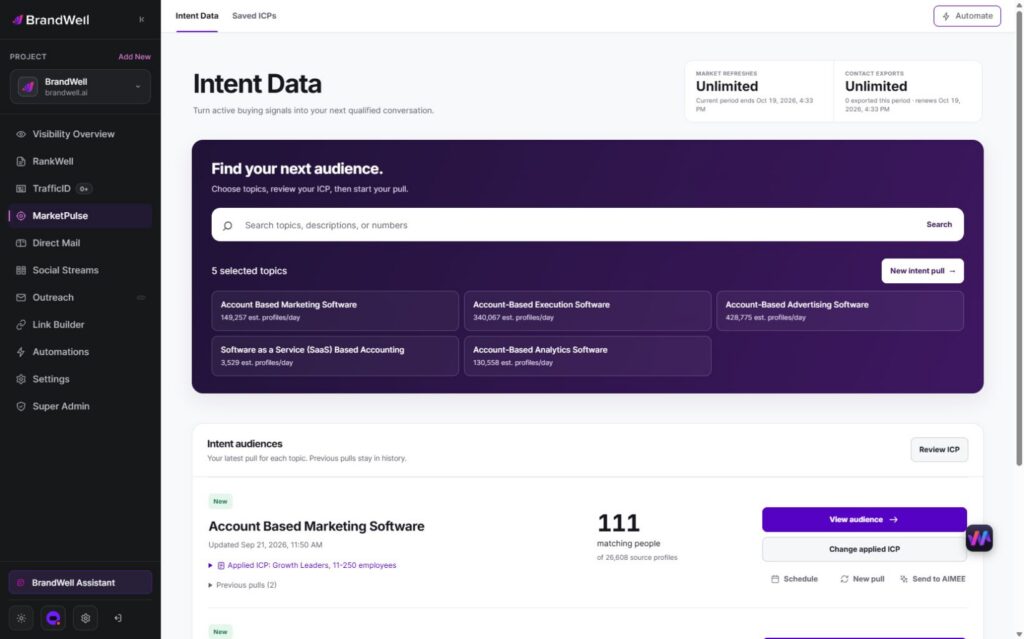
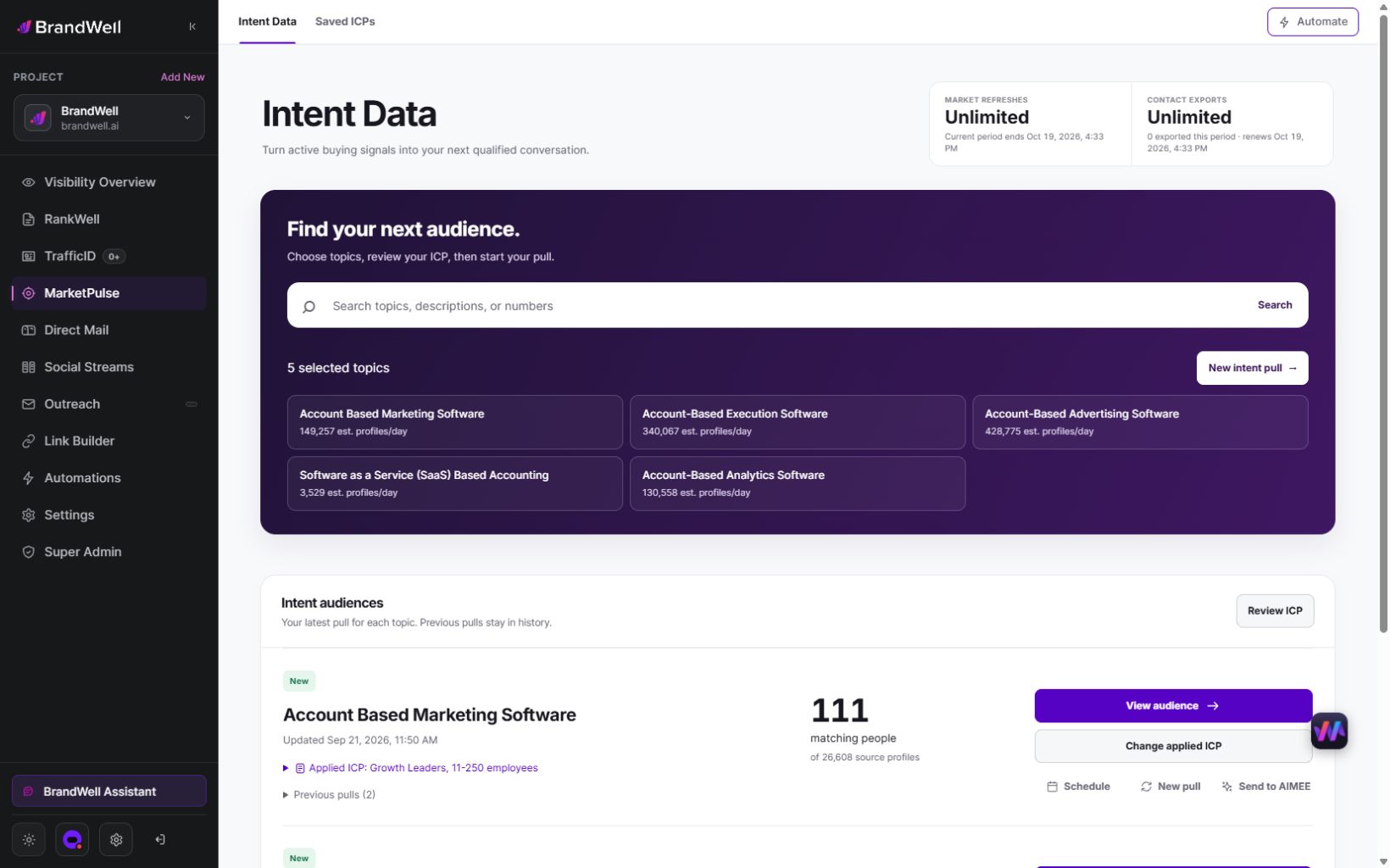
MarketPulse is starting at $500/mo. Choose relevant topics, apply a saved ICP and review actual matching audience fields. Approve eligible exports or a configured next step separately.
| Plan | Topics and refreshes | Monthly exports |
|---|---|---|
| Starter | 1 topic, weekly | 25,000 contacts |
| Growth | 3 topics, daily | 100,000 contacts |
| Scale | 10 topics, daily | Unlimited contacts |
Swipe the table to see all columns.
A pull retrieves available data from the previous 24 hours for one topic. Daily use across all included topics provides 90 Growth pulls or 300 Scale pulls in a 30-day month. Weekly Starter pulls vary by calendar month. Available audience size and contact fields vary, and audiences may overlap. Refreshes stop at the plan limit without overage charges.
- Find and qualify: search the topic catalog, save your ICP, and review the people and companies that match.
- Act on the research: export qualified contacts or prepare an Outreach or Direct Mail workflow. Connected products, channel usage, and fulfillment may cost extra.
- Get help from AIMEE: Growth and Scale include AIMEE for the initial user to research accounts and prepare the next step through connected tools.
Agencies and other service businesses can build client deliverables around their available Intent Scans and exports. Keep each client’s scope, permissions, and service fees clear. A subscription is not a promise of a white-label platform or exclusive access to a market.
Explore MarketPulse and watch the demo or compare plans starting at $500/mo. Any early-access discount is a separate, time-limited offer shown to an eligible recipient.
Custom build, reseller platform, managed provider, or manual status quo?
| Approach | Best when | Agency controls | Hidden work | Switching trigger |
|---|---|---|---|---|
| Manual/no intent | Demand is unproven or client volume is too low | Existing research and outreach | Slow research, inconsistent timing, no scalable signal layer | Repeated clients ask for the same capability |
| Custom build | Signal or workflow is proprietary and volume supports engineering | Product, UX, scoring, integrations, billing | Data sourcing, identity, security, privacy, uptime, support | Ongoing platform cost is lower than vendor dependency and a real moat exists |
| Separately contracted reseller or branded delivery | Rights, implementation, delivery effort and economics are separately verified | Client contract, brand, retail price, delivery | Vendor diligence, service operations, client success | Provider limits margin, coverage, or differentiation |
| Managed provider | The agency wants expert execution with less internal operations | Client strategy and relationship | Less control, possible lower margin, provider coordination | The service becomes repeatable enough to internalize |
| Referral | The agency is validating demand or avoiding delivery risk | Introduction and surrounding advisory | Little client/product control and lower recurring economics | Several clients buy and the agency can own delivery |
Swipe the table to see all columns.
Migration should preserve client consent and notices, field definitions, suppression lists, source lineage, opportunity history, report definitions, and exports. Never switch solely because a headline price is lower. Model retraining, portal migration, client communication, and lost history can erase the apparent savings.
Cost drivers and the pricing model
A defensible managed intent service cost model separates five buckets:
- Subscription and minimums: base platform, clients, topics, seats, or streams.
- Usage: records, resolutions, enrichments, validations, API calls, reports, storage, and overages.
- Implementation: discovery, integrations, cleanup, branding, templates, training, and governance.
- Recurring service: analysis, activation, optimization, client success, reporting, and support.
- Variable campaign costs: advertising, inboxes, calling, creative, direct mail, or specialist contractors.
Build three scenarios. In the expected case, use realistic signal volume and staff time. In the high case, assume more matches, more exceptions, and more client questions – not just more revenue. In the low case, model thin coverage and weak adoption. Each scenario should show revenue, direct cost, gross profit, gross margin, contribution after sales and overhead, and cash collection timing.
How actual usage and signal value should change retail pricing
Actual research and delivery costs inform a cost floor. Willingness to pay and measured client value need separate evidence. Do not assume rarity, timing or topic exclusivity automatically justify a higher fee. Verify any special rights and actual downstream usefulness.
Use this chain:
signal source → topic and recency → identity confidence → ICP eligibility → approved activation → measured outcome
Every break in the chain lowers economic value. Website visitor intent may support immediate account research, but it still needs account matching and a relevant play. Third-party topic research can reveal in-market accounts beyond the website, but topic quality and exclusivity must be validated. Person-level data can accelerate activation where available, yet its legal basis, accuracy, and appropriate use demand more scrutiny.
KPIs for pricing, margin, and ROI
Do not use record volume as the primary success metric. A useful pricing KPI stack has four layers:
- Delivery: usable coverage rate, valid contact rate, on-time delivery, time to first action, exception rate, and usage against allowance.
- Adoption: percent of qualified signals accepted, percent acted on inside the SLA, workflow completion, and client user engagement.
- Commercial outcomes: meetings per eligible account, accepted opportunities, stage progression, pipeline per account, win rate, sales-cycle time, and gross profit.
- Agency economics: gross margin by client, delivery hours, software cost as a percent of revenue, revenue retention, expansion, payback, and cash collection.
Useful formulas include:
gross margin = (client revenue − direct delivery cost) ÷ client revenuecost per activated account = total program cost ÷ accounts receiving the agreed playopportunity yield = accepted opportunities ÷ eligible accountsincremental gross profit = incremental won revenue × client gross marginprogram ROI = (incremental gross profit − fully loaded program cost) ÷ fully loaded program cost
Benchmarks should come from the agency’s own comparable cohorts. A vendor-wide conversion percentage may use different markets, definitions, and attribution. During a pilot, report baseline, sample size, and limitations; never present immature pipeline as closed-won ROI.
Best-fit clients and disqualifiers
This agency service fits best when the client has:
- a defined B2B ICP and enough eligible accounts;
- meaningful gross profit per new customer;
- a sales cycle long enough for timing and prioritization to matter;
- CRM ownership and measurable stages;
- capacity to act on signals promptly;
- permissioned channels and suppression processes;
- a willingness to run a controlled pilot and share outcomes.
It is a poor fit when the buyer expects every signal to become a lead, has no reliable CRM, cannot name its target market, lacks sales capacity, sells a very low-value transactional product, or refuses to separate influenced pipeline from incremental revenue. A reseller should also decline a client whose requested outreach or data use cannot be supported responsibly.
Use a fit score before quoting: market coverage, client economics, activation readiness, measurement readiness, governance readiness, and relationship potential. A low score calls for a smaller advisory project, a referral, or no sale – not a deeper discount.
Pricing risks, compliance, and client trust
The biggest managed intent service pricing mistakes are not arithmetic errors. They are promise and governance errors.
Margin and scope risks
Unmetered usage, free integrations, unlimited revisions, unclear support, and custom reporting can destroy margin. Put a change-order rule in the contract. State what happens when a client adds topics, markets, users, channels, or data fields.
Billing and attribution risks
Tie fees to services the agency controls. If a bonus depends on meetings or opportunities, define acceptance, duplicates, existing pipeline, no-shows, attribution windows, and CRM evidence. Never let one stakeholder reject results using rules that were not agreed before launch.
Data-use and privacy risks
The agency and client must understand their roles, notices, lawful basis or other applicable permission, retention, deletion, security, and downstream sharing. BrandWell’s privacy policy and terms describe the provider-side framework, but each agency remains responsible for its own client agreement and use.
Verify actual source, role, purpose, recipient, jurisdiction and channel requirements with the responsible reviewers. Record permission, suppression, retention, correction and deletion controls for the scoped service.
Client-trust risks
Do not tell a prospect, “We saw you researching this topic.” Use intent to prioritize research and make outreach more relevant without exposing invasive detail. Tell clients what a signal does and does not prove. Document sources and confidence privately, suppress excluded people and accounts, and make opt-outs easy to honor.
A recurring agency package blueprint
A strong package turns pricing into a retained operating cadence.
Foundation package
- ICP, account, and topic definition;
- limited signal feed or branded report;
- enrichment and validation rules;
- CRM delivery or secure export;
- monthly insight review;
- documented usage and overages.
Activation package
- everything in Foundation;
- one or two approved signal-to-action playbooks;
- copy and audience templates;
- routing, SLA, and rejection reasons;
- weekly QA and optimization;
- monthly funnel and cost scorecard.
Revenue program
- multiple segments, markets, or topics;
- coordinated ads, sales, lifecycle, or account plays;
- advanced integration and client enablement;
- experiment or matched-cohort design;
- quarterly business review and expansion plan;
- tighter service levels and governance.
In MarketPulse, choose an available topic, apply a saved ICP and review actual audience fields. Use those records to scope a permitted export or configured Outreach, Direct Mail or AIMEE review. Confirm the destination, acknowledgement and effort before promising managed delivery.
Report actual usage, qualified actions, unresolved exceptions, effort and mature outcomes. Test whether the service continues to improve decisions. Expansion needs evidence of capacity, relevant markets and sustainable economics.
Frequently asked questions
How much should an agency charge for buyer intent data and lead activation?
Start with actual costs, defined deliverables and capacity. Calculate a consistent margin, test willingness to pay and separate implementation, recurring work and variable costs. There is no researched universal fee range in this guide.
Should I apply a simple percentage markup or price the full managed outcome?
Use markup for transparent pass-through usage. Price the managed outcome for strategy, qualification, routing, activation, reporting, and improvement. Most agencies need both.
What gross margin should I target?
Choose a target consistent with your service model and cash needs, then calculate the price floor from real costs. A target is not evidence that buyers will pay; validate willingness to pay and change scope when the floor exceeds the value ceiling.
What belongs in the setup fee?
Discovery, audience and topic mapping, integrations, data cleanup, branding, routing, templates, dashboards, measurement design, governance review, and training.
How should in-market buyer signals affect price?
Price increases only when signals are usable: relevant, current, identifiable enough for the action, permitted, and connected to a measurable workflow. More signals without better decisions may increase cost without increasing value.
What should be reviewed before a quote is approved?
Coverage, permitted resale, included usage, overages, client responsibilities, service capacity, margin, topic availability, data use, measurement, payment terms, and change control.
Can an agency promise topic exclusivity?
Do not promise exclusive topics or protected markets without explicit verified rights in the actual agreement. MarketPulse topic access is not itself evidence of exclusivity, a white-label portal or custom client billing.
What should an initial MarketPulse evaluation measure?
Measure topic relevance, ICP fit, usable matching contacts, and the work required to prepare your first campaign. MarketPulse is starting at $500/mo. Set the scope and success criteria before expanding into additional BrandWell tools or a larger agency package.
What is the best managed intent service software?
Choose inputs for the actual service gap: topic research, identifiable site visits, contact review or approved activation. Verify rights, implementation, client data separation, operating effort and outcomes. There is no universal best software or assumed white-label entitlement.
When should the agency reprice?
Review exceptions monthly and the model quarterly. Reprice when actual usage, service hours, vendor costs, scope, support burden, client value, or contract risk materially changes.
The pricing decision in one sentence
Charge for the repeatable revenue workflow you can responsibly deliver, expose the variable cost you cannot control, and use pilot evidence – not record volume or competitor headlines – to decide whether the package deserves to expand.
Check the fee with a worked cost model
Margin and markup use different denominators
A fictional agency service costs $2,000 and sells for $5,000. The $3,000 difference is a 60% margin on revenue and a 150% markup on cost. Adding a 60% markup instead gives a $3,200 fee and a 37.5% margin. These are hypothetical service calculations, not suggested standard fees.
Cost classification and cash still matter
The SEC financial statement guide distinguishes gross profit from later operating expenses, and earnings from cash flow. Use consistent cost categories; a profitable service can still have a cash collection gap.
If the fictional $5,000 fee incurs another $800 of delivery work, cost rises to $2,800 and the modeled margin falls to 44%. A budgeted contingency is not an incurred cost until the relevant work occurs. Track the forecast, actual cost and cash timing separately.
Capacity is not completed delivery
A fictional team has allowance for 100 pulls but uses 60. Report 60% usage of that pull capacity. A pull may return many records; it is not one contact or a completed client deliverable. Record actual review, approvals and acknowledged actions separately.
Copyable quote worksheet
Scope: [Actual markets, topics, refreshes, exports and deliverables.] Effort: [Implementation, review, activation, reporting and support.] Costs: [Subscription, labor, connected tools, usage and fulfillment.] Fee: [Defined cost model, target margin and approved discount.] Client: [Responsibilities, acceptance and value hypothesis.] Change: [Capacity, approvals, exceptions, renewal and exit.]
Review current MarketPulse plans and workflow, starting at $500/mo.
Reviewed and updated October 6, 2026.

Written by