On this page
- Who this is for
- The direct comparison
- A six-part intent audience framework
- When buyer intent data is the right input
- When lead lists are the right input
- When lookalike or predictive audiences are the right input
- The combined audience strategy
- Current MarketPulse research input
- Tools and templates that matter more than another dashboard
- Pricing and total cost
- Measurement, ROI, and benchmarks
- Best-fit scenarios and disqualifiers
- Mistakes, quality problems, and privacy risks
- Package a recurring agency audience service
- Audience checklist
- Frequently asked questions
- Check the actual audience product and experiment
Buyer intent data, lead lists, and lookalike audiences solve different problems:
- Buyer intent data helps decide when an otherwise eligible account may deserve attention.
- Lead data helps identify which companies or people can be reached.
- Modeled audiences seek additional platform users predicted to resemble a permitted seed or perform a chosen action. Product names, eligible sources and expansion settings differ by platform.
Choose the input that addresses the actual gap: relevant research context, contact information or modeled reach. If you combine inputs, preserve their meanings and test whether the resulting action improves mature outcomes against a suitable comparator.
The wrong approach is to call every intent record a buyer, every contact a lead, or every lookalike a fit. Each is a probabilistic input. The audience wins only if it improves qualified pipeline or contribution profit after data, media, labor, and compliance costs.
Current MarketPulse offer: intent-data plans start at $500/mo. See the product, demo, and current plans. Updated October 6, 2026.
Who this is for
- B2B paid-media leaders deciding how to spend on stronger fit and timing.
- Demand generation and growth teams comparing topic research, modeled audiences and static contact lists.
- Agency owners packaging audience intelligence, activation, and measurement as a recurring service.
- RevOps and privacy reviewers responsible for identity, CRM outcomes, consent, suppression, and data lineage.
The direct comparison
| Dimension | Buyer intent data | Lead lists | Lookalike or predictive audiences |
|---|---|---|---|
| Primary question | Which eligible accounts show current relevant behavior? | Which accounts or people match selected attributes and can be reached? | Which additional platform users resemble a seed or predicted outcome? |
| Typical unit | Account, topic, event, sometimes person | Company or person record | Platform user or modeled audience member |
| Main strength | Timing and prioritization | Addressability and workflow inputs | Scalable reach and algorithmic discovery |
| Main weakness | Noise, coverage gaps, ambiguous identity | Staleness, weak timing, list fatigue | Limited transparency and possible drift from ICP |
| Best use | Prioritize research, ads, seller action, and nurture | Build, enrich, validate, and route a target universe | Expand delivery after the seed and conversion signal are sound |
| What it does not prove | A specific person intends to buy | The contact wants outreach | The user is in market or commercially qualified |
Swipe the table to see all columns.
This audience comparison is a decision guide, not a universal ranking. Use intent when timing changes the play. Use lead data when the main gap is identity or contactability. Use platform modeling when qualified reach is the bottleneck and the platform has enough quality feedback to learn.
A six-part intent audience framework
A practical audience framework uses six gates:
- Fit: Is the account, company, or role inside the serviceable ICP?
- Evidence: Is the behavior relevant enough to change priority?
- Freshness: Is it recent enough for this topic and sales cycle?
- Identity: Is the match confidence adequate for the proposed account- or person-level action?
- Permission and policy: Is the source, destination, jurisdiction, and channel approved?
- Outcome: Does the audience improve qualified business results against a fair comparison?
No composite score should let high activity override an ineligible company, stale data, missing permission, or unreliable identity. The gates make the decision explainable.
When buyer intent data is the right input
Intent audiences work best for high-consideration B2B markets where research precedes a sales conversation and the advertiser knows which accounts fit. Examples include enterprise software, managed services, complex professional services, industrial technology, security, infrastructure, and business systems.
Useful audience use cases include:
- Prioritizing a named account list for advertising.
- Selecting accounts for competitor, migration, integration, or implementation creative.
- Moving a fit account from broad awareness to a seller research task.
- Expanding an open opportunity to additional buying-group roles.
- Monitoring customer accounts for expansion or competitive-research hypotheses.
- Giving an agency a current topic layer for weekly client reports and activation.
Intent is less helpful when research behavior is too sparse, the topic is ambiguous, the product is low-ticket and self-serve, or the advertiser lacks a distinct action for the signal.
When lead lists are the right input
Lead data is useful when a team needs to define an account universe, enrich CRM records, find appropriate roles, validate contact information, or route known relationships. It can support outbound and audience construction, but freshness and contactability need separate checks.
A list becomes dangerous when the team mistakes availability for relevance. A job title and email address do not establish a need, timing, lawful basis, channel permission, or message. Bought or licensed data also creates diligence questions about source, notice, permitted use, updates, rights handling, and retention.
Use a list for:
- Market mapping and account selection.
- Missing-field enrichment.
- Buying-group research after an account qualifies.
- Suppression, territory, ownership, and routing.
- Contact validation immediately before a permitted action.
Do not use a list to imply that every record is a qualified lead.
When lookalike or predictive audiences are the right input
Platform-native modeled audiences can scale beyond a seed when the seed represents the outcome you want. They often help when direct account matching is too small for efficient delivery or when the platform has stronger behavioral context than the advertiser can observe.
The seed matters. A list of all website visitors teaches a different pattern than closed-won customers, sales-qualified accounts, or high-retention users. A small, biased, stale, or mixed seed can produce an audience that is similar in ways that do not matter commercially.
Use modeled expansion when:
- The seed is lawful, current, large enough, and tied to quality.
- The campaign needs more reach than a named-account audience can provide.
- The conversion event represents revenue quality, not merely a cheap click.
- The team can compare expansion with a tighter control audience.
Do not assume platform similarity equals B2B fit or current demand. Optimization may favor easy conversions unless offline quality and value are returned to the platform.
The combined audience strategy
A combined approach can keep each input visible. The following layers are a planning framework, not a claim that using every layer outperforms a simpler approach.
Layer 1: Build the eligible account universe
Use firmographic, technographic, geographic, customer, competitor, and economic rules to define whom the company can serve. Keep exclusions visible. This is the denominator for coverage and outcome reporting.
Layer 2: Add first-party behavior
Group website pages, product events, campaigns, webinars, and CRM activity by commercial meaning. Preserve timestamp and consent state. A repeat visit to migration documentation deserves a different interpretation from a homepage view.
Layer 3: Add third-party topic research
Map category, problem, competitor, integration, and implementation topics to the account universe. Require a freshness window and minimum relevance. Multiple corroborating signals can be more useful than one opaque score.
Layer 4: Resolve identity and validate contacts
Use company-level audiences when person confidence is weak. Enrich people only after an account passes fit and timing gates. Validate immediately before activation, check current role and relationship, and suppress opt-outs, customers, active opportunities, competitors, and employees as appropriate.
Layer 5: Create separate activation cells
Do not place everything in one campaign. Create cells such as:
- Fit + current intent.
- Fit + no current intent.
- Current intent + weak fit, normally excluded or observed only.
- Lookalike expansion from qualified outcomes.
- Retargeting or first-party engagement, subject to approved tracking rules.
Separate cells make delivery and outcomes easier to inspect. Intent and non-intent groups may differ before advertising; those cells alone do not establish a causal effect.
Layer 6: Return downstream quality
Send campaign, account, opportunity, value, and disposition outcomes to the measurement layer. Where the platform supports approved conversion feedback, use quality-weighted events rather than raw form fills. Keep a durable CRM or warehouse record because platform reporting alone cannot explain the full buying cycle.
Current MarketPulse research input
Review source unit, topic meaning, fit, identity, freshness, allowed destinations, costs and actual outcomes. A research product and an advertising platform have different jobs.
BrandWell publishes this guide about its own research product and workflow decisions. This is not an independent provider ranking. Verify actual scope, source, destination rules, effort and outcomes for your use case.
Topic research with a saved ICP
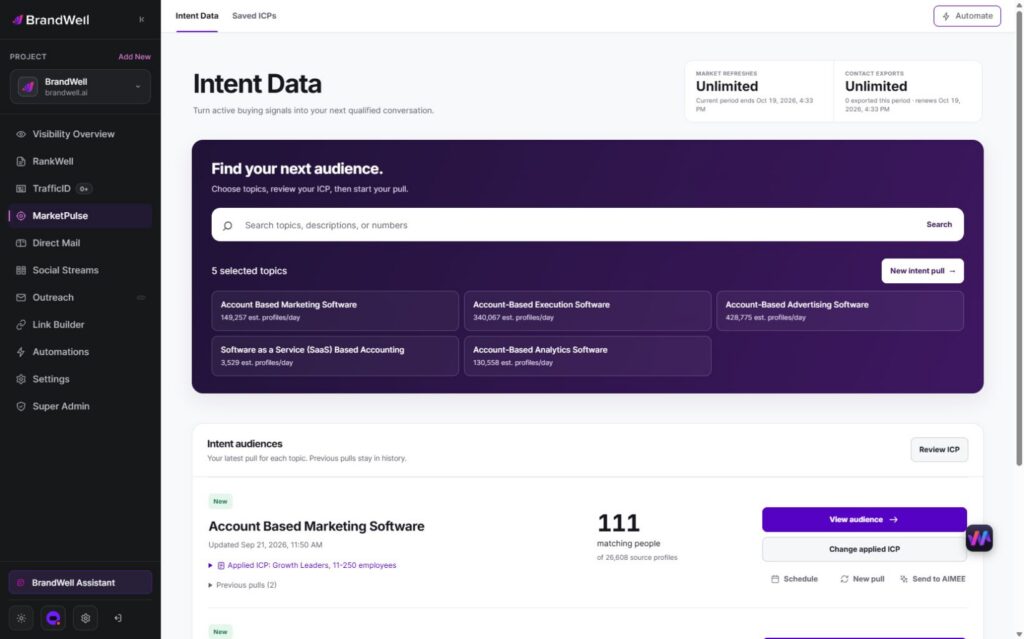
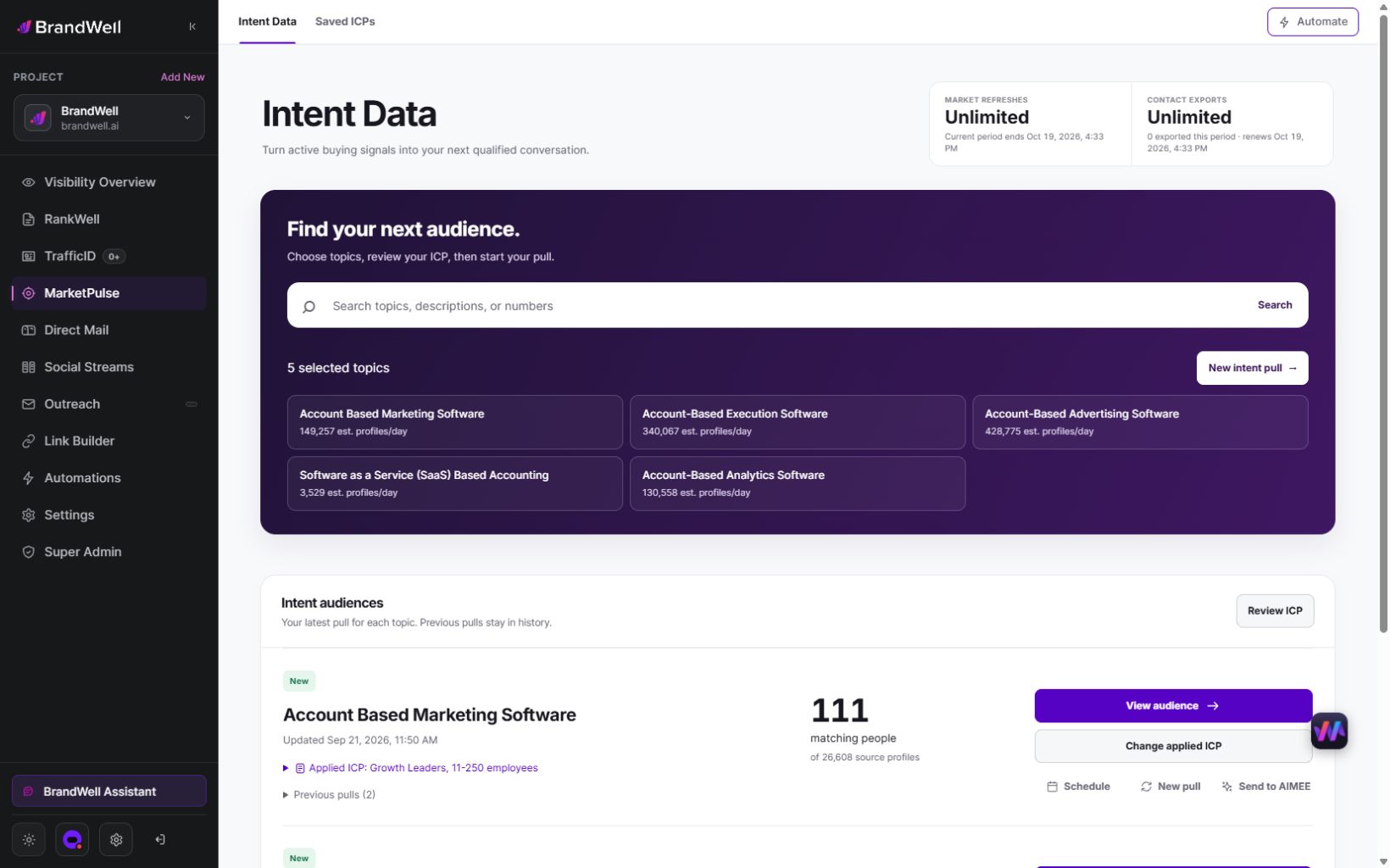
MarketPulse is starting at $500/mo. Choose available research topics, apply a saved ICP and review actual audience and contact fields before approving a next step.
| Plan | Topics and refreshes | Monthly exports |
|---|---|---|
| Starter | 1 topic, weekly | 25,000 contacts |
| Growth | 3 topics, daily | 100,000 contacts |
| Scale | 10 topics, daily | Unlimited contacts |
Swipe the table to see all columns.
A pull retrieves available data from the previous 24 hours for one topic. Daily use across all included topics provides 90 Growth pulls or 300 Scale pulls in a 30-day month. Weekly Starter pulls vary by calendar month. Available audience size and contact fields vary, and audiences may overlap. Refreshes stop at the plan limit without overage charges.
- Find and qualify: search the topic catalog, save your ICP, and review the people and companies that match.
- Act on the research: export qualified contacts or prepare an Outreach or Direct Mail workflow. Connected products, channel usage, and fulfillment may cost extra.
- Get help from AIMEE: Growth and Scale include AIMEE for the initial user to research accounts and prepare the next step through connected tools.
Agencies and other service businesses can build client deliverables around their available Intent Scans and exports. Keep each client’s scope, permissions, and service fees clear. A subscription is not a promise of a white-label platform or exclusive access to a market.
Explore MarketPulse and watch the demo or compare plans starting at $500/mo. Any early-access discount is a separate, time-limited offer shown to an eligible recipient.
Tools and templates that matter more than another dashboard
The most useful audience templates are:
- ICP and exclusion worksheet: eligible accounts, industries, sizes, geographies, customer and competitor rules.
- Signal dictionary: source, event, topic, unit, timestamp, confidence, lookback, permitted use.
- Audience cell plan: inclusion, exclusion, channel, creative, bid, frequency, and hypothesis.
- Identity decision tree: account-level action, person-level action, quarantine, or suppression.
- Allowed-use matrix: source × jurisdiction × purpose × destination × retention × owner.
- Experiment plan: treatment, control, randomization unit, primary metric, guardrail metric, duration, and minimum decision rule.
- Cost model: data, platform, media, services, labor, governance, and overages.
- Outcome map: campaign and account IDs connected to contacts, opportunities, value, and disposition.
These artifacts make audience best practices inspectable. They also prevent a platform’s available settings from quietly becoming the strategy.
Pricing and total cost
Audience pricing cannot be compared from media CPM alone. Model:
total program cost = audience/data + identity/enrichment + ad platform/media + creative + implementation + agency labor + client labor + governance
Lead data may charge by records, credits, seats, enrichment, validation, or exports. Intent may charge by topics, accounts, feed, audience, volume, or platform configuration. Ad platforms charge media and may change delivery economics dynamically. Enterprise suites often combine several layers in a quote.
MarketPulse is starting at $500/mo. Compare topic coverage, refreshes, exports and current terms with the work your team can actually review. Review current MarketPulse plans.
Run sensitivity cases for:
- Signal density and usable-audience size.
- Match rate by destination.
- Enrichment and validation consumption.
- Media CPM and frequency.
- Creative and landing-page work.
- Seller or analyst review time.
- Overages and custom reporting.
Measurement, ROI, and benchmarks
Audience KPIs should be staged:
Data and delivery
- Eligible account coverage.
- Signal freshness and usable-signal rate.
- Destination match rate.
- Unique reach, frequency, and spend.
- Suppression and duplicate rate.
Engagement and account progression
- Engaged accounts, high-value page visits, and qualified responses.
- Sales acceptance and time to action.
- Buying-group coverage for open opportunities.
- Stage progression within a fixed window.
Pipeline and economics
- Opportunity rate per eligible account.
- Qualified pipeline per 1,000 eligible accounts.
- Win rate and contribution margin.
- Customer acquisition cost and payback.
- Incremental lift and agency gross margin.
Use treatment and control groups drawn from the same eligible universe. Randomize at the account level where account influence is the outcome. Avoid placing subsidiaries from one corporate family in different groups when exposure can spill over.
Observed opportunity-rate difference = treatment opportunity rate minus comparator opportunity rate. Calling it causal lift requires an appropriate design and evidence; pre-existing differences and spillover can distort the comparison.
Estimated incremental ROI = (estimated additional contribution before program cost minus actual full program cost) divided by actual full program cost. Preserve the assumptions, uncertainty and outcome maturity behind the estimated contribution.
Audience benchmarks should come from the advertiser’s baseline and controlled experiments. Platform clicks and view-through conversions are diagnostic, not proof that intent created revenue. Different attribution windows can reverse the apparent winner.
Best-fit scenarios and disqualifiers
Choose an intent-prioritized audience when
- The client sells a high-consideration B2B offer.
- The eligible account universe is known.
- Relevant topics produce enough fresh activity.
- The team can route signals into distinct ads or plays.
- CRM outcomes can be joined back to accounts.
Choose a lookalike or predictive audience when
- Qualified reach is constrained.
- The seed represents a valuable outcome.
- The platform has enough signal to learn.
- The team accepts less transparency in exchange for scale.
- A controlled expansion test is possible.
Choose a lead-data workflow when
- Identity, roles, enrichment, or contact validation is the immediate gap.
- The company has a clear reason and approved channel for contacting the role.
- Records can be refreshed, suppressed, and governed.
Do not scale any of them when
- The offer or ICP is unclear.
- No owner can act on the output.
- The team cannot separate fit, timing, and identity.
- The use involves sensitive or consequential decisions without expert review.
- Success is defined as raw records, clicks, or platform-attributed pipeline.
Mistakes, quality problems, and privacy risks
Common audience mistakes include:
- Calling a research signal an identified buyer.
- Enriching and uploading everyone before checking fit.
- Building a lookalike from low-quality conversions.
- Mixing customers, prospects, competitors, and employees in the seed.
- Allowing audience expansion without an exclusion or spend test.
- Comparing platforms with different attribution windows.
- Ignoring account hierarchy and cross-device duplication.
- Sending outreach that reveals tracked behavior.
- Retaining audience exports and raw events indefinitely.
- Letting an agent upload, send, or modify systems without approval limits.
Before activation, verify actual source rights, permissions, recipient, jurisdiction, destination and channel requirements with the responsible reviewers. Preserve suppression, retention and deletion controls. Topic research or an available email address does not itself authorize an upload or message.
Package a recurring agency audience service
| Package | What the client receives | Cadence | Primary boundary |
|---|---|---|---|
| Audience intelligence | Topic map, eligible account coverage, branded report, audience recommendations | Weekly or monthly | No guaranteed volume or identity |
| Activated audiences | Intelligence plus fit, identity, validation, audience deployment, creative brief, and QA | Weekly operations; monthly outcome report | Media and destination fees separated |
| Managed intent growth | Multi-source signals, seller and ad plays, experiments, agent-ready workflows, and executive reporting | Continuous monitoring; quarterly strategy | Human approval, change control, and legal review |
Swipe the table to see all columns.
Scope agency service fees separately from the actual research subscription, media and delivery work. Verify custom reporting, client interfaces, integrations, rights and implemented destinations separately. Agree topics, markets, approvals, reporting, retention, change control and exit responsibilities.
In MarketPulse, choose a relevant topic, apply a saved ICP and review actual audience fields. Approve eligible exports or the next configured Outreach, Direct Mail or AIMEE workflow separately. Check destination acknowledgements and outcomes before expanding capacity.
Audience checklist
- Define the revenue outcome and eligible account universe.
- Separate fit, timing, identity, and platform similarity.
- Test topic coverage before promising volume.
- Preserve signal source, unit, timestamp, and confidence.
- Gate person-level enrichment behind account qualification.
- Validate and suppress immediately before activation.
- Build distinct intent, non-intent, and expansion cells.
- Keep bids, creative, frequency, and landing pages comparable.
- Predefine the comparison and allocation method. Matched observational groups can retain confounding; they are not equivalent to random assignment.
- Join outcomes to CRM opportunities and contribution margin.
- Review privacy, contracts, and platform terms for each destination.
- Require approval for uploads, sends, sensitive uses, and irreversible changes.
Frequently asked questions
How should B2B advertisers approach intent audiences versus lookalikes?
Use ICP fit as the foundation, intent as a timing layer, identity for addressability, and platform modeling for controlled reach expansion. Keep each audience cell separate so the team can measure whether intent adds qualified value.
What workflow, data, integrations, and team are required?
You need an eligible account list, first- and third-party signals, identity confidence, enrichment, validation, suppression, CRM, ad destinations, creative, opportunity data, and an experiment plan. Demand owns the use case, RevOps owns joins, paid media owns delivery, and privacy/legal reviewers approve data uses.
Which tools and operational resources are most useful?
Useful review artifacts preserve source, timestamp, unit, identity, permissions, actual destination and outcomes. Pair these with the ICP worksheet, audience plan, cost model and experiment record.
When should intent, lead lists, or lookalikes be used?
Use intent for timing, lead data for identity and contactability, and lookalikes for modeled scale. Combine them only through visible gates rather than one opaque score.
What budget and pricing model should a buyer expect?
MarketPulse is starting at $500/mo. Budget the actual subscription, identity work, media, creative, review, implementation and reporting separately. Check current topic, refresh and export allowances before committing.
How should ROI be measured?
Compare treatment and control at the account level. Track qualified opportunity and contribution-profit lift after the full cost. Use clicks, reach, and platform conversions as leading indicators, not final proof.
Which companies fit best?
High-consideration B2B advertisers with a defined account universe, relevant signal density, adequate media or sales capacity, and reliable CRM outcomes fit best.
How do fit, identity, freshness, and outcome evidence work together?
Check fit, evidence, freshness, identity, permitted purpose, suppression and destination requirements before acting. Hold unresolved mandatory checks. Measure mature outcomes separately; later results do not retroactively supply missing permission.
What are the biggest data-quality and privacy risks?
The biggest risks are false identity, stale or ambiguous topics, poor seeds, platform drift, missing suppressions, invasive messaging, unclear data rights, incompatible attribution windows, and uncontrolled automation.
How should an agency sell this as a recurring service?
Sell monitored audience intelligence, qualified activation, measurement, and improvement – not a one-off list. Define modules, cadence, media, approvals, usage, reporting, and change control while the agency sets its own client price.
Check the actual audience product and experiment
Lookalike is not a universal current product name
LinkedIn discontinued lookalike audiences on February 29, 2024. Its guidance points to Predictive Audiences or Audience Expansion for different uses. Check current eligible sources and settings instead of assuming the same feature exists across platforms.
Keep account research separate from contact inventory
A fictional company observation leads to five proposed stakeholder contacts. Report one account observation and five proposed contacts, not five people observed researching. Check their roles, available fields and permissions before any approved action.
A rate difference is a result to explain
A fictional intent group produces 12 opportunities from 100 accounts, while another group produces 8 from 100. The observed difference is 4 percentage points. If teams selected the groups using different account quality or existing relationships, that difference does not isolate the effect of intent. Record allocation, overlap, exposure, outcome window and missing results before estimating added contribution.
Same period, separate economics
Track actual data, media, creative, implementation and review costs for the measured period. Attribute each opportunity once under the stated rule. Platform-attributed revenue, estimated pipeline and realized contribution are different measures.
Review the MarketPulse topic and ICP workflow, starting at $500/mo.
Reviewed and updated October 6, 2026.

Written by