



On this page
Google’s public guidance does not give publishers a complete test for determining how a passage was written. It describes detecting spam and evaluating content. Those are different questions from proving whether an individual sentence originated with AI.
For a content team, the useful task is to verify claims, contribute relevant information and publish an accountable article. Do not build a strategy around supposed detector evasion, hidden language fingerprints or a promise that a particular tool makes content safe from search updates.
What Google actually says
Google’s published AI-content guidance allows appropriate AI use and describes systems that identify spam however it is produced. It does not publish a passage-level authorship test. Avoid presenting speculation about BERT, MUM or analytics metrics as a documented AI-detection mechanism.
Google’s scaled-content-abuse policy concerns pages primarily created to manipulate rankings without helping users. Its scope is not limited to AI. Producing many pages without added value can be a problem regardless of the production method.
Separate three different questions
- Production: what tools and people participated in creating the article?
- Evidence: are its claims, sources and examples supported?
- Search performance: how does the page appear for relevant queries over time?
A page can have verified production records and still contain a factual error. It can contain a useful answer and still receive little search traffic. Neither observation establishes a universal rule about the author’s tools.
Review the article instead of guessing its origin
Start by reading the whole draft. Identify statements about quantities, dates, customers, product capabilities and expected outcomes. Open the cited sources and check that they support the actual wording.
- Remove figures with no verifiable source.
- Replace obsolete screenshots and product instructions.
- Distinguish fictional illustrations from real customer evidence.
- Use accurate attribution and explain material production assistance when appropriate.
- Have the responsible reviewer approve the final claims and next step.
Do not add a personal anecdote that nobody experienced simply to make the page seem authentic. A documented example, a current screenshot or a clearly labeled hypothetical scenario is more honest and useful.
An original claim-correction example
Imagine an AI-assisted draft for a payroll-software business says, “Our software prevents every filing error and saves each customer ten hours a week.” Without evidence, both claims are unsuitable for publication.
The editor can instead describe the documented checking feature, explain its limits and show an illustrative checklist for preparing records. That improvement addresses the reader’s decision. Changing the tone or swapping synonyms would not establish the original promises.
If a genuine study supports a time-saving figure, include its date, participants, task and result. Do not extend a measured result to all customers or to a different product without evidence.
Do not treat E-E-A-T as an editor score
Experience, expertise, authoritativeness and trustworthiness describe qualities to consider, not a universal pass/fail score a writer can claim. Accurate attribution, relevant evidence and clear limits are practical editorial checks. They do not guarantee rankings or inclusion in an AI answer.
Review the claims readers are likely to rely on. A current product tutorial should use current product evidence. A medical, financial or legal explanation needs appropriately qualified review and reliable sources for the specific subject.
Use current BrandWell for a reviewed workflow
Use Visibility for keyword research and opportunity investigation, then RankWell to develop a brief, draft and reviewed article. Check the article, sources, media and search preview before publishing through your configured workflow.
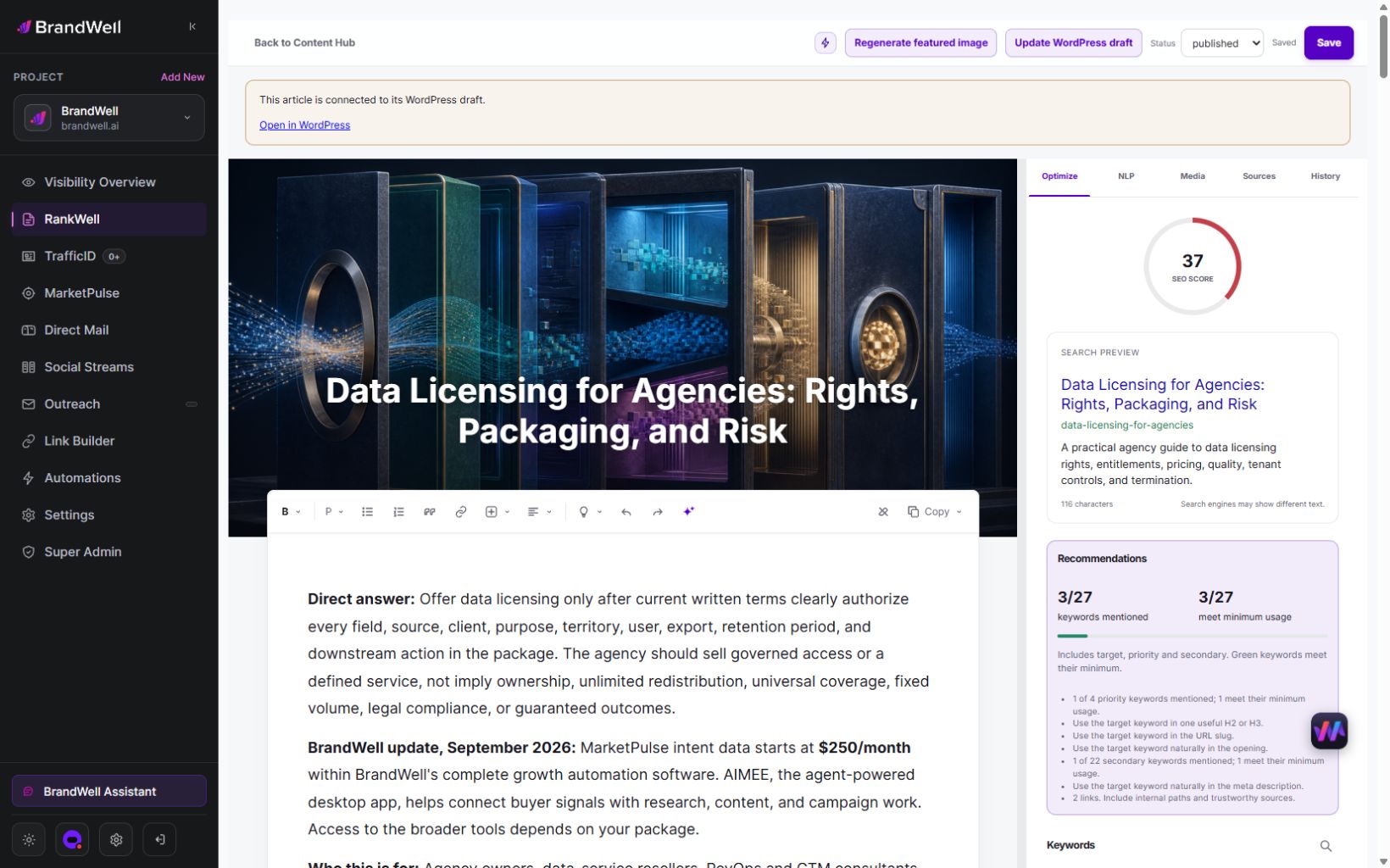
Keep the brief, sources, reviewer notes and publication history. Those records explain the work done; they should not be marketed as proof of automatic search-policy compliance.
Measure outcomes without inventing detection signals
Use search and business data to evaluate relevant outcomes. Do not label a bounce-rate change or a ranking decline as proof Google identified AI authorship. Check what else changed in the site, traffic and query mix.
In a hypothetical example, a guide receives 900 impressions and nine clicks before revision, then 1,000 impressions and 15 clicks afterward. CTR changes from 1% to 1.5%. That is an observation worth investigating, not evidence of a detector score or proof that a single edit caused the improvement.
Common questions
Is AI-assisted content automatically prohibited?
Google’s guidance does not impose a blanket prohibition. Review the actual content and purpose against the relevant policies.
Can I guarantee a draft will rank after editing?
No. Editorial corrections improve the work you control, while search outcomes require subsequent observation.
What should the team prioritize?
Useful answers, supported claims, truthful attribution, current product information and an accountable publishing decision.
Reviewed and updated October 3, 2026.

Written by
Jeff Joyce has been helping brands grow online since the Myspace era, when custom HTML layouts were still a competitive advantage. What started in design quickly evolved into a career spanning social media, content strategy, video, agency ownership, and growth marketing. After building his own agency and testing countless AI tools, Jeff joined BrandWell with a clear focus: helping marketers understand how AI can actually improve the way they create, optimize, and scale content. Today, Jeff brings a CMO-level perspective to BrandWell's marketing strategy, blending brand positioning, content, video, customer education, and growth. His work centers on turning complex AI concepts into clear, practical marketing that helps brands move faster, create better content, and stay competitive without losing their voice.
 Farnaz Kia