On this page
- Who is this for?
- Separate research, hypotheses and confirmed facts
- A seven-step signal-informed Challenger workflow
- Tool classes, templates, and operating-model alternatives
- Pricing, cost, and total budget
- Measure review, confirmation and actual outcomes
- Mistakes, data-quality failures, and privacy controls
- Define an agency service and its boundaries
- Prepare a bounded research brief with AIMEE
- Challenger intent workflow checklist
- A fictional signal-to-outcome review
- Prepare topic research in MarketPulse
Use buyer-intent research to prepare a Challenger-style conversation, then validate the hypothesis with the buyer. A topic match can inform research priorities; it cannot establish a named person’s problem, budget, commitment or consent.
The methodology owner describes Challenger through teaching a perspective, tailoring it to the customer and guiding the buying conversation, with constructive tension. The seven-step workflow below is our proposed application of intent research, not official training, certification or evidence of improved sales results.
Keep recorded research separate from seller inference and buyer-confirmed facts. Use the actual source and resolution method to state what the signal supports rather than classifying every source as equally certain or probabilistic.
Who is this for?
This challenger sales with buyer intent data framework fits B2B sales, enablement, RevOps, and agency teams selling a meaningful change: a complex service, a new operating model, a cross-functional platform, or another considered purchase. It is strongest when the team already has an ICP, a defined sales process, trained managers, useful customer evidence, and CRM outcomes that can be joined back to signals.
Good use cases include prioritizing account research, selecting a relevant commercial insight, preparing stakeholder-specific discovery, re-engaging an account when a fresh topic appears, and reviewing whether a stalled opportunity needs a new point of view.
Do not buy or expand an intent program merely because the team wants more activity. It is a poor fit when the offer has no credible insight, reps cannot explain the source or limits of a signal, CRM dispositions are missing, outreach controls are weak, or managers will treat a score as proof. Methodology training should come first if sellers cannot yet Teach, Tailor, or Take Control without a signal feed.
Separate research, hypotheses and confirmed facts
Use the following author-proposed evidence categories in an account brief. They are documentation states, not calibrated probabilities or official Challenger certification criteria.
- Observed signal: A topic, website event, form activity, or other event was recorded under a defined source and unit.
- Matched context: The account or person match passed stated identity and firmographic checks, with conflicts preserved.
- Seller hypothesis: A human or agent proposed a possible problem, stakeholder, teaching angle, or next question. This is inference.
- Buyer-confirmed fact: A buyer confirmed the situation, consequence, priority, role, milestone, or decision process in a recorded interaction.
Do not silently promote evidence up the ladder. An account-level research surge does not establish who researched. A matched contact does not establish need. A pricing-page visit does not establish budget. Repeated activity does not establish a critical event. This distinction is the foundation for challenger sales with buyer intent data signal quality and measurement.
A seven-step signal-informed Challenger workflow
1. Set the readiness and acceptance rules
Define the accounts and events worth reviewing before data arrives. Include ICP fit, topic specificity, source, analysis unit, freshness window, identity-confidence floor, exclusions, permitted uses, and the maximum review queue each rep can work.
A signal should enter the queue only if the team can state why it may change a decision. “High intent” is not an acceptance rule. “A fitting account showed repeated, recent research on an implementation problem we can credibly teach about” is closer. RevOps owns the definition; sales leadership owns capacity; privacy and legal reviewers approve permitted uses.
2. Create a signal record that survives scrutiny
For each accepted event, record the account, optional person match, signal source, exact topic or behavior, first and most recent observation, frequency, confidence, known conflicts, active opportunity state, customer status, suppression state, and expiry. Preserve whether the evidence is account-level or person-level.
Freshness should influence priority, not truth. A recent signal may deserve faster review, but it remains a signal. Expire it rather than allowing old activity to follow an account indefinitely.
3. Build a research brief, not a surveillance script
Combine the signal with public company facts, relevant role context, previous first-party interactions, and the team’s verified customer evidence. Then write three short fields:
- Observed: What the systems actually recorded.
- Hypothesis: What may be happening and why it matters.
- Unknown: What only a buyer can confirm.
The brief should omit needlessly sensitive detail. It should never say, “We saw you researching…” unless the source, disclosure, context, channel rules, and human review make that appropriate. Most sellers can use the evidence without revealing it: lead with a useful perspective on the business issue, not a claim about the person’s browsing.
4. Develop a teaching angle with an evidence test
A Challenger teaching angle must be more than a topic match. State the familiar approach, the overlooked cost or risk, the new way to think, and the evidence supporting that reframe. Then run three tests:
- Is the insight true beyond this account?
- Is the evidence current, attributable, and safe to use?
- Does the new perspective lead naturally to a capability the buyer may need, without forcing the seller’s product into the conclusion?
If the team lacks evidence, downgrade the output to a discovery hypothesis. Never let an agent invent a benchmark, customer result, or market fact to make the reframe sound stronger.
5. Tailor by role without pretending to know the person
Use role and account context to select likely questions, proof, and language. Finance may care about exposure and payback; operations may care about capacity and failure modes; an executive sponsor may care about strategic consequences. These are preparation paths, not personality predictions.
The seller should open with a relevant observation about the category or operating pattern, invite correction, and ask a neutral question. For example: “Teams adding this workflow often find that the handoff, not the data, becomes the bottleneck. Is that relevant in your environment, or is the constraint somewhere else?” The buyer can reject the premise without friction.
6. Take control with buyer-confirmed next steps
Use the signal to prepare the conversation, but use buyer dialogue to control the sale. Confirm the problem, consequence, stakeholders, decision path, and useful next action. Record who agreed to what and when. If the buyer does not confirm relevance, close or downgrade the signal rather than increasing pressure.
Do not manufacture deadlines, urgency or buyer commitments. Invite correction, respect the buyer’s stated preferences and stop when appropriate. These are operating boundaries for this proposed workflow, not a claim that a signal establishes a sale.
7. Feed outcomes back into the signal policy
After review, capture accepted, rejected, no-contact, wrong account, wrong person, stale, duplicate, already customer, active opportunity, meeting, qualified opportunity, loss, and won outcomes. Compare cohorts by source, topic, recency, fit, confidence, and action.
The feedback loop should improve acceptance and routing rules – not merely inflate the score. If sellers reject most signals for the same reason, fix the upstream definition. If a topic creates meetings but no qualified pipeline, review the teaching angle and fit. If the team cannot trace an outcome back to the signal version and human action, do not claim the program caused it.
Tool classes, templates, and operating-model alternatives
Choose tools by the evidence and controls needed: source, identity unit, freshness, missing fields, export, actual integration support, suppression, access, outcomes and corrections. The following categories serve different jobs:
- Intent and identity data: supplies research evidence and associations under a defined method. Limitation: a topic or contact association does not establish a person’s need or permission to contact them.
- CRM and RevOps automation: Routes records, logs dispositions, and joins outcomes. Limitation: automation scales bad rules as efficiently as good ones.
- Enablement and methodology resources: Teaches Challenger behaviors, reinforces coaching, and supplies approved insight assets. Limitation: training disconnected from live work can decay; data disconnected from training can encourage misuse.
- Account-research and AI workspaces: Drafts briefs, hypotheses, and questions. Limitation: generated text requires source checks and human approval.
- Agency or expert services: Designs and runs the workflow for clients. Limitation: the client still owns lawful-use decisions, seller behavior, and final outreach.
- Spreadsheet templates: Useful for a bounded pilot with fields for observed, inferred, confirmed, confidence, owner, and outcome. Limitation: manual systems require strict access, version, and deletion controls.
For a challenger sales with buyer intent data comparison, do not frame software, training, agency, and in-house work as interchangeable. Training builds capability. Data adds evidence. Operations connect evidence to action. An agency can supply capacity. A mature program often combines them, while a small team may begin with training plus a tightly controlled manual pilot.
Pricing, cost, and total budget
There is no universal challenger sales with buyer intent data pricing benchmark. Build total cost from separate lines: methodology licensing or training, intent and identity data, enrichment, CRM or warehouse work, enablement content, integration, analyst and rep review time, privacy and legal review, agency services, and ongoing coaching. Media and outreach infrastructure belong in separate lines so the data fee does not masquerade as the whole program cost.
A pilot budget should also include the cost of doing nothing and the cost of a false positive: wasted rep time, irrelevant contact, brand damage, or a privacy incident. Choose the smallest scope that can produce enough reviewed outcomes to change a decision.
Measure review, confirmation and actual outcomes
Challenger sales with buyer intent data ROI should be evaluated as a chain, not one attribution number. Track:
- Eligible signals, accepted signals, expiry, duplicates, and suppression rate.
- Match coverage, confidence, conflict rate, and wrong-person or wrong-account dispositions.
- Time to human review, action rate, and seller acceptance.
- Conversations, meetings accepted, buyer-confirmed problems, and agreed next steps.
- Qualified opportunities, stage progression, cycle time, pipeline, and revenue when mature.
- Opt-outs, complaints, negative replies, data incidents, and manual cleanup.
- Full program cost, cost per accepted signal, cost per buyer-confirmed problem, and cost per qualified opportunity.
Compare signal-informed and suitable baseline cohorts where feasible. Preserve denominators and maturation windows. A descriptive difference is not incremental lift. Challenger sales with buyer intent data KPIs should show where value appeared and where uncertainty remains.
Set stop-or-expand rules before the pilot. Stop or redesign when data provenance cannot be established, seller rejection stays high, privacy controls fail, the sample cannot support the decision, or outcomes never progress beyond activity. Expand only when accepted-signal quality, buyer experience, qualified pipeline, operational capacity, and economics improve together.
Mistakes, data-quality failures, and privacy controls
The biggest challenger sales with buyer intent data mistakes are treating a topic as a diagnosis, treating an account signal as a named person’s action, exposing private-feeling evidence in outreach, skipping customers or open opportunities, and using an agent to send unapproved messages.
Record source, freshness, supported identity, permitted action, retention and suppression. Review exceptions and give access only to the roles that need it. Do not hide a disputed association inside an unreviewable score.
ICO’s B2B marketing guidance explains that identifiable business-contact data can remain personal data and public availability does not remove obligations. The guidance is under review following UK legislative changes. Review the actual jurisdictions, sources and channels before activation.
Define an agency service and its boundaries
An agency can sell a recurring challenger sales with buyer intent data service without pretending to provide Challenger certification. A practical package includes topic and ICP design, signal ingestion, identity and fit checks, a weekly research queue, hypothesis briefs, approved teaching-angle templates, CRM routing, seller feedback, governance, and a monthly signal-to-pipeline review.
Use a research product for the evidence it provides and verify any additional workflow requirement. A proposed agency service does not imply native branded reporting, methodology licensing, automatic enrichment or a verified buyer diagnosis.
A client report should separate observed research, seller hypotheses, buyer confirmations, outcomes, errors and policy changes. State the service scope and responsibility for training, outreach and measurement; do not promise renewal from activity alone.
Prepare a bounded research brief with AIMEE
Give the agent a bounded job:
- Read only the approved signal record, ICP rules, exclusions, verified evidence library, CRM context, and permitted-use policy.
- Output four labeled blocks: Observed, Possible hypotheses, Unknowns to validate, and Recommended research.
- Draft two neutral discovery questions and one teaching-angle candidate with its source and limitation.
- Flag identity conflicts, stale signals, active customers, open opportunities, opt-outs, missing provenance, and unsupported claims.
- Do not send outreach, change CRM stages, update suppressions, or reveal browsing details.
- Route the packet to the named seller or manager for approval, then record the approved action and later disposition.
AIMEE can help prepare research and tasks through configured tools and access. Specify the authorized scope and review owners. Tool access does not make the output a buyer-confirmed fact or authorize unapproved outreach.
Challenger intent workflow checklist
Before launch, confirm:
- ICP, accepted signals, analysis unit, freshness, confidence, expiry, and exclusions.
- Challenger training ownership and approved teaching evidence.
- Separate observed, inferred, and buyer-confirmed fields.
- CRM routing, queue capacity, review SLA, and disposition taxonomy.
- Privacy notice, permitted uses, contracts, access, retention, deletion, and suppression.
- Baseline, maturation window, costs, KPIs, and stop-or-expand rules.
- Human approval for every consequential action.
- Current BrandWell package, pricing, data scope, and evaluation terms if included.
The goal is not to make a signal sound certain. It is to help a prepared seller bring a more relevant perspective, validate it with the buyer, and learn from the outcome.
A fictional signal-to-outcome review
Suppose a hypothetical program reviews 120 signals, accepts 60 for research, records 20 buyer-confirmed problems and eventually creates six defined opportunities. Acceptance is 60/120, or 50%; confirmed problems are 20/60, or about 33% of accepted records; opportunities are six of the original 120, or 5%.
If the fully counted program costs $2,000, the observed cost per opportunity is about $333.33. This is hypothetical arithmetic, not a BrandWell benchmark, customer-acquisition cost, ROAS or causal lift. Confirm the denominator and mature outcome window before comparing it with another cohort.
Preserve rejected and unresolved records. A meeting with no confirmed problem is not the same as a qualified opportunity, and an opportunity already in progress should not be counted as created by the research.
Prepare topic research in MarketPulse
MarketPulse provides topic research with standard plans starting at $500/mo. Growth includes three topics with daily pulls; Scale includes ten topics with daily pulls. Available fields and audiences vary, and audiences can overlap.
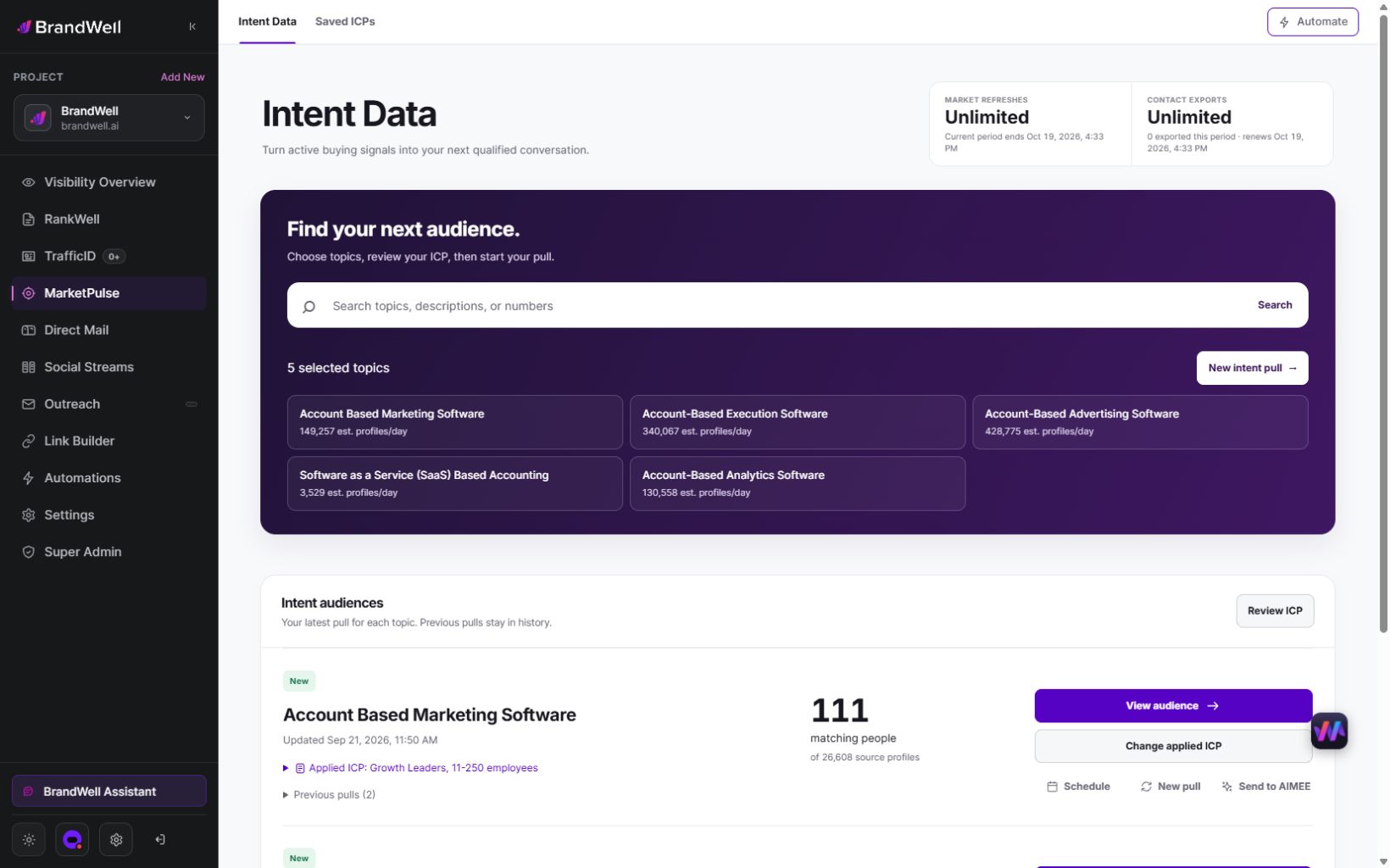
Select a relevant topic and apply your ICP. Review the available evidence, then use AIMEE through configured tools to prepare a sourced brief and questions. Verify the source, unknowns and permitted next action before taking the research into a conversation.
Watch the MarketPulse demo and review plans or browse BrandWell’s current products.
Reviewed and updated October 3, 2026.

Written by