Short answer: Choose B2B buyer intent topics from the decisions buyers make, not from the largest keyword list a provider can monitor. Start with narrow problems, categories, competitors, integrations, and solution approaches; add synonyms and exclusions; test each topic against a fit-only baseline; and keep only topics that produce enough fresh, qualified, actionable evidence to change a revenue decision.

Who is this for? B2B teams and agencies seeking offsite in-market evidence without flooding marketing and sales with broad, ambiguous topic surges.

A topic is not a keyword bid and a topic surge is not a buying declaration. Topic and identity signals remain probabilistic, not proof that a person is buying. Providers may use different content taxonomies, publisher networks, baselines, thresholds, time windows, and account-resolution methods. The operating task is to create a documented hypothesis that can survive those differences: “Research on this concept, by this type of account, within this window, is useful for this action.” Consequential outreach, spend, CRM overwrites, and public posting require human approval.

Choose intent topics from buyer jobs and decisions

Begin with the buyer’s change, not your product name. Interview sales, customer success, implementation, customers, and lost prospects to identify the jobs that precede a purchase:

  • Problem recognition: symptoms, risks, operational constraints, and trigger events.
  • Category learning: the solution category and adjacent approaches a buyer may investigate.
  • Requirements: capabilities, standards, integrations, deployment models, and security concerns.
  • Evaluation: vendor names, alternatives, comparisons, migration, and total-cost questions.
  • Implementation: adoption, workflow, governance, measurement, and change-management topics.

For every proposed topic, write the buyer decision it represents, at least two plausible non-buying explanations, the target account profile, the source’s observable unit, a freshness hypothesis, the proposed action, and the outcome that would justify keeping it. Reject topics that are merely popular, too broad to distinguish your category, or impossible for the team to act on.

A useful starting portfolio has three layers: a small core of precise category and problem topics; a challenger set of competitor, integration, and requirement topics; and an exclusion set that catches recruiting, education, consumer, news, investor, support, and unrelated meanings. Expansion should be earned through evidence rather than added to increase volume.

Build the taxonomy, synonym, exclusion, and ownership workflow

This intent topic selection implementation guide creates a maintained system:

  1. Define the market and decision. Record ICP, geography, buying roles, offer, sales motion, outcome, and activation owner.
  2. Collect buyer language. Use calls, win/loss notes, search-console terms, implementation questions, competitor comparisons, support themes, and subject-matter interviews.
  3. Create topic families. Group problem, category, capability, competitor, integration, compliance, use-case, and implementation concepts.
  4. Add synonyms and boundaries. Include acronyms, legacy names, adjacent phrases, and semantic variants; define meanings that should not count.
  5. Inspect provider definitions. Verify which topics exist, how custom topics work, what underlying content is included, the baseline, threshold, lookback, account level, and update cadence.
  6. Run a bounded test. Freeze the topic set, ICP, observation window, and action before looking at outcomes.
  7. Label records. Mark true relevance, ambiguous relevance, wrong market, stale evidence, duplicate, and operationally unusable.
  8. Compare against fit-only. Examine precision, coverage, acceptance, activation, qualified outcomes, and incremental evidence where feasible.
  9. Keep, revise, split, merge, or retire. Record the decision and evidence in a versioned change log.

The intent topic selection operational checklist should name an owner for taxonomy, provider configuration, source rights, routing, measurement, and privacy review. Useful intent topic selection templates include a buyer-decision map, topic dictionary, synonym and negative-topic list, provider-translation sheet, labeling guide, baseline test plan, outcome scorecard, and change log.

One implementation example is a broad “automation” topic. Split it into the specific job, platform category, integration pair, or operational constraint the buyer researches. Exclude industrial, home, testing, or unrelated workflow meanings as appropriate. The correct split depends on the provider’s taxonomy and observed sample, not just the wording.

Seven tools and templates for topic discovery and testing

These intent topic selection best practices use the same criteria: input, output, best fit, and limitation. The “tools” are reusable operating resources rather than a vendor ranking.

1. Buyer-job interview guide

Input: interviews with buyers and revenue teams about triggers, alternatives, requirements, and implementation. Output: decision language in the buyer’s words. Best fit: new or changing categories. Limitation: recalled language can differ from actual research behavior and interview samples can overrepresent recent deals.

2. Query and content-mining worksheet

Input: owned-search queries, site search, sales-call themes, support questions, community language, and public category documents. Output: a deduplicated candidate set with evidence source. Best fit: teams with useful first-party language. Limitation: owned data reflects people who already found the brand and may miss offsite discovery.

3. Buyer-decision topic map

Input: candidate concepts organized by problem, category, requirement, competitor, integration, and implementation. Output: a visual taxonomy tied to a decision stage and action. Best fit: cross-functional alignment. Limitation: a tidy map can create false confidence if provider coverage and real-world ambiguity are not tested.

4. Synonym and negative-topic dictionary

Input: acronyms, variants, homonyms, adjacent categories, consumer meanings, recruiting terms, and support language. Output: inclusion, exclusion, and manual-review rules. Best fit: ambiguous categories. Limitation: not every provider exposes Boolean controls or the underlying page/query needed to apply exclusions.

5. Provider translation sheet

Input: the internal taxonomy plus each source’s official topic catalog, custom-topic process, thresholds, cadence, and signal definition. Output: exact, approximate, unavailable, or needs-validation mappings. Best fit: multi-source or vendor-selection work. Limitation: identical topic labels can still represent different publisher coverage and scoring logic.

6. Labeled baseline test

Input: a frozen topic portfolio, ICP, fit-only comparison cohort, observation window, and review rubric. Output: precision, noise, coverage, actionability, and outcome evidence by topic family. Best fit: teams with enough account volume and analyst capacity. Limitation: small samples and observational differences can make apparent winners unstable.

7. Versioned topic scorecard

Input: quality, activation, outcome, cost, complaint, and drift evidence over repeated windows. Output: keep, modify, expand, reduce, or retire decisions with an owner. Best fit: recurring programs and agencies. Limitation: optimizing only for downstream wins can discard early-stage topics and encode sales-team behavior into the taxonomy.

Topic intent vs. website engagement and firmographic targeting

An intent topic selection comparison should keep the observation unit visible:

  • Offsite topic intent can identify research beyond the brand’s site. It expands timing evidence but depends on network coverage, taxonomy, baselines, and account resolution.
  • Website engagement is directly observed by the brand and can preserve page-level context. It occurs later in discovery and can include customers, candidates, and accidental traffic.
  • Firmographic targeting establishes who fits without claiming current research. It is explainable and stable, making it a strong baseline, but it does not solve timing.
  • Review-site activity can provide category and competitive context. Coverage is limited to the marketplace and usually does not identify the researcher.
  • Direct hand raises are strong first-party evidence. They arrive at lower volume and after the buyer chooses to identify themselves.

The best intent topic selection alternatives can be combined. Start with firmographic fit, add owned engagement, then test narrow offsite topics where earlier evidence would change a decision. Do not license topic data merely because first-party traffic is limited; contextual advertising, qualitative research, or better positioning may solve the actual problem with less operational risk.

Budget for taxonomy access, custom topics, testing, and operations

Intent topic selection pricing may be embedded in an intent-data platform, based on topic count, usage, accounts, seats, exports, delivery method, custom-topic work, geography, or a larger ABM package. Compare only quotes that specify the same topic rights, underlying signal definition, history, cadence, fields, support, activation rights, and term.

Intent topic selection cost also includes discovery interviews, taxonomy design, custom-topic setup, integration, labeling, analyst review, sales enablement, privacy and security review, reporting, and false-positive remediation. Model cost per available topic, monitored account, delivered signal, accepted signal, activated account, qualified outcome, and incremental outcome. A less expensive feed can cost more if broad topics create manual review and wasted action.

Verify a provider’s current public pricing or request a scoped written quote. Topic protection must be treated separately: if available, it should be defined in writing by exact topic, market, geography, term, conflict rules, and remedy. It is not universal exclusivity.

Measure precision, noise, coverage, activation, and pipeline

Intent topic selection KPIs should reveal whether the taxonomy improves decisions:

  • Precision: relevant accepted records divided by reviewed records for a topic or topic family.
  • Noise: wrong-market, ambiguous, stale, duplicate, or non-actionable records divided by reviewed records.
  • Coverage: qualified target accounts observed, with the source network and time window stated.
  • Operations: latency, owner acceptance, time to action, expiry, suppression, and exception rate.
  • Activation: eligible audience, reached accounts, completed research briefs, sales acceptance, and coordinated plays.
  • Outcomes: qualified responses, opportunities, progression, wins, time to outcome, and incremental evidence.

Intent topic selection ROI should use full cost and a fit-equivalent comparison. Report whether the result is descriptive, associated, attributed, or experimentally incremental. Avoid universal intent topic selection benchmarks: precision and coverage depend on category language, provider network, baseline, thresholds, ICP, buying cycle, reviewer rules, and action quality. The durable benchmark is the team’s prior frozen topic version and fit-only baseline.

Who benefits from topic intent – and when simpler signals are better

Intent topic selection for B2B teams seeking off-site in-market evidence works best when the category has distinctive research language, average account value can fund the data and workflow, a clear ICP reduces noise, owners can act within the freshness window, and CRM outcomes can be returned. It is useful for account prioritization, competitive plays, market-entry research, content planning, paid-media cohorts, opportunity support, and recurring agency reports.

Use simpler signals when the topic language is generic, the addressable market is tiny, provider coverage cannot be inspected, the team lacks a qualified action, or firmographic fit and first-party engagement already answer the decision. A small set of named accounts plus good account research can outperform a large topic portfolio with ambiguous evidence.

Combine topics with fit, identity, freshness, activation, and outcomes

A durable intent topic selection strategy treats topic research as one input. The intent topic selection framework records the source, topic version, observable unit, baseline and threshold, event and delivery time, account match and confidence, fit decision, identity level, permitted use, action, owner, expiry, and outcome.

For intent topic selection use cases, map the strength of the evidence to the action:

  • Broad problem topic plus fit: monitor or adjust educational content; do not infer a buying project.
  • Narrow category topic plus repeated evidence: prioritize account research or a qualified media cohort.
  • Competitor topic plus owned engagement: prepare a comparison brief and let an owner decide the response.
  • Integration or implementation topic plus open opportunity: alert the opportunity team with the evidence and its limitations.

Intent topic selection activation workflows improve when every record carries a reason code and expiry. Intent topic selection signal quality and measurement should remain separate: a reliable delivery is not necessarily relevant; a relevant account is not necessarily reachable; a reached account is not necessarily influenced; and attributed pipeline is not automatically incremental.

Use this as an intent topic selection decision guide: keep a topic only when it is explainable, distinguishable, sufficiently covered, fresh, qualified, lawful to use, operationally actionable, and valuable under the chosen measurement method. The corresponding planning guide should show assumptions and limitations. Intent topic selection examples without source definitions and denominators are anecdotes, not benchmarks.

Avoid broad-topic noise, false positives, and privacy mistakes

Common intent topic selection mistakes include selecting product features instead of buyer jobs, copying paid-search keywords into a provider taxonomy, monitoring ambiguous one-word concepts, failing to use exclusions, combining provider scores as if they share a scale, ignoring delivery latency, and expanding before validating the core set.

Also avoid resolving an account topic to a named person without evidence, contacting appended roles as though they researched, retaining data beyond contract scope, using sensitive topics, sharing records across agency clients, and changing outreach or spend without approval. Review source contracts, collection context, permitted uses, retention, deletion, regional coverage, and data-subject handling with privacy and legal specialists.

Control noise with topic-specific sampling, two-person labels for ambiguous records, fit gates, negative-account lists, confidence tiers, short expiry, a manual-review queue, and a versioned rollback. If a provider cannot explain the signal definition or supply a reviewable sample, mark the topic unavailable rather than inventing precision.

Package topic selection and monitoring as a managed agency service

Intent topic selection services can become a recurring agency offer with discovery, taxonomy design, source mapping, pilot configuration, weekly monitoring, signal validation, approved activation recommendations, monthly evidence reporting, and periodic recalibration. Scope the number of topic families, accounts, sources, markets, integrations, service levels, analyst review, client approvals, and reporting. The agency should control its client billing and retail packaging.

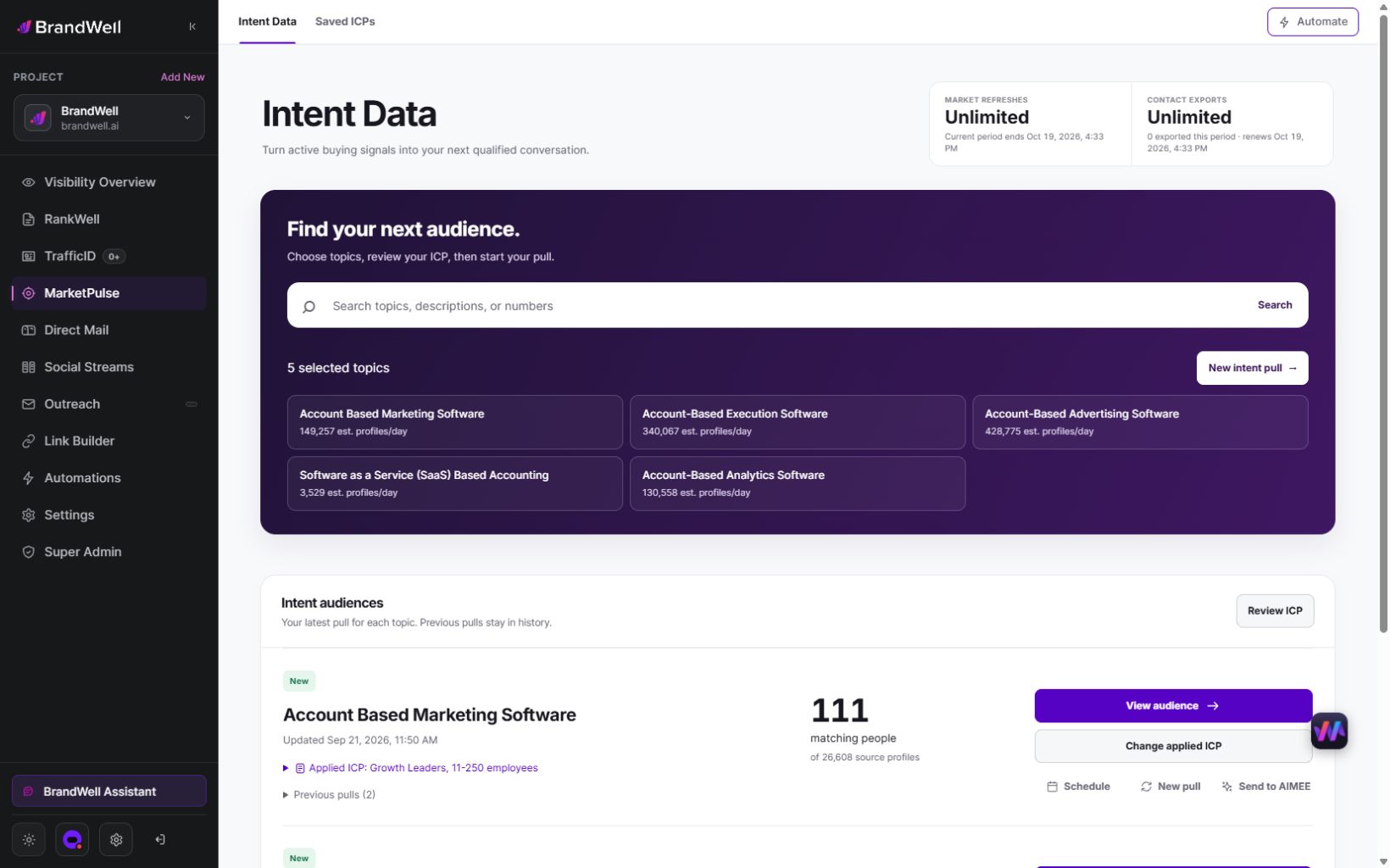
BrandWell is being developed as a separate white-label agency-reseller intent-data offer built on LeadFuze infrastructure, distinct from the legacy SEO writer. Subject to current product and legal review, its intended differentiator is a complete white-label sales-and-delivery engine for agencies, with branded delivery, service modules, agency-controlled client billing, and agent-ready operating instructions. BrandWell agency plans range from $2,500 to $5,000 per month, depending on topic count, term, and available contractually scoped topic exclusivity. The current written quote and Order Form control. Agencies can purchase a $70 seven-day reseller pilot that includes agency-branded topic reports and the complete sales playbook, subject to the current written pilot terms. Before operational use, complete product, pricing, privacy, security, compliance, legal, and platform-policy review.

For an intent topic selection agency guide, BrandWell may fit agencies that want a branded delivery engine, recurring reports, service modules, and agent-ready operating instructions. It is not a universal fit: a buyer needing only a raw production API or a topic unavailable in the validated source should choose another operating model. LeadFuze’s public intent page should be treated as Coming Soon; its enrichment APIs do not independently establish a production topic-intent endpoint.

Agent-ready operating instructions:

  1. Provide Claude or ChatGPT the buyer-decision map, candidate topics, provider definitions, synonym/exclusion rules, sample records, ICP, and outcome labels.
  2. Ask it to propose keep, split, merge, exclude, or manual-review decisions with a reason and cited input; prohibit invented provider coverage.
  3. Have a human taxonomy owner approve every production change and consequential activation rule.
  4. Optionally execute approved browser configuration through the separate Moxby product, preserving screenshots, version numbers, and rollback instructions.

A small, maintained taxonomy that changes real decisions is more valuable than hundreds of topics that merely produce activity.

The paid reseller pilot at a glance

The $70 BrandWell reseller pilot gives an agency seven days to test the commercial play. BrandWell generates topic reports in the agency’s brand and provides the full sales playbook for taking the service to market and seeking client commitments before full-plan signup.

This helps the agency validate demand and determine whether expected commitments can cover its costs and support a profit center. It is a validation process, not a promise of commitments or profit. Review the $70 seven-day reseller pilot.