On this page
- Treat stage labels as hypotheses
- Define evidence and action owners
- Create a falsifiable offer test
- Use current research for the decision
- Budget the whole offer program
- Measure downstream quality
- Check test prerequisites and errors
- Keep a challengeable offer worksheet
- Scope separate agency delivery
- Four offer tests to build around the research
- Copyable offer-test record
- Frequently asked offer questions
Choose a B2B offer as a testable hypothesis from actual evidence, account fit, current relationship and permitted use. Research does not establish a named person’s stage or readiness. Compare an offer against a defined control using qualified outcomes, costs and missing feedback.
Who this is for: creative strategists, paid-media directors, conversion-rate optimization leads, demand-generation teams, and agency owners designing offer selection by intent signal. This is an operational offer-testing guide, not a generic personalization or scoring article.
Current MarketPulse offer: intent-data plans start at $500/mo. See the product, demo, and current plans. Updated October 3, 2026.
Treat stage labels as hypotheses
“Awareness,” “consideration,” and “decision” are useful planning shorthand, but an intent vendor cannot observe a buyer’s internal stage directly. A topic surge can reflect research, a student, a competitor, a consultant, or a project unrelated to your offer. A product-page visit can be a customer looking for support. A job change can create relevance without demand. Treat every signal as evidence with alternatives.
Classify five dimensions: source type, topic specificity, recency, account fit, and identity confidence. Add negative evidence such as existing customer status, open support issue, competitor domain, student email, non-target geography, suppression, or recently rejected opportunity. The result is not a stage label; it is an offer eligibility decision.
Test educational proof, assessments, calculators, consultations, workshops, trials or demos against the actual problem and relationship. Evidence strength alone does not establish the best offer. Keep the current default or a manually selected offer as the control; no gated offer can also be a valid choice.
Define evidence and action owners
- Record source, observed behavior, topic, recency, account, person candidate if any, confidence, eligible use, and suppressions.
- Map the signal to a problem hypothesis, not a claim about the buyer. Write at least one plausible alternative explanation.
- Check ICP fit, relationship, current customer state, active opportunity, region, and channel permissions.
- Select one offer class: educational proof, self-assessment, calculator/benchmark, consultation, trial, workshop, or demo.
- Write a message brief that explains why the offer is useful without revealing surveillance or asserting hidden knowledge.
- Assign a control, primary outcome, quality outcome, analysis window, stop rule, and owner.
- Return conversion quality, sales acceptance, opportunity progression, and complaints or opt-outs to the decision rule.
The team needs demand strategy, creative or content, paid or lifecycle operations, RevOps, sales feedback, and privacy/platform review. Integrations can read signals and write audience or CRM fields, but a human should approve a new high-friction offer, a sensitive segment, or a person-level action.
Create a falsifiable offer test
Use a brief with these fields: evidence summary, account fit, competing explanation, selected offer, control offer, message angle, landing path, qualifying event, downstream quality measure, exclusions, approval owner, and rollback. Do not change audience, creative, offer, and landing page simultaneously unless the test is intentionally bundled.
Examples must remain hypotheses. A finance-relevant topic from a target account might receive a cost model rather than an immediate demo. A visitor returning to integration documentation might receive an implementation checklist. Several recent, validated contacts from an active opportunity may justify a tailored workshop coordinated with the account owner. A single anonymous content view should not trigger a sales consultation.
Benchmark offer performance against comparable eligible traffic, not a global website average. A narrower intent segment can produce a higher form rate yet worse pipeline because the audience is tiny or the offer over-qualifies. Preserve both conversion and downstream-quality evidence.
Use current research for the decision
Use current MarketPulse research as an input, then design the actual offer, approval, landing experience and evaluation separately. Verify ICP relevance, permitted purpose, source uncertainty, implementation, full costs and outcome feedback before activation.
Current MarketPulse research workflow
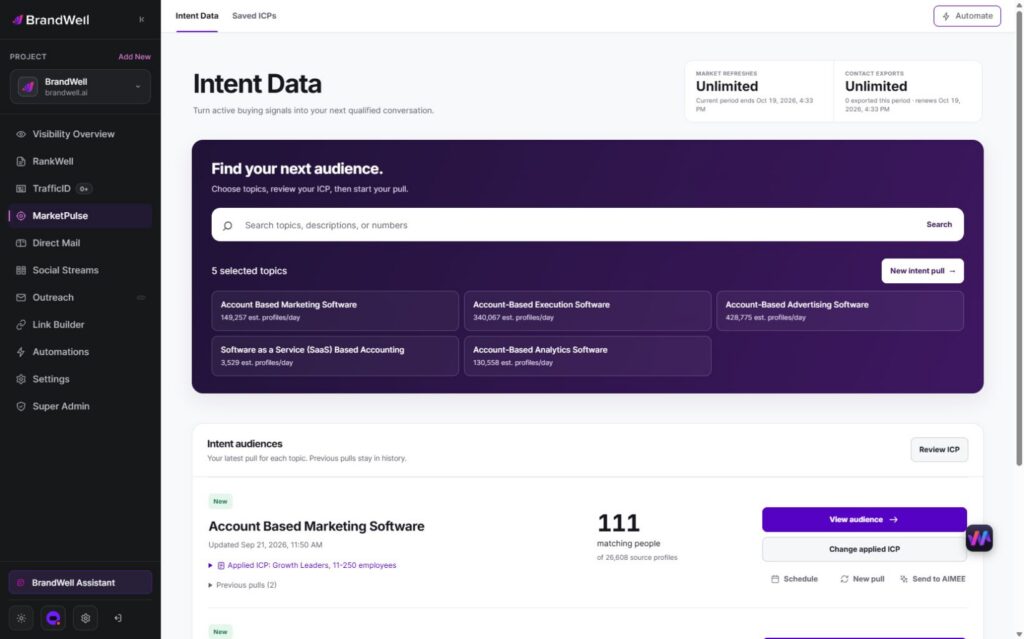
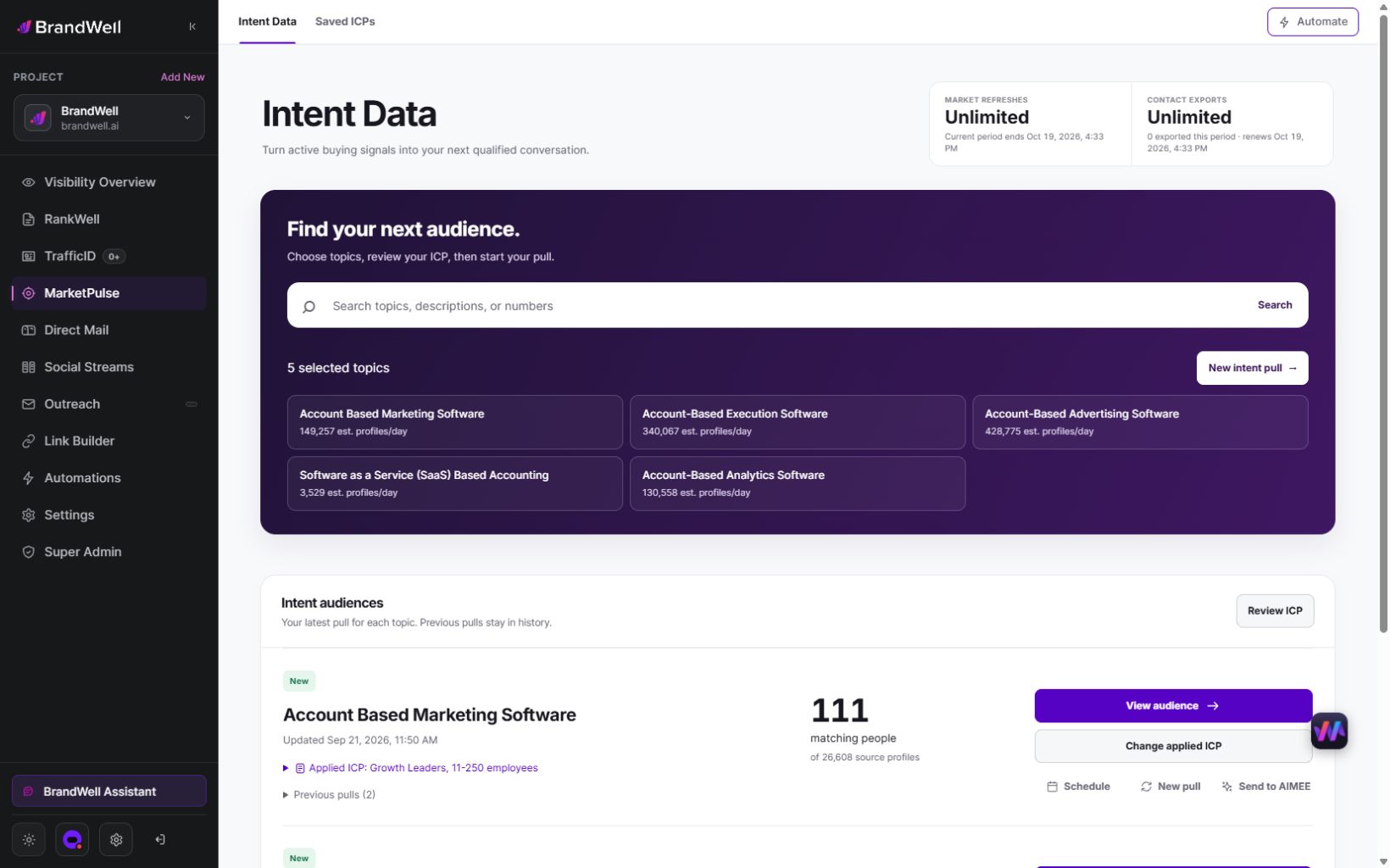
BrandWell MarketPulse: intent data starting at $500/mo. Find people researching topics relevant to what you sell, apply saved ICP filters, and review available contact details before taking action.
| Plan | Topics and refreshes | Monthly exports |
|---|---|---|
| Starter | 1 topic, weekly | 25,000 contacts |
| Growth | 3 topics, daily | 100,000 contacts |
| Scale | 10 topics, daily | Unlimited contacts |
Swipe the table to see all columns.
A pull retrieves available data from the previous 24 hours for one topic. Daily use across all included topics provides 90 Growth pulls or 300 Scale pulls in a 30-day month. Weekly Starter pulls vary by calendar month. Available audience size and contact fields vary, and audiences may overlap. Refreshes stop at the plan limit without overage charges.
- Find and qualify: search the topic catalog, save your ICP, and review the people and companies that match.
- Act on the research: export qualified contacts or prepare an Outreach or Direct Mail workflow. Connected products, channel usage, and fulfillment may cost extra.
- Get help from AIMEE: Growth and Scale include AIMEE for the initial user to research accounts and prepare the next step through connected tools.
Agencies and other service businesses can build client deliverables around their available Intent Scans and exports. Keep each client’s scope, permissions, and service fees clear. A subscription is not a promise of a white-label platform or exclusive access to a market.
Explore MarketPulse and watch the demo or compare plans starting at $500/mo. Any early-access discount is a separate, time-limited offer shown to an eligible recipient.
Budget the whole offer program
Total cost includes signal or platform access, identity/enrichment, integration, creative and content production, landing experiences, media or lifecycle operations, experimentation, analytics, sales feedback, and agency management. Price the same accounts, topics, events, users, experiences, tests, destinations, and term. Treat free or entry plans as configuration examples, not proof they include the required workflow.
For an agency, a recurring offer-selection service can be priced around a fixed number of signal reviews, offer cells, creative briefs, launches, and decision reports. Keep media, production, web development, and paid platform fees separate. Protect margin with a change-control rule for new audiences, channels, or offers.
Measure downstream quality
Leading metrics include eligible audience, match or account-association rate, offer exposure, click or engagement, and valid conversion. Quality metrics include target-account share, qualification, sales acceptance, meeting completion, opportunity creation, stage progression, and disqualification reason. Risk metrics include complaints, opt-outs, policy rejection, and identity corrections. Operational metrics include build time, QA defects, and time to rollback.
The primary analysis compares each intent-informed offer with a control for a defined eligible population. Do not celebrate a higher form rate if qualified opportunity rate falls. Do not use a tiny “hot” segment as proof of a general strategy. Where randomized testing is not feasible, state the limits of before/after or matched comparisons.
Check test prerequisites and errors
This approach fits B2B teams with several useful offers, a defined account market, enough traffic or media volume to compare cells, clean CRM outcomes, and operators who can act on the result. It fits agencies that already manage paid media, CRO, content, lifecycle, or ABM. It is a weak fit when every visitor receives the same demo, there is no reliable outcome data, the identity basis is unclear, or the segment is too small.
Avoid inferring stage from one signal, revealing that a person was monitored, sending a demo to weak evidence, changing audience and offer together without a control, optimizing only to forms, ignoring existing opportunities or customers, and allowing stale signals to persist. Respect suppression, privacy, and platform policy. Stop when match confidence is poor, complaints rise, the offer harms quality, or the outcome cannot be measured.
Keep a challengeable offer worksheet
For every test, write the observed evidence in one sentence without interpretation. Then add the problem hypothesis, alternative explanation, account-fit fields, relationship status, current opportunity state, identity confidence, and expiry. The next block records the proposed offer, why its commitment level is proportionate, the control, the message constraint, the channel, and the person responsible for approval. A final block captures exposure, valid response, qualification, sales acceptance, opportunity result, complaint or correction, and the rule change.
This worksheet prevents the team from rewriting history after a result. If the demo wins, the record shows whether the audience was stronger, the offer was better, or several variables moved together. If an educational proof asset generates fewer forms but more qualified opportunities, the team can protect that insight from a shallow conversion-rate review. If both cells fail, the agency can question the topic, fit, identity, creative, or offer inventory rather than blaming intent data as one undifferentiated input.
Review ten rejected cases as carefully as ten wins. Wrong-person matches, active customers, outdated topics, existing sales conversations, and unclear permission boundaries teach the eligibility model. A mature intent-informed paid-media offer program gets better by narrowing what it will claim and when it will ask for commitment.
Scope separate agency delivery
A practical monthly service includes signal QA, an offer eligibility review, two or three test briefs, approved activation instructions, creative/landing QA, downstream-quality reporting, and one rules update. The client approves offers and claims. Sales supplies acceptance and disqualification. The agency documents the decision and keeps a suppression and exception register.
Start with one topic family and two offers: a useful low-friction asset and the current default. If the team cannot explain why an account qualified for the test and what evidence would reverse the decision, do not scale automation. The goal is a better buyer experience and better qualified pipeline – not a more elaborate surveillance story.
Four offer tests to build around the research
Educational proof against a gated asset
Compare useful ungated guidance with a gated version for the same approved population. State whether the primary outcome is engagement, a valid response or a qualified opportunity. More form submissions do not establish more buying intent.
A problem assessment against the current default
Test whether an assessment clarifies an actual business problem. Document the offer’s output, necessary inputs, reviewer and next action. An inferred topic is not a diagnosis of the company.
A calculator with disclosed assumptions
Show actual input definitions and exclusions. Keep hypothetical savings separate from measured customer results. Collect only the information needed for the approved purpose.
A consultation, workshop or demo
Check fit, relationship, qualification and actual delivery capacity. Publish what the session provides and what it requires. A topic appearance alone does not make a sales conversation appropriate.
Copyable offer-test record
Population: [Actual eligible unit, scope and exclusions.] Evidence: [Source, topic, age, uncertainty and competing explanation.] Offer: [Actual benefit, commitment and delivery.] Control: [Current offer and assignment.] Approval: [Owner, recipient, purpose and channel.] Outcome: [Unique exposure, valid response, qualification and missing feedback.] Decision: [Costs, uncertainty and stop or repair rule.]
Use an actual comparison, not two unrelated campaigns
Google Ads’ custom-experiment guidance describes allocating traffic and budget between original and trial campaigns. Verify current support for your actual campaign. This does not establish that BrandWell supplies offer experimentation or that arbitrary campaigns are randomized.
A higher form rate can hide weaker opportunities
In fictional cells with 1,000 eligible exposed accounts each, A generates 100 forms and five qualified opportunities; B generates 60 forms and eight opportunities. Form rates are 10% and 6%. Opportunity rates are 0.5% and 0.8% of exposed accounts, or 5% and 13.3% of forms. Different denominators answer different questions. These observed counts do not establish significance or causation.
Capacity can reverse the apparent winner
Twenty fictional consultations require 30 minutes of preparation and 30 minutes of delivery each: 20 hours. With 12 qualified delivery hours available, the gap is eight hours. Verify staffing, turnaround, no-shows and actual outcomes before sending more invitations.
Define the cost per qualified result
A fictional cell costs $500 research, $600 creative, $400 landing implementation, $1,000 media and $500 review: $3,000. Five qualified opportunities make the defined cost $600 each; adding $500 correction work makes it $700 each. Eight opportunities at the same original cost would be $375 each. Overhead, tax and financing are excluded; zero opportunities make the ratio undefined. These are invented inputs, not BrandWell prices or benchmarks.
Use current product inputs without assuming custom automation
MarketPulse research is starting at $500/mo. Search a relevant topic, save the approved ICP and review actual matches before preparing an offer brief. AIMEE can organize supplied context through configured tools. Owners approve actual exports, audience uploads, messages and CRM writes. Landing-page personalization, experiments and managed agency delivery require separately verified implementation, rights and fees.
Frequently asked offer questions
Does a topic identify the buyer’s funnel stage?
No. Record alternatives and test the actual offer.
Should the largest form count win?
Compare qualified results, capacity, costs and missing feedback.
Can I change audience and offer together?
A bundled test can evaluate the bundle, but cannot isolate the offer’s effect.
What supports a larger rollout?
Approved use, representative evidence, actual delivery capacity and measurable qualified results.
Review current research: explore MarketPulse and current plans.
Reviewed and updated October 3, 2026.

Written by