On this page
- Current MarketPulse research workflow
- Require actual operating readiness
- Use five qualification stages
- Evaluate six scorecard components
- Compare discovery and bounded pilots
- Model the full service price floor
- Separate readiness from commercial results
- Check actual fit and exclusions
- Trace source through actual outcomes
- Record cost and implementation risks
- Require evidence before recurring delivery
- Copyable client-readiness decision
- Frequently asked readiness questions
Evaluate client readiness before selling an intent-data operating service. Define the reachable market, full delivery costs, allowed actions, owners and follow-up capacity. A promising research sample cannot resolve missing permissions, weak economics or an unowned queue.
For agency owners, growth leads, paid-media directors and GTM consultants evaluating current MarketPulse research and a separately scoped operating service. This scorecard is planning guidance, not a performance promise, legal conclusion or entitlement to a white-label platform.
Current MarketPulse offer: intent-data plans start at $500/mo. See the product, demo, and current plans. Updated October 3, 2026.
Current MarketPulse research workflow
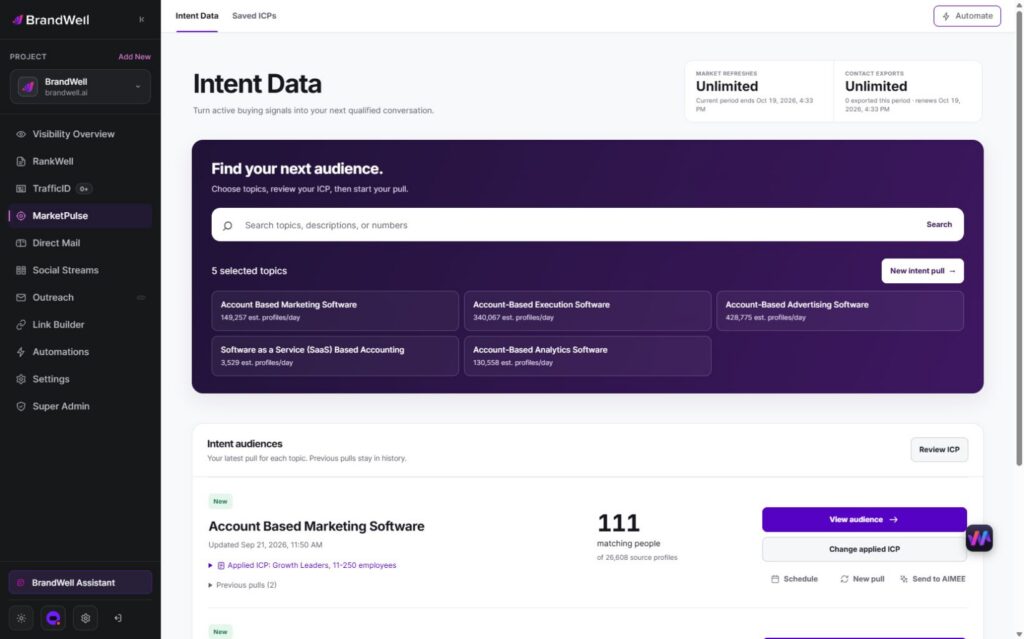
BrandWell MarketPulse: intent data starting at $500/mo. Find people researching topics relevant to what you sell, apply saved ICP filters, and review available contact details before taking action.
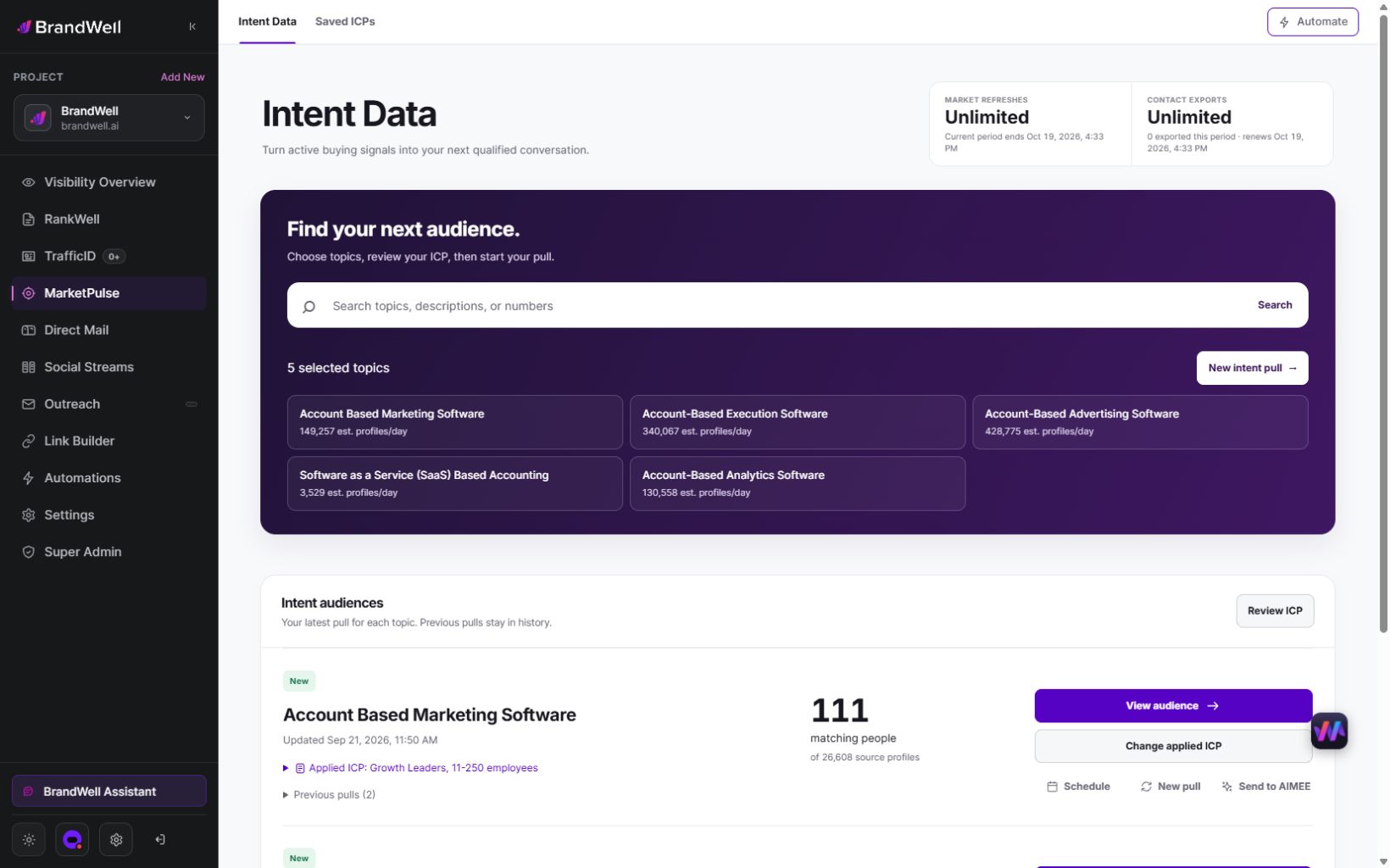
MarketPulse plans are starting at $500/mo. Verify current package scope and offers on the product page.
| Plan | Topics and refreshes | Monthly exports |
|---|---|---|
| Starter | 1 topic, weekly | 25,000 contacts |
| Growth | 3 topics, daily | 100,000 contacts |
| Scale | 10 topics, daily | Unlimited contacts |
Swipe the table to see all columns.
A pull retrieves available data from the previous 24 hours for one topic. Daily use across all included topics provides 90 Growth pulls or 300 Scale pulls in a 30-day month. Weekly Starter pulls vary by calendar month. Available audience size and contact fields vary, and audiences may overlap. Refreshes stop at the plan limit without overage charges.
- Find and qualify: search the topic catalog, save your ICP, and review the people and companies that match.
- Act on the research: export qualified contacts or prepare an Outreach or Direct Mail workflow. Connected products, channel usage, and fulfillment may cost extra.
- Get help from AIMEE: Growth and Scale include AIMEE for the initial user to research accounts and prepare the next step through connected tools.
Agencies and other service businesses can build client deliverables around their available Intent Scans and exports. Keep each client’s scope, permissions, and service fees clear. A subscription is not a promise of a white-label platform or exclusive access to a market.
Explore MarketPulse and watch the demo or compare plans starting at $500/mo. Any early-access discount is a separate, time-limited offer shown to an eligible recipient.
Require actual operating readiness
An agency should approach qualifying clients for intent-data services as a capacity-and-economics decision. “The client wants more leads” is not a qualification standard. A ready client has:
- a defined market with enough relevant companies or people to produce a workable signal pool;
- deal economics that can support data, activation, reporting, and agency labor;
- an agreed ideal-customer profile and exclusions;
- lawful, platform-permitted ways to use each data field;
- an owner for sales or marketing follow-up;
- conversion events that can be measured; and
- realistic expectations about probabilistic signals.
This creates a defined delivery boundary because work begins with a bounded use case rather than a vague promise to “find everyone in market.” Intent is evidence of relevant behavior, not proof that a person will buy, has consented to outreach, or should be identified in a message.
Use three outcomes: qualified, qualified for a limited pilot, or not ready. A high total score must never override a hard stop such as an impermissible use, a sensitive-category restriction, no accountable client owner, or economics that cannot cover delivery.
Use five qualification stages
A repeatable intent data service client qualification checklist needs named inputs, decision rights, and a review cadence.
- Discovery owner gathers inputs. Record ICP, geography, deal value, gross margin, sales cycle, reachable market, monthly media or outbound capacity, CRM state, current conversion volume, privacy notices, desired channels, and response-time capacity.
- Data lead tests feasibility. Map candidate topics, estimate signal availability, inspect sample records, define required fields, test identity and enrichment coverage on a representative sample, and document what cannot be resolved.
- Activation owner checks eligibility. Verify actual source, recipient, purpose, jurisdiction, account, destination rules and approval before action. A research record does not automatically establish first-party customer context, permission to message or eligible audience-upload rights. Hold unresolved checks.
- Commercial owner models the service. Separate subscription costs, setup, media, integrations, QA, strategy, reporting, and contingency. Set a minimum contribution-margin gate and a change-order rule.
- Approvers decide and record conditions. The agency owner approves economics; the client’s business owner approves goals and staffing; privacy, security, legal, and platform-policy reviewers approve data use; and the delivery lead accepts the SLA.
Review fit before contract, after a bounded test, at the first operating review, and before renewal or material scope expansion. Review sooner if matchability, signal volume, data rights, destination policy, or client follow-up changes.
Approval limits: automation may classify, summarize, draft, and route within approved rules. A human should approve new data sources, new purposes, audience uploads, public or direct outreach, suppression overrides, score-threshold changes, and material spend changes.
Evaluate six scorecard components
Score each component from 0 to 3: 0 = missing or unacceptable, 1 = material gap, 2 = workable with conditions, 3 = ready. Use the same evidence standard for every prospect. The score is a discussion tool, not a universal benchmark.
1. Reachable-market sufficiency
Test: Define the ICP, geography, exclusions, topic set, expected refresh cadence, and the minimum usable volume required by each activation channel. Ask for a market-coverage sample before estimating delivery.
Pass evidence: a documented addressable set and enough eligible, matched records for the intended workflow.
Failure mode: broad topics can produce irrelevant records while narrow topics may provide too little usable volume. Measure actual eligible and targetable volume after destination requirements and exclusions. An uploaded row count is not a verified usable audience.
2. Unit economics and budget fit
Test: Model service revenue minus data, integrations, activation labor, reporting, client success, media management, and a rework reserve. Stress-test a lower match rate and slower sales cycle.
Pass evidence: positive contribution margin under the conservative case, with a written owner for overages.
Failure mode: the agency prices from raw-record volume while absorbing strategy, cleaning, support, and campaign work for free.
3. Data readiness and provenance
Test: Inventory first-party records, identifiers, consent or lawful-basis records, suppression lists, CRM duplicates, field definitions, retention rules, and vendor provenance. Test a blinded sample rather than a hand-picked success set.
Pass evidence: a data dictionary, documented source and permitted purpose, stable keys, quality checks, and a deletion/suppression path.
Failure mode: a high match percentage is mistaken for correctness. Verify available provenance, source context, actual purpose, necessary fields, access, retention, correction, deletion and suppression ownership. Missing rights or labels remain unknown; vendor assurance alone does not validate each record.
4. Activation eligibility
Test: Create a field-to-purpose-to-destination matrix. For every route – CRM, ad platform, outbound, nurture, report, or export – name the allowed fields, legal and policy basis, retention, suppression process, and approver.
Pass evidence: at least one valuable activation path is cleared and technically feasible.
Failure mode: the service is sold before discovering that the client cannot upload the audience, use the identifiers, install a tag, or mention the signal in outreach.
5. Follow-up capacity and SLA
Test: Name the queue owner, response window, daily capacity, routing rules, disposition codes, and escalation path. Run a tabletop exercise with sample records.
Pass evidence: the client can act on the expected volume and close the feedback loop.
Failure mode: qualified records age in a spreadsheet while both parties blame signal quality.
6. Evidence and expectation discipline
Test: Define a baseline, eligible population, acceptance criteria, leading indicators, pipeline outcomes, evaluation window, and attribution limits before launch.
Pass evidence: the client accepts that intent is probabilistic and agrees to report accepted, rejected, contacted, meeting, opportunity, and revenue outcomes consistently.
Failure mode: an increase in attributed conversions is presented as incremental impact without a control or suitable experiment.
A prospect with 15–18 points and no hard stop is generally ready for scoped design. Ten to 14 suggests a conditional pilot. Below 10 suggests remediation first. These thresholds are invented planning bands, not validated probabilities or universal readiness standards. Test them against actual delivery history and keep mandatory gates separate.
Compare discovery and bounded pilots
The main alternatives differ in risk, simplicity, and margin protection.
| Approach | Evidence used | Simplicity | Delivery risk | Margin protection | Possible use | Limitation |
|---|---|---|---|---|---|---|
| Conversation-only discovery | Stakeholder answers | High | High | Low | Early lead triage | Optimistic claims go untested |
| Structured readiness scorecard | Documents, samples, approvals, economics | Medium | Medium | High | Standard proposals | Requires cross-functional participation |
| Paid or conditional pilot | Live sample workflow and agreed acceptance test | Lower | Lower after test | Highest when scoped | Uncertain coverage or integration | A poorly designed pilot becomes free production work |
| Decline and prescribe remediation | Gap register and re-entry conditions | Medium | Lowest | Protects future margin | Hard-stop gaps | Delays near-term revenue |
Swipe the table to see all columns.
Choose the review format from the actual unresolved question. Use a bounded pilot only to test a named feasibility gap. State the sample, allowed actions, workload, decision criterion, stop date and conditions for paid delivery.
Model the full service price floor
Pricing assumptions should include five cost pools:
- Data: topic access, records, enrichment, validation, identity services and separately scoped usage costs.
- Build: market mapping, taxonomy, score rules, integrations, dashboards, and QA.
- Activation: audience preparation, media operations, outbound preparation, CRM routing, and suppression handling.
- Governance: privacy, security, legal and platform review, access controls, audit logs, and deletion work.
- Service: strategy, reporting, client success, optimization, and incident or rework reserve.
Use a simple minimum-economics model:
Required monthly fee = (expected monthly delivery cost + risk reserve) / target delivery-cost ratio
Then compare the fee with the client’s contribution margin per won customer and a conservative range of incremental opportunities. Do not backsolve a guaranteed ROI from an assumed close rate.
Separate readiness from commercial results
Keep the measures separate for qualification quality, delivery quality, adoption, and business outcomes:
- Pre-sale quality: percentage of prospects with complete evidence; hard-stop rate; time to decision; pilot-to-service conversion.
- Delivery quality: usable-record rate; duplicate rate; required-field completeness; freshness; match acceptance; suppression success; exception rate.
- Adoption: time from signal to review; percentage routed; percentage acted on within SLA; disposition completeness.
- Revenue quality: accepted opportunities, qualified pipeline per eligible record, win rate by signal cohort, realized contribution margin, retention, and expansion.
- Experiment evidence: change versus a predeclared baseline or comparable control, with sample size and uncertainty disclosed.
Keep the actual assignment, comparator, outcome unit, maturity, missing feedback and uncertainty. A platform-attributed conversion or a selected group with better results does not by itself establish incremental impact.
There is no honest universal benchmark for acceptable intent-signal accuracy, match rate, or ROI. Establish the client’s baseline, sample method, denominator, and rejection reasons, then improve against that disclosed starting point.
Check actual fit and exclusions
Evaluate actual market, deal contribution, necessary roles, approved channels, destination readiness and follow-up capacity. A recurring service also needs verified operating work, reporting and costs. A pilot can test named unknowns; attractive economics alone do not clear missing rights or ownership.
A limited pilot fits a client with attractive economics but one or two testable unknowns, such as topic volume, identity coverage, or destination matchability.
Exclude or remediate clients when:
- the market is too small for the intended channel;
- the product is a low-margin impulse purchase with no credible intent workflow;
- sensitive categories or platform rules make the proposed use unacceptable;
- the client demands claims that reveal private behavior or imply surveillance;
- nobody owns follow-up or feedback;
- the CRM cannot preserve source, suppression, or outcome fields;
- the client requires guaranteed pipeline or revenue; or
- the agency would need to violate its minimum margin or approval policy.
Contract type should follow uncertainty. Use a fixed-scope assessment for diagnosis, a bounded pilot for unresolved feasibility, and a recurring service only after the operating conditions are proven.
Trace source through actual outcomes
A bounded intent-service client qualification test follows the record from source to outcome:
- Signal source: What behavior occurred, at what unit – person, account, device, or aggregate – and how fresh is it?
- Identity check: What identifiers support the match? What confidence and ambiguity exist? What remains unknown?
- Fit check: Does the person or company meet agreed ICP, geography, role, exclusion, and contactability rules?
- Eligibility check: Is the proposed use permitted by contract, law, notice, user choice, and destination policy?
- Activation: Which queue, campaign, report, CRM object, or nurture path receives the record? What needs human approval?
- Evidence: Was the record accepted, acted on, converted, rejected, suppressed, or expired? What baseline or control supports the conclusion?
Do not hide destination losses. Preserve source, eligible, approved, acknowledged, targetable and acted-on states with actual reasons. Test volume after each verified destination stage rather than declaring uploaded records activated.
AIMEE can organize supplied ICP, field definitions, permitted-use matrix, sample records and costs through configured tools. Preserve evidence for each ordinal score, unknowns and separate hard stops. Owners approve actual exports, messages, audience uploads, spend changes and CRM writes. A draft does not establish legal eligibility or native custom scoring.
Given the approved ICP, data dictionary, permitted-use matrix, sample records, and cost assumptions, score each readiness dimension from 0–3. Cite the supplied evidence for every score. Return unknown when evidence is missing. Flag hard stops separately. Do not infer consent, identity, purchase intent, or legal eligibility. Draft recommendations only; do not upload audiences, contact people, change spend, or modify CRM records without the named human approver.AIMEE can prepare a review brief through configured connected tools. Keep proposed actions separate from actual approvals and destination acknowledgements. Confirm the implementation and permissions before execution.
Record cost and implementation risks
Before signature, record an owner and mitigation for:
- underestimated enrichment, integration, media, or support cost;
- unbounded revisions, custom reporting, or client workspaces;
- unexpected service workload and unclear exception billing;
- low signal volume or targetable match loss;
- false matches, stale fields, duplicate records, and identity ambiguity;
- purpose expansion beyond the original data-use review;
- missing lawful basis, notice, consent, suppression, or deletion process;
- ad-platform restrictions or account ineligibility;
- outreach that exposes observed behavior or sounds invasive;
- insecure exports, excess access, uncontrolled retention, or cross-client leakage;
- attribution presented as causation; and
- client inactivity that is mislabeled as provider failure.
Verify the actual recipient type, purpose, jurisdiction, channel, source rights, destination and suppression before execution. A contract, checklist or match does not establish permission for every action. Assign named owners and resolve unanswered requirements before launch.
Require evidence before recurring delivery
When an agency sells a recurring buyer-intent service, qualification must cover operating durability:
- enough recurring signal volume, not one impressive sample;
- a refresh, expiry, and suppression policy;
- monthly economics under expected and downside cases;
- named client owners for each action path;
- reporting that includes rejections and unknowns;
- change control for topics, thresholds, destinations, and spend;
- renewal gates based on usable delivery, adoption, pipeline evidence, and client margin; and
- an expansion rule that requires evidence before adding modules.
MarketPulse supplies topic research and available match details. AIMEE can organize supplied context through configured tools. An agency operating service, branded weekly report, CRM synchronization or custom client interface needs separately verified implementation, rights, scope and fees. The research subscription does not establish those delivery capabilities.
Review an available MarketPulse topic, saved ICP and actual preceding-24-hour matches for the approved research purpose. Keep uncertain company context visible. AIMEE can organize supplied context through configured tools; named owners approve actual exports, messages, audience uploads and CRM writes.
The client is ready when the agency can answer four questions with evidence: Will the market produce usable signals? Can the client legally and operationally act? Can both sides measure what happened? Can the agency deliver at a healthy margin without overstating certainty? If any answer is unknown, scope the unknown into a test – or decline the work until it is resolved.
Before operational use, complete product, pricing, privacy, security, compliance, legal, and platform-policy review.
Copyable client-readiness decision
Use: [Actual research purpose and allowed action.] Pool: [Unique unit, ICP, period and exclusions.] Gates: [Required rights, destination, owner and capacity.] Evidence: [Source, sample, missing fields and uncertainty.] Work: [Routine, specialist and follow-up effort.] Economics: [Fee, full costs, reserve and exclusions.] Decision: [Proceed, bounded test, repair or defer; owner and recheck.]
Test the specific feasibility gap
GOV.UK alpha guidance focuses prototypes on risky assumptions and the budget and people needed to proceed. It describes government service development, not an agency success benchmark. Applied here, test a named unresolved integration or workload constraint rather than using a pilot to postpone a known mandatory failure.
A high score cannot average away a failed gate
In a fictional six-component scorecard, scores of 3, 3, 3, 3, 3 and 1 sum to 16/18. That is 88.9% of the ordinal scale, not an 88.9% probability of success. If the follow-up owner is absent or a required destination approval is unresolved, the service remains on hold despite the total. Record missing evidence separately from a known failure and define what clears the gate.
Distinguish the sample from the usable market
Suppose a fictional 100-record sample has 80 fit records, 60 with required fields and 40 passing all proposed gates. Usable share is 40% of the original sample, not the 80% fit rate. With no verified target-population sampling frame, that sample does not establish total reachable-market coverage.
Check actual specialist and follow-up time
If 40 fictional eligible records require 15 minutes each, routine review needs ten hours. Eight exceptions at 30 minutes each need four specialist hours. A client with 12 routine hours but only two specialist hours has a two-hour specialist gap; the roles are not assumed interchangeable. Twenty seller follow-ups at 20 minutes each need another six hours and 40 minutes from the actual follow-up owner.
Use the full price floor
With fictional standard Growth cost of $500, $600 review, $300 support and $400 setup, defined first-period costs are $1,800. Adding a $300 reserve gives $2,100. At a target 70% delivery-cost ratio, the fee floor is $3,000; a $2,500 proposed fee misses that planning target. Acquisition, general overhead, tax and financing are excluded. These invented agency inputs are not BrandWell service fees, typical margins or a return guarantee.
Start with actual research before delivery promises
Review an available MarketPulse topic, saved ICP and actual preceding-24-hour matches. Preserve uncertain company context and variable contact fields. AIMEE can organize supplied research through configured tools. Owners approve actual exports, messages, Outreach enrollment, audience uploads and CRM writes. Custom scoring, reports, interfaces and synchronization require separately verified implementation, rights, scope and fees.
Frequently asked readiness questions
Does 16/18 mean an 88.9% chance of success?
No. An ordinal planning score is not a calibrated probability.
Can a high score override missing ownership?
No. Clear every mandatory gate before delivery.
Does a fit sample prove total market coverage?
No. Preserve the sampling frame and all downstream exclusions.
Does total spare time prove readiness?
No. Check the actual specialist and follow-up roles.
Review the research product: explore MarketPulse and current plans.
Reviewed and updated October 3, 2026.

Written by