On this page
- Commercial research and transactions are different
- Examples of useful query groups
- Start with the decisions your customers make
- Use BrandWell research to build a specific brief
- Choose the page format that supports the decision
- Make the promise match the page
- Measure qualified outcomes
- Do not confuse keyword intent with person-level intent data
- Frequently asked questions
Commercial keywords suggest that someone is evaluating a product, service, or purchasing option. “Payroll software for small teams,” “managed IT service pricing,” and “intent data platform features” are examples of possible commercial research.
They are clues about a task, not proof that an individual is ready to buy. A useful page helps the person evaluate fit with accurate details and a clear next step.
Commercial research and transactions are different
For editorial planning, it helps to separate evaluation from action. A commercial query may ask about features, costs, limitations, or alternatives. A transactional query more directly asks to purchase, book, subscribe, or request a quote.
The distinction is not absolute. A pricing search can come from a buyer, an existing customer, or someone doing research. A product-name query can be navigational. Treat the interpretation as a hypothesis to test against the content and results.
Examples of useful query groups
- Fit: payroll software for multi-location teams
- Cost: managed IT service pricing
- Capability: intent data platform export options
- Implementation: website visitor identification setup requirements
- Evaluation: questions to ask a marketing automation provider
- Action: request a managed IT services quote
The last example is more directly transactional. The others can support a decision without implying that the searcher already chose a provider. These examples are not volume estimates or guaranteed sales opportunities.
Start with the decisions your customers make
Ask sales and onboarding teams which questions matter before a purchase. List eligibility, use cases, implementation effort, limits, billing, support, and evidence customers request.
Compare those questions with your current pages. A product page may answer some, while a focused guide should explain a complex decision. Do not create a different page for every minor wording variation.
Review relevant Search Console queries and the destination pages receiving impressions. Look for a mismatch between what the search suggests and what the page actually explains.
Use BrandWell research to build a specific brief
Investigate candidate phrases in BrandWell’s keyword research workflow and prepare the selected page in RankWell. Define the buyer’s decision and the evidence required to support it.
For example, a page about intent-data pricing should explain the plan, what a pull means, usage limits, and which needs fit each tier. Repeating “affordable intent data” is not an adequate answer to a cost question.
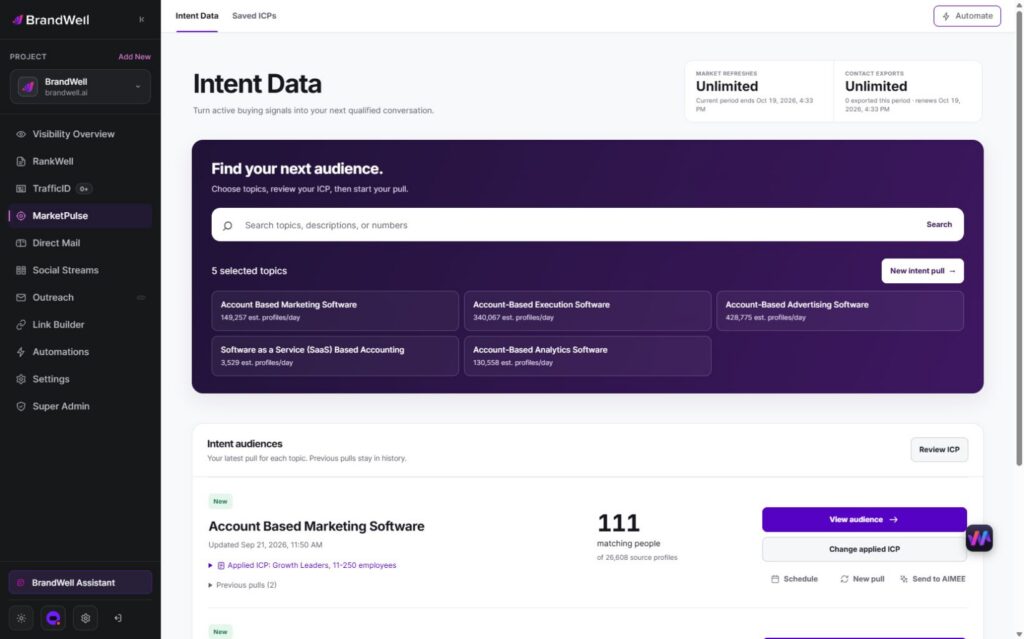
MarketPulse plans are starting at $500/mo. Link to the current product page for plan details rather than relying on an old screenshot or mixing early-access terms with public pricing.
Choose the page format that supports the decision
A feature query may need a product explanation with examples. An implementation query needs prerequisites and a realistic workflow. A pricing query needs clear costs, inclusions, and relevant limitations.
If the article is a review or evaluation, distinguish direct experience from information supplied by a vendor. Google’s review guidance emphasizes evidence and meaningful analysis. Do not invent testing or present a marketing preference as independent proof.
Use a comparison of decision criteria when it helps readers, without manufacturing an unsupported claim that one solution is universally best.
Make the promise match the page
Write a title that explains the actual decision the page helps with. A heading promising a calculator should lead to a usable calculation. A page promising setup instructions should show the steps, not only a demo request.
Keep product claims current and specific. Explain the difference between included features, optional products, and configured integrations. Make screenshots readable on mobile and identify sample data where applicable.
A direct answer can be concise without oversimplifying material conditions. Avoid hiding the limitation that determines whether the product fits.
Measure qualified outcomes
Define what counts as progress for the page: a qualified demo request, a purchase, a relevant trial, or another intentional action. Check measurement before using the numbers to guide investment.
Google’s Search Console metric definitions help interpret search visibility. Compare CTR within relevant query groups and account for position, device, and query-mix changes.
For an original hypothetical example, a page receiving 400 visits and eight qualified requests has a 2% visit-to-qualified-request rate in that sample. That is not a forecast for another page, and it does not prove those requests became customers.
Do not confuse keyword intent with person-level intent data
A commercial keyword describes a search phrase. An audience signal is a different kind of information. Neither should be presented as certainty about someone’s budget, authority, or buying date.
Keep your content plan, audience workflows, and sales qualification connected but distinct. A relevant query can guide a useful article; a real conversation still establishes the buyer’s situation.
Frequently asked questions
Are comparison searches low value?
Not necessarily. They can reflect a serious decision. Evaluate relevance and outcomes rather than assigning every comparison a low-intent label.
Should I ignore a query with low estimated volume?
No. A narrow question can matter to a valuable audience. Consider fit, evidence, and production effort alongside estimates.
Does adding commercial keywords automatically improve ranking?
No. The page must satisfy the task and meet technical and quality requirements. Keywords alone are not a ranking instruction.
Reviewed and updated October 2, 2026.

Written by
Julia McCoy has contributed articles to BrandWell on content marketing, writing, and search engine optimization. This archive retains her original bylines; individual articles may be updated by the BrandWell editorial team.