
Short answer: The best competitive intent-data provider is the one whose observable research signals match your market, whose source and identity boundaries you can explain, and whose activation workflow produces qualified outcomes in your own CRM. Treat competitor research as probabilistic evidence – not proof that a company or named person is ready to buy.
Who is this for? B2B revenue teams and agencies comparing competitor-research intent, account intelligence, review-site activity, or a white-label intent service.
Competitive intent data can help answer a useful timing question: which accounts or profiles may be researching your category, named competitors, implementation questions, or alternatives now? It cannot answer that question with certainty. Sources observe different environments, match activity at different units, refresh at different cadences, and expose different activation fields.
That is why a competitive intent data comparison should begin with a signal contract, not a logo grid. Define the observed behavior, source type, company or profile-matching method, timestamp, freshness rule, permitted use, destination, and success event. Then test each provider against the same workflow and a suitable baseline.
Disclosure: BrandWell owns and publishes this article. BrandWell appears first because it is our product; every option is evaluated using the same disclosed criteria, and another provider may be a better fit for some buyers.
How the seven providers are evaluated
Every company below is reviewed against the same competitive intent data checklist:
- Best fit: the buyer, market, and operating model the option most clearly serves.
- Signal and data coverage: what the vendor says its data represents and at what unit.
- Provenance and freshness: what a buyer should verify about source, timestamp, lag, and decay.
- Identity confidence: how account or person matching should be validated without overstating certainty.
- Activation: how evidence can reach reports, CRM, ads, outreach, or workflows.
- Governance: permitted use, minimization, access, suppression, retention, and approval needs.
- Pilot and evidence: how to test signal quality and downstream impact before expanding.
- Pricing and total cost: the verified or qualified planning information and additional operating effort.
- Limitation: the most important reason another option or simpler method may fit better.
7 competitive intent-data providers to evaluate
1. BrandWell

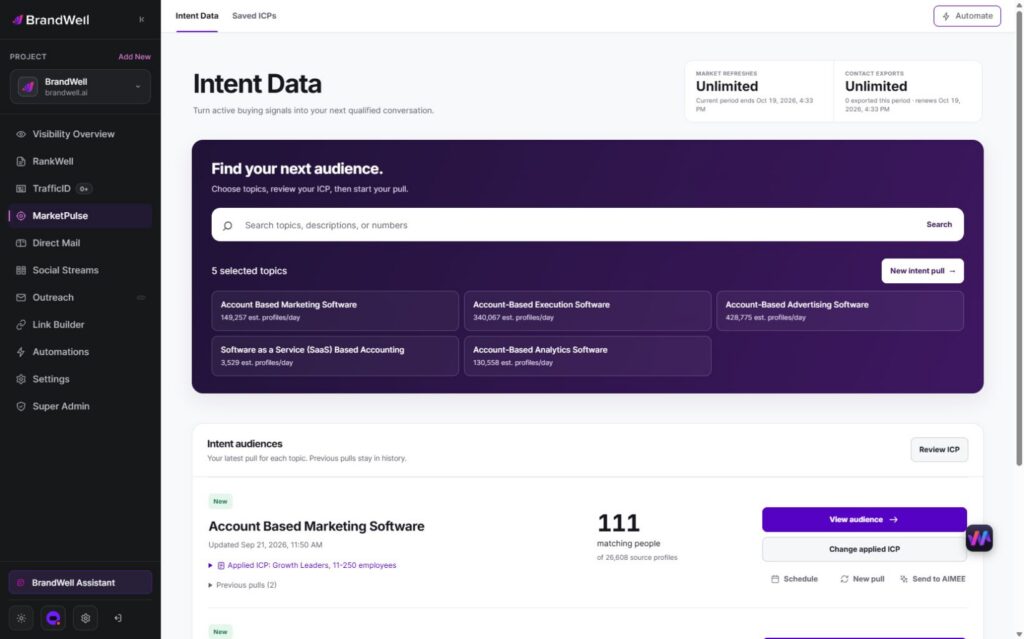
Best fit: BrandWell Intent is designed for agencies and resellers that want to launch a branded, recurring intent-data service rather than simply hand clients a feed. It is a separate agency-reseller product built on LeadFuze infrastructure, not the legacy BrandWell SEO writer.
Signal and data coverage: the owner-defined model can combine enabled intent and identity modules, including topic research, profile or visitor identification, enrichment, validation, and downstream activation. Exact current module scope, source provenance, coverage, and fields require product review. A profile or visitor match is probabilistic and must not be described as definitive proof that a named person researched a topic or plans to purchase.
Provenance, freshness, and identity: buyers should confirm the source and unit for every enabled signal, when activity was collected and delivered, how profiles and companies are matched, how confidence is expressed, how often records refresh, and when evidence decays. Topic exclusivity is conditional on availability and must be confirmed in writing.
Activation and agency model: the proposed service can include white-label portals, branded topic reports, configurable modules, and workflows. Agencies control retail pricing and bill their own clients while paying wholesale for enabled modules and usage. Agent-ready workflow instructions can be prepared for Claude, ChatGPT, or optional browser execution through Moxby. Moxby is a separate browser-first product. Consequential outreach, ad activation, personal-data decisions, and material client actions remain subject to human approval.
Agencies can purchase BrandWell’s $70 seven-day reseller pilot. It includes agency-branded topic reports and the complete sales playbook under the current written pilot terms. Other product capabilities and any topic exclusivity remain subject to their separate current written scope. The pilot should measure match quality, freshness, client relevance, report usability, approved actions, and qualified outcomes – not just record volume.
BrandWell agency plans range from $2,500 to $5,000 per month, depending on topic count, term, and available contractually scoped topic exclusivity. The current written quote and Order Form control. A final quote and pricing review are required. That range is not a claim that BrandWell is universally cheapest. Include agency labor, client setup, verification, activation, governance, and media or outreach spend in the budget.
Limitation: BrandWell is not a universal fit for a team that wants only a self-serve enterprise ABM suite or has no agency/reseller operating model. Product, source, pilot, pricing, and exclusivity details should be confirmed before a client promise is made.
2. Bombora

Best fit: Bombora is a logical option for teams evaluating third-party topic research at the account level and for platforms or operations teams that want such evidence delivered into an existing stack.
Signal and data coverage: Bombora describes Company Surge and topic-intent capabilities built around observed business research. Treat the result as an account/topic trend, not a person-level purchase declaration. Ask whether the exact offer is a feed, platform view, integration, audience, or partner-delivered component.
Provenance, freshness, and identity: validate the Data Co-op or other current source methodology, publisher and geography coverage, topic taxonomy, baseline logic, observation and delivery timestamps, lag, decay, company matching, and what happens when coverage is sparse. Confirm whether identity remains at an account level or is supplemented by another contracted source.
Activation and governance: map the fields and permitted uses available through the purchased delivery method. Confirm CRM, marketing, advertising, warehouse, export, or partner-integration paths; access controls; retention; suppression; and whether data may be used for a client or reseller use case. Do not let a surge value automatically send outreach.
Pilot and evidence: draw a representative sample across ICP tiers and topics. Check company accuracy, topic relevance, freshness, sales acceptance, actions, held meetings, qualified opportunities, and lift over fit-only coverage. Preserve low-signal and rejected records, not just successes.
Pricing and total cost: public list pricing was not verified; contact the vendor for a current quote. Directional market research suggests that some enterprise alternatives may cost roughly $5,000 to $10,000 per month and often require annual contracts. This is not vendor list pricing; obtain a scope-matched written quote. This is anecdotal, non-vendor-verified, non-universal context – not a vendor quote or verified contract term. Confirm current package, topic or account minimums, delivery, integrations, usage, term, implementation, and renewal. Add enrichment, identity, operations, verification, and activation costs.
Limitation: account/topic research is probabilistic and does not prove an individual is buying. Teams that need person-level workflow evidence, a white-label reseller engine, or a broader ABM suite may need additional systems or a different option.
3. 6sense

Best fit: 6sense is most relevant to enterprise teams evaluating a broad account-intelligence and ABM operating platform rather than a standalone competitive-intent feed.
Signal and data coverage: 6sense describes intent and account intelligence combined with customer data, identity resolution, predictive or buying-stage models, sales intelligence, advertising, and workflow activation. Buyers should isolate which sources and fields support the competitor-research use case and which conclusions are model outputs.
Provenance, freshness, and identity: ask for source-level documentation, topic or keyword granularity, account-match methodology, timestamp definitions, refresh and decay behavior, model explainability, coverage for your ICP, and how conflicting first- and third-party evidence is handled. A predicted stage is probabilistic, not a verified procurement fact.
Activation and governance: evaluate CRM and marketing integrations, audience creation, sales workflows, warehouse or API access, permissions, auditability, and how human owners can approve or reject suggested actions. Confirm which capabilities are in the quoted package and how personal data and generated actions are governed.
Pilot and evidence: test a bounded segment with clear baseline criteria. Measure match rates, explanation quality, user adoption, accepted accounts, time to action, qualified opportunities, and incremental outcomes. Separate the impact of intent from implementation, media, and seller behavior.
Pricing and total cost: public list pricing was not verified; contact the vendor for a current quote. Directional market research suggests that some enterprise alternatives may cost roughly $5,000 to $10,000 per month and often require annual contracts. This is not vendor list pricing; obtain a scope-matched written quote. This is anecdotal, non-vendor-verified, non-universal context – not a vendor quote or verified contract term. Confirm the current bundle, data or usage credits, seats, modules, integrations, implementation services, minimums, term, and renewal. Include RevOps, enablement, administration, data cleanup, media, and change-management effort.
Limitation: a broad enterprise platform may add cost, implementation load, and operating complexity for a team that only needs a topic feed, a narrow competitive-research trigger, or an agency-controlled white-label service.
4. Demandbase

Best fit: Demandbase is an option for enterprise ABM teams that want account intelligence, prioritization, advertising, and coordinated sales and marketing activation in one operating environment.
Signal and data coverage: Demandbase describes account and buying-group intelligence, intent, first-party engagement, data, and activation. For competitive intent, require a precise explanation of the source mix, observed behavior, topic coverage, account unit, and which elements are raw observations versus scores or journey-stage interpretations.
Provenance, freshness, and identity: validate collection and delivery timestamps, source coverage, company resolution, buying-group construction, identity confidence, scoring inputs, decay, and performance in the accounts you actually sell to. The platform’s own materials describe intent in probabilistic terms; preserve that boundary in seller-facing copy.
Activation and governance: compare account lists, CRM and marketing integrations, advertising, sales intelligence, reporting, API or warehouse access, role permissions, client-use rights, and approval gates. A coordinated platform can be valuable only if teams agree on evidence states, ownership, and outcome definitions.
Pilot and evidence: select a segment where the client has clean CRM outcomes. Compare fit-only accounts with accounts that also show relevant, fresh research. Measure acceptance, action, qualified pipeline, media efficiency where applicable, and attribution limits.
Pricing and total cost: public list pricing was not verified; contact the vendor for a current quote. Directional market research suggests that some enterprise alternatives may cost roughly $5,000 to $10,000 per month and often require annual contracts. This is not vendor list pricing; obtain a scope-matched written quote. This is anecdotal, non-vendor-verified, non-universal context – not a vendor quote or verified contract term. Confirm the platform fee, users, modules, data, advertising requirements, integrations, services, minimums, term, and renewal. Budget for implementation, administration, enablement, content, media, and governance.
Limitation: Demandbase may be more platform than a small team, specialist data buyer, or reseller needs. Buyers seeking a raw feed or agency-controlled white-label delivery should confirm whether the commercial and operating model fits.
5. G2 Buyer Intent

Best fit: G2 Buyer Intent is most relevant to software vendors whose buyers actively research products and categories on G2 properties and who value product-, category-, or comparison-context signals.
Signal and data coverage: G2 describes buyer-intent activity associated with its software research environment. Availability and activity types can depend on plan and product participation. Verify which views, comparisons, alternatives, category interactions, or other events are included, and whether reporting is account-level.
Provenance, freshness, and identity: ask how activity is attributed to a company, what geography and device conditions affect matching, when an event is collected and delivered, how duplicates are handled, and what confidence fields are exported. Review-site research is meaningful context but does not prove that a named employee is on a buying committee.
Activation and governance: confirm current CRM, marketing-automation, advertising, export, and partner integrations; package entitlements; retention; suppression; and the messages permitted by contract and policy. Sales copy should address the category problem without revealing hidden tracking.
Pilot and evidence: compare accounts with relevant G2 activity to matched category-fit accounts without observed activity. Track match quality, sales acceptance, held meetings, opportunity creation, progression, and win rate while controlling for existing brand awareness and G2 profile exposure.
Pricing and total cost: public list pricing was not verified; contact the vendor for a current quote. Directional market research suggests that some enterprise alternatives may cost roughly $5,000 to $10,000 per month and often require annual contracts. This is not vendor list pricing; obtain a scope-matched written quote. This is anecdotal, non-vendor-verified, non-universal context – not a vendor quote or verified contract term. Confirm the applicable plan, profile or sponsorship dependencies, activity coverage, users, exports, integrations, commitment, implementation, and renewal. Include enrichment, identity validation, routing, and sales labor.
Limitation: the signal scope is tied to review-site behavior rather than the whole market. It may fit software categories well while offering limited evidence for markets or buyer journeys that rarely use those properties.
6. Informa TechTarget

Best fit: Informa TechTarget is an option for B2B technology marketers that want intent derived from a technology-focused publisher and research network, potentially combined with media, content, demand, or sales use cases.
Signal and data coverage: the company describes technology-buyer research and intent products. Confirm the current product name, audience and source network, topic granularity, account or person unit, geographic coverage, available fields, and whether a purchased package includes platform access, integrations, services, or media.
Provenance, freshness, and identity: ask which behaviors are directly observed, which profiles are registered or inferred, how accounts and buying groups are matched, how timestamps are defined, what delivery lag exists, how evidence decays, and how a buyer can audit source quality without exposing protected publisher data.
Activation and governance: verify current CRM, marketing, sales, audience, media, export, and service paths; geography and use restrictions; role permissions; suppression; retention; and client or resale rights. Keep content-consumption evidence distinct from a verified purchase request.
Pilot and evidence: select technology topics directly tied to the offer and a representative account sample. Evaluate audience fit, company and profile matching, freshness, accepted actions, qualified meetings, opportunities, and incremental lift. Include accounts with weak or no observed activity as a baseline.
Pricing and total cost: public list pricing was not verified; contact the vendor for a current quote. Directional market research suggests that some enterprise alternatives may cost roughly $5,000 to $10,000 per month and often require annual contracts. This is not vendor list pricing; obtain a scope-matched written quote. This is anecdotal, non-vendor-verified, non-universal context – not a vendor quote or verified contract term. Confirm package, audience, topics, geography, users, data delivery, integrations, services, media, minimums, term, and renewal. Include content, campaign, verification, and operations effort.
Limitation: the best-fit coverage may be concentrated in technology buying contexts. Companies outside that market or teams seeking only a broad cross-industry feed should test coverage before committing.
7. ZoomInfo

Best fit: ZoomInfo is relevant to sales, marketing, and RevOps teams already evaluating a broad go-to-market data suite and wanting intent alongside contact, company, technographic, website-visitor, enrichment, and workflow capabilities.
Signal and data coverage: ZoomInfo describes buyer intent and other market signals within its larger GTM data and activation ecosystem. Buyers should confirm the exact source or sources supporting competitive intent in the proposed package, which events are first-party versus third-party, and which outputs are observed versus modeled.
Provenance, freshness, and identity: validate topic definitions, data provenance, timestamps, refresh, account and contact resolution, validation methods, confidence fields, geographic coverage, and how older evidence is suppressed or decayed. Broad profile coverage does not prove that every matched person participated in research.
Activation and governance: evaluate CRM, sales, marketing, enrichment, workflow, audience, API, export, and administration capabilities in the actual package. Confirm credit usage, permissions, source contracts, client-use rights, retention, deletion, suppression, and approval before automated messages or audience changes.
Pilot and evidence: test the precise modules a team would buy rather than a curated demo environment. Sample fit tiers, verify account and people data, inspect freshness and false positives, track user adoption and accepted actions, and measure qualified pipeline against a matched baseline.
Pricing and total cost: public list pricing was not verified; contact the vendor for a current quote. Directional market research suggests that some enterprise alternatives may cost roughly $5,000 to $10,000 per month and often require annual contracts. This is not vendor list pricing; obtain a scope-matched written quote. This is anecdotal, non-vendor-verified, non-universal context – not a vendor quote or verified contract term. Confirm features, users, credits, data, add-ons, integrations, services, minimums, contract, and renewal. Include implementation, data cleanup, administration, enablement, and activation labor.
Limitation: bundled breadth may be unnecessary for a buyer seeking only topic intent, a narrow competitor-research workflow, or an agency-controlled white-label client service.
Build the competitive intent data workflow
A provider cannot make a weak process operational. The competitive intent data implementation guide should preserve a chain of evidence:
- Lock the outcome and ICP. Define the qualified action, account fit, exclusions, and revenue event before choosing topics.
- Write a signal contract. Record source, observed behavior, unit, company or profile match, collection and delivery timestamps, confidence, and permitted use.
- Define evidence states. Separate observed, verified, relevant, corroborated, actionable, and validated.
- Layer fit, timing, and identity. Keep each in its own field; do not hide a failed gate inside an average score.
- Assign owners and destinations. Define which records become monitoring, nurture, CRM tasks, audiences, client reports, or no action.
- Require approvals. A person reviews consequential outreach, ad activation, personal-data decisions, pricing, and material client actions.
- Close the outcome loop. Preserve accepted and rejected signals, meetings, opportunities, revenue, disqualifications, and complaints.
The data model should include company ID, topic or competitor, event source, evidence unit, observed and delivered dates, freshness state, account fit, identity confidence, relevance rationale, owner, destination, approval, expiry, and outcome. Useful integrations can include CRM, marketing automation, sales engagement, ad platforms, identity and contact validation, warehouse, reporting, and a client portal. Sync only the data needed for the approved use.
Agent-ready instructions can make the handoffs repeatable. Claude or ChatGPT can summarize the evidence and prepare a suggested action; Moxby can optionally carry an approved browser workflow. The safe instruction pattern is collect → cite → classify → propose → request approval → execute → log. An agent should never convert an inference into a fact.
Competitive intent data alternatives and best-fit use cases
Fit-only targeting is enough when the team needs total-addressable-market coverage and has no reliable timing signal. Broad lists are useful for coverage tests but carry high verification and personalization costs. First-party engagement is often more direct because the activity occurs on your properties, although it can include customers, candidates, partners, and researchers. Competitive research can reveal category exploration earlier, but the source and identity boundary may be less direct. No action is appropriate when fit, freshness, relevance, permission, or economics fail.
The strongest competitive intent data use cases have recognizable research topics, enough market volume to test, a defined ICP, meaningful contract value, and a team able to act quickly but thoughtfully. Examples include account prioritization, competitive displacement, content selection, ABM audience design, sales research, customer-risk monitoring, and agency reporting. The signal is a poor fit when topic coverage is weak, deal value cannot support verification, the category is sensitive, or the team plans to send the same message to every flagged account.
Competitive intent data pricing and total operating effort
Compare total cost, not the data license alone. Model vendor fees, topics or accounts, profiles or credits, seats, integrations, implementation, enrichment, identity and contact validation, media or outreach spend, analyst and seller time, client-service labor, security review, compliance review, and the opportunity cost of false positives.
The owner’s market-research context suggests that some enterprise intent products may be budgeted around $5,000–$10,000 per month and annual commitments. That context is anecdotal and non-vendor-verified, not a current quote or fact. It should never replace the exact competitor pricing language used above or a written vendor proposal.
Useful unit economics include cost per verified account, relevant signal, accepted action, held meeting, qualified opportunity, and incremental contribution. A provider with a higher fee can be less expensive operationally if match quality, activation, and adoption are better. A low-cost feed can be costly when analysts and sellers must repair it.
Measure competitive intent data ROI
Competitive intent data KPIs should follow the evidence chain: source coverage, match rate, freshness, relevance, sales acceptance, action rate, time to action, held meetings, qualified opportunities, stage progression, pipeline, wins, contribution margin, opt-outs, and complaints. Report denominators and sample sizes. Signal volume alone is not a success metric.
Use a holdout or matched comparison where feasible. Keep ICP, segment, seller, territory, and time window as consistent as possible. Exclude pipeline already open before the signal from “signal sourced” reporting. Treat influenced pipeline as different from sourced pipeline and both as different from recognized revenue.
Incremental program value = contribution from qualified outcomes above the baseline − vendor, integration, labor, media, and activation costs.
Competitive intent data benchmarks should come from the buyer’s own market after the workflow stabilizes. Cross-company rates can mislead because sources, topics, segments, sales cycles, qualification, and attribution differ.
Control signal quality, privacy, and automation risk
The biggest competitive intent data mistakes are claiming a named person researched a competitor without direct evidence, hiding source limitations, using stale activity, skipping ICP fit, choosing overly broad topics, letting every surge trigger outreach, ignoring customers or active opportunities, and measuring only clicks or raw meetings.
Before activation, document source contracts, client-use rights, controller and processor roles, permitted purpose, data minimization, access, security, retention, deletion, suppression, opt-outs, complaints, and audit logs. Use useful, non-invasive messaging that addresses the business problem rather than revealing tracking. For US commercial email, consult the FTC’s CAN-SPAM compliance guide. The ICO’s guidance for organizations using data-broker marketing services is another authoritative due-diligence resource. Qualified reviewers must determine which rules apply.
How agencies can package a recurring service
A competitive intent data agency guide should sell the operating loop: client-specific ICP and topic design, source and permitted-use review, daily or weekly evidence processing, profile or account validation, branded reports, approved CRM or audience activation, client review, and outcome calibration. Do not sell a raw list as a finished service.
A useful recurring package can include a branded portal, a weekly “why this account” report, action recommendations, suppression and governance logs, monthly performance review, and quarterly topic or play tests. The agency should set retail pricing based on client value, coverage, human service, and activation – not mark up records without accountability.
Agencies can purchase BrandWell’s $70 seven-day reseller pilot. It includes agency-branded topic reports and the complete sales playbook under the current written pilot terms. Other product capabilities and any topic exclusivity remain subject to their separate current written scope. It is a strong candidate when the agency wants infrastructure for the service; another provider may fit better when the buyer wants a broad enterprise ABM platform, a technology-publisher audience, review-site behavior, or a standalone account-topic feed.
Implementation checklist
- Define the qualified outcome, ICP, exclusions, and no-action state.
- Document each source, observation unit, timestamp, confidence, and permitted use.
- Keep fit, timing, identity, activation, and outcome evidence separate.
- Test representative topics, regions, account tiers, and weak-signal cases.
- Verify people and channels; enforce suppression and retention.
- Assign an owner, SLA, approval, destination, expiry, and rollback.
- Run a bounded pilot with a baseline and auditable attribution rules.
- Review product, pricing, finance, privacy, security, compliance, legal, and platform-policy claims before release.
- Expand only when qualified outcomes justify the total operating cost.
Bottom line
Choose competitive intent data by source fit, explainability, freshness, identity confidence, activation, governance, economics, and measured outcomes – not by the loudest intent score. The right provider is the one your team can validate and operate responsibly in its own market.
How BrandWell helps agencies validate demand
BrandWell offers agencies a paid seven-day reseller pilot for $70. BrandWell generates topic reports with the agency’s branding and provides the complete sales playbook for presenting the service, handling the sales conversation, and seeking client commitments before a full-plan signup.
This lets the agency validate interest and review whether expected commitments cover the planned costs before it treats the offer as a profit center. BrandWell cannot guarantee commitments or financial performance. Review the $70 seven-day reseller pilot.