On this page
- Current MarketPulse research workflow
- Check discovery fit and capacity
- Keep confidence separate from buying probability
- Use eight discovery steps
- Prepare neutral questions
- Compare research and discovery tools
- Budget review and seller time
- Measure buyer-confirmed needs and outcomes
- Verify data and action boundaries
- Scope a separate agency discovery service
- Copyable assistant discovery brief
- Discovery readiness checklist
- Copyable discovery evidence record
- Frequently asked questions
Use buyer intent data in consultative selling to prepare a better question path, not to pre-answer the questions. The signal can inform a seller reviewing which account to review, what topic may deserve attention, and which neutral questions to prepare. It cannot establish a named person’s need, authority, consent, urgency, budget, or willingness to buy.
A bounded consultative-selling workflow treats every signal as a clue with a confidence level and expiration. The seller combines that clue with fit, identity, first-party context, account history, and permitted-use rules. Then the seller asks, listens, summarizes, and allows the buyer to correct the entire hypothesis. Only buyer-confirmed evidence should move qualification, forecast, or next-step commitments.
Measure whether the approach makes discovery more useful; preparation alone does not establish an improvement. It fails when “personalization” becomes an accusation about someone’s browsing, when an intent score replaces diagnosis, or when an agent fills the CRM with plausible but unconfirmed pain. The operating rule is simple: signals choose what to investigate; buyers establish what is true.
Across this guide, intent signals are probabilistic evidence, not proof of identity, need, consent, buying stage, commitment, or a future purchase.
Current MarketPulse offer: intent-data plans start at $500/mo. See the product, demo, and current plans. Updated October 3, 2026.
Current MarketPulse research workflow
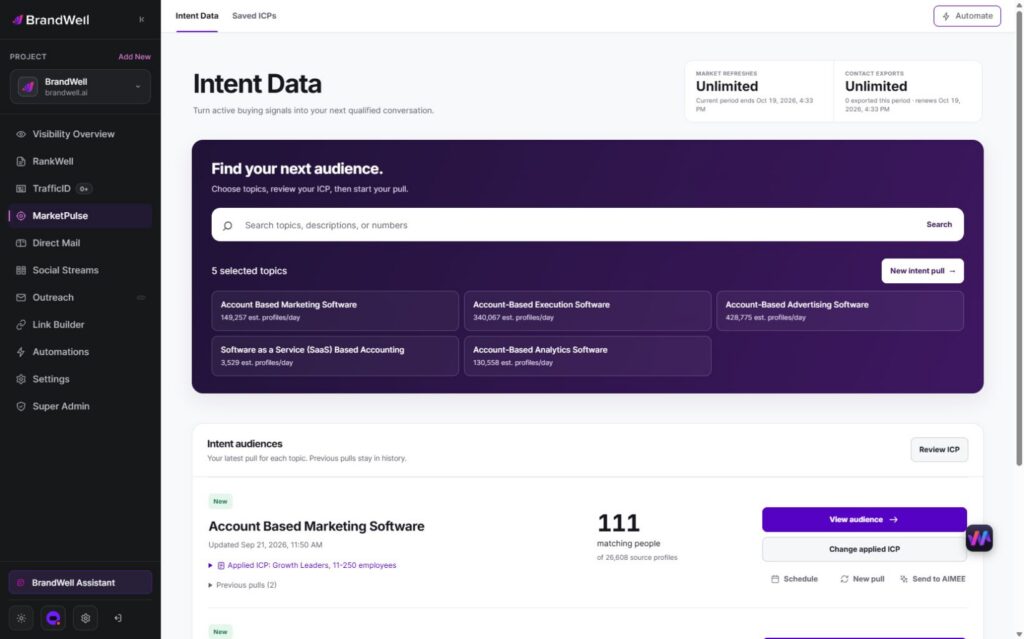
BrandWell MarketPulse: intent data starting at $500/mo. Find people researching topics relevant to what you sell, apply saved ICP filters, and review available contact details before taking action.
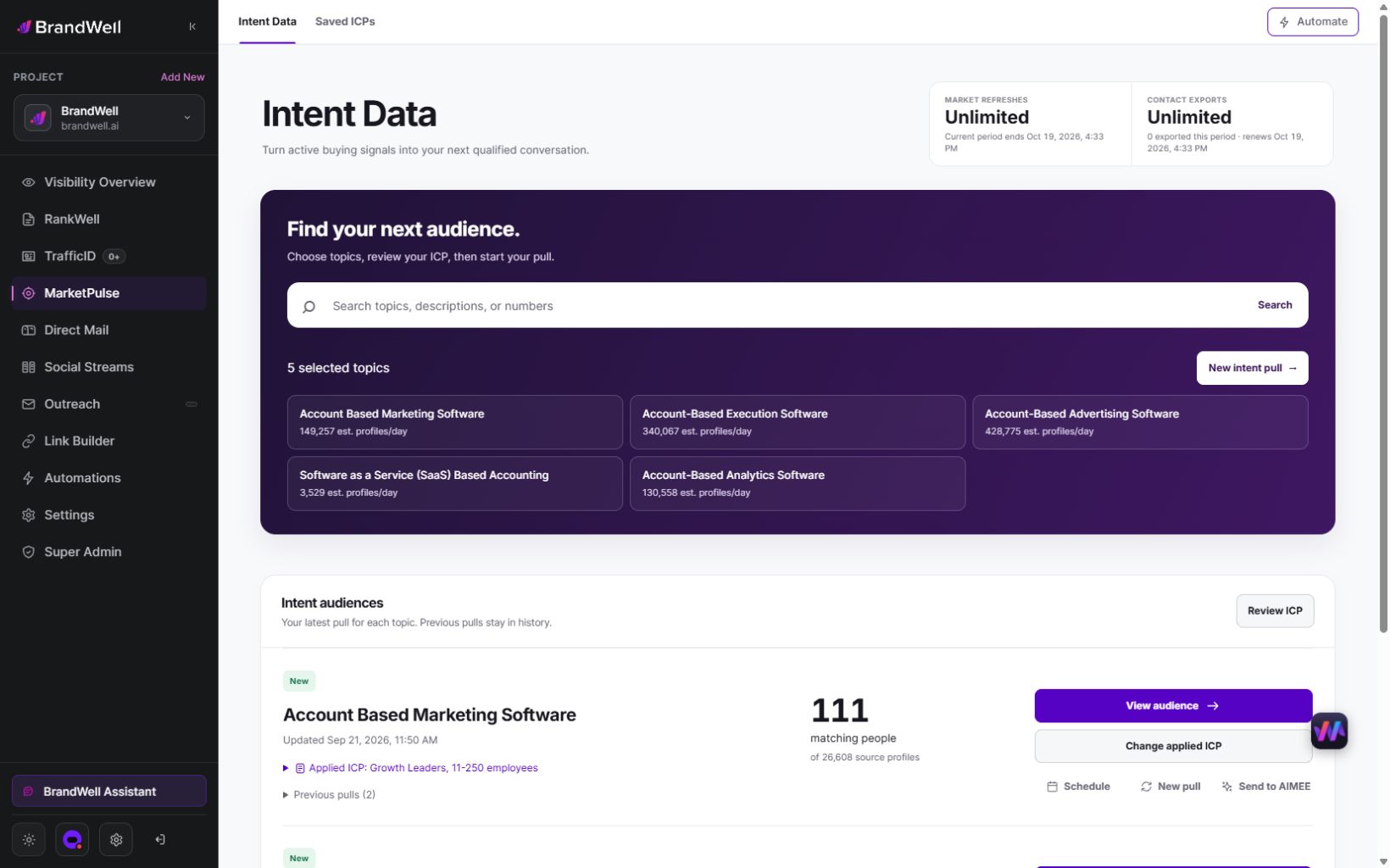
MarketPulse plans are starting at $500/mo. Verify current package scope and offers on the product page.
| Plan | Topics and refreshes | Monthly exports |
|---|---|---|
| Starter | 1 topic, weekly | 25,000 contacts |
| Growth | 3 topics, daily | 100,000 contacts |
| Scale | 10 topics, daily | Unlimited contacts |
Swipe the table to see all columns.
A pull retrieves available data from the previous 24 hours for one topic. Daily use across all included topics provides 90 Growth pulls or 300 Scale pulls in a 30-day month. Weekly Starter pulls vary by calendar month. Available audience size and contact fields vary, and audiences may overlap. Refreshes stop at the plan limit without overage charges.
- Find and qualify: search the topic catalog, save your ICP, and review the people and companies that match.
- Act on the research: export qualified contacts or prepare an Outreach or Direct Mail workflow. Connected products, channel usage, and fulfillment may cost extra.
- Get help from AIMEE: Growth and Scale include AIMEE for the initial user to research accounts and prepare the next step through connected tools.
Agencies and other service businesses can build client deliverables around their available Intent Scans and exports. Keep each client’s scope, permissions, and service fees clear. A subscription is not a promise of a white-label platform or exclusive access to a market.
Explore MarketPulse and watch the demo or compare plans starting at $500/mo. Any early-access discount is a separate, time-limited offer shown to an eligible recipient.
Check discovery fit and capacity
This consultative selling with buyer intent data framework is for B2B account executives, SDRs, sales managers, RevOps, enablement leaders, and agencies that support considered purchases. Consider it when the company has a clear ICP, a defined discovery standard, a CRM disposition taxonomy, useful first-party context, and managers who inspect evidence rather than field completion.
Strong use cases include prioritizing a research queue, preparing discovery for a fitting account, identifying a possible change in an existing opportunity, choosing a relevant diagnostic asset, and giving a seller context before a re-engagement conversation.
Do not buy or expand the program if the sales team cannot conduct neutral discovery, if activity volumes exceed human review capacity, if signal provenance or permitted use is unclear, or if outcomes cannot be joined back to records. For low-consideration offers, tiny markets, or teams with strong inbound demand but weak follow-up discipline, fixing the basic process may produce more value than adding third-party signals.
Keep confidence separate from buying probability
Label each account item:
- Observed: The system recorded a specified event under a named source and unit.
- Contextual: Fit, firmographic, role, CRM, or first-party information was matched with known confidence.
- Hypothesized: A seller or agent proposed a possible need, consequence, stakeholder, or question.
- Confirmed: A buyer explicitly confirmed the fact in a conversation, form, or other reliable first-party interaction.
- Disconfirmed: The buyer or accountable seller rejected the hypothesis.
- Unknown: Evidence is absent or conflicting.
Confidence is not a probability that the person will buy. It expresses how much support the team has for a specific statement. A fresh, repeated account-level topic may increase review priority while leaving the person, need, and project completely unknown.
Use eight discovery steps
1. Define the discovery decision
Write what the signal is allowed to change. It may change account-review priority, the research packet, the first question, the asset offered, or the review cadence. It should not automatically change opportunity stage, forecast, contact frequency, or legal basis.
Choose an analysis unit – account, person, opportunity, or site visitor – and preserve it. Account research must not be narrated as a named contact’s activity. Define ICP fit, source, topic, freshness, confidence, exclusions, expiry, review owner, and capacity before launch.
2. Create a minimum viable signal card
The card should include signal ID, source, unit, event or topic, recency, repetition, match method, confidence, firmographic fit, role relevance, prior first-party interactions, opportunity state, customer state, suppressions, permitted uses, and expiry. Include raw and normalized values so reviewers can see what changed.
Add three empty discovery fields: possible meaning, question to test it, and buyer-confirmed answer. Keeping the last field empty is a feature. It prevents automation from turning research into false CRM completeness.
3. Triage fit, identity, and freshness together
Do not rank on intensity alone. A strong topic from the wrong market should not outrank a modest signal from a perfect-fit account. A person match with a conflict should not trigger person-level outreach. A stale signal should not remain “hot” because its cumulative score is high.
Use a review matrix: fit, topic relevance, freshness, identity confidence, first-party context, and active relationship. Make the weights visible and versioned. Send conflicts and high-consequence actions to a human rather than hiding them behind one score.
4. Draft neutral question paths
Build a small branching question bank rather than a script. Begin with current process and context. Move to friction only if the buyer identifies it. Explore consequence only if a real problem exists. Ask about stakeholders, priority, and decision mechanics after the buyer has established relevance.
A prepared opener could be: “We work with teams reviewing how this process should run. How are you handling it today?” A follow-up could be: “Where, if anywhere, does that approach create extra work or risk?” Both invite a “nowhere” answer. Avoid: “We know you are struggling with this.”
5. Listen, summarize, and confirm
The consultative moment is not the question; it is what happens after the answer. Capture the buyer’s language, ask for an example, separate symptoms from causes, and summarize: “I heard X, with Y consequence, and Z is still uncertain. Is that accurate?”
Record confirmed and unconfirmed items separately. Do not turn silence into agreement. Do not infer authority from title. Do not infer urgency from research recency. If the buyer’s reality contradicts the intent hypothesis, keep the correction. It is valuable training data.
6. Recommend a proportionate next step
Match the next action to buyer-confirmed need and confidence. Options may include sending a relevant guide, scheduling a diagnostic session, involving a technical stakeholder, scoping an assessment, or ending the sequence. A direct demo is not automatically the right response to a “high-intent” label.
State why the next step helps the buyer, which evidence is needed, who owns it, and when it will be reviewed. If the buyer has not confirmed a problem or useful outcome, do not manufacture momentum.
7. Route and govern the handoff
Send the seller the signal card, hypothesis, question path, exclusions, and approved next-action options. Use explicit routing rules for owners, territories, active opportunities, customers, partners, and suppressed records. Keep one accountable person for the action.
The workflow must support rejection. Sellers need fast codes for wrong fit, stale, duplicate, wrong person, insufficient evidence, no current project, do not contact, and useful signal. A system that records only positive actions cannot learn.
8. Improve the model from downstream evidence
Join signal and workflow versions to seller disposition, buyer confirmation, meeting, qualified opportunity, stage progression, loss reason, revenue when mature, opt-out, complaint, and cost. Review by topic, source, unit, confidence, fit, recency, and action.
Do not train on outcomes that the system itself created without noting the feedback loop. Do not call a descriptive conversion difference “lift” unless the design supports it. The purpose is to make the next review queue more useful, not to defend the original score.
Prepare neutral questions
The GOV.UK interview guidance recommends open questions and concrete examples. Adapt that questioning discipline to discovery while allowing the buyer to reject the premise. This user-research guidance does not prove sales conversion or validate a BrandWell scoring model.
Use these as templates, then adapt them to the buyer’s language:
- Situation: “How does the process work today, and who is involved?”
- Change: “What prompted you to revisit it, if anything?”
- Friction: “Where does the current approach create delay, work, cost, or risk?”
- Evidence: “Can you walk me through a recent example?”
- Consequence: “What happens when that issue persists?”
- Priority: “How does this compare with other initiatives?”
- Authority: “Who else needs to understand or evaluate a change?”
- Outcome: “What would a useful result look like, and how would you recognize it?”
- Constraint: “What would make a change impractical?”
- Next step: “What would be the most useful next action from your perspective?”
These consultative selling with buyer intent data templates are designed to expose uncertainty. They are not a covert qualification checklist.
Compare research and discovery tools
Compare consultative selling with buyer intent data tools by evidence transparency, workflow fit, human review, feedback, privacy, auditability, and total cost – not by the number of “hot” accounts promised.
- Signal and identity data: Helps prioritize research. Limitation: topic and identity matches can be wrong, stale, or account-level.
- CRM and routing automation: Places cards, owners, questions, and dispositions in the workflow. Limitation: incomplete fields can look falsely authoritative.
- Call, note, and enablement systems: Captures and reinforces discovery. Limitation: transcription or summarization still needs review and may contain sensitive data.
- AI research assistants: Drafts briefs and neutral question paths from approved evidence. Limitation: plausible language is not verified truth.
- Agency or expert services: Runs recurring research, routing, QA, and reporting. Limitation: the client remains accountable for selling behavior, lawful use, and claims.
- Manual spreadsheet pilot: Useful for a small queue with strict fields and access. Limitation: versioning, retention, deletion, and scale require discipline.
Methodology training disconnected from live evidence can still be the best alternative when reps lack basic discovery skill. Intent data is not a substitute. An in-house model fits teams with RevOps, data, enablement, and review capacity. An agency fits teams that need operating capacity. Software fits teams with a defined process ready to automate.
Budget review and seller time
Consultative selling with buyer intent data pricing should separate signal/data fees, identity and enrichment, CRM or warehouse integration, enablement, analyst and seller review, agency services, security and privacy work, ongoing QA, and any outreach infrastructure. Include the opportunity cost of seller time and the cost of false positives.
Pilot with a queue the team can actually review. A lower data price can create a higher consultative selling with buyer intent data cost if it produces more conflicts, irrelevant contacts, and manual cleanup.
Measure buyer-confirmed needs and outcomes
Consultative selling with buyer intent data KPIs should include:
- Accepted, expired, duplicate, conflicted, and suppressed signals.
- Match coverage and wrong-account or wrong-person rates.
- Time to review, review capacity, action rate, and seller acceptance.
- Hypotheses confirmed, disconfirmed, or left unknown.
- Buyer-confirmed problems, consequences, stakeholders, and useful next steps.
- Meetings accepted, qualified opportunities, stage progression, cycle time, pipeline, and mature revenue.
- Opt-outs, complaints, negative feedback, data incidents, and cleanup time.
- Total program cost and cost per buyer-confirmed problem or qualified opportunity.
Consultative selling with buyer intent data ROI is not “pipeline touched by a signal.” Use suitable comparison cohorts, maturation windows, and full costs. Disclose selection and overlap. Set stop-or-scale rules before the pilot: stop on weak provenance, unusable identity, poor seller acceptance, repeated buyer harm, or missing outcomes; expand only when evidence quality, buyer experience, qualified pipeline, and economics improve together.
Verify data and action boundaries
Risks in this workflow include asking leading questions, claiming to know a person’s private research, auto-populating needs, ignoring active relationships, and optimizing for contact volume instead of useful diagnosis.
Keep only necessary research details in the buyer-visible plan. Verify actual source rights, access, retention, deletion, sharing and client responsibilities. Preserve the restricted signal ledger separately from approved buyer commitments.
Before contact, verify the actual jurisdiction, recipient, purpose, opt-out status and channel requirements. A work address, public record or research signal does not itself establish permission for the proposed message. Resolve missing approval before any action.
Scope a separate agency discovery service
A consultative selling with buyer intent data agency guide should package a repeatable operating layer: ICP and topic design, signal cards, fit and identity QA, weekly research queues, question-path templates, routing, disposition, manager review, and monthly signal-to-confirmed-need reporting.
MarketPulse supplies topic research and available match details for businesses and agencies. AIMEE can organize supplied context through configured tools. An agency discovery service, branded report, CRM synchronization or custom client interface needs separately verified rights, implementation, scope and fees. The research product does not confirm buyer need, authority, urgency, budget or purchase readiness.
Review an available MarketPulse topic, saved ICP and actual preceding-24-hour matches for the agreed research purpose. AIMEE can organize supplied context through configured tools. Keep research inputs separate from the shared plan; named sellers and buyers confirm actual commitments.
A credible recurring report shows observed, hypothesized, confirmed, disconfirmed, and unknown items; seller dispositions; qualified outcomes; risks; costs; and changes to the acceptance policy. It does not present intent as a secret window into the buyer’s mind.
Copyable assistant discovery brief
Use this bounded instruction:
- Read the approved signal card, ICP rules, exclusions, CRM context, verified evidence library, and permitted-use policy.
- Produce labeled blocks: observed facts, possible hypotheses, identity or freshness conflicts, neutral questions, and unknowns requiring buyer confirmation.
- Never state that a person has a pain, project, budget, authority, or deadline unless the CRM contains buyer-confirmed evidence.
- Draft a question path that allows the buyer to reject the premise.
- Recommend no more than one proportionate next step and explain the evidence required.
- Do not send outreach, change CRM stages, modify suppression, or disclose browsing details.
- Send the packet to the named seller or manager for approval and record the final disposition.
AIMEE can prepare a review brief through configured connected tools. Preserve observed fields, uncertain matches, missing evidence and proposed questions. It does not establish buyer commitment or permission to alter a shared plan. Named humans approve messages and actual edits.
Discovery readiness checklist
Before rollout, confirm:
- Decision the signal may change and actions it may not trigger.
- Account/person/opportunity unit, fit, identity, freshness, confidence, expiry, and exclusions.
- Signal card, neutral question bank, separate hypothesis and confirmation fields.
- Rep capacity, routing, review SLA, disposition, and manager coaching.
- Costs, baseline, maturation, KPIs, and stop-or-scale rules.
- Provenance, permitted use, access, retention, deletion, suppression, and channel review.
- Human approval for outreach, CRM, activation, and claims.
- Current BrandWell package, pricing, data scope, and evaluation terms if used.
The operational goal is a more useful conversation – not a more convincing guess.
Copyable discovery evidence record
Observed: [Actual source, unit, event time, match state and uncertainty.] Hypothesis: [Possible question, not an asserted need.] Question: [Neutral opening that permits rejection.] Answer: [Actual buyer statement, source and date.] State: [Confirmed, rejected, unrelated or unresolved.] Next step: [Buyer-agreed action, owner and date, or no action.]
For example, verified company context may suggest a workflow question: “Your site describes [actual offer]. How does your team prioritize accounts today?” Ask for a recent example and summarize their answer for correction. Do not claim a named person privately researched a topic or infer budget from recency.
Worked example: confirmation is not a purchase
Assume a fictional set of 20 completed discovery conversations. Eight buyers confirm the hypothesized problem, six reject it, two describe an unrelated issue and four remain unresolved. Confirmation is 40% of all conversations or 50% of the 16 resolved conversations. Report the four unresolved answers with either denominator; an empty field is not confirmation.
Five of the eight confirmed-problem buyers agree a next action: 62.5% of confirmed buyers or 25% of all conversations. Agreement is not a held meeting, purchase or revenue. Preserve each later outcome and its date. These invented rates are not industry benchmarks or evidence that intent research caused better discovery.
Check capacity and the full review cost
Suppose 40 research cards require 15 minutes each, or ten hours, and 20 discovery conversations with note review require 30 minutes each, or ten more hours. Total work is 20 hours against an 18-hour available budget, leaving a two-hour capacity gap before exceptions. Reduce the queue, allocate approved capacity or change the scope; do not hide the gap in an average.
At $100 per hour plus $250 in allocated tools, defined costs are $2,250. A fictional $2,500 fee leaves $250, or 10%. Three additional $100 correction hours raise costs to $2,550 and create a negative $50 remainder. Setup, acquisition, general overhead, tax and financing are excluded and can further change the result. These figures are invented agency inputs, not BrandWell prices or typical margins.
Prepare the supported BrandWell research input
Review an available MarketPulse topic, saved ICP and actual preceding-24-hour matches against the discovery purpose. Verify public company context and preserve uncertainty. TrafficID is separately scoped own-site visitor work. AIMEE can organize supplied context through configured tools. Owners approve exports, messages, Outreach enrollment, audience uploads and CRM writes. Discovery reports and custom interfaces require separately verified implementation and rights.
Frequently asked questions
Does research establish a buyer-confirmed problem?
No. Record the actual answer and allow rejection.
Is a confidence label buying probability?
No. State what the confidence refers to and preserve uncertainty.
Should unresolved answers be counted as positive?
No. Keep them visible and name the denominator.
Does agreeing a next step establish revenue?
No. Track actual later outcomes separately.
Review the research product: explore MarketPulse and current plans.
Reviewed and updated October 3, 2026.

Written by