


On this page
- What belongs in a content marketing campaign?
- Two historical content marketing campaigns worth studying
- Write a campaign brief before creating content
- An original B2B example: an IT office-move campaign
- Build and manage the campaign in BrandWell
- Measure the campaign from attention to qualified outcomes
- Improve the next campaign with evidence
- Frequently asked questions
A content marketing campaign is a coordinated set of useful content built around one audience, business objective and next action. An article, email, video and social post become a campaign when they answer related questions and lead people toward the same outcome. Publishing more assets alone does not make the campaign effective.
This guide covers two documented historical examples, a practical campaign brief and an original B2B example you can adapt. The goal is to make the planning, production and measurement decisions clear before you spend the budget.
What belongs in a content marketing campaign?
- Audience: the people facing a specific problem, including who influences or approves a purchase.
- Objective: a defined business outcome, such as qualified consultations or adoption of an existing service.
- Core message: the useful idea each asset supports, backed by evidence you can publish.
- Content and distribution: the formats, destinations and permissions needed to reach the audience.
- Next action: a relevant resource, demonstration, inquiry or purchase step.
- Measurement: the events, costs and qualification rules that will determine whether the campaign worked.
A campaign can have a start and end date without pretending that every buyer will decide within that period. Record follow-up ownership and a reporting window that fits your sales process.
Two historical content marketing campaigns worth studying
Oreo Daily Twist: a repeatable creative format
In its August 2012 announcement, Kraft described Oreo Daily Twist as a 100-day series of digital advertisements responding to topical events through Oreo imagery. The company also invited fans to suggest topics. See the original campaign announcement. The Clio record identifies a 2013 Silver award.
The transferable planning lesson is to establish a recognizable format and a clear editorial decision process. A small business might publish a weekly answer to a recurring customer question, with the same structure and a different example each week. It should choose a cadence its team can sustain. An award does not establish the campaign’s incremental revenue, and a famous brand’s schedule is not a performance benchmark for your business.
GoPro Million Dollar Challenge: participation with a defined output
GoPro’s historical HERO11 challenge invited users to submit raw camera footage for a highlight video. Featured contributors would share a $1 million pool; that edition’s deadline was April 2, 2023. These details appear in GoPro’s challenge description. This is a historical example, not an invitation to enter an active contest.
The practical lesson is to tell contributors exactly what to submit and how it will be used. A service company could invite customers to share an approved project story or demonstrate a process. Obtain permission for publication, agree on attribution and review factual claims. Participation and attractive footage do not, by themselves, prove a sales increase.
Write a campaign brief before creating content
Use these questions to make the campaign concrete:
- What customer problem are we addressing? Use sales questions, support conversations and relevant search research to identify a real decision.
- What can we credibly show? List approved examples, process screenshots, subject-matter reviewers and primary sources. Do not invent a customer result to fill a gap.
- What should someone do next? Match the offer to their stage. A planning checklist can suit an early question; a consultation can suit a specific implementation problem.
- Where will each asset be used? Specify the landing page, relevant newsletter audience, social formats and any paid distribution separately.
- Who approves and follows up? Assign an editor, a claims reviewer and an owner for inquiries.
- What will count as success? Define qualification and reporting rules before results arrive.
Consistency should apply to the promise and evidence, not to identical copy everywhere. A short social explanation and an in-depth article can serve the same campaign while answering different levels of detail.
An original B2B example: an IT office-move campaign
The following is a hypothetical planning example, not a BrandWell customer case study. An IT service business wants consultations from local companies planning an office move. Its useful central message is: identify the technology dependencies before moving day.
- Main resource: an office-move technology checklist covering connectivity, equipment, access, backups and responsible owners.
- Article: explain how to assign a migration owner and plan dependencies, with a clearly labeled sample timeline.
- Short video: walk through the checklist using an illustrative project rather than disclosing a customer’s network.
- Social content: three distinct questions about lead times, equipment inventory and staff access, each linking to the relevant resource.
- Opted-in email: deliver the requested checklist, then explain the consultation scope and how to book.
- Sales handoff: record the company’s location, planned move date and service needs before treating the inquiry as qualified.
The campaign should explain its limitations. A checklist is not a completed migration plan, and an audience interested in office moves is not automatically a list of people ready to buy IT services.
Build and manage the campaign in BrandWell
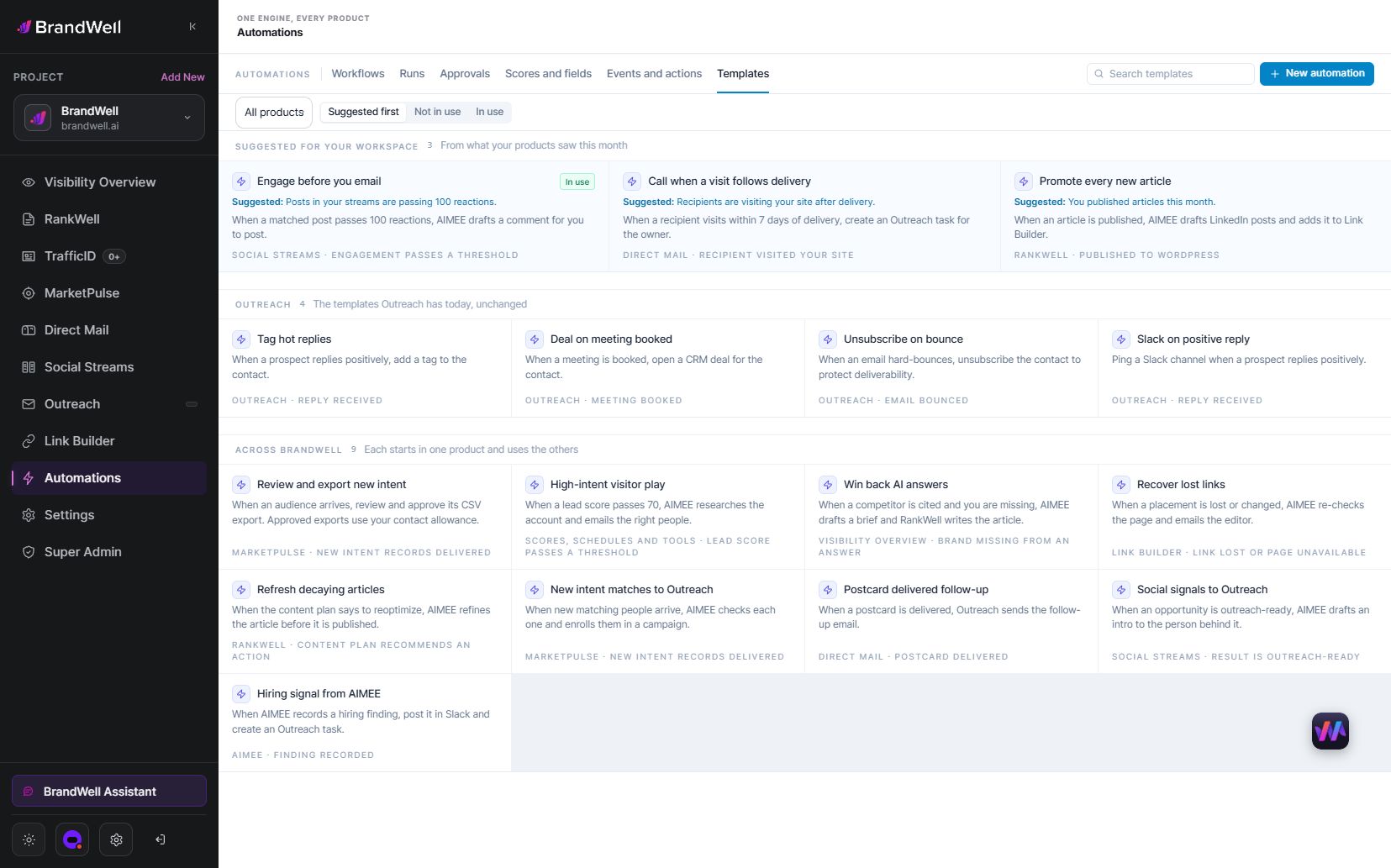
Start with the customer question and your approved evidence. Use keyword research in Visibility to explore relevant search opportunities. In RankWell, turn the brief into a draft, review the sources and examples, and prepare content for your configured publishing workflow. Reviewers still need to verify claims, links, readability and whether the next action makes sense.
Plan related assets and their publication order rather than letting separate teams create conflicting promises. Use Automations for configured triggers, follow-ups and handoffs. Define required permissions, approvals and stop conditions before enabling a workflow. AIMEE’s configured tools can support the work, but a generated draft is not evidence that a campaign has been approved or published.
If recent topic research is useful for audience planning, MarketPulse plans are starting at $500/mo. Available intent data can inform research and prioritization; it does not establish an individual’s purchase intent or give permission to contact them. Keep consent, channel rules and qualification separate from topic interest.
Measure the campaign from attention to qualified outcomes
Choose metrics that answer different questions instead of calling every interaction a conversion:
- Discovery: relevant search impressions, clicks and distribution reach.
- Engagement: resource use, meaningful video engagement and visits to the next step.
- Response: completed requests, booked consultations or other defined actions.
- Quality: inquiries meeting your service and audience criteria.
- Economics: production and distribution cost, qualified opportunity cost and recorded sales outcomes.
For illustration, suppose a campaign costs $600, receives 1,000 measured visits, produces 20 inquiries and yields eight qualified inquiries. Its visit-to-inquiry rate is 2%, inquiry-to-qualified rate is 40%, and cost per qualified inquiry is $75. Those are hypothetical calculations, not expected results. Revenue and profitability still depend on closed sales, delivery costs and the attribution method.
Keep source labels consistent and record how campaign links, forms and sales records join together. Track known gaps, including consent restrictions and offline conversations. If several channels touched a buyer, explain which one receives credit in the report. Attribution is a reporting rule; it is not proof that the campaign caused the sale.
Improve the next campaign with evidence
If reach is high but relevant visits are low, inspect the promise and distribution audience. If visits produce few requests, inspect the offer, clarity, page usability and form. If requests are unqualified, refine the audience and state eligibility more clearly. Change one meaningful part at a time when practical, and record the dates so the results remain interpretable.
For search-led campaigns, compare page-level impressions, clicks and click-through rate alongside position and query mix. A clearer title may help readers understand the page, but there is no guarantee that it will raise CTR or produce an AI overview citation. Answer the customer’s question directly, publish useful evidence and keep the page current.
Frequently asked questions
How is a campaign different from a content strategy?
A strategy defines the longer-term audience, positioning and operating choices. A campaign applies those choices to a specific objective, group of assets and measurement plan.
Does every content campaign need paid ads?
No. Distribution can use relevant owned audiences, search, social content and partnerships. Paid promotion is a separate budget decision that should have its own cost and outcome tracking.
Can AI run the whole campaign?
AI can help organize briefs, draft content and support configured tasks. People still need to approve claims, customer permissions, offers, publication and follow-up rules. Measure total time including review and corrections.
What should a small team do first?
Choose one customer problem, create one useful central resource and define one next action. Add supporting content when you have the capacity to review it and follow up on the response.
Build the campaign around a useful answer your business can support. Explore RankWell for the content workflow and Automations for configured follow-up and handoffs.
Reviewed and updated October 3, 2026.

Written by
Julia McCoy has contributed articles to BrandWell on content marketing, writing, and search engine optimization. This archive retains her original bylines; individual articles may be updated by the BrandWell editorial team.

