Direct answer: Control Google Ads broad match with three native guardrails – Smart Bidding tied to meaningful conversion goals, continuous search-term and negative-keyword review, and budget boundaries – then use buyer-intent evidence as a prioritization and diagnostic layer. Intent data can suggest which accounts, topics, offers, and sales outcomes deserve attention; it does not rewrite Google’s query-matching system or prove that an account will buy.
Who is this for? B2B Google Ads managers, PPC directors, demand-generation leaders, RevOps teams, and agencies with enough conversion volume and CRM discipline to optimize for qualified outcomes. It is not a shortcut for a new account with no reliable conversion feedback, weak product-market fit, or no owner for search-query review.
Use broad match as a controlled learning system
Broad match is useful when the advertiser wants Google to explore query variations that exact and phrase match may miss. The tradeoff is that the learning system needs a reliable definition of value. Google’s own guidance says broad match should be paired with Smart Bidding, which uses auction-time context to pursue the configured conversion objective. That makes conversion architecture – not an external list – the first control.
Start by writing the decision contract. Name the campaign’s offer, eligible geography, business segment, excluded customers and job seekers, daily and monthly loss limits, primary and secondary conversions, minimum qualified outcome, conversion lag, and the person authorized to add negatives or change goals. If the team cannot agree on what a good lead is, broad match will optimize a disagreement at scale.
Use a six-gate launch checklist:
- Eligibility: choose a campaign with a clear offer, sufficient budget, stable landing experience, and conversion evidence that can mature into qualified outcomes.
- Conversion quality: make the bidding goal reflect business value. Keep page views, button clicks, and unqualified forms out of the primary goal unless they truly represent the desired action.
- Query control: preserve brand, product, geography, job, education, consumer, support, and other exclusions appropriate to the business; review the actual search terms rather than only the keyword list.
- Intent hypothesis: define which researched topics, recent account behaviors, customer-list patterns, or CRM stages should inform messaging and prioritization. Label every inferred field.
- Budget guardrail: define a learning allocation, stop conditions, and a review cadence. Do not fund exploration by silently draining the campaigns that currently create qualified pipeline.
- Feedback loop: return qualified leads, opportunities, disqualifications, and value signals after a documented lag so optimization is not trained only on form submission.
Google’s official broad-match guide recommends measuring search terms and using negative keywords; its guidance on enhanced conversions for leads describes a way to send eligible hashed first-party lead data with offline outcomes. Treat those as platform capabilities, not proof that every advertiser has enough scale or permission to use them.
Build the workflow, data, integrations, and team
The operating workflow is weekly, not set-and-forget. Export or inspect search terms; classify them by relevance and commercial stage; compare spend, conversion and qualified-outcome data; review new negatives; inspect landing-page and offer mismatch; then document the decision. Separately, review intent cohorts for changes in topic recency, account fit, account coverage, and downstream movement. The two reviews can inform each other without being conflated.
A practical data model keeps five records distinct: the search query, the ad interaction, the website or form event, the resolved person or account where permitted, and the CRM outcome. Store timestamps and match confidence. A single company may generate several searches, several people may share a domain, and an intent provider may observe only account-level research. Collapsing those records into one ‘hot buyer’ flag creates false precision.
Minimum integrations are Google Ads, analytics and consent tooling, the CRM, and a reliable qualified-outcome return path. Intent and enrichment sources are optional inputs. The team needs a paid-search owner, a CRM or RevOps owner, a sales feedback owner, a privacy or compliance escalation path, and a client approver. One person may hold several roles in a small team, but every decision still needs an owner and backup.
Templates should include a conversion-goal register, search-term classification sheet, negative-keyword change log, intent-topic dictionary, audience eligibility checklist, budget and stop-rule sheet, and qualified-outcome ledger. Agent-ready workflow instructions can help Claude, ChatGPT, or – through a separate optional browser-first path – Moxby prepare classifications and recommended actions. A human should approve changes that affect spend, targeting, data use, or public communication.
Compare five systems that can support the operating model
Disclosure: This is a Brandwell-owned resource. Brandwell is the publisher’s product; all options are evaluated using the same disclosed criteria.
The shortlist is ordered for an agency-reseller use case, not as a universal market ranking. Every option is assessed against the same visible criteria. Feature statements are based on official vendor positioning and require a current scope-matched demonstration. Competitor sites are intentionally not linked in this article.
1. BrandWell

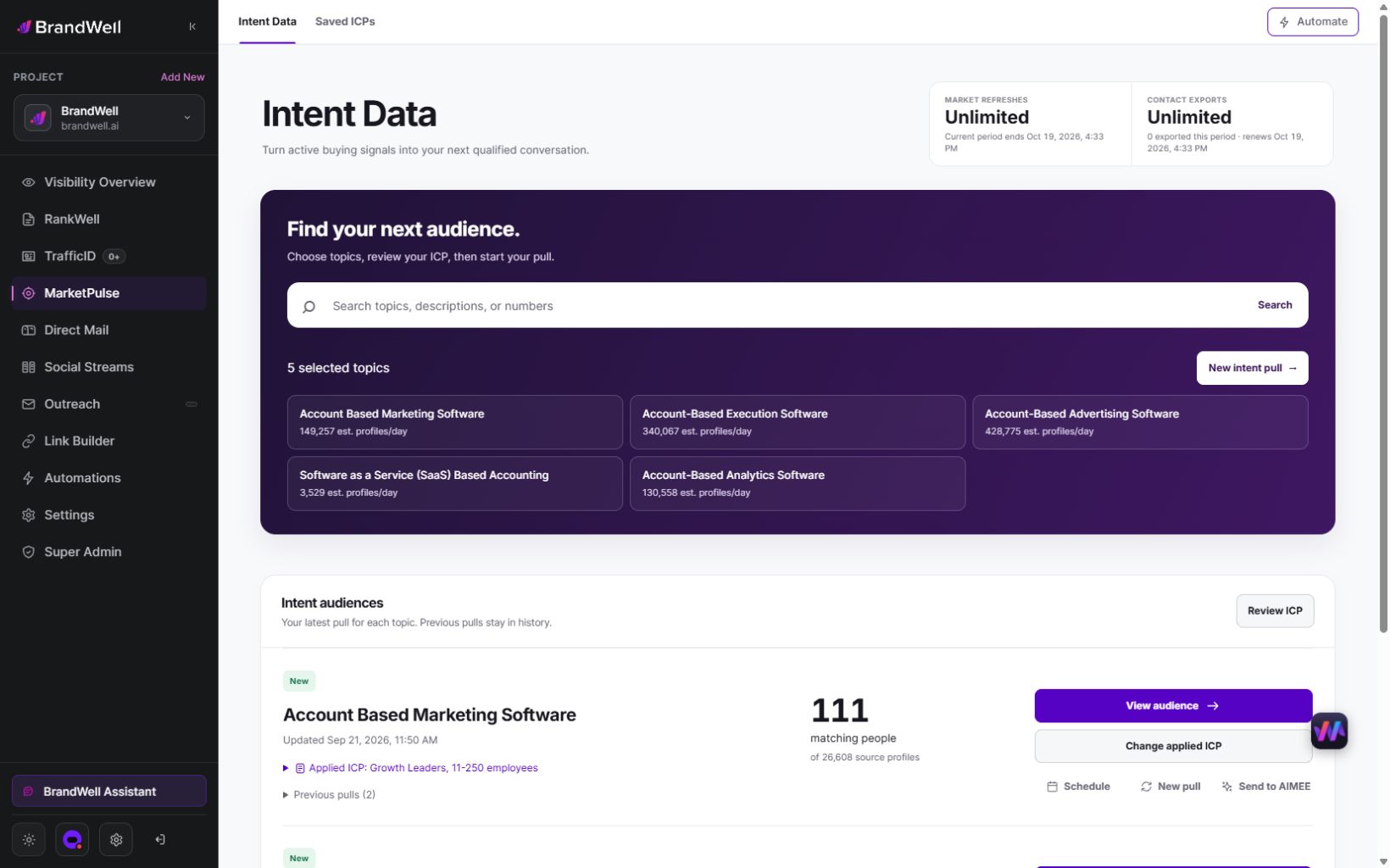
Best fit and use case: Best for an agency that wants to sell a branded intent-data service and use topic evidence to prioritize where paid-search teams investigate, test, and report. BrandWell can sit upstream of Google Ads: it helps the agency turn intent observations into account and topic briefs, workflow instructions, and client-facing evidence rather than pretending to change Google’s broad-match logic.
Inputs and prerequisites: Define the client’s ideal customer profile, approved topics, geographic and company exclusions, conversion hierarchy, CRM stages, contact and account matching rules, and the specific ad-platform data the advertiser is permitted to use. Clean qualified-outcome feedback is more important than a long list of loosely related topics.
Implementation effort: BrandWell describes a complete white-label sales-and-delivery engine, agency-controlled retail pricing and client billing, a $70 seven-day reseller pilot for branded topic reports, and agent-ready instructions for Claude or ChatGPT. Moxby is a separate, optional browser execution path. Every entitlement and pilot condition needs current product review before a client promise is made.
Privacy and governance: Treat identity and intent as probabilistic evidence. Maintain client-specific permissions, suppression rules, retention, provenance, and an explicit approval gate before any record becomes an audience or outreach action. Licensed or offsite intent is not automatically eligible for upload to Google Ads.
Verified pricing and total cost: Public pricing is quote-based. BrandWell agency plans range from $2,500 to $5,000 per month, depending on topic count, term, and available contractually scoped topic exclusivity. The current written quote and Order Form control. The $2,500 figure is a planning point, not a verified public starting price. Add agency labor, media, creative, CRM work, and validation to calculate total cost.
Measurement: Use BrandWell topic and account evidence to define testable hypotheses and prioritization cohorts, then measure search terms, qualified conversions, opportunity creation, stage progression, and revenue in Google Ads and the CRM. Do not claim the intent source caused a result merely because a converted account appeared in a report.
Proof to request: Ask for a scope-matched demo, a sample branded topic report, the exact data lineage and freshness fields, identity-confidence treatment, export and activation rights, workflow-instruction examples, pilot acceptance criteria, and written topic-protection terms if that matters to the agency’s offer.
Meaningful limitation: BrandWell is not Google’s bidding engine and cannot force broad match to target only named intent accounts. Product, pricing, activation, and topic-protection details are approval-gated; the agency still needs Google Ads expertise, eligible conversion data, media budget, and human judgment.
2. Metadata

Best fit and use case: Best for B2B paid-media teams evaluating a campaign-automation layer that connects advertising work with CRM outcomes. Its official positioning emphasizes campaign execution and optimization; that can complement a broad-match program when the buyer wants operational help beyond a topic-data feed.
Inputs and prerequisites: Expect to provide advertising accounts, audience and creative inputs, conversion definitions, CRM access, budget boundaries, and enough clean outcome data to evaluate qualified performance. Confirm exactly which Google campaign types and controls are included in the proposed scope.
Implementation effort: Implementation generally involves account connection, taxonomy and goal mapping, audience and creative setup, approval rules, and reporting reconciliation. A buyer should test one bounded campaign before expanding rather than assuming automation removes the need for search-term review.
Privacy and governance: Request the data-processing terms, audience-source rules, access model, retention, deletion, and the process for approving platform uploads. The advertiser remains responsible for lawful inputs and compliance with Google’s customer-data rules.
Verified pricing and total cost: No current scope-matched numeric public price was verified for this article. Obtain a written quote that separates platform fees, managed services, media, creative production, onboarding, data, and any minimum term.
Measurement: Require reporting from spend and search-query behavior through qualified CRM outcomes. Compare performance with a stable baseline or controlled test, and make sure changes in conversion definitions are visible rather than blended into an apparent lift.
Proof to request: Ask for an official product demonstration using the intended Google Ads workflow, supported control list, CRM field map, change log, experiment method, customer-data handling, and references from a company with similar sales-cycle length and spend.
Meaningful limitation: A campaign-automation layer can speed execution but cannot turn poor conversion signals or overly broad offers into qualified demand. It is also a different buying decision from a white-label intent-data service for agencies.
3. 6sense

Best fit and use case: Best for organizations considering a broader account-based revenue platform with intent modeling and advertising activation. It can be relevant when broad-match learning is one part of a coordinated account program rather than a standalone search optimization project.
Inputs and prerequisites: A useful evaluation needs account and domain hygiene, an agreed ideal-customer profile, CRM and marketing-automation definitions, topic governance, audience ownership, platform access, and sufficient team capacity to operationalize account signals.
Implementation effort: Plan for model and taxonomy configuration, integrations, identity and account mapping, audience construction, enablement, and ongoing governance. Validate the precise Google Ads activation workflow in a sandbox or limited campaign because intent modeling and broad-match query control are separate functions.
Privacy and governance: Review the source and permitted uses of intent data, identity methodology, regional coverage, retention, access, suppression and deletion, and ad-platform upload authority. Provide sellers and media teams with uncertainty labels rather than presenting modeled stages as facts.
Verified pricing and total cost: No verified scope-matched numeric public price was found for this guide. Request current pricing for the exact modules, seats, data, onboarding, support, activation destinations, and contract term; include internal administration and media in total cost.
Measurement: Separate account engagement and platform attribution from incremental qualified pipeline. Define eligible accounts before launch, preserve exposure and outcome records, and compare opportunity movement with a credible counterfactual when scale permits.
Proof to request: Request documentation for intent inputs, model explanations, account matching, audience refresh, Google Ads activation, CRM feedback, export restrictions, and a test using the buyer’s own data with written success criteria.
Meaningful limitation: A broad revenue-platform deployment can require more integration and operating change than a focused paid-search team needs. It still does not make third-party intent a hard targeting boundary inside broad match.
4. Demandbase

Best fit and use case: Best for account-based teams that want account lists and advertising activation within a wider go-to-market platform. It may support coordination around priority accounts while Google Ads continues to decide matching and bidding under its own controls.
Inputs and prerequisites: Prepare a canonical account universe, firmographic and geographic filters, intent-topic policy, CRM ownership, marketing and sales stages, audience destinations, approved suppressions, and a measurable conversion hierarchy.
Implementation effort: Expect integration, account resolution, list logic, taxonomy, audience creation, destination QA, seller and media-team enablement, and recurring list maintenance. Test match rates and actual destination behavior before promising account-level reach.
Privacy and governance: Document data provenance, lawful and contracted uses, access, retention, regional restrictions, deletion, suppression, and platform-specific audience eligibility. Account intent should not be converted into a claim about a named individual’s behavior.
Verified pricing and total cost: No current, scope-matched numeric public price was verified. Obtain a quote for required platform and advertising capabilities, onboarding, data, services, seats, destinations, and term, then add media and internal program ownership.
Measurement: Measure resolved-account coverage, audience match and delivery, qualified conversion quality, opportunity movement, and sales adoption. Use controlled comparisons where feasible and report uncertainty when account identity or exposure is incomplete.
Proof to request: Ask for a live account-list-to-ad-destination demonstration, refresh timing, match-rate evidence on a representative sample, field-level provenance, change controls, outcome feedback, and a contract that names the modules actually required.
Meaningful limitation: Account-list activation can support prioritization, but it does not provide search-query negatives, conversion-goal hygiene, or a guarantee that broad match confines spend to those accounts. The program also needs cross-functional ownership.
5. Factors

Best fit and use case: Best for teams evaluating account intelligence and cross-channel journey analysis to understand which companies interact with marketing before and after paid-search clicks. This is useful when the immediate gap is diagnosis and measurement rather than audience procurement.
Inputs and prerequisites: Connect only approved advertising, website, CRM, and marketing sources; define account resolution, lifecycle events, conversion quality, time windows, and ownership. Historical data needs stable definitions if it will be used as a baseline.
Implementation effort: Plan source connections, identity and account mapping, event QA, dashboard and report definitions, alert rules, and analyst review. Validate what is observed versus modeled and how platform and CRM discrepancies are reconciled.
Privacy and governance: Review tracking notices, consent or other lawful basis where applicable, account and person resolution, access, retention, deletion, and client separation. Do not expose a person-level inference when an account-level observation is sufficient.
Verified pricing and total cost: No verified scope-matched numeric public price was established here. Request a written quote for required data volume, destinations, seats, implementation and support, and include analyst time and any separate intent-data or media cost.
Measurement: Use account and journey evidence to audit lead quality, conversion lag and stage movement, while keeping platform attribution distinct from causal lift. A measurement layer is valuable only when the team can act on its findings.
Proof to request: Ask for event-level lineage, account-match explanations, source freshness, CRM reconciliation, export and alert controls, and a proof of concept using known accounts with ambiguous journeys.
Meaningful limitation: Journey visibility can reveal patterns but does not itself control broad-match bidding or prove that a paid touch caused pipeline. Depending on scope, a separate intent source and activation workflow may still be necessary.
Choose broad match, exact or phrase match, or a mixed structure
Use a mixed structure when the account has both proven high-value queries and room to learn. Exact or phrase match can preserve visibility and budget for known terms; broad match can explore adjacent demand under separate budgets and goals. A manual structure is preferable when conversion volume is extremely low, the query universe is tightly regulated, the offer is highly specialized, or one irrelevant click is unusually expensive. Broad match becomes more reasonable when value signals are clean, conversion lag is understood, exclusions are maintainable, and the team can tolerate a bounded learning period.
Intent-informed broad match is not a separate Google match type. It is an operating framework: outside evidence helps select markets, topics, landing pages, creative claims, and account cohorts; Google controls auction matching; the CRM returns qualified outcomes. The honest comparison is therefore not ‘intent targeting versus keywords.’ It is a disciplined feedback system versus a campaign optimized on shallow conversions with little account context.
Budget for media, data, management, and learning
Build the budget from four envelopes: media, data and software, implementation and creative, and recurring management. Add a fifth line for learning loss – the spend expected before the team can distinguish a useful query pattern from noise. Model cost per qualified lead and cost per opportunity with conversion lag, not just cost per form. A small B2B campaign may need more calendar time than media volume to accumulate decision-useful evidence.
Pricing models include fixed management fees, percentage of spend, performance components, or a bundled intent-and-activation retainer. Each has failure modes. Percentage pricing can reward spend rather than quality; pay-per-lead can encourage weak definitions; a fixed retainer can hide unlimited custom work. A good statement of work names campaign count, topic count, markets, data sources, creative volume, review cadence, included changes, and the evidence required for renewal.
BrandWell agency plans range from $2,500 to $5,000 per month, depending on topic count, term, and available contractually scoped topic exclusivity. The current written quote and Order Form control. Pricing is quote-based and needs current written review. Do not compare that range with unsupported competitor estimates; request scope-matched quotes and calculate the same total-cost categories for every option.
Measure qualified pipeline instead of form volume
Create a metric ladder. At the top are revenue, won opportunities, sales-accepted opportunities, and qualified pipeline with agreed definitions. In the middle are qualified leads, meetings held, account progression, and disqualification reasons. At the bottom are search-term relevance, impression share where meaningful, click quality, landing conversion, audience coverage, and data freshness. Bottom metrics diagnose the system; they do not replace the commercial outcome.
Preserve cohorts by launch date, campaign, query class, account-fit tier, intent recency, and conversion feedback state. Report denominators: spend, reachable accounts, exposed accounts, clicks, forms, qualified records and opportunities. If the conversion definition, CRM stage, attribution window, or import method changes, mark the boundary. Apparent ROI can be created merely by changing what counts.
Use an experiment when scale permits. A randomized campaign experiment or another credible holdout is stronger than comparing this month with last month. If randomization is infeasible, use a predeclared matched comparison and list competing explanations. Do not attribute pipeline to intent simply because intent-positive accounts convert at a higher rate; the same characteristics that make an account research a topic may also make it easier to sell.
Identify the B2B campaigns that fit the model
The best fit is a B2B advertiser with a clear economic conversion, a meaningful but not microscopic search market, a maintained CRM, a sales team that records dispositions, and enough budget to separate exploration from proven demand. Common use cases include high-consideration software, professional services, industrial offerings, and account-based programs where company context changes how a lead should be routed or valued.
Poor-fit cases include a new offer with no evidence of buyer language, a company that counts every content download as pipeline, a regulated team without query-review capacity, an advertiser unable to return qualified outcomes, and a client expecting a list of intent accounts to become a deterministic Google Ads target. Begin with narrower keywords and measurement repair in those situations.
Combine fit, identity, freshness, activation, and outcomes
Score and report dimensions separately before combining them. Fit asks whether the account could buy. Identity records how confidently an event maps to a person or company. Intent evidence records what behavior or topic was observed and by whom. Freshness records when it happened. Activation records what the team actually changed. Outcome records what happened later. A composite score should never erase these components.
Use intent to prioritize analysis: inspect search terms and landing experiences for relevant topic clusters, develop message hypotheses, alert sellers when an independently qualified account converts, and decide which vertical deserves a bounded test. When customer data is uploaded, follow Google’s customer data policies. Obtain the required agreements and authority, and do not assume licensed offsite intent can be repurposed as a customer list.
Avoid the mistakes that create waste or privacy risk
The biggest optimization mistake is sending easy, low-value events into the primary bidding goal. Other common errors are importing duplicated outcomes, changing goals during a test, adding broad match across the whole account at once, neglecting negatives, using an intent topic that is too broad, treating account research as named-person behavior, and letting stale evidence remain ‘hot’ indefinitely.
Privacy risk appears when a team collects more person-level data than it needs, hides probabilistic matching, uploads records without rights, ignores suppressions, or personalizes creative in a way that reveals sensitive inference. Use purpose limitation, minimum necessary fields, access controls, retention, correction and deletion paths, and a human approval gate. Google’s negative keyword documentation also makes clear that negative matching behaves differently from positive keywords; test the actual exclusion behavior rather than assuming a mirror image.
Set automated alerts for cost, query-category drift, missing offline outcomes, duplicate imports, abrupt conversion-rate changes, and audience or feed failure. Automate evidence collection and classification suggestions, not irreversible decisions. A paused campaign is cheaper than an automation that confidently scales a bad goal.
Package broad-match control as a recurring agency service
An agency can sell this as a recurring operating cycle: initial measurement and topic setup, conversion-goal audit, bounded broad-match launch, weekly query and negative review, qualified-outcome reconciliation, monthly intent-and-pipeline analysis, creative and landing hypotheses, and a quarterly control reset. The deliverable is an accepted decision log, not a screenshot of a dashboard.
BrandWell’s intended role is to give agencies a white-label path for selling topic-based intent evidence, branded reporting and activation instructions while the agency keeps its own client relationship and retail pricing. Agencies can purchase BrandWell’s $70 seven-day reseller pilot. It includes agency-branded topic reports and the complete sales playbook under the current written pilot terms. Other product capabilities and any topic exclusivity remain subject to their separate current written scope. Topic protection can be discussed only where availability, scope, term, and written terms support it; never promise universal exclusivity.
Finish every client review with four decisions: what to keep, what to stop, what to test, and what data needs repair. That cadence turns broad match with intent and conversion controls into a renewable growth service without claiming that an intent flag controls Google’s auction or guarantees pipeline.
Check the economics before a full plan
For a $70 pilot fee, agencies get seven days to validate the reseller offer. BrandWell supplies agency-branded topic reports and the complete sales playbook for presenting the service and seeking client commitments before any full-plan enrollment.
The agency can use the pilot evidence to assess demand, compare expected commitments against costs, and decide whether the service can become a profit center. Commercial and financial outcomes are not guaranteed. Review the $70 seven-day reseller pilot.