On this page
- Current MarketPulse research workflow
- Define a shared account hypothesis
- Test ten ads-to-outreach steps
- Compare six coordination patterns
- Compare manual and scoped coordination
- Count joint operating costs
- Measure a distinct account funnel
- Check actual campaign feasibility
- Require fit and action gates
- Prevent disclosure and conflicting touches
- Scope separate agency coordination work
- Copyable shared-account sequence record
- Frequently asked coordination questions
Coordinate LinkedIn Ads and sales outreach around an approved account hypothesis, distinct channel roles and shared suppression. Keep aggregate ad engagement separate from known contact context and buyer-confirmed outcomes. A click or topic appearance is not an automatic seller task or proof that a named person saw an ad.
Who is this for? LinkedIn Ads managers, ABM leaders, demand-generation directors, SDR leaders, RevOps teams, and B2B agency owners with a defined account universe, enough audience scale for the platform, and reliable opportunity data. It is not for teams that plan to reveal individual ad or website behavior in outreach.
Current MarketPulse offer: intent-data plans start at $500/mo. See the product, demo, and current plans. Updated October 3, 2026.
Current MarketPulse research workflow
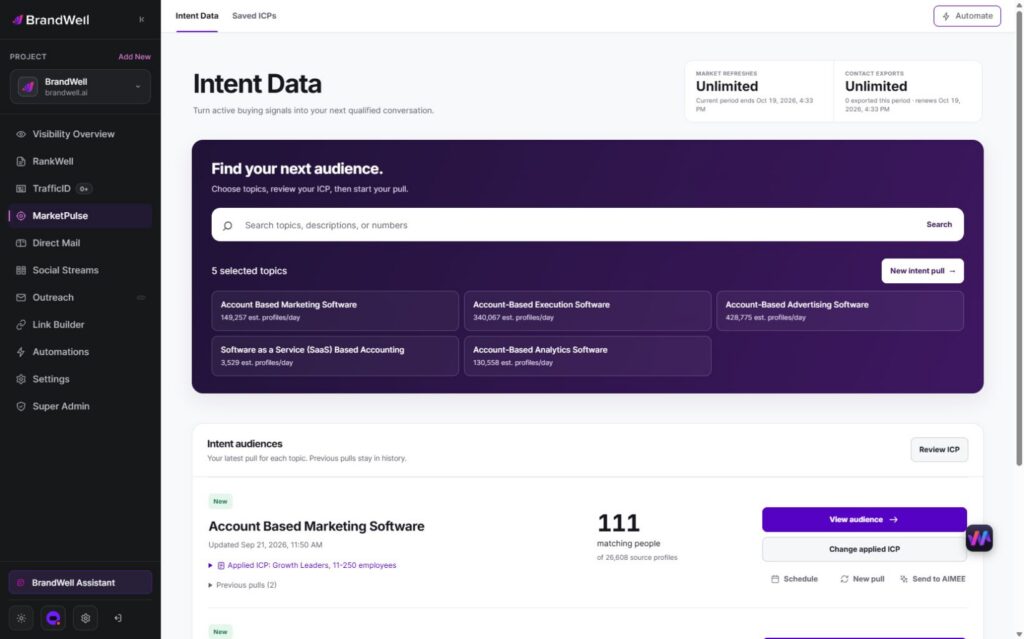
BrandWell MarketPulse: intent data starting at $500/mo. Find people researching topics relevant to what you sell, apply saved ICP filters, and review available contact details before taking action.
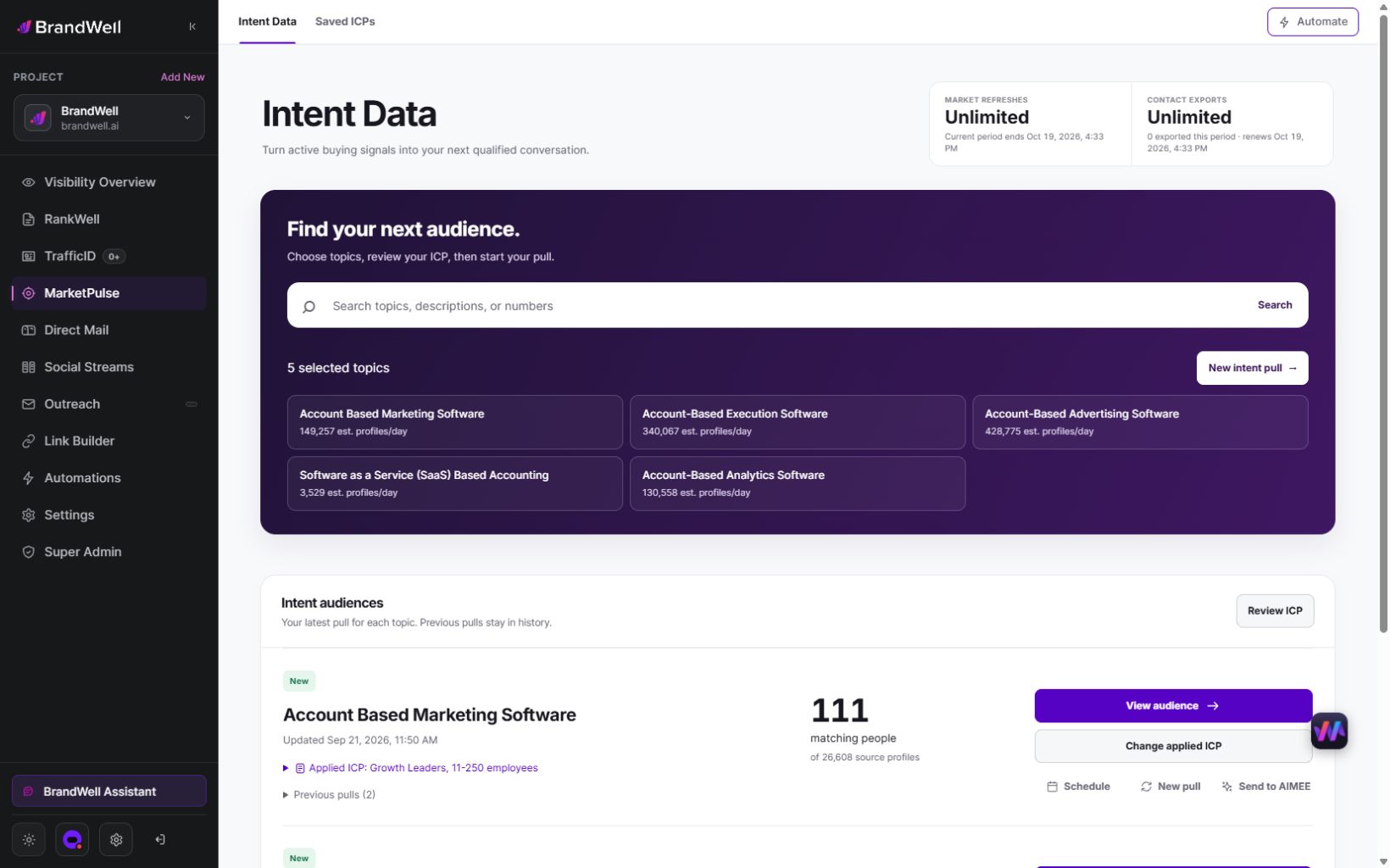
MarketPulse plans are starting at $500/mo. Verify current package scope and offers on the product page.
| Plan | Topics and refreshes | Monthly exports |
|---|---|---|
| Starter | 1 topic, weekly | 25,000 contacts |
| Growth | 3 topics, daily | 100,000 contacts |
| Scale | 10 topics, daily | Unlimited contacts |
Swipe the table to see all columns.
A pull retrieves available data from the previous 24 hours for one topic. Daily use across all included topics provides 90 Growth pulls or 300 Scale pulls in a 30-day month. Weekly Starter pulls vary by calendar month. Available audience size and contact fields vary, and audiences may overlap. Refreshes stop at the plan limit without overage charges.
- Find and qualify: search the topic catalog, save your ICP, and review the people and companies that match.
- Act on the research: export qualified contacts or prepare an Outreach or Direct Mail workflow. Connected products, channel usage, and fulfillment may cost extra.
- Get help from AIMEE: Growth and Scale include AIMEE for the initial user to research accounts and prepare the next step through connected tools.
Agencies and other service businesses can build client deliverables around their available Intent Scans and exports. Keep each client’s scope, permissions, and service fees clear. A subscription is not a promise of a white-label platform or exclusive access to a market.
Explore MarketPulse and watch the demo or compare plans starting at $500/mo. Any early-access discount is a separate, time-limited offer shown to an eligible recipient.
Define a shared account hypothesis
The foundation of coordinating LinkedIn ads and sales outreach is a shared account hypothesis: this company fits the ICP, recent evidence suggests the problem may be relevant, and a coordinated sequence could increase useful exposure or conversation. The evidence is probabilistic. It does not establish which employee saw an ad, who visited a page, or whether anyone has authority or budget.
Set one outcome before building the sequence: qualified conversation, accepted opportunity, expansion meeting, event registration that reaches qualification, or another revenue-adjacent milestone. Then assign each channel a different job:
- Paid media creates repeated, role-relevant exposure and gives a buying group a low-friction way to learn.
- Sales outreach opens a human conversation using defensible business context, not private behavioral detail.
- Intent data determines priority, timing, and message theme while remaining one input among fit, identity, freshness, and eligibility.
- RevOps preserves source, suppression, ownership, and downstream outcomes.
Verify the actual supported audience source, campaign, minimum size, account permissions and purpose before implementing a sequence. Platform engagement counts do not establish that a named prospect saw a particular ad.
Test ten ads-to-outreach steps
Use this implementation guide:
- Define the target account universe. Apply firmographic fit, territory, existing relationship, contract, and exclusion rules before intent scoring.
- Map eligible signals. Record topic activity, first-party site behavior, CRM engagement, event response, ad engagement, and public business triggers with their level: account, person, device, or aggregate.
- Create tiers and expiry. Require recent, corroborated evidence for a sales-priority tier. Weaker account evidence can enter paid education. Every tier expires.
- Resolve identities conservatively. Preserve match type and confidence. Do not turn an account-level match into a person-level assertion.
- Build audiences and exclusions. Upload only data that the client may use for the stated purpose. Exclude customers, employees, competitors, active opportunities when necessary, opt-outs, blocked territories, and sensitive segments.
- Assign channel roles. Map creative and seller messages to the same problem theme, but do not repeat identical copy. Set exposure windows, outreach windows, and stop rules.
- Route human tasks. Give the account owner an evidence summary, public research prompt, suggested asset, message guardrails, and expiry. The owner chooses whether to contact.
- Control frequency. Cap ad frequency where the platform allows, cap sales touches internally, and suppress responders or open opportunities from conflicting sequences.
- Join outcomes. Capture audience delivery, ad engagement, form completion, meetings, qualification, opportunities, and revenue without claiming that one touch caused the result.
- Run a joint readout. Paid media, SDR, sales, and RevOps review the same account cohorts and adjust thresholds together.
The stack typically includes a CRM, marketing automation, intent and identity data, audience activation, LinkedIn Campaign Manager, sales engagement, suppression/consent records, and a warehouse or reporting layer. Name one owner for the audience, one for seller execution, one for data quality, and one for compliance escalation.
Compare six coordination patterns
Evaluate each pattern on the same criteria: eligible signal, audience scale, timing, sales capacity, message relevance, suppression, and measurable outcome.
1. Paid education before seller outreach
Place high-fit, intent-qualified accounts into a role-specific educational campaign, then allow outreach only after an agreed exposure window or additional independent signal. The seller leads with the business problem and a useful asset.
Failure mode: Ad delivery is uneven and cannot guarantee a particular contact saw anything. Waiting for a fixed window can also make a genuinely urgent signal stale.
2. Seller outreach followed by paid reinforcement
Start with a researched, relevant seller touch to known eligible contacts. Add the account or contact cohort to paid media so the broader buying group can encounter proof, implementation guidance, or category education.
Failure mode: Poor outbound relevance cannot be repaired with more ads. Without suppression, recipients may experience the sequence as coordinated pressure.
3. Parallel account-level sequence
Launch ads and outreach from the same account tier while keeping person-level actions independent. This fits larger target lists, longer sales cycles, and teams that need speed.
Failure mode: Parallel activity creates attribution overlap and can over-contact the same accounts. A clean holdout becomes harder unless designed before launch.
4. Ad-engagement escalation
Use permitted aggregate engagement only as an input to account research. Require actual fit, uncertain identity, appropriate known contact context and action eligibility before outreach. Engagement is not a buyer commitment.
Failure mode: Engagement can reflect accidental clicks, low-authority viewers, job seekers, or content curiosity. A click-to-task automation overstates signal strength.
5. Form-open and form-submit split
Keep form opens, submissions and actual qualification distinct. LinkedIn’s Lead Gen Form measurement guidance explains that pre-submission Sponsored Content clicks can count as clicks and form opens. An open is not a submitted lead.
Failure mode: Form opens are not leads, while submissions can still be low fit or invalid. A lead metric without downstream qualification can reward the wrong creative.
6. Opportunity-stage buying-group support
When sales opens an opportunity, shift paid media from acquisition to buying-group education, proof, implementation, or risk reduction. Coordinate with the account owner and suppress contacts from prospecting messages.
Failure mode: Overly narrow audiences may not deliver, and unapproved account targeting can conflict with a seller’s deal strategy or platform policy.
Keep a shared account template, signal dictionary, sequence map, eligibility checklist, message brief, suppression plan, service-level ownership and joint readout. Verify actual tool behavior separately.
Compare manual and scoped coordination
A manual approach is appropriate when the target account list is small, seller judgment is strong, and signal volume is too low to automate. It is transparent and flexible but inconsistent at scale. Uncoordinated ads and outbound are easier to operate by channel, yet they duplicate spend, create message conflict, and make account-level learning difficult.
Test whether scoped coordination changes useful review and handoff decisions. Count data costs, false positives, uncertain identity, destination requirements, suppressions and operating effort. Do not assume a best method or guaranteed qualified outcome.
Where supported, test platform expansion separately from strict membership. Verify source eligibility, exclusions, actual audience boundaries and reporting. A selected seed does not establish that every reached person qualified under its rules.
The decision guide is: use manual coordination for a small named-account motion, intent-led tiers for prioritizing a larger eligible universe, platform expansion for controlled discovery, and declared form or opportunity stages for direct response.
Count joint operating costs
Coordinating LinkedIn ads and sales outreach pricing includes media, creative, data, identity/enrichment, audience operations, Campaign Manager work, seller research, sales-engagement tooling, CRM integration, analytics, legal and security review, and agency management. Total cost also depends on account count, countries, audience match, creative variants, sales capacity, cadence, and reporting depth.
Build a scenario for each tier:
- eligible accounts and contacts;
- estimated activatable audience after match and platform rules;
- media allocation and creative cost;
- seller research and outreach capacity;
- suppression and QA labor;
- expected qualified-conversation threshold required to justify the program.
Treat actual matching, post-exclusion size and delivery readiness as feasibility checks, not performance forecasts. Verify the current platform and account requirements before action.
Measure a distinct account funnel
Use account-level cohorts and one qualification definition. Leading KPIs include eligible audience rate, match and delivery rate, reach within target accounts, frequency, seller task acceptance, delivery, relevant reply, form completion, meeting, and time to response. Revenue KPIs include qualified conversation, accepted opportunity, pipeline, win, revenue, sales-cycle movement, and full cost per accepted opportunity.
Keep distinct conversion definitions for actual qualified leads, appointments, accepted opportunities and purchases. A platform event label is not evidence that the underlying business acceptance occurred.
For ROI, compare an eligible coordinated cohort with a comparable holdout or staggered rollout. Preserve media-only, outreach-only, combined, and control cells when volume allows. Report influenced and incremental outcomes separately. Avoid universal benchmarks; use internal baselines by account tier, segment, creative, seller team, and signal combination.
Check actual campaign feasibility
Evaluate actual account scope, eligible size, maintained creative, seller capacity, shared exclusions and qualified outcomes. Possible tests include education, events, reactivation and opportunity support; industry alone does not establish feasibility.
Poor-fit cases include tiny audience pools, undefined ICP, consumer or sensitive targeting, weak CRM hygiene, no sales follow-up, excessive existing frequency, or a product that closes through immediate self-service. If the ad team and sales team cannot share exclusions and account status, fix operations before adding intent data.
Agencies also need written ownership for client data, audience uploads, creative approvals, seller messages, platform accounts, and outcome reporting.
Require fit and action gates
Use a transparent tier formula rather than a hidden “buyer” label:
- Fit: industry, size, location, stack, use case, and commercial eligibility.
- Signal: source specificity, strength, corroboration, and whether it is account- or person-level.
- Identity: match type, confidence, and relevant known relationship.
- Freshness: time since each signal and a defined decay rule.
- Activation: platform minimums, upload permission, seller capacity, and approved message.
- Outcome: later qualification and opportunity evidence used to recalibrate.
A high-fit account with a strong topic signal but no reliable person can enter paid education. A known contact with a weak signal may receive ordinary account-based outreach if a separate public business reason exists. Only stronger corroborated evidence and eligibility should create a high-priority seller task.
Prevent disclosure and conflicting touches
Avoid claims about a named person’s ad exposure. LinkedIn’s off-platform data explanation describes aggregate ad-performance reporting and says website retargeting does not identify individual members to advertisers. Verify actual use requirements separately.
Verify actual source, recipient, purpose, jurisdiction and channel requirements before follow-up. A research match, ad open or data receipt does not establish permission for outreach. Hold unresolved checks and obtain qualified advice where needed.
Controls should cover data minimization, lawful source and purpose, consent where required, opt-out and deletion propagation, role-based access, encryption, retention, audience-size rules, sensitive categories, frequency, seller suppression, audit logs, and incident response. A human must approve outreach, audience activation, creative, and material spend changes. Before operational use, complete product, pricing, privacy, security, compliance, legal, and platform-policy review.
Scope separate agency coordination work
An agency can sell a recurring service that includes account tiers, intent monitoring, audience refresh, creative themes, SDR playbooks, suppression, joint weekly operations, and monthly pipeline readouts. Keep media, data, creative, seller execution, and pass-through costs visible. Set SLAs for signal freshness, audience refresh, task review, suppression, reporting, and incident handling; never guarantee that an account is in market.
Review an available MarketPulse topic, saved ICP and actual preceding-24-hour matches for the approved research purpose. Keep uncertain company context visible. AIMEE can organize supplied context through configured tools; named owners approve actual exports, messages, audience uploads and CRM writes.
BrandWell does not replace Campaign Manager, the CRM, a consent system, sales execution, or legal judgment. Before operational use, complete product, pricing, privacy, security, compliance, legal, and platform-policy review.
Copyable shared-account sequence record
Account: [Actual fit, owner and uncertain research context.] Channels: [Distinct education and seller roles.] Eligibility: [Actual source, recipient, purpose and permissions.] Timing: [Exposure hypothesis, expiry and contact cap.] Suppression: [Shared state, propagation receipt and exception.] Outcome: [Open, submission, qualification, opportunity and unique IDs.] Decision: [Full costs, approver, hold, repair and next test.]
A form open is not a submitted lead
Assume a fictional cohort has 100 form opens, 20 submissions, 14 valid submissions, eight qualified conversations and five accepted opportunities. Submitted/open rate is 20%; valid/submitted is 70%; qualified/valid is 57.1%; opportunity/submitted is 25%. Keep the 80 opens without submission distinct. Counts do not establish unique people unless deduplication actually occurred. These invented inputs are not BrandWell performance results.
Do not disclose inferred ad exposure
A seller can lead with an actual public business reason and a relevant resource: “Your published rollout plan raises a useful transition question. Would a readiness checklist help?” Verify that the public plan and checklist exist. Avoid “You watched our ad yesterday” or “Your CFO researched this topic” when the evidence is aggregate or uncertain. Ad exposure and an independently known business contact remain separate fields.
Coordinate suppression before the next action
Suppose a fictional known contact replies at 10 a.m. A seller marks the shared sequence paused, but a separate outreach queue still has a message scheduled for 10:05. The pause record does not prove queue suppression. Verify destination acknowledgement before the pending action, log a failed propagation and repair conflicting activity. A research subscription does not itself provide every cross-system suppression integration.
Count the joint cost without double-counting wins
A fictional joint program with $1,000 media, the standard $500 Growth subscription and $800 seller/review work has $2,300 defined costs. If ads and outreach each show four accepted opportunities but two IDs overlap, the unique union is six. Defined cost is $383.33 per unique opportunity, not $287.50 using eight appearances. Setup, acquisition, general overhead, tax and financing are excluded. These invented inputs are not BrandWell agency-service fees or typical results; overlap does not establish causal credit.
Prepare approved account research
Review an available MarketPulse topic, saved ICP and actual preceding-24-hour matches for the approved research purpose. Keep uncertain context and actual public sources visible. AIMEE can organize supplied research through configured tools. Owners approve exports, messages, Outreach enrollment, audience uploads and CRM writes. Custom coordination, shared suppression, reports and routing require separately verified implementation, rights, scope and fees.
Frequently asked coordination questions
Does a form open make someone a submitted lead?
No. Keep the actual submission and qualification separate.
Does aggregate ad reporting identify a named viewer?
No. Do not turn aggregate evidence into a person claim.
Does setting a pause prove every destination stopped?
No. Verify actual propagation and acknowledgement.
Can two channel appearances be counted as two opportunities?
No. Deduplicate actual opportunity IDs.
Review the research product: explore MarketPulse and current plans.
Reviewed and updated October 3, 2026.

Written by