On this page
- Current MarketPulse research workflow
- Define actual qualified-outcome economics
- Set owners and bounded monitoring rules
- Test seven cost-control approaches
- Keep platform bidding definitions distinct
- Backsolve and stress-test the cap
- Separate delivery, quality and causal evidence
- Check actual objective and sample feasibility
- Keep each activation denominator visible
- Record learning, overlap and exceptions
- Scope separate bidding operating work
- Copyable cost-control decision
- Frequently asked cost-cap questions
Plan a small-audience cost control from actual contribution value, qualification, outcome maturity and full costs. Then verify the platform objective, eligible delivery and sparse-data limits. A cost cap is not a guaranteed price for every result or a substitute for a budget stop, approval rule and useful qualified-outcome test.
Who is this for? Performance marketing directors, paid media managers, demand-generation leaders, and agencies running narrow, high-value B2B audiences where underdelivery and false confidence are as dangerous as overspending.
Current MarketPulse offer: intent-data plans start at $500/mo. See the product, demo, and current plans. Updated October 3, 2026.
Current MarketPulse research workflow
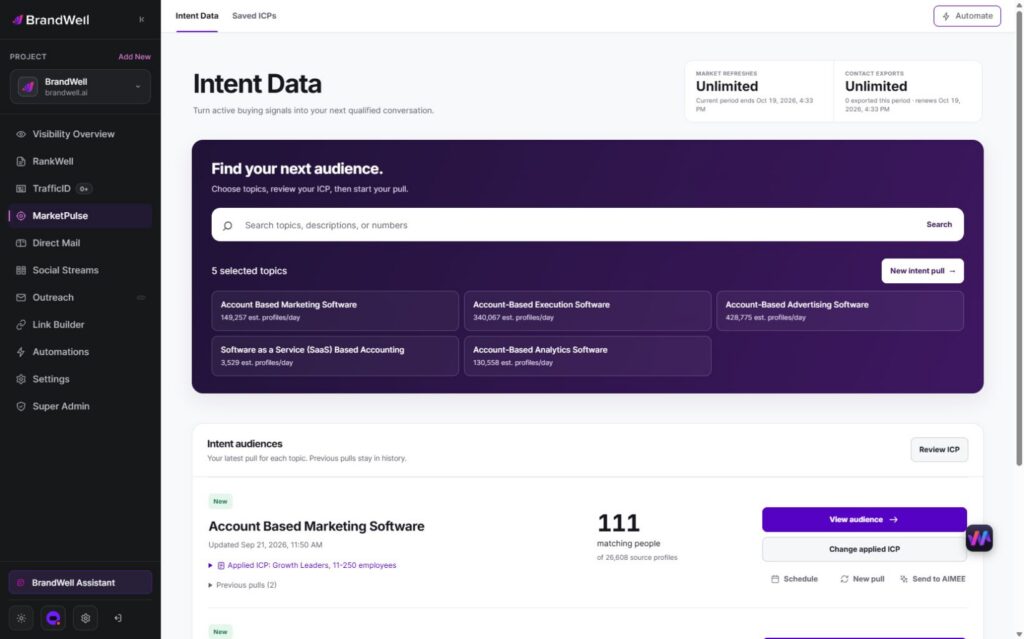
BrandWell MarketPulse: intent data starting at $500/mo. Find people researching topics relevant to what you sell, apply saved ICP filters, and review available contact details before taking action.
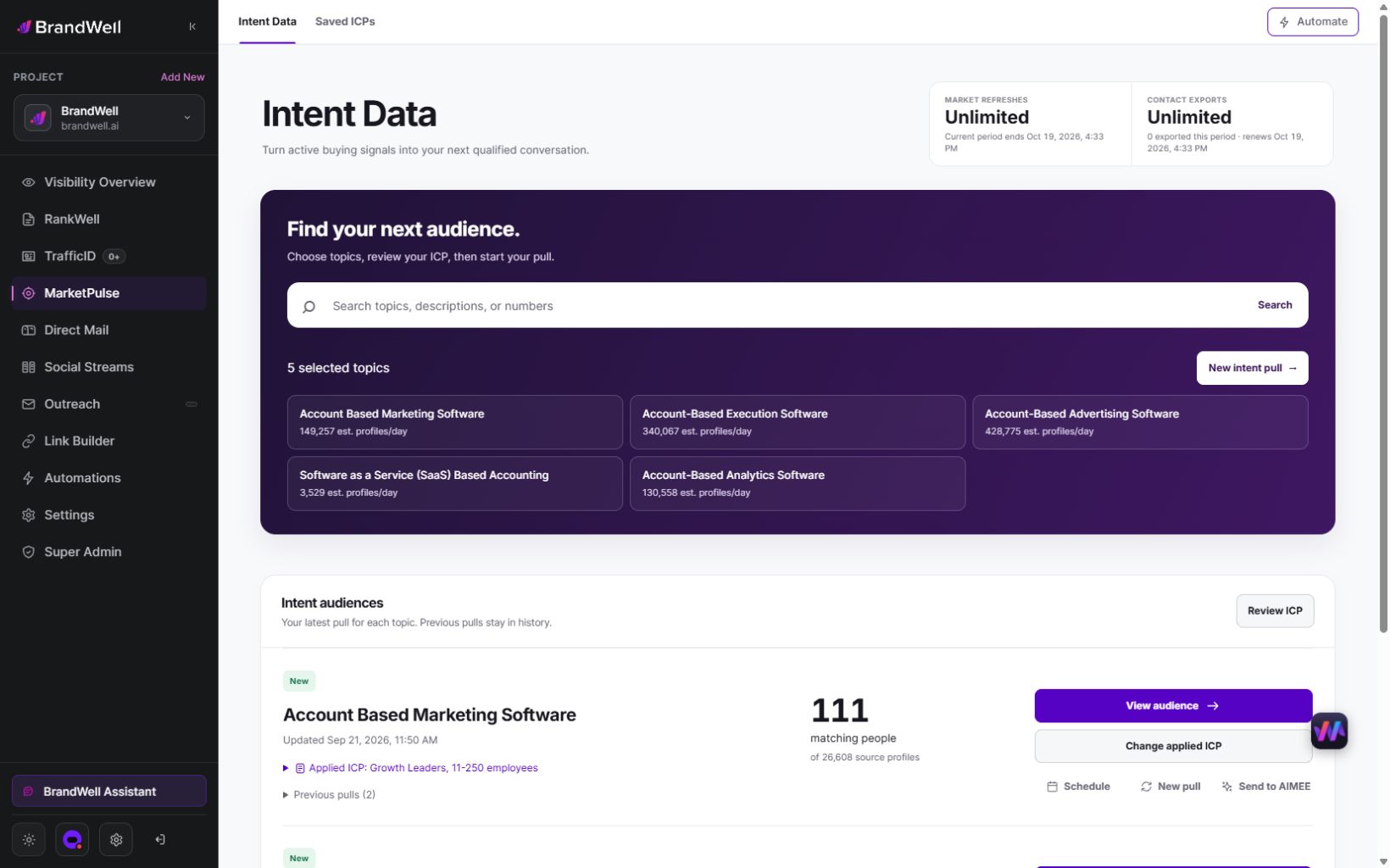
MarketPulse plans are starting at $500/mo. Verify current package scope and offers on the product page.
| Plan | Topics and refreshes | Monthly exports |
|---|---|---|
| Starter | 1 topic, weekly | 25,000 contacts |
| Growth | 3 topics, daily | 100,000 contacts |
| Scale | 10 topics, daily | Unlimited contacts |
Swipe the table to see all columns.
A pull retrieves available data from the previous 24 hours for one topic. Daily use across all included topics provides 90 Growth pulls or 300 Scale pulls in a 30-day month. Weekly Starter pulls vary by calendar month. Available audience size and contact fields vary, and audiences may overlap. Refreshes stop at the plan limit without overage charges.
- Find and qualify: search the topic catalog, save your ICP, and review the people and companies that match.
- Act on the research: export qualified contacts or prepare an Outreach or Direct Mail workflow. Connected products, channel usage, and fulfillment may cost extra.
- Get help from AIMEE: Growth and Scale include AIMEE for the initial user to research accounts and prepare the next step through connected tools.
Agencies and other service businesses can build client deliverables around their available Intent Scans and exports. Keep each client’s scope, permissions, and service fees clear. A subscription is not a promise of a white-label platform or exclusive access to a market.
Explore MarketPulse and watch the demo or compare plans starting at $500/mo. Any early-access discount is a separate, time-limited offer shown to an eligible recipient.
Define actual qualified-outcome economics
A cost cap is useful only when it protects a business outcome the team has defined. Choose the optimization event, the downstream qualified event, the attribution window, and the maximum acceptable cost for that qualified event. If the platform optimizes to a form submission but sales cares about accepted opportunities, the cap must include the observed gap between those stages.
Build a simple chain: value per qualified outcome × allowable acquisition share × conversion probability from platform event to qualified outcome. Then reduce the result for uncertainty, refunds or churn where relevant, and operating cost. Use your own recent, comparable data; do not assume a broad platform average represents the actual cohort.
Intent is probabilistic evidence, not a guarantee that an account or person is ready to buy. A narrow audience can restrict delivery while still creating sparse data, high overlap, and volatile auctions. The first decision is therefore not “What cap should we type?” but “Can this event, audience, and budget produce a decision-worthy test?”
Set owners and bounded monitoring rules
Start with an input sheet containing target-account eligibility, intent source and freshness, identity-match denominator, eligible audience count, expected media reach, conversion stages, gross value or margin, campaign budget, and minimum learning period. Record which inputs are observed, estimated, or platform-reported. Assign owners for audience construction, economics, campaign changes, CRM quality, privacy, and client approval.
Launch with a written hypothesis and a rollback condition. Monitor delivery, spend, effective cost, frequency, audience decay, stage quality, and exclusions at a fixed cadence. Create exceptions for underdelivery, sudden match-rate change, tracking failure, overlapping campaigns, or a qualified-pipeline cost above the agreed ceiling. Never let an agent silently loosen a cap to spend budget.
LinkedIn’s current cost-cap guidance describes an average cost target whose actual result can differ. Certain audience, bidding and creative changes reset learning. Verify actual objective support and change behavior before implementation; do not generalize LinkedIn rules to other platforms.
Test seven cost-control approaches
1. Break-even qualified-outcome method
Start with contribution value from a qualified outcome and multiply it by the observed probability that the campaign event reaches that outcome. Apply a conservative margin before setting the ceiling. Limitation: sparse or biased CRM outcomes can make the result look more precise than it is.
2. Historical cohort method
Use prior campaigns with the same platform, objective, audience type, geography, and offer. Calculate distributions rather than one blended average, and separate intent cohorts from retargeting and broad audiences. Failure mode: borrowing a cheap historical CPA from a different conversion event creates a cap the new campaign cannot deliver.
3. Controlled exploration band
Launch a bounded range around the economic estimate and predefine which delivery and quality outcomes permit movement. Make small changes at agreed review points rather than reacting daily. Limitation: the audience may be too small for each band to collect comparable evidence.
4. Uncapped calibration period
When policy, risk, and budget allow, use a short, tightly budgeted calibration to observe auction cost and conversion mix before imposing a cap. Keep the audience and creative stable. Failure mode: teams mistake the calibration period for proof and scale before downstream quality arrives.
5. Qualified-lead backsolve
Optimize to the available platform event but set the ceiling from the probability of an accepted sales lead, not all conversions. Import downstream outcomes only with governed mapping and consent. Limitation: sales routing and follow-up influence acceptance, so the model must not blame bidding for every rejected lead.
6. Incrementality-constrained method
Reserve a control where feasible, measure the incremental qualified outcome, and translate that lift into an incremental acquisition cost. Disclose assignment and contamination. Limitation: small B2B audiences may not support a precise lift estimate; “no clear result” must remain an acceptable conclusion.
7. Portfolio allocation method
Set different ceilings for cohorts with different value, freshness, or evidence quality, while keeping total budget and overlap governed at the portfolio level. Failure mode: excessive segmentation fragments learning and causes the same account to compete across campaigns.
Keep platform bidding definitions distinct
A cost cap generally asks an automated system to pursue volume around an average cost goal. A bid cap limits auction bids more directly and can restrict delivery. Target CPA optimizes toward a cost per chosen event, which may or may not be the platform’s cost-cap implementation. Target ROAS needs reliable conversion values. Unconstrained automated bidding gives the platform more freedom and depends on budget and conversion signals for control.
Use the platform’s current definitions rather than treating these labels as interchangeable across channels. Cost caps fit a team with a defensible event value and enough event flow to learn. Manual or bid controls may fit strict auction limits or diagnostic phases. Unconstrained bidding can fit exploration with a hard budget. The best alternative for a very small intent audience may be to broaden the audience, improve the conversion event, or use a manual review rather than forcing automation.
Backsolve and stress-test the cap
Define five inputs: expected contribution value per won customer, win probability from qualified opportunity, qualification probability from the platform event, allowable acquisition share, and uncertainty reserve. Multiply through the chain, then subtract incremental operations and creative costs if those are not already included. Run low, base, and high cases rather than publishing a universal cap.
Next test feasibility. Estimate how many eligible accounts remain after fit, freshness, exclusions, consent, and identity match. Estimate achievable reach and conversions, not raw list size. A campaign can have attractive economics and still be unable to deliver enough events. Set a campaign budget stop, frequency guardrail, and exception threshold alongside the cap. Cost caps for intent audiences are a governance system, not one number.
Separate delivery, quality and causal evidence
Report four layers separately. Delivery covers eligible size, matched size, reach, frequency, spend, and underdelivery. Platform performance covers the optimized event and platform-attributed CPA. Business quality covers accepted leads, opportunities, stage progression, and qualified-pipeline CPA. Causal evidence covers holdout or lift design, incremental outcomes, uncertainty, and contamination.
Do not turn CTR or attributed conversions into an ROI claim. A lower platform CPA can coincide with worse pipeline quality. Compare the distribution of account fit and outcomes, and preserve delays long enough for sales-stage data to mature. When sample size is small, show counts and ranges rather than a dramatic percentage.
Check actual objective and sample feasibility
Check actual supported objective, targetable population, usable exposure, conversion tracking and source freshness. Value and an industry label do not establish enough event flow for a useful test. Separate a planning hypothesis from evidence that a bidding control improved results.
They are a poor fit for a tiny audience with almost no conversions, a client without CRM stage definitions, or a campaign where the intent feed is stale. Use fewer cohorts and a broader eligible pool before creating many caps. For a paid media manager, check actual complexity, eligible volume and interpretable outcome evidence before creating more segments.
Keep each activation denominator visible
Keep denominators through the entire activation chain: accounts with eligible intent, accounts resolvable for the platform, matched audience members, reached members, converters, accepted leads, opportunities, and wins. Each loss has a reason. This prevents the cost calculation from silently using a raw list denominator while the campaign can reach only a fraction.
Verify actual source, recipient, purpose, jurisdiction, account and destination before activation. A topic match does not automatically establish first-party customer context, permission to message or eligible audience-upload rights. Keep unresolved requirements on hold.
Record learning, overlap and exceptions
Set alerts for no spend, sudden spend acceleration, audience collapse, match-rate shift, frequency concentration, duplicate account exposure, and tracking breaks. Document platform learning or reset conditions. Check whether high-intent accounts are also in retargeting, customer, or broad campaigns; otherwise one cohort may take credit for exposure created elsewhere.
Protect privacy by minimizing fields, isolating clients, enforcing retention and suppression, and avoiding messaging that reveals research behavior. Intent does not equal consent. Human approval is required for cap changes that materially alter spend, audience expansion, customer-data uploads, CRM overwrites, and public reporting. Every automation needs an audit log and tested rollback.
Scope separate bidding operating work
An agency offer should include economic modeling, audience eligibility, platform setup, cap and budget rules, exception monitoring, downstream outcome mapping, monthly business-quality reporting, and a documented decision cadence. Price the operating work separately from media spend and data usage. State which party owns tracking, creative approval, CRM hygiene, and platform access.
AIMEE can prepare a review brief through configured connected tools. Keep proposed actions separate from actual approvals and destination acknowledgements. Confirm the implementation and permissions before execution.
Use a client decision log that records the economic model, source data window, campaign objective, entered control, daily and total budget, audience denominator, exclusions, approval, monitoring thresholds, changes, and final recommendation. Separate platform-reported cost from qualified-pipeline cost in every view. When a cap is changed, retain both the old and new value plus the reason; otherwise the team cannot distinguish planned learning from reactive optimization.
The agency should also define a no-test outcome. If expected reach, event volume, match quality, or measurement coverage cannot support a useful read, recommend a broader cohort, a different event, or a measurement repair phase. Document a no-test decision when the actual exposure, outcomes or measurement cannot support the specified question.
Copyable cost-control decision
Event: [Platform optimization event and downstream qualified outcome.] Economics: [Contribution, win probability, qualification and cost exclusions.] Audience: [Eligible, targetable and exposed units.] Control: [Actual platform strategy, entered value and budget stop.] Window: [Maturity, review cadence and missing outcomes.] Approval: [Owner, change reason, learning check and rollback.] Decision: [Full costs, uncertainty, repair or bounded continuation.]
Backsolve from contribution rather than headline revenue
Suppose a fictional won customer contributes $10,000 after defined delivery costs. A qualified opportunity has a 20% assumed win chance, so its assumed expected contribution is $2,000. Allocating 30% to acquisition produces $600 per opportunity. If 25% of platform leads become qualified opportunities, the modeled acquisition allowance is $150 per platform lead. If nonmedia operating work costs $30 per lead, the modeled media allowance is $120. These are invented planning inputs, not a recommended bid, validated probability or BrandWell return.
Stress-test qualification before entering a control
If qualification in that example falls from 25% to 10%, modeled acquisition allowance falls from $150 to $60 per platform lead. Subtracting the same $30 nonmedia work leaves $30 for media. The outcome depends on actual costs, maturity and comparable source data; averaging away uncertainty can produce an unaffordable target.
An average target is not a per-result guarantee
Ten fictional platform results cost $1,200, or $120 each on average. That average does not mean every result cost $120 or that the entered cap prevented higher costs. Keep actual spend, returned event definition and the separate total budget stop visible. A budget or target is also not evidence that all planned delivery occurred.
Low platform CPA can hide poor qualification
Two fictional campaigns each spend $1,000. A produces 20 platform leads and four qualified opportunities: $50 per lead and $250 per opportunity. B produces ten leads and five opportunities: $100 per lead and $200 per opportunity. B has the higher platform CPA but lower qualified-opportunity cost. These invented observations are descriptive; assignment, maturity, seller effort and uncertainty still matter.
Zero outcomes do not create a zero cost
A fictional test with $1,000 media, $500 standard Growth subscription, $300 review and $200 creative has $2,000 defined costs. Four qualified opportunities imply $500 each. With zero qualified opportunities, cost per opportunity is undefined, not $0. Setup, acquisition, general overhead, tax and financing are excluded. These invented costs are not BrandWell bidding-service fees or typical performance.
Prepare an approved research and economics brief
Review available MarketPulse topics, saved ICP filters and actual preceding-24-hour matches without treating source volume as targetable reach. AIMEE can organize supplied research and assumptions through configured tools. Owners approve exports, messages, audience uploads, bidding and spend changes, and CRM writes. Custom campaign integrations, downstream joins and cost-control automation need separately verified implementation, rights, scope and fees.
Frequently asked cost-cap questions
Does a cap guarantee every result costs less?
No. Verify the platform’s average-target behavior.
Is headline revenue the same as contribution value?
No. State delivery costs and the actual economic boundary.
Does lower platform CPA prove lower opportunity cost?
No. Preserve actual qualification and mature outcome counts.
What is cost per opportunity when none occur?
Undefined. Report actual spend and zero outcomes separately.
Review the research product: explore MarketPulse and current plans.
Reviewed and updated October 3, 2026.

Written by